2025 Hyundai Kona Limited AWD

Considering the execution of the Kona. . .

By Gary S. Vasilash

During the development of the 11th-generation Ford F-150 (2004-2008) J Mays was the vice president of Design at Ford.

One of the briefs that the design team had was to improve the interior design of the truck.

During a presentation at the Ford design facility in Dearborn Mays pointed out that while the exterior sheet metal gets people in a vehicle—they go to the showroom, see it, and if they like it get into it—but the interior design keeps them there.

If you think about it, vehicle interiors are far more important than exteriors.

Yes, it may be that seeing whatever in your driveway puts a smile on your face whenever you go out to get into it.

But that lasts a few moments and when you are in the vehicle there are a whole lot of moments spent behind the wheel.

According to autoinsurance.com the average time spent driving to work in 2024 was 26 minutes. So that would be a roundtrip time of 52 minutes. Five days a week, then that’s more than four hours.

Yes, the interior environment in a vehicle matters. A lot.

The Vehicle Then & Now

Which brings me to the Hyundai Kona.

I am a fan of the exterior of the first-generation (model years 2018-2023) Hyundai Kona. It added significant amounts of style to the small SUV category, a category that was (and pretty much continues to be) dominated by designs that are readily forgotten.
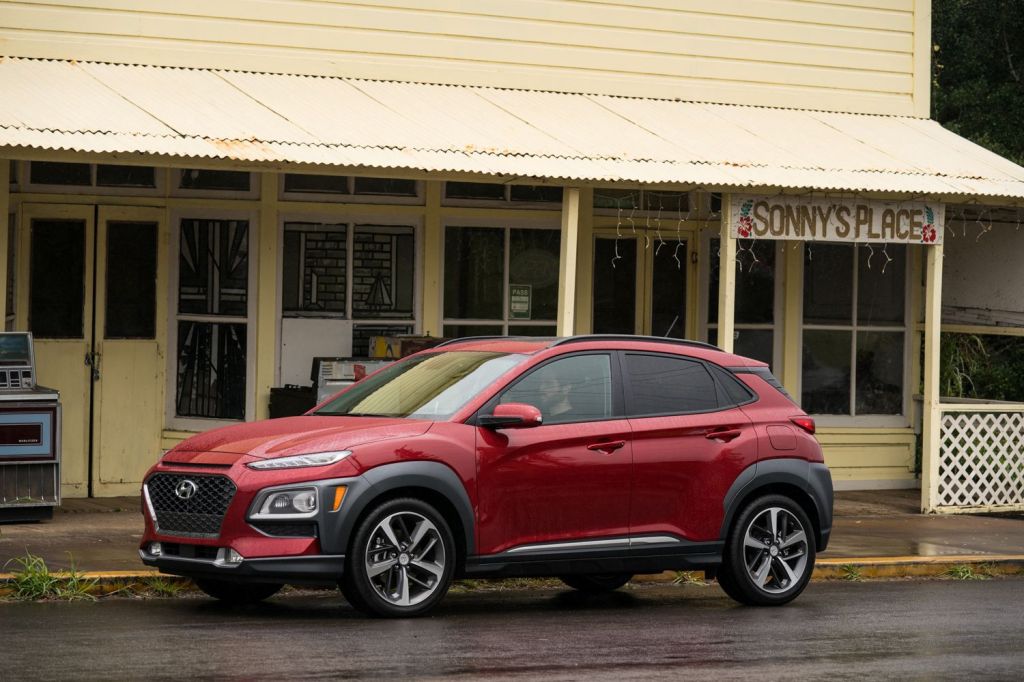
Kona then–first generation. (Photos: Hyundai)

The exterior design is sporty. And at least in terms of cargo capacity, it is reasonably utile: 19.2 cubic feet of cargo space with the second row up and 45.8 cubic feet with the seat down.

But that was then and this is now.

Kona now–second generation.

The second-generation Kona was launched in model year 2024. Driven here is 2025.

And the exterior sheet metal is in my estimation less sporty and more, well, manhwa (i.e., the Korean term for “manga”).

Lots of Room

But the utility quotient is way up, with cargo capacity being 25.5 cubic feet behind the second row and 63.7 cubic feet with the seatback folded.

Similarly, the passenger volume is way up: it is 94.1 cubic feet (w/o sunroof) for the first-generation Kona; it is 101.2 cubic feet for gen two.

Lots of Tech

And the interior of the second-generation Kona is a nice place to be because it is exceedingly well done.

I just took a quick drive to the store in the Kona. While waiting behind a few cars to make a left turn, when the car ahead of the Kona moved and I didn’t immediately react, a “bing” and a message on the gauge screen pointed out that the car had moved way.

When I got home it pointed out that I should look in the rear seat as I had opened the rear door to put in groceries.

While that rear-seat notification is now common (according to the Alliance for Automotive Innovation, which organized voluntary commitments among its members in 2019 for rear-seat reminder systems, as of November 2024 there were 263 models available with the tech), the Leading Vehicle Departure Alert is rare.

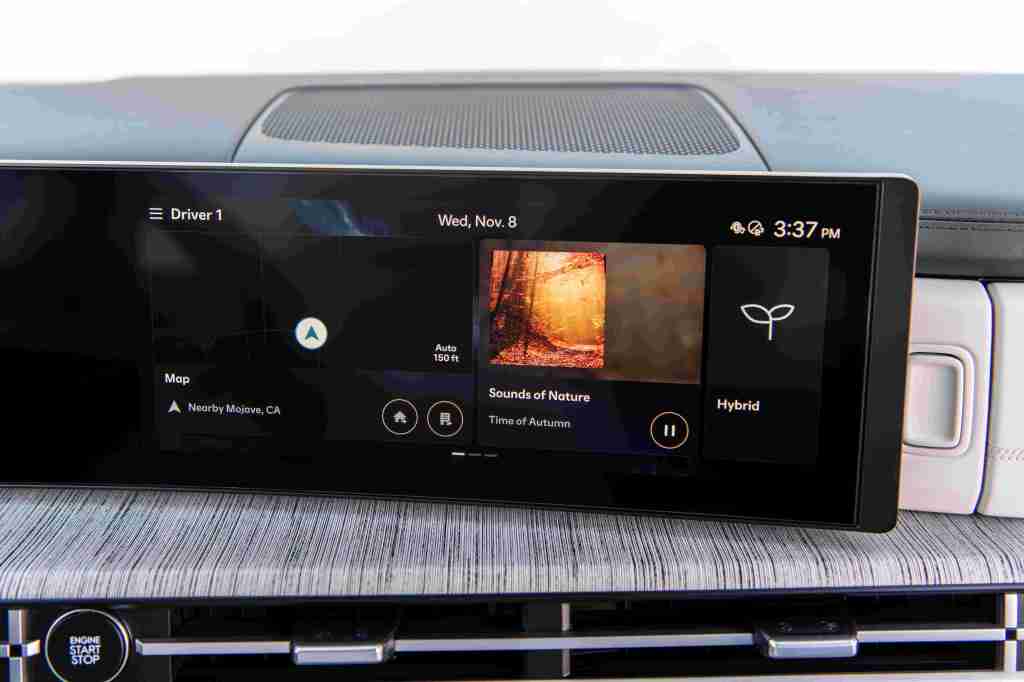
And there’s Blind Spot View Monitor. Flick the turn signal to either direction and there is an appropriate live camera image of that side of the vehicle shown in the gauge cluster. While this is available only in the Limited trim, the Limited AWD driven here has an MSRP of $33,400.

“Smaht. Very Smaht.”

And for that you get a vehicle with that, remote smart parking assist (“Smaht Pahk” as the 2020 TV commercial with John Krasinski, Rachel Dratch and Chris Evans put  it), a 12.3-inch digital instrument cluster, another 12.3-inch navigation screen, heated and ventilated front seats, a heated leather covered steering wheel (and on the subject of leather: the seating surfaces are H-Tex, a faux leather which is convincing), a proximity keyfob with pushbutton start (keep the key in your pocket or purse: the door unlocks and you can start the vehicle), and an overall look of clean, contemporary design on the inside of the vehicle.

The vehicle is powered by a 1.6-liter turbocharged engine that produces 190 hp and 195 lb-ft of torque. It is stickered at 24 mpg city, 20 mpg highway and 26 mpg combined, which is pretty much what I got while driving it.

Thoughtful

One of the striking things about the Kona is that it has what I consider a “deliberate design.”

Sure, all vehicles have a design brief and to the extent that’s executed, their designs are deliberate.

But it seems there is a considerably stronger level of consideration applied here, both inside and out.

What’s more, the technology that are part of the package tends to be the sort of things that other OEMs put in vehicles that are much higher in price.

BMW Design Goes Holistic

Why it is making a change to its design org

By Gary S. Vasilash

Generally, when offices are moved around in an organization so that someone gets someone else’s job, who then gets another, it is treated like a series of internal moves.

And if as part of that movement there’s a decision made to change some of the focus of the individual operations, that tends to be an emendation to the titles of the people who have moved.

But at BMW Group, changes that will become effective October 1 for several members of the design team, the company is making much ado about it.

There is a substantiative change (beyond the one for whatever company has the contract to print business cards, because that company will have a nice contract): Maximillian Missoni, who recently left Polestar, is joining the BMW Design team.

The rationale for (1) consolidating Colour and Material Design across all the brands and (2) dividing the brand team into two studios (this is a bit vague, however, as tehre seem to be a studio for compact and mid-size vehicles and upper mid-size and luxury vehicles, although there is still Rolls-Royce Design) is, says Adrian van Hooydonk:

“Technology and customer preferences are currently changing faster than ever. Automotive design has become more diverse. Designing digital experiences and sound also plays an increasingly important role, along with sustainable and recycled materials. The design showcases all the innovative potential of our products and brands. That’s why, more than ever, every single detail matters, as well as the holistic and harmonious integration of the various elements.”

Curiously, there’s no mention of an audio studio.

New Design Head at Polestar

Römers understands the importance of first impressions. . .

By Gary S. Vasilash

“Polestar is the role model of a design-driven automotive company and it’s a great honor to take on the responsibility for the Design department. I’m looking forward to working with the creative team to design the next generation of Polestar cars,” said Philipp Römers, who is taking the Head of Design position at the electric vehicle company, succeeding Maximilian Missoni.

Römers is moving to the company from AUDI AG. He has been with the Volkswagen Group for the better part of his career. (He had had a stint at Ford.)

Born in Cologne in 1979, Römers studied transportation design at Pforzheim University.

He started at Volkswagen in 2005, where he designed exteriors for models including the Golf 7 and the Passat B8.

Philipp Römers, new head of Design at Polestar. (Image: Audi).

Then he moved from Wolfsburg to Ingolstadt in 2014, where he led teams developing the Audi A3, A6 and Q8.

And undoubtedly his work in the Audi e-tron and the e-tron GT, both electric, will serve him well in his position at Polestar.

While at Audi Römers  said:

“The very first thing that people who are interested come into contact with is still the exterior. It has to arise desire. Ultimately, the first impression is decisive with respect to whether someone stays or just walks away, zooms in on their screen or quickly keeps browsing. Ideally, aesthetic form and function are combined.”

That approach should serve him well at Polestar.

BMW’s Seat of Tomorrow

At some point everything will come together and what is a concept now is likely to become a serially produced product. Or at least elements will

By Gary S. Vasilash

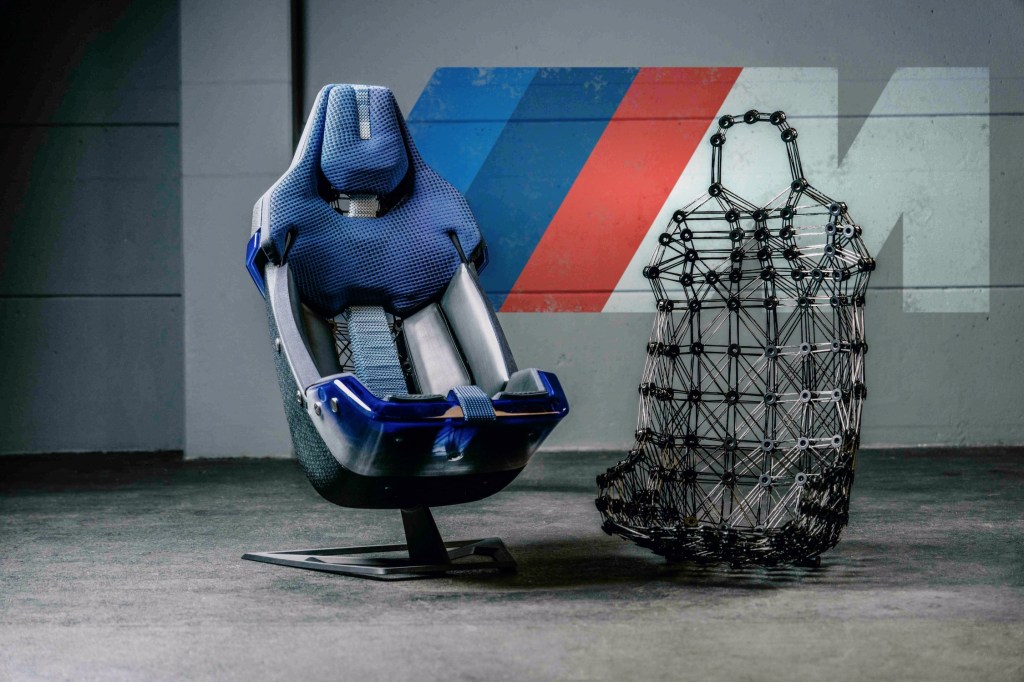
The BMW M Visionary Materials Seat—designed by BMW Group Designworks with the BMW design team; supported by Automotive Management Consulting GmbH, Bcomp Ltd, Gradel Lightweight Sàrl, and Lasso Ingenieurgesellschaft mbH—was recognized in the Sustainable Process category in the Altair Enlighten Awards presented last week during the 2024 Center for Automotive Research Management Briefing Seminars.

And some of you have probably already seen it and are thinking that I’m slow to the draw here.

The BMW M Visionary Materials Seat. On the left you can see a printed foam structure. On the right those are the fiber-would support elements use. (Image: BMW)

I wanted to get a bit more info on the seat, about which Falco Hollmann, Innovation Manager Lightweight Design & Sustainability at BMW M GmbH, said: “We are showing today what will be possible tomorrow with existing technologies and materials in order to take our efforts to reduce emissions and conserve resources to the next level. This is about more than just substituting materials; it is above all about designing for circularity.”

Many reports have it that it doesn’t have a support structure, which may make it sound like it is, well, floppy. Which wouldn’t be particularly effective as a seat.

Although it doesn’t have a conventional seat structure, it does have structural elements.

For example, there are robotically wound fiber composite elements (the black stick-like pieces on the object on the right of the photo) that form a load-carrying core structure.

Then there is the blueish/white mesh structure that you can see on the left side of the photo in the center part of the seat, which, according to a BMW spokesperson, is “made from a soft, gel-supported (reusable) structure from an additive manufacturing technology.”

(That is not a cutaway of the seat. It is designed with a minimalist approach so that foam component is visible.)

One of the things associated with the development of the seat is LCA: life cycle assessment. From start to finish—and beyond.

There is another factor taken into account, something less familiar than LCA: SQR.

That’s “secondary raw materials quota.”

A goal was to use materials that would go on to have a post-seat useful existence without additional processing steps (as would be the case with typical recycling), which led to the deployment of natural fibers, fiber composites, leather alternatives and algae-based polymers.

One of the important aspects of the development of the seat is the learnings obtained that can be applied to things that aren’t merely concepts.

Roberto Rossetti, Head of Development Total Vehicle-Lifecycle at the BMW Group:

“One of our biggest lessons was the balancing, in other words, how to model our process chain to generate missing primary data. The data obtained provides new insights, both in terms of today’s negative contributing factors and the design of tomorrow’s processes. This experience provides a solid foundation for continuously improving sustainability and developing innovative solutions for forward-thinking mobility.”

Clever Steering Wheel Design

Yes, it is still round. But it provides increased functionality

By Gary S. Vasilash

Steering wheels have increasingly become not only the means by which drivers can aim their vehicles, but as a user interface for a variety of functions, from controlling the audio system to engaging cruise control.

Then there is the packaging for the airbag.

Oh, and the steering wheel still is the place where one honks the horn. (Something that is more apparent in, say, New York City.)

Note the horizontal interface across the wheel. (Image: ZF LIFETEC)

A new approach to the steering wheel has been concepted by ZF LIFETEC.

No, this isn’t something where the configuration is radically changed, as though someone is piloting an aircraft rather than an auto.

But there is a horizontal element that goes across the diameter of this concept steering wheel that is described as serving as a control for the “vehicle’s entertainment and assistance functions.”

It is a seamless surface with force-sensitive “buttons.”

The airbag?

It “deploys from the top side of the steering wheel through the upper steering wheel rim toward the driver.”

By this repositioning from where the airbag is typically located the designers and engineers are able to provide that horizontal section with a variety of functions, perhaps even at some point a central screen.

2024 Hyundai Kona Electric Limited

Well, you can’t like everything. . .

By Gary S. Vasilash

To start with something completely subjective:

For the past few years it seems like there hasn’t been a Hyundai the exterior design of which I haven’t been most impressed by. Sedan or crossover, ICE or electric, the design team at Hyundai has been delivering in a way that I’m sure there are some at other OEM studios can only shake their heads at in wonder, admiration and jealousy.

Former head of Ford design J. Mays used to say, in effect, that it cost as much to stamp a boring body panel as it does an intriguing one. So given that. . . .

It does seem to be the case, however, that Hyundai’s competitors have watched the way the company is gaining market share, going from a brand that didn’t seem to be having much of an effect on the market* (in effect, just getting buyers on the margin) to one that is growing, step by step (i.e., in pre-pandemic 2019 Hyundai sold 668,771 vehicles in the U.S.; in 2023 that number was up to 801,195; 2024 sales through May show a 2% increase over 2023, not a big number by any means, but one that is still on the plus side). And what those competitors see is that people in non-trivial numbers like non-boring sheet metal, so they have, in an increasing number of instances, elevated their games.

Which is good for consumers.

That said, Hyundai design has persistently produced vehicles that are striking.

Which led me to fear that I was becoming too enamored with the marque.

A shift (and it has a single-speed reduction gear transmission). . .

But then I saw the rear of the 2024 Kona Electric and that fear became unfounded.

Rear of the 2024 Kona Electric (Images: Hyundai)

It strikes me—yes, yes, entirely subjective—as simply too slabby.

The rear of the original Kona, model year 2018, is something that I think is far more interesting. And as I spend time looking at photos of the earlier iteration of the Kona, I think its design is superior to the current one. The forms are much tighter.

Rear of the original, 2018, Hyundai Kona. I like this one better. Much, much better.

Of course, OEMs are interested in moving their current models, not ones from the past. (Interestingly, in terms of purchasing, the Cox Automotive 2023 Automotive Car Buyer Journey Study found that 68% of buyers considered both new and used vehicles and it is worth noting that there some 36 million used vehicles sold in 2023, more than double the number of new. For the consumer, used matters.)

OK. Now completely objective info.

Just the facts. . .

The Kona Electric is, well, an electric vehicle. It is powered by a permanent magnet synchronous motor that produces 150 kW (a.k.a., 201 hp).  The motor powers the front axle. There is a 64.8 kWh lithium-ion battery. According to the EPA this setup provides a range of 261 miles.

With DC fast charging the battery can go from 10% to 80% in approximately 43 minutes. With a Level II charger, using the 11 kW onboard charger, it can go from 10% to 100% in 6 hours, 14 minutes. (This is the sort of thing that can happen at home.)

The Kona Electric’s outside measurements are: wheelbase, 104.7 inches; length, 171.5 inches; width, 71.9 inches; and height, with roof rails, 62.2 inches.

The Kona Electric’s inside measurements are: passenger interior volume with sunroof, 96.8 cubic feet.

The Kona Electric’s cargo capacities are: behind the second row, 25.5 cubic feet; second row folded, 63.7 cubic feet.

The Kona Electric’s frunk capacity: 0.95 cubic feet. (Think of a place to store the charging cable.)

Not just the facts. . .

On the inside (now going back to the subjective mode with some numbers thrown in) there is the clean, contemporary look that Hyundai is bringing to all of its vehicles.

There is a 12.3 driver information screen and a 12.3-inch infotainment screen. While it doesn’t fake being one screen, for practical purposes this is 24.6 inches of screen, which is quite impressive. (Plus the visual appearance is first-rate.)

There is an eight-way power driver seat; the passenger has to adjust their own, xix ways. But both front seats are heated and ventilated and are trimmed out with “H-Tex” leatherette (a.k.a., pleather).

There are wireless Apple CarPlay and Android Auto and Bose premium audio.

There is Hyundai Digital Key, which means you can use your phone in lieu of the fob; the fob has proximity capability which means you can approach the locked vehicle and it will open when you tug the handle.

There is an array of safety tech (e.g., blind-spot collision warning; parking distance warning; navigation-based smart cruise control with stop and go; lane-keep assist). There is also something that is useful in regular driving: use the turn signal and there is a camera view in the driver information screen showing what’s along side the vehicle (yes, the sort of thing you can see in the side-view mirrors—but better).

So. . .

Drives well. (Somewhat) reasonable range (I am in the 300-mile club). Good tech and nice interior. Excellent MSRP for this loaded (Limted) model: $41,045.

But then there’s the back. . . .

2025 Toyota Camry XLE

Shake it up. . .

By Gary S. Vasilash

It may seem that the most controversial move made by Toyota for the 2025 Camry—the  ninth generation of the midsize sedan—was to make all of them, be it FWD or AWD, LE, SE, XLE, or XSE trim, hybrids.

2025 Camry XLE. Stylish, well-equipped, and a hybrid. (Image: Toyota)

That’s right: Every Camry is a hybrid.

Under the hood across the board is a 2.5-liter, four-cylinder engine supplemented by electric motor generators such that the FWD version produces 225 net-combined horsepower (engine + motor) and the AWD 232 hp. This is Toyota’s fifth-generation hybrid system. Yes, they’ve been at it a while.

Depending on the drive configuration the fuel efficiency goes from a low of 44/43/44 mpg, city/highway/combined, for the XSE AWD (the top of the line) to 53/50/51 mpg for the LE FWD. To call 44 mpg combined “low” is, well, ridiculous.

Lots and lots and. . .

Realize that the Camry is the perennial best-selling car in the U.S. (22 years running), with the company delivering 290,649 units in the U.S. last year, units produced by Toyota in its manufacturing complex in Georgetown, Kentucky. (During the history of the plant, which opened in 1986, there have been more than 11 million Camrys built within those ever-growing walls. Yes, the expansion there has been notable such that today there is 9-million square feet under roof, which, according to Toyota, is equivalent to the size of 157 football fields.)

One might think that Toyota would not want to rock the proverbial boat, to make changes that might seem upsetting to what is clearly a loyal base of buyers. It’s not like there haven’t been hybrid powertrains in Camrys.

There have—since model year 2008 (calendar year 2007).

But it has always been a powertrain selection until now. You could get a Camry with or without electrification.

Yet the product planners at Toyota decided that the best thing to do was to go all in on hybrids.

Yikes! one might think.

The time is right

But broader market timing seems propitious, as there is the swerve away from full electric vehicles to electrified vehicles, a.k.a., hybrids. In 2023 Toyota Motor North America overall sales—including Lexus models, its bZ4X electric and Mirai fuel cell—included 29.2% hybrid models, up from 23.9% in 2023. One can only imagine the number when 2024 is calculated.

What I found to be surprising about the Camry XLE wasn’t under the hood but on the inside: there is trim covered with Dinamica, a microfiber, that has a quilted pattern. It is light gray. Black is available, as well.

Said another way: there is fabric covering surfaces on the door panels and dash board where you otherwise would see leather or plastic. The material is produced with recycled polyester without the use of organic solvents, so it is comparatively environmentally advantageous.

Yes, that trim is actually a fabric.

It is also surprising for those of us who are more used to seeing smooth materials that are naturally or mechanically grained.

A generational difference

However, when I showed the Camry to a Gen Z niece, she thought the interior was the most wonderful she’d ever seen. And when I explained that the car in question is a hybrid, it gained significantly more points in her book.

So what might seem like a risky move by Toyota is undoubtedly a correct one.

It is often said that a given generation doesn’t want to buy the type of vehicles that they’re parents had driven them in. In my niece’s case it was a Honda Odyssey and Ford Flex.

She and her husband presently drive a pickup for no reasons of utility.

But it seems that a sedan is on the table for her. And given what Toyota has done with the ’25 Camry, it is something that is of even greater interest.

And here’s another thing to consider: at her age she has a whole lot of vehicles in her future, so if she finds appeal in the Camry, odds are good that the company will get more business from her in the future. Given the reliability of Toyotas and given that the Camry is full of tech for purposes of entertainment and safety, it seems that the edge of style makes it all the more attractive.

Certainly a clever move by Toyota.

A Rolls for Not Everyone (But Is There One That Is?)

One wonders if there is a specific slot for a skateboard. . .

By Gary S. Vasilash

This is an interior shot of the Roll-Royce Black Badge Cullinan Series II.

Rolls describes this as catering to “a select subset of Rolls-Royce clients with specific tastes and priorities.” Certainly that. (Image: Rolls-Royce)

About this interpretation of the SUV Anders Warming, director of Design at Rolls, says:

“The dark, primal elements that are so essential to the Black Badge character are expressed here in extremis, and are further amplified by dramatic and assertive coachwork reserved for this disruptive expression of the brand.”

Those seats feature a material named “Duality Twill.” It is a rayon made with bamboo. The bamboo is “inspired by the extensive bamboo grove in Le Jardin des Méditerranées on the Côte d’Azur.” That grove was nearby Sir Henry Royce’s winter home, Villa Mimosa. Royce, incidentally, has been dead since 1933. Given the price of real estate in the neighborhood, one wonders about the existence of a bamboo grove.

The embroidery on the fabric for all of the seats features 2.2 million stitches made with 11 miles of thread.

Also, the seats can be made with “Placed Perforation.” This means up to 107,000 holes measuring 0.8 and 1.2 millimeters.

The perf pattern is said to be “inspired by the constantly changing shapes and shadows of the clouds over the Home of Rolls-Royce at Goodwood in the twilight hours.” Of course it is.

But one thing: isn’t that color scheme something that one could imagine on the inside of a Jeep Wrangler inspired by Monster Energy Drink?

TWR Supercat: Shape of Things to Come?

This isn’t just playing games

By Gary S. Vasilash

(Image:TWR)

This car looks like something out of a video game. Elaborate. Expressive. Excessive.

But it is what the TWR Supercat is supposed to look like—the physical version, in all of its carbon fiber glory, will be introduced by the British builder of vehicles this summer.

Deliveries of the £225,000 limited-build vehicle (base price) are to start in Q4 2024. Prospective owners can place a £10,000 deposit (refundable) to get in the queue.

One of the more interesting aspects of the Supercat is it lead designer: Khyzyl Saleem.

TWR describes Saleem as “among the world’s leading digital and 3D car concepting stylists.”

According to his LinkedIn page he specializes in “Vehicle Design using 3D software.” He has worked as an artist for a gaming company. He is the co-founder, director, head of 3D for digital design firm FUZE Studio.

All of which is to say that at least so far as limited-run vehicles go, it very well may be that designers like Saleem may be the ones whose imaginations are in greater demand than traditional car designers who come from a more mechanically based background.

Designing the 2024 Hyundai Santa Fe

Kevin Kang talks about how global designers looked beyond the world of COVID to the one that we’re experiencing today—when more people want to get out in the world. Which have rise to the fifth-generation of the Santa Fe SUV.

(Images: Hyundai)

By Gary S. Vasilash

One of the things that COVID gave rise to is the design—inside and out—of the fifth-generation, 2024 Hyundai Santa Fe.

As Kevin Kang, Head of Department, Design, Hyundai Design North America, explains, the work on the project (code name: MX5) began in late 2019, and within a few months the design teams in the U.S., Korea and Europe were communicating with one another via digital means, including putting on virtual reality headsets (with individuals expressed as avatars) so the design-in-becoming could be viewed and manipulated.

Because they were all aware of the varying levels of lockdown that COVID was causing, the designers thought about the future, about what people would be interested in doing post-pandemic. And so research was conducted and it was determined, Kang recalls, that people would be more interested in getting out into the world.

Kevin Kang and his colleagues thought about a vehicle that would faciliate getting people out into the world with confidence and capability.

In some instances this going out would be a visit to Costco to load up on things rather than waiting for the Amazon truck to deliver. In other cases it would be spending some time at a camp site.

So they decided that they would work to develop a three-row, midsize SUV that would blur the boundaries between the two activities, combining create comforts with capability.

This led them to start at the back.

Kang explains that what makes an SUV an SUV is not how it appears from the front or the side, but it is all about the back. About the tailgate.

They maximized the opening.

Whereas the opening in the previous generation is 44.5 inches wide and 30 inches high, the ’24 Santa Fe’s opening is 50.2 inches wide and 32 inches wide.

The design team determined that the best place to start designing an SUV is from the hatch.

(One result of going so big and working to make it fully accessible: they had to lower the position of the brake lights.)

(One result of people working during COVID and using Clorox wipes with regularity on objects they’d have to hand: they put a UV sterilization tray above the glovebox: pop in your phone, close the lid and activate.)

The Best Box

To state the obvious, the ’24 Santa Fe is boxy. Both inside and out.

Kang: “We wanted to create the best-looking box ever.”

But this isn’t something that was done purely for reasons of styling.

Kang, again: “For me, a logical design is the superior one.”

(For those who might think that boxy on the outside rather than something sleek and swoopy means it is like trying to move a brick through the air, know that the drag coefficient for the new Santa Fe is 0.294. . .and the drag coefficient for the outgoing model is 0.33. And lower is better. However, it is worth noting that part of this aero efficiency is achieved through the use of something borrowed from the company’s IONIQ electric vehicles: active air flaps in the front fascia.)

Making Models

The designers who worked on the interior of the Santa Fe thought about things like what would be involved in going from home to a campsite. This would not necessarily be an A to B undertaking, but have intermediate stops that might be picking up kids from school, stopping at a supermarket, hitting a Starbucks. . .and then making it to the great out of doors.

All of which means acquiring things along the way and, in some instances, generating trash.

To figure this out in a logical manner the designers made one-fifth scale models of the interior of the vehicle as well as the stuff that would come along for the ride. This led them to creating spaces for things.

Like a large tray space in the center console that can be used to place things a fast-food to-go bag. (The shifter has been moved to the steering column and the cupholders moved back on the console.) And a drawer readily accessible to the second-row passengers (though it can be reached from the front) that could be used to toss trash.

And they addressed ergonomics, as well. For example, Kang says that they took a lesson from the cockpit of aircraft. In planes there are ledges around the screens for the instruments that the pilot can use to steady their hands during flight.

Providing a place to position one’s hand when using the touch screen.

So they designed what they call a “palm rest,” a trim piece that runs across the middle of the instrument panel with a slightly bigger surface below the infotainment screen: this allows someone to have stability when making selections from the screen.

Meanwhile, on the Exterior. . .

Going back to the exterior, Kang says that they worked to keep the greenhouse surfaces as flat as possible (again, the surface of a box). Of course, to provide a sense of ruggedness, there are fender bulges, though these are done in an interesting way: around the outer area of the flair there is a chamfer that goes into the surface of the vehicle which results in a more massive appearance of the surround as it bulges outward.

The trim in the rocker area of the Santa Fe is piano black, which is surprising on a vehicle that does have some offroad capabilities (there is an XRT trim that has a higher ground clearance than the other models—8.3 inches rather than 7.0 inches—which provides greater approach, departure and breakover angles, so for those inclined to go to campgrounds that are well off the proverbially beaten path, it is the trim to take). Kang says that while matte finishes might be preferable, consumers find that to look not particularly upscale: remember that the Santa Fe is designed for the daily suburban driver, as well.

The front of the Santa Fe has a horizontal LED lamp that stretches across the top grille, terminating in the headlamps. This forms a double “H” shape: the “H” that is formed where the horizontal bar meets the vertical lights on either side and an “H” that is formed by the headlamps that each have a pair of vertical lights.

Note the “H” shapes designed in the lighting and fascia.

Then on the fascia above the lower grille there is still another “H” formed with the body-colored material surrounded by darker trim.

While this reads as though it would be gaudy, it is actually more subtlety executed.

No Russian Dolls

Is this use of the “H” something that may show up on subsequent Hyundai vehicles?

Kang thinks not.

“We have collectively decided not to do the Russian-doll approach to design,” he says.

In the SUV lineup, for example, there is the Tucson smaller than the Santa Fe and the Palisade larger. But all three vehicles exhibit their own stylings.

Each vehicle has a design onto itself.

And this makes absolute sense. Globally, Kang points out, Hyundai has more than 60 different models.

Trying to make a family look for dozens of vehicles would probably be nothing more than an exercise in frustration.

While the first read on the ’24 Santa Fe may bring to mind the Land Rover Defender (arguably not a bad thing, especially as that vehicle starts at a price well above the sticker for the Santa Fe AWD hybrid with the top-of-the-line Calligraphy trim package), that sense quickly disperses as it is clear that given the detail outside and in, this is a vehicle that is clearly its own thing.