Bentley’s Credible Claim

There’s luxury. And then there’s luxury. . .


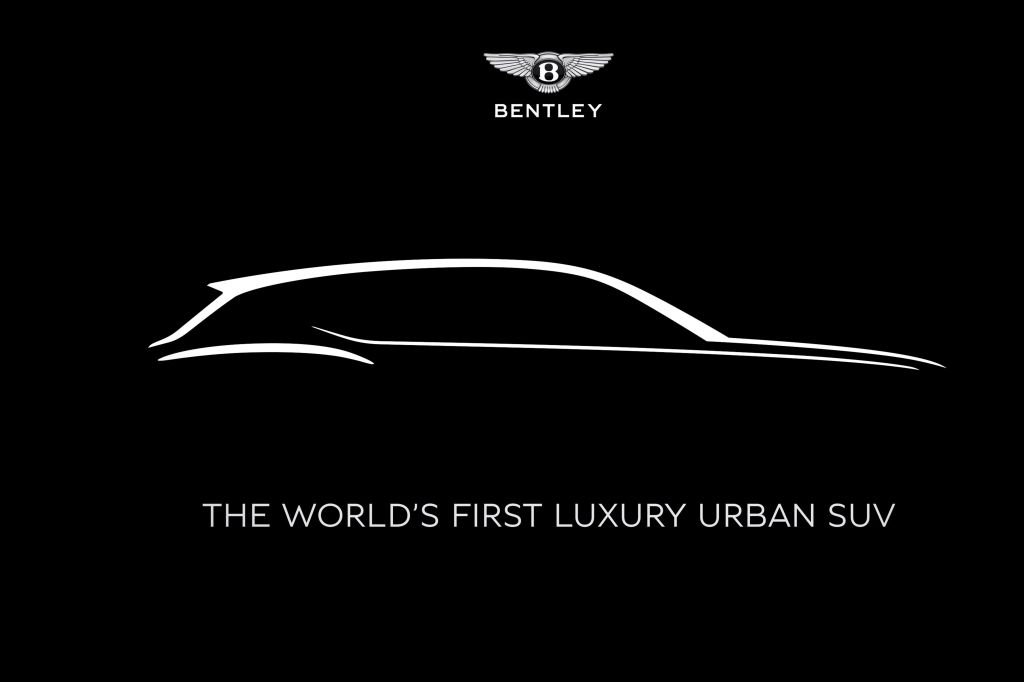
Given that the average price of a Bentley is on the order of $300,000, when the company announces that it is going to “create an entirely new segment, the world’s first true Luxury Urban SUV,” you’ve got to give it to them.


After all, while we may think of “luxury” in the context of something from Mercedes—which, of course, has SUVs—it is that rarefied air that Bentley is in that Mercedes—even with its Maybach brand—is without.


The new SUV, which is to launch in 2026, is a battery electric vehicle. Presumably that explains the “Urban” part, as in the company figures this will not be a vehicle to take on some sort of grand tour.

Bentley plans to be fully EV by 2035.


Presently its Continental GT coupe, convertible and Flying Spur models are plug-in hybrids; the V8-based propulsion system replaces the W12 engine that had once been under the bonnets of the cars coming out of Crewe.

Bentley Joins Leather NGO

Sustainability is the name of the game. . .

By Gary S. Vasilash

One of the considerations that OEMs—especially in the higher end of the market—have to come to grips with is developing vehicles that are as environmentally sound as they can be. This isn’t simply an issue of sticking motors and batteries into propulsion systems. It also goes to the point of the types of materials that are used in the vehicles.

Let’s face it: while companies may use recycled steel and aluminum and plastic, odds are end consumers don’t pay a whole lot of attention to that.

What they do pay attention to is what’s on the inside of vehicles.

Which brings us back to the environmental aspects.

As in:

“Leather is a timeless, luxury material that has always epitomized the elegance, durability and quality of a hand-crafted Bentley interior. It has a rich history that dates back decades in our cars and has always stood the test of time.”

That’s Marc Stang, Technical Expert, Leather and Colour Development at Bentley Motors.

The problem is one of sustainability. Leather is generally iffy in that regard.

Somehow tanning leather with olive oil byproducts even seems like it would be nicer to touch than leathers treated with all manner of potentially hazardous things. (Image: Bentley Motors)

So Bentley Motors has become the first automotive member of Leather Naturally, an NGO that focuses (no surprise) on using certified, properly-sourced leather in a variety of industries.

One of the things that Bentley is doing regarding the leather it offers is to deploy a sustainable leather tanning process.

Rather than the heavy metals, minerals and aldehydes that are typically used in tanning, the Bentley Olive Mill Waste Water tanned Leather is produced using an organic byproduct of the olive oil industry (which goes to the point of that name).

Presumably this will allow leather to stand the test of time a little longer at the venerable motor car company.

Sunk Anticipation

By Gary S. Vasilash

One of the things that hasn’t been mentioned about the burning then sinking of the Felicity Ace cargo ship, the vehicle carrier that caught fire on February 17, then sank this week in the Atlantic, is that there are now some 4,000 customers who are not going to be getting their Bentleys, Audis, Porsches, Lamborghinis, and Volkswagens anytime soon.

While there isn’t a specific brand or model delineation, Porsche has acknowledged that about 25% of the vehicles that are now sunk (possibly the charred husks of said vehicles), let’s face it: When it comes to Bentleys and Lambos, there is an inverse relation between their volume and their MSRP, so even if there are but a few, that is undoubtedly a big chunk of the estimated $438-million worth of cargo on board.

Audis, of course, are not inexpensive, but compared to the other three, not nearly as much. And Volkswagens, of course, are the everyman accessible brand among the group.

But those brands (all, incidentally, under the umbrella of the Volkswagen Group) are, like any right now, be it Ford or Toyota or Kia, still facing the chip shortage. Which means the ability to make vehicles is still restricted.

Which means there are some order-holders who will find their wait has just gotten that much longer.

Bentley Looks to Its Future

By Gary S. Vasilash

If you were to draw an inverted triangle between Liverpool, Manchester and Crewe, with Crewe being the point at the bottom, that gives you a sense of the location in northern England where some 4,000 people work building Bentleys.

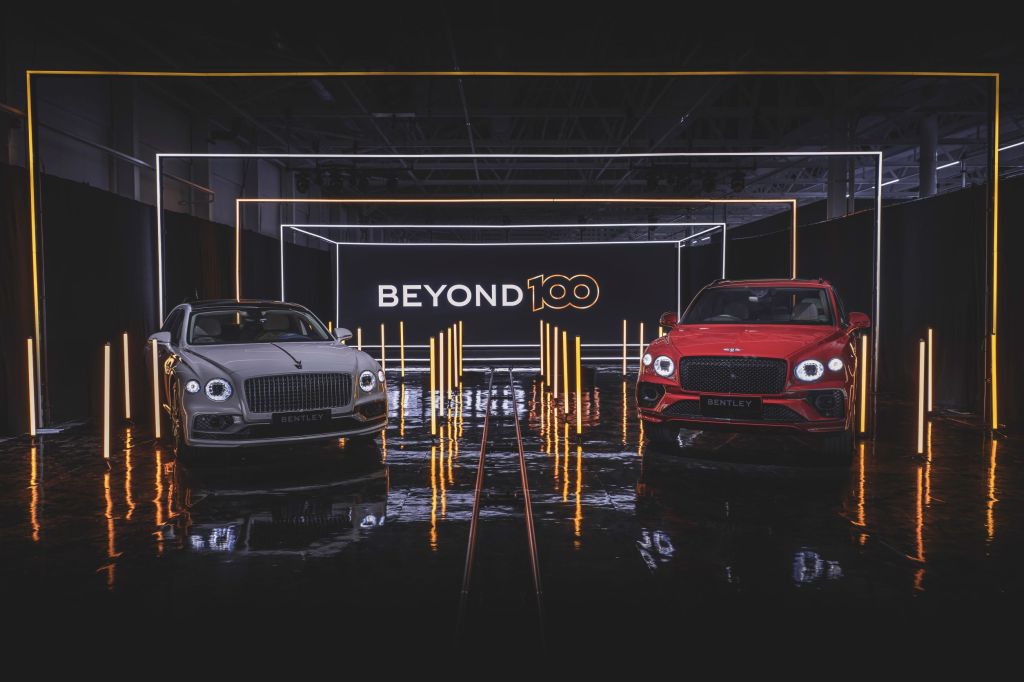
Bentley is 102 now. It clearly plans to be in the game for many more years to come. (Image: Bentley)

Today it was announced that Bentley is making a £2.5-billion investment in sustainability, which includes building at Crewe what is being called a “Dream Factory” for the production of electric vehicles.

Bentley’s first EV will be built at Crewe in 2025, and by 2030, when the brand is fully electric, there will be four more vehicles.

As Adrian Hallmark, chairman and CEO of Bentley, put it:

“Our aim is to become the benchmark not just for luxury cars or sustainable credentials but the entire scope of our operations. Securing production of our first BEV in Crewe is a milestone moment for Bentley, and the UK, as we plan for a long-term sustainable future in Crewe.”

Automotive manufacturing in the UK needs all the help it can get, and clearly the Volkswagen Group, of which Bentley is a part, is giving it some.

The Flying Spur Hybrid Launched

Not exactly what you might think vis-à-vis a fuel-efficient vehicle

By Gary S. Vasilash

The Bentley Flying Spur is an imposing, stately sedan that is meant to go fast, thus its name.

The car is 209 inches long, 87 inches wide (mirror to mirror), 58 inches high, and when equipped with a V8 weighs 5,137 pounds. Large, solid and powerful.

It has a top speed of 198 mph.

The car has also been offered with a W12 engine (think of two V’s).

And now there is another variant, the Flying Spur Hybrid.

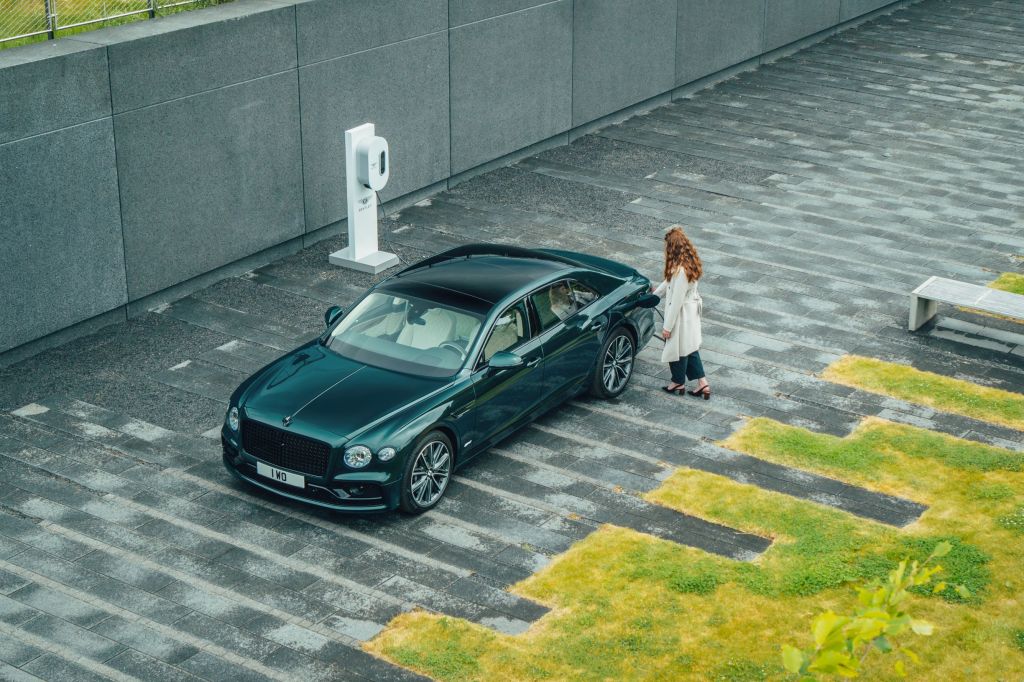
Yes, you can plug it in to charge the 14.1 kWh lithium-ion battery. (Image: Bentley)

It is part of Bentley’s “journey to electrification.”

The hybrid powertrain is based on a 2.9-liter V6 gasoline engine with an electric motor fitted between the engine and the transmission.

The turbocharged V6 engine produces 416 hp. The electric motor produces 134 hp. The system output is 543 hp.

While the V8 has more horsepower overall—549.5 hp—when looked at from a per liter metric, the Hybrid generates 152 hp per liter, more than the V8.

However, the V8’s 198 mph top speed bests the Hybrid, which is poking along at 177 mph.

What’s more, the V8 can go from 0 to 60 more quickly—in 4.0 seconds. 0.1 faster than the Hybrid.

When you get back to the point that these vehicles weigh more than two tons, even 4.1 seconds seems nearly impossible—especially for what the company describes as “the most efficient Bentley ever.”