Calling It Something Doesn’t Make It So

You don’t get to decide. . . .

By Gary S. Vasilash

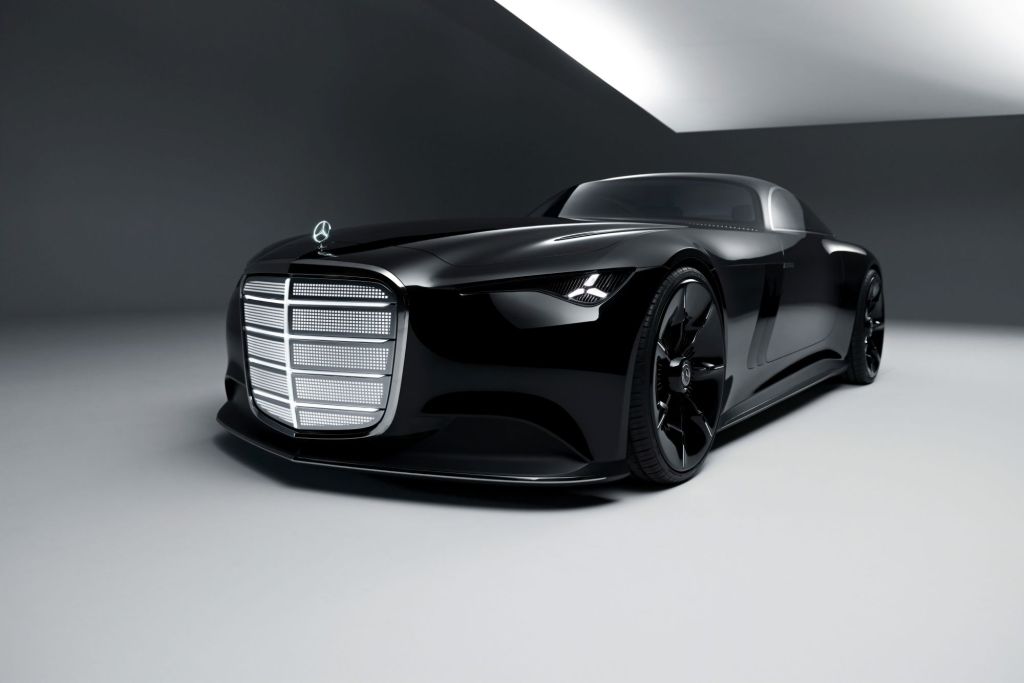
(Image: Mercedes-Benz)

“Inspired by the golden era of automotive design of the 1930s, this show car embodies the pure essence of Mercedes-Benz. With its hood giving it a majestic presence, sculptural flowing lines and a touch of Art Deco, it rises to become a true icon of automotive beauty. The interior with its continuous bench seat and the elegant rear, evoking memories of the legendary 300 SL. Our Vision Iconic is more than just an automobile – it is a sculpture in motion, an homage to timeless elegance and a statement for the future. The symbiosis of traditional craftsmanship, state-of-the-art technology and an unmistakable design language makes it the ultimate expression of value, prestige and grace: the most beautiful, most prestigious kind of thing.”

–Gorden Wagener, Chief Design Officer Mercedes-Benz Group AG

Yes, this concept car may have all of those attributes from the hood to the flowing lines and so on.

But one thing it isn’t is “a true icon of automotive luxury.”

Something becoming an “icon” isn’t a matter of nomenclature (e.g., “Vision Iconic”).

It becomes an icon because there is cultural respect given to something over a period of time.

One could describe the Mercedes-Benz 300 SL, the gull-wing-door vehicle that came out in 1954, as “iconic.” That’s why Wagener is able to cite it as “evoking memories.”

The term “icon” is earned, not labeled.

BMW is eating Mercedes’ Mittagessen in a big way so far as sales are concerned. Perhaps a bit of humility and attention to getting more desirable product on the road now might help Mercedes even if those vehicles aren’t self-proclaimed icons.

The Trials of Remodeling

If you had an NVIDIA-powered system you could pull off that basement remodel without a hitch. . .

By Gary S. Vasilash

If you are, say, redoing your basement, you might think you’ve got everything planned out to the final light fixture but discover along the way that there happens to be something that isn’t going to allow it to happen as anticipated, such as a support pole being in the “wrong” place. (It, of course, is in the right place. Your plans are off.)

You might think that this is something that couldn’t happen during professional projects.

Like when modifying an existing factory to accommodate a new vehicle or to add capacity.

Turns out, factories can be just like basements.

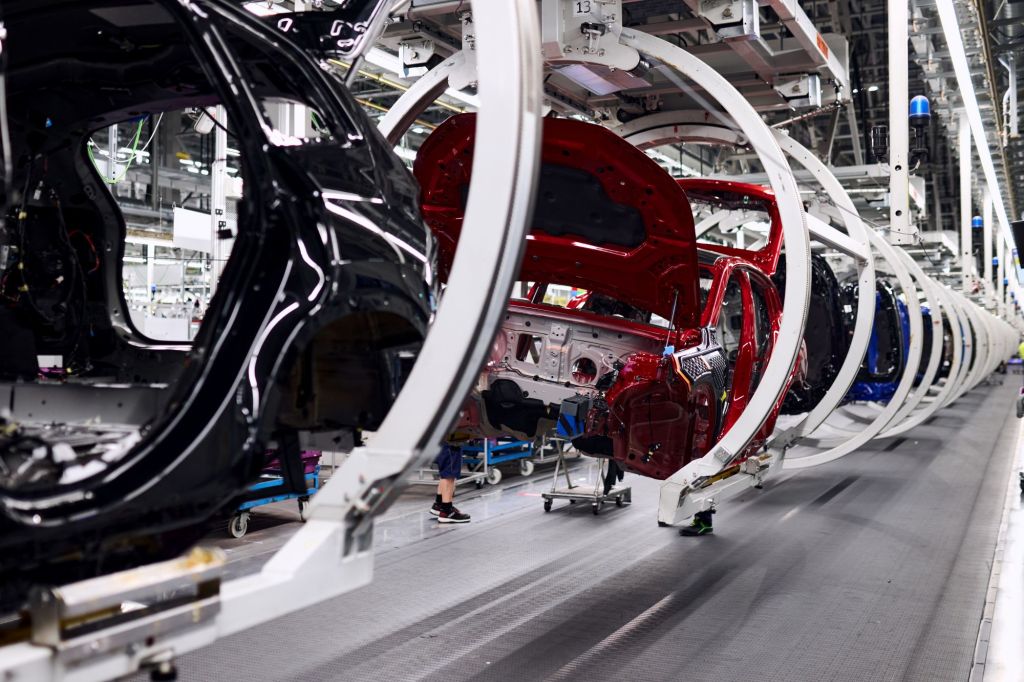
While half of those robots are where they need to be, the question is whether the other half will be able to do what needs to be done. So simulation lets BMW engineers know. (Image: BMW)

Only the consequences can be greater when it turns out the support beam is the way.

BMW plans to launch more than 40 new or updated vehicles between now and 2027.

It has more than 30 production sites to prepare.

To do this with as minimal a hitch as possible it is using its “Virtual Factory.”

That’s a simulation system that’s based on the NVIDIA Omniverse.

Inputs to the simulation include everything from building data to vehicle metrics, equipment information to manual work operations.

Simulations are run in real time.

Potential collisions (e.g., banging into a column) are automatically determined.

What’s surprising is that pre- this digital twin approach it was sometimes necessary to manually move a vehicle through the plant to make sure everything fit.

And in some cases it was necessary to drain the dip tanks in the paint shop, which is not only time-consuming, but expensive.

And speaking of costs: BMW says the Virtual Factory approach will save as much as 30% in production planning.

How BMW Is Doing Well

What it takes to be successful is more than any one thing. . .

By Gary S. Vasilash

When it comes to the German luxury Big Three, it seems as though Mercedes is roiling with things like headcount reductions and other measures to reduce costs; Audi is somewhat invisible (in the U.S. its 2024 sales were down by 14%, which puts it in third place, but at 196,576 to second place Mercedes’ 324,528, so that is a far-away third), and BMW, well, it would be fair to say it is doing well.

Last year BMW Group sold a total 371,346 vehicles in the U.S., up 12.3%.

(Image: BMW)

There are arguably two reasons this is likely the case:

  1. BMW has an assortment of powertrains: ICE, hybrid and EV. Customers have a choice.
  2. The company’s supervisory board made an announcement today regarding members of its board of management, focusing on the Development Division, but going beyond that. Oliver Zipse, chairman of the board of management, said: “Technology and innovation are and will remain key success factors for BMW. “That is why we have been combining the technological expertise and the great innovative capacity of our Development, Production, Purchasing and Supplier Network Divisions in our comprehensive technology clusters for years.”

Note well Development, Production, Purchasing, and Supplier Network.

The success of a company just isn’t what it puts under the hoods of its vehicles or what kind of ADAS is deploys.

It is predicated on the integration of parts of its organization.

Without this solid integration, something gets left out and problems arise.

Dealing with Diesels

European drivers still buy them. So a better fuel alternative is important. . .

By Gary S. Vasilash

Although “diesel” is something of a dirty word in the U.S.—at least so far as personal vehicles go: let’s face it, most of those Class 8 trucks hauling cargo across the country and across town are powered by diesel fuel—according to the most recent figures from the European Automobile Manufacturers’ Association, this past October of the light vehicles registered in the European Union, 10.9% were powered by diesel.

While that is a far cry from what the percentage once was, it is important to know that the 10.9% is greater than the percentage of registration for plug-in hybrid vehicles, which as 7.7%.

Which explains why, for example, BMW Group is building diesel models in addition to an array of vehicles with other powertrains.

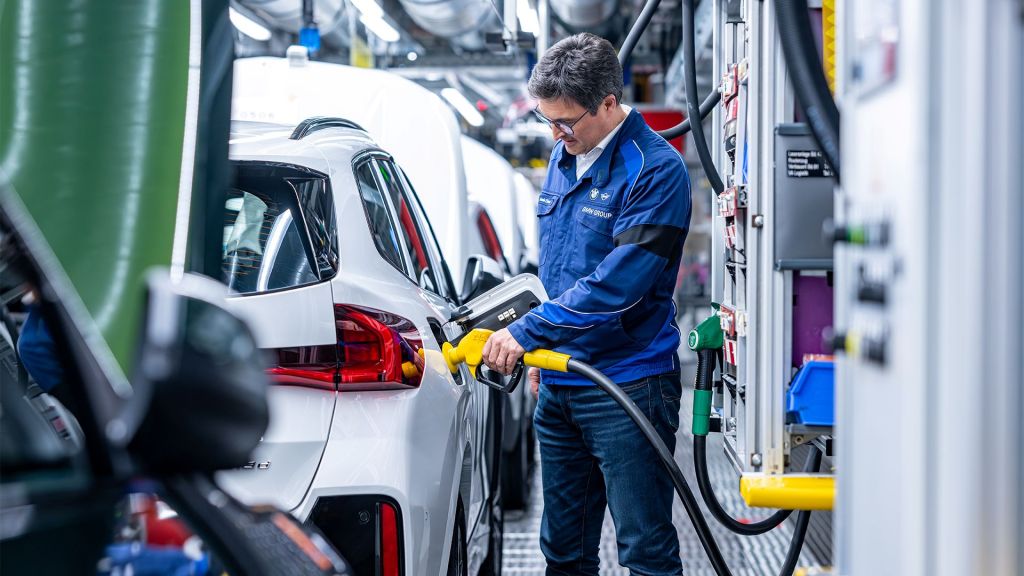
Fueling a BMW before it leave the plant with a hydrotreated vegetable oil fuel. (Image: BMW)

But BMW will be fueling the vehicles that leave its plants with HVO 100, a 100% hydrotreated vegetable oil, that is produced by Neste, a Finnish firm.

The companies have calculated that on a life-cycle basis, compared with fossil-fuel diesel there is a greenhouse gas reduction of up to 90% with the HVO 100.

Oliver Zipse, Chairman of the Board of Management, BMW AG:

“When it comes to climate protection, every ton of CO2 saved counts. The more than 250 million existing vehicles in Europe are an important factor here: Their CO2 balance could be significantly improved if the regenerative share of fuel was increased. We are going ahead: From January 2025, we will fill up all diesel models produced in Germany with HVO 100 before delivery to dealers — a high-quality diesel replacement with up to 90% lower CO2e emissions in the overall balance sheet.”

Zipse’s point about the exiting diesel cars on the road can’t be overlooked.

It is going to take quite some time for those to be replaced by non-diesel alternatives.

Consequently, the importance of renewable fuels like HVO 100 cannot be underestimated.

Detroit Has 0 Michelin Starred Restaurants

Munich has one in a facility where people take delivery of their cars. . .

By Gary S. Vasilash

While it is not uncommon for an automotive company to send out a news release regarding the retirement of an executive, BMW has sent one headlined:

BMW Welt bids farewell and thank you to star chef Bobby Bräuer

Which is, well, uncommon.

Bräuer is an executive, the executive chef of EssZimmer restaurant.

EssZimmer has achieved two Michelin stars since he took over the restaurant in 2012.

BMW Welt and BMW Group headquarters: notable architecture in Munich. (Image: BMW)

EssZimmer is one of the restaurants at BMW Welt in Munich, a facility that is not only a place where people can receive deliveries of their vehicles, but a public display of BMW Group products (BMW, BMW M, BMW i, MINI, Rolls-Royce, and BMW Motorrad)—since BMW Welt opened in 2007 more than 250,000 people have taken delivery there. There are three other restaurants and a bistro.

There are over three million people who visit BMW Welt each year.

There are displays, conferences, events and other activities that are both put on by BMW Welt (more than 400 people work there) or by organizations that rent space within the facility.

There is car culture and there is car culture.

Seems that BMW checks both boxes with its vehicle and with BMW Welt.

What E-Truck Did BMW Pick?

Its passenger vehicle competitors make big rigs. BMW doesn’t. . .

By Gary S. Vasilash

Although Mercedes and Audi (well, as in its owner, Volkswagen Group) make semitrucks, BMW doesn’t.

BMW announced that to bring components to its battery production operation at BMW Group Plant Leipzig, it is using two trucks to shuttle between the factory and a logistics center.

To make this appropriate, the trucks are electric.

So where did BMW source the trucks?

Mack? Peterbilt?

Nope.

Designwerk.

BMW uses e-truck to deliver e-components. (Image: BMW)

The company was founded in 2008. Its first vehicle launched in 2009: a three-wheel mail delivery vehicle.

It began work on commercial trucks in 2018 and now has models ranging from 18 to 44 tons.

However, the trucks are based on Volvo FM, Volvo FMX and Volvo FH series chassis.

Designwerk also offers one based on “the low-entry chassis of the Econic from Daimler Trucks AG.”

The trucks in the BMW application are based on the Volvo chassis.

An interesting thing: Volvo Group—the company that builds commercial vehicles, not the Volvo that makes passenger vehicles—bought 60% of Designwerk in 2021.

BMW Design Goes Holistic

Why it is making a change to its design org

By Gary S. Vasilash

Generally, when offices are moved around in an organization so that someone gets someone else’s job, who then gets another, it is treated like a series of internal moves.

And if as part of that movement there’s a decision made to change some of the focus of the individual operations, that tends to be an emendation to the titles of the people who have moved.

But at BMW Group, changes that will become effective October 1 for several members of the design team, the company is making much ado about it.

There is a substantiative change (beyond the one for whatever company has the contract to print business cards, because that company will have a nice contract): Maximillian Missoni, who recently left Polestar, is joining the BMW Design team.

The rationale for (1) consolidating Colour and Material Design across all the brands and (2) dividing the brand team into two studios (this is a bit vague, however, as tehre seem to be a studio for compact and mid-size vehicles and upper mid-size and luxury vehicles, although there is still Rolls-Royce Design) is, says Adrian van Hooydonk:

“Technology and customer preferences are currently changing faster than ever. Automotive design has become more diverse. Designing digital experiences and sound also plays an increasingly important role, along with sustainable and recycled materials. The design showcases all the innovative potential of our products and brands. That’s why, more than ever, every single detail matters, as well as the holistic and harmonious integration of the various elements.”

Curiously, there’s no mention of an audio studio.

BMW + Toyota = >H2

The hydrogen collaboration continues. . .

By Gary S. Vasilash

(Image: BMW)

You might recognize the building in the background. BMW headquarters in Munich. The four cylindrical towers (partially obscured here) that are meant to resemble the four cylinders in a combustion engine.

Then you look at the vehicles. The one on the left and the center are from Toyota, a Hilux and a Mirai; the one on the right a BMW iX5.

All of these vehicles are powered by hydrogen.

The two gents are Oliver Zipse, Chairman of the Board of Management of BMW AG (left) and Koji Sato, President and Member of the Board of Management (Representative Director) Toyota Motor Corporation.

The two are shaking on their further partnership in the development of fuel cell electric vehicle (FCEV) technology.

Toyota has had FCEVs available to consumers.

Soon—or at least by 2028—the same will be said of BMW.

Zipse:

 “This is a milestone in automotive history: the first-ever series production fuel cell vehicle to be offered by a global premium manufacturer. Powered by hydrogen and driven by the spirit of our cooperation, it will underscore how technological progress is shaping future mobility. And it will herald an era of significant demand for fuel cell electric vehicles.”

Whether that demand is going to become real remains to be seen.

Sato makes a solid point, one that other OEM execs probably wish they could make, even though they were probably feeling really good when Toyota was being criticized for not going all-in on battery electric vehicles:

“In our long history of partnership, we have confirmed that BMW and Toyota share the same passion for cars and belief in ‘technology openness’ and a ‘multi-pathway’ approach to carbon neutrality.”

For the foreseeable future, there isn’t going to be one approach to reducing carbon and those legacy OEMs that recognize that will be the market leaders.

BMW Piloting Innovative Wind Turbine Device

Looking for ways to reduce its carbon footprint. . .

By Gary S. Vasilash

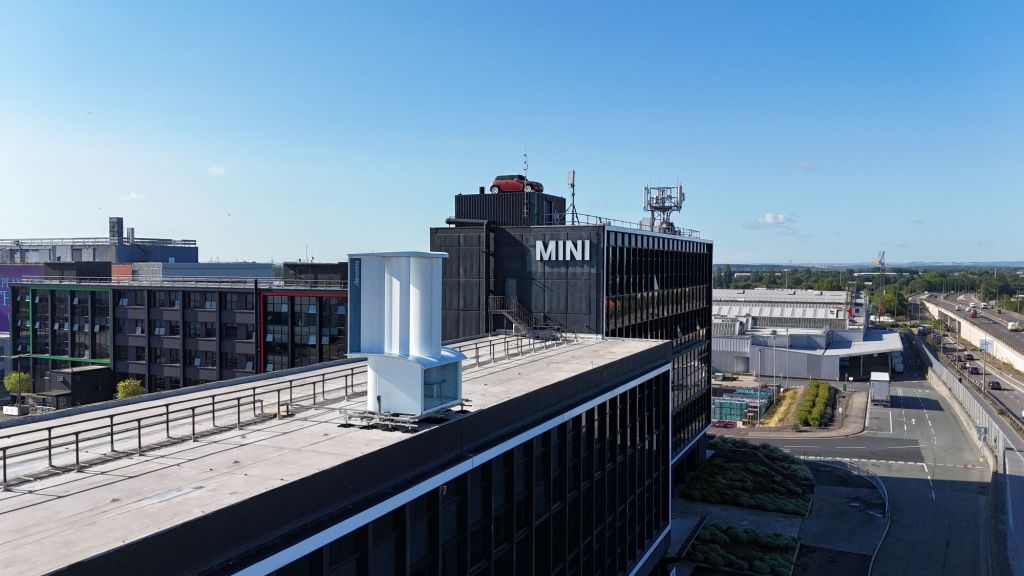
While there is currently some concern in the U.S. about the consequents of wind turbines, a clever alternative that collects wind energy with no visible moving parts. BMW Group is trying it out at its MINI plant in Oxford, U.K.

The wind energy unit, developed by Aeromine Technologies, is located on top of a building toward the prevailing wind.

There are wing-like vertical airfoils in the unit. These create a vacuum and suck the air into the unit where an internal propeller spins to create electricity

As it is contained, there is little likelihood that there would be an abundance of birds meeting an untimely end.

Rather than the familiar wind turbine design, that white box-like object is fitted with vertical airfoils that draw in air and an internal propeller to generate electricity. It is said to be quiet and friendlier to the avian population. BMW is piloting the unit from Aeromine Technologies at its plant in Oxford, U.K. (Image: BMW)

The pilot project at the plant is on the body shop building, which has had solar panels on its roof for 10 years.

The rationale for trying out the wind power is because the solar panels are less effective during the evening and winter, when apparently there is an abundance of wind.

BMW Group’s engagement with Aeromine came through the company’s “BMW Startup Garage,” which works to connect BMW business units with startup companies.

BMW’s Seat of Tomorrow

At some point everything will come together and what is a concept now is likely to become a serially produced product. Or at least elements will

By Gary S. Vasilash

The BMW M Visionary Materials Seat—designed by BMW Group Designworks with the BMW design team; supported by Automotive Management Consulting GmbH, Bcomp Ltd, Gradel Lightweight Sàrl, and Lasso Ingenieurgesellschaft mbH—was recognized in the Sustainable Process category in the Altair Enlighten Awards presented last week during the 2024 Center for Automotive Research Management Briefing Seminars.

And some of you have probably already seen it and are thinking that I’m slow to the draw here.

The BMW M Visionary Materials Seat. On the left you can see a printed foam structure. On the right those are the fiber-would support elements use. (Image: BMW)

I wanted to get a bit more info on the seat, about which Falco Hollmann, Innovation Manager Lightweight Design & Sustainability at BMW M GmbH, said: “We are showing today what will be possible tomorrow with existing technologies and materials in order to take our efforts to reduce emissions and conserve resources to the next level. This is about more than just substituting materials; it is above all about designing for circularity.”

Many reports have it that it doesn’t have a support structure, which may make it sound like it is, well, floppy. Which wouldn’t be particularly effective as a seat.

Although it doesn’t have a conventional seat structure, it does have structural elements.

For example, there are robotically wound fiber composite elements (the black stick-like pieces on the object on the right of the photo) that form a load-carrying core structure.

Then there is the blueish/white mesh structure that you can see on the left side of the photo in the center part of the seat, which, according to a BMW spokesperson, is “made from a soft, gel-supported (reusable) structure from an additive manufacturing technology.”

(That is not a cutaway of the seat. It is designed with a minimalist approach so that foam component is visible.)

One of the things associated with the development of the seat is LCA: life cycle assessment. From start to finish—and beyond.

There is another factor taken into account, something less familiar than LCA: SQR.

That’s “secondary raw materials quota.”

A goal was to use materials that would go on to have a post-seat useful existence without additional processing steps (as would be the case with typical recycling), which led to the deployment of natural fibers, fiber composites, leather alternatives and algae-based polymers.

One of the important aspects of the development of the seat is the learnings obtained that can be applied to things that aren’t merely concepts.

Roberto Rossetti, Head of Development Total Vehicle-Lifecycle at the BMW Group:

“One of our biggest lessons was the balancing, in other words, how to model our process chain to generate missing primary data. The data obtained provides new insights, both in terms of today’s negative contributing factors and the design of tomorrow’s processes. This experience provides a solid foundation for continuously improving sustainability and developing innovative solutions for forward-thinking mobility.”