BMW Addressing Emissions

Those associated with paint shops in this case. . .

By Gary S Vasilash

While there is a considerable—and justified—amount of attention paid to tailpipe emissions, there is also plenty of spew associated with the production processes that create those cars and trucks.

Like when the vehicles are painted.

You know how fresh paint has a pungent fragrance?

That is generally the result of things like volatile organic compounds that are not particularly good for the environment.

So in automotive paint shops there are measures taken to clean the exhaust before sending it out the smoke stacks (a.k.a, chimneys).

This includes running the exhaust through a bed of ceramic media that is at very high temperatures—as in 1,000 degrees Celsius.

To get those temps natural gas is usually deployed for the ovens.

BMW has completed testing on a method that uses electricity from renewable sources to achieve these temperatures.

It’s called eRTO—for “electric regenerative thermal oxidation).

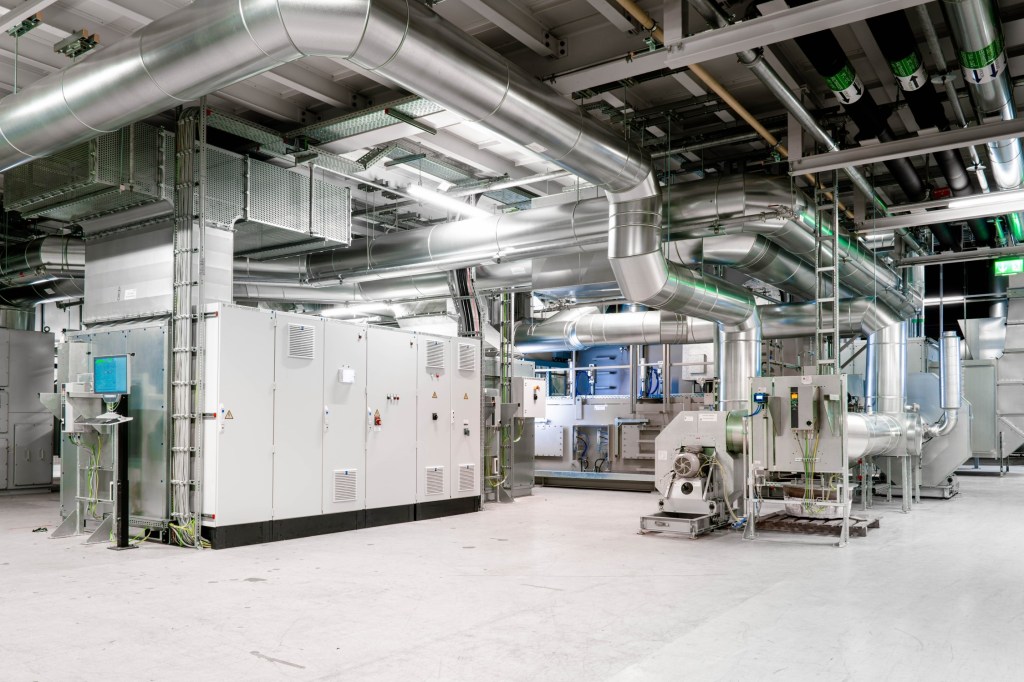
BMW is installing paint shop equipment that will help clean exhaust using electricity from renewable sources rather than natural gas. (Image: BMW)

Says Michele Melchiorre, head of Production System, Planning, Tool Shop, Plant Construction at BMW Group:

“For other energy-intensive paint shop processes, such as vehicle drying and water heating, solutions already exist for working without natural gas. So, electric exhaust purification is the final steppingstone for the BMW Group to run its paint shops on regenerative energy in the future.”

And that future is pretty much now in BMW plants in Germany and China, where eRTO is working along side the natural gas process.

Next year, a new BMW Group plant in Debrecen, Hungary, will have eRTO only.

Electric. Autonomous. Useful.

This is a vehicle that makes absolute sense.

By Gary S. Vasilash

If you’ve ever been in an automotive plant you’ve undoubtedly been surprised by the number of forklift trucks zipping around that are transporting parts, equipment and various other things that go into building things.

An autonomous vehicle operating in a BMW plant–capable of handling 55 tonnes. (Image: BMW)

The BMW Group Plant Regensburg is quite similar to other state-of-the-art factories. . .but then there’s this, which apparently is something that doesn’t exist elsewhere: Its uses of an electric lidar-equipped transport vehicle.

What’s notable is not only that this is an autonomous vehicle, but that it transports payloads up to 55 tonnes.

It operates at speeds up to 2.5 mph.

“Not fast,” you think. But (1) it is inside a facility where people are working, so speed is relative, and (2) it is carrying up to 55 tonnes of steel—not the sort of thing you want to bump into.

The autonomous vehicle operates in the factory’s stamping operation. It is used to transport tools for the presses—there are four press lines that turn some 1,100 tonnes of steel into approximately 131,000 stamped parts (e.g., side frames, door outers, hoods) per day—as well as steel blanks that are turned into those parts.

Tires Matter in the Snow

Especially for electric vehicles. . .

By Gary S. Vasilash

One of the things that seemingly more European drivers—particularly those in Germany—do that isn’t as frequently performed by Americana drivers is to swap out their tires from summer tires to winter tires. Winter tires provide more grip than even the all-season tires that are more common in the U.S. And a lot more grip that that provided by summer tires.

Apparently there is a bit of an issue with winter tires and electric vehicles.

BMW/Pirelli jontly developed winter tire with EV applicataions as the focus. (Image: BMW)

The compounds and the tread patterns found on winter tires that provide the grip are such that the rolling resistance is increased.

And when it comes to EVs in particular, that rolling resistance can decrease range.

So BMW Group and Pirelli have developed 20-inch P Zero Winter 2 tires, specifically for the BMW 7 Series, including the electric i7.

The companies say that compared to a conventional winter tire, the i7 can get 50 km (31 miles) of additional range.

According to Dr. Mihiar Ayoubi, senior vice president, Development Driving Pleasure, BMW Group (with a title like that, I’d quote him even if it was not even tangential to the subject), “These tires exemplify our commitment to pushing the boundaries of our cars in even dimension.”

The tires will be available in August, then fitment for the new BMW X3 later this year.

.

Additive Aids at BMW

This is where 3D printing really gets the job done. . .

By Gary S. Vasilash

Although every now and then there is an announcement about a “3D-printed car,” it is pretty much that: a 3D-printed car. Or maybe a few of them. In any case, these are objects that are exceedingly expensive and take a comparatively long time to produce.

BMW has been using additive manufacturing (the more technical name for the process) for more than 30 years. In fact the company has established an “Additive Manufacturing Campus” in Oberschleißheim.

Last year in excess of 300,000 parts were printed there. And another 100,000 parts were printed at other BMW facilities.

One of the categories where the technology is used to great effect is in the manufacture of “production aids.”

Getting a Grip

Things like grippers for robots.

Explains Jens Ertel, Head of BMW Additive Manufacturing, by using additive, “We can individually adapt to specific requirements at any time, as well as being able to optimize their weight.”

Why does that matter?

“Less weight allows higher speeds on the production line, shorter cycle times and reduced costs.”

A key reason why they are able to reduce the weight of the grippers is because the process allows the creation of shapes that can’t otherwise be efficiently produced.

Try to make that blue shape–a robotic gripper–with something other than additive manufacturing. (Image: BMW)

That is, just as a stamping press can produce a body panel in a matter of seconds while a 3D printer would take hours, a 3D printer can produce an intricate organic shape generated by topology optimization in a fraction of the time it could be produced—if at all (reasonably speaking) by conventional manufacturing processes.

One of the organic robot grippers, produced in 22 hours, is being used to handle composite-reinforced plastic (CFRP) roofs for BMW M GmbH models.

Although this gripper weighs about 264 pounds, that’s 20%, or some 50 pounds, lighter than a gripper made with conventional manufacturing processes.

Another gripper that was made with additive is being used to handle the entire floor assembly of a BMW i4.

Making Molds

If you’ve ever seen additive manufacturing in action (IRL or on YouTube), chances are this is something where there is a laser beam running over a liquid or powder surface at speed and voila! a part emerges.

But there is another way that 3D printing is being used in manufacturing to great effect, which is using it to produce sand casting molds (essentially, the laser is used to melt the resin on sand particles or there is another process that uses a machine that is like an office ink-jet printer but what it uses in place of ink is an adhesive to bind the particles of sand together).

The finished mold—which allows things like curved internal holes that can’t be made by drilling (after all, drills are straight)—is then filled with liquid aluminum.

The gripper produced with this process is 30% lighter than the one conventionally made.

Sure, making production aides with 3D printing may not be as sexy as producing an entire car.

But it is a whole lot more effective and useful.

BMW & People

What you need for success. . . .

By Gary S. Vasilash

Oliver Zipse, chairman of the Board of Management of BMW AG, spoke to the company’s investors earlier this week and opened with a topic that is absolutely important to any company—in automotive and everywhere else—but tends not to get the attention it deserves: the employees.

“Becoming a little bit better every day—that is what we aspire to.” –Oliver Zipse (Image: BMW)


Zipse noted that the company has more than 150,000 employees in locations across the world (fun fact: BMW’s largest plant is located. . .in Spartanburg, South Carolina; Zipse said that at BMW the U.S. is referred to as the company’s “second home”).

Zipse:

“In autumn of last year, we surveyed all our associates around the world: 85 percent said they fully support the company’s goals and strategy. And even 93 percent are proud to work for the BMW Group.”

Without having supportive people, people who are proud of where they work and undoubtedly proud of what they produce, then no company can consistently produce products that people are proud to own.

And regardless of whether it is electric or ICE, autonomous or manual, it all comes down to the women and men who work on building the vehicles.

Credit to Zipse and his colleagues for recognizing that and putting it at the top of his speech, where it belongs.

MINI in the U.K.

Although MINI is owned by BMW, it is a nice gesture on behalf of the Bavarian-based company to keep production operations going in the U.K.

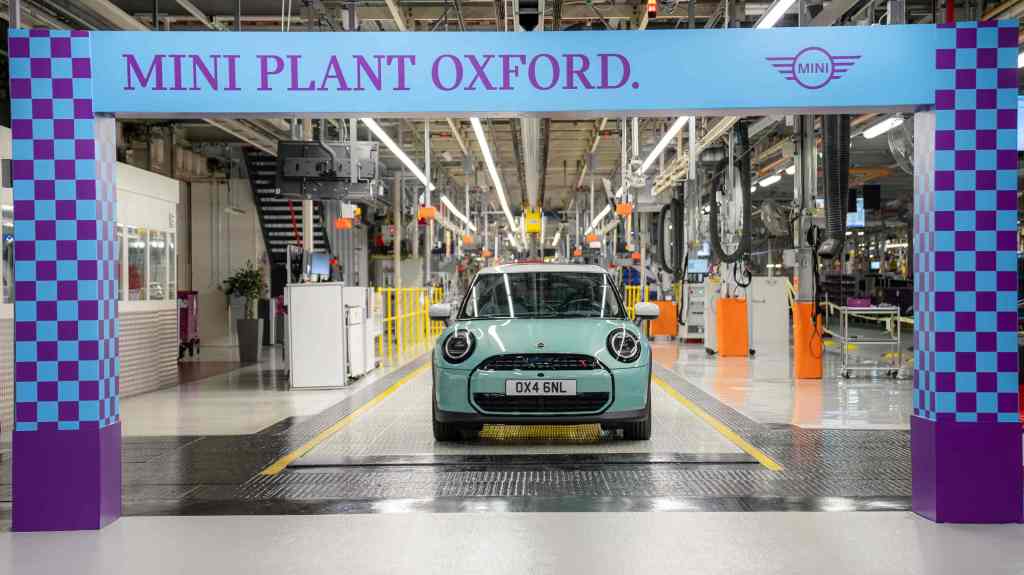
Start of gen five. (Image: MINI)

Today the production for the fifth-generation MINI Cooper began at Plant Oxford, the place where initial production of the vehicles commenced back in 1961; Charlie Cooper, grandson of John Cooper, where the surname for the car came from, drive the first three-door off the line.

In addition to performing final assembly at the plant in Oxford, two other U.K. plants contribute to MINI production: BMW Group Plant Swindon produces stampings and subassemblies; BMW Group Plant Hams Hall manufacturers three- and four-cylinder engines for the vehicles.

BMW 3D Printing for Bobsleigh Competitors

By Gary S. Vasilash

“We have been using 3D printing to make components for prototypes, customized one-offs, as well as for series production for more than 30 years.

“The major advantages of 3D printing are the time and cost savings as well as a high degree of flexibility. This allows us to quickly manufacture, test and efficiently optimize different variants.”– Claudia Rackl, BMW Group Additive Manufacturing Projects & Qualification.

That “series production” has to be taken with a chunk of salt however.

Last year BMW brand sold 2,253,835 vehicles on a global basis.

According to findings reported out in 2022 of a study by 12-member consortium funded by the German Federal Ministry of Education and Research and led by BMW Group, using the laser powder bed fusion process—a type of additive manufacturing—about 50,000 components per year could be produced in common production with the process.

Or about 2% of the BMWs sold last year could be so equipped with a 3D-printed component.

Of course, the capabilities of the process are increasingly regularly, but it still has a long way to go in terms of volume production.

One place that BMW Group is using 3D printing to great effect is in its work with the German Bobsleigh, Luge, and Skeleton Federation, of which it is a technology partner.

It is using the process to create better bobsleigh shoes.

BMW 3D printed bobsleigh shoe plates. (Image: BMW)

Nailed It

Bobsleigh shoes have rows on nails permanently attached to the toe area of the soles so that there is grip when the participants start their run.

The thing is: because these nails are permanently attached (let’s face it: when the sled is being pushed there is a whole lot of force acting on those nails, so they need to be secure), when they’re worn out (ice is, after all, abrasive), the shoes are tossed.

So they’re now working with 3D printing to create plates with threads that not only allowed the tailoring of the spiked arrangement for individual athletes, but would allow replacement of the plates as needed.

According to René Spies, head coach of the team, “We tested the spike plates in the World Cup and received a lot of positive feedback from the athletes. Nevertheless, a few tweaks are still necessary here and there, but we expect to have the perfect shoes to compete in by the 2026 Olympic Winter Games at the latest.”

And quick tweaks are ideal for 3D printing.

Making MINIs

By Gary S. Vasilash

MINI, a quintessentially British brand, is owned by BMW, a company with a German state in its name.

Last fall BMW announced an investment of more than £600 million in the MINI factories at Oxford—yes, as in the place that also has the university—and Swindon—the place where the Wernham Hogg office that merged with the Slough branch in “The Office” was located.

About the investment Milan Nedeljković, Member of the Board of Management of BMW AG responsible for production, said, “With this new investment we will develop the Oxford plant for production of the new generation of electric MINIs and set the path for purely electric car manufacturing in the future.”

MINI Aceman. No, that isn’t the production paint. It is undergoing final tests–evidently in Arizona, given that license plate–before production starts for the EV in a plant in China. (Image: MINI)

The MINI Cooper 3-door and the MINI Aceman, both EVs, will go into production in the U.K. in 2026.

Going back to the owner of the brand’s HQ country, it isn’t entirely surprising that the MINI Countryman is made in Leipzig.

What may be a bit of a surprise, however, is where the Aceman will soon start production: at a plant in Zhangjiagang, Jiangsu Province, China.

About the Aceman, Stefanie Wurst, head of MINI said, “The all-electric MINI Aceman opens new opportunities for customers who want a smaller crossover than our successful MINI Countryman. The consistent electrification of our product portfolio makes a clear statement about the future of the MINI brand.”

The Aceman is based on a new EV platform developed by BMW and Great Wall Motor.

U.K. . . .Germany. . .China.

Mr. Bean couldn’t have imagined this.

BMW and EVs

By Gary S. Vasilash

When it comes to discussions of electric vehicles, the topics seem to be, in order of frequency:

  1. Tesla. Anything. Mileage recalculations. Musk’s recreational habits. Labor issues. Massive number of vehicles being sold (which actually doesn’t get the attention that it should: when you subtract Tesla vehicle sales from electric vehicle sales, things don’t look quite as bullish as one might think).
  2. GM. Mainly its failure to produce notable volumes. For 2023 it delivered 9,154 Cadillac LYRIQs, 483 Chevy Blazer EVs, 461 Silverado EVs, 3,244 HUMMER EVs, 14 Zevo 400s, and 483 Zevo 600s (the last two are commercial vehicles). That is a total 13,838 vehicles. Out of 2,594,698 sold.
  3. Ford. One thing is the refocus on hybrids. The other thing is the changing prices for the F-150 Lightning, with the recent notable rise in MSRP. You might have imagined that when the vehicle launched the perceived demand was such that they would have quickly hit economies of scale that would cause prices to, well, not rise. For 2023 it sold 24,165 Lightnings, which is excellent in the context of GM. But when you take into account the total 750,789 F-Series trucks sold, that’s about 3%.

A company that gets little attention is BMW when it comes to EVs.

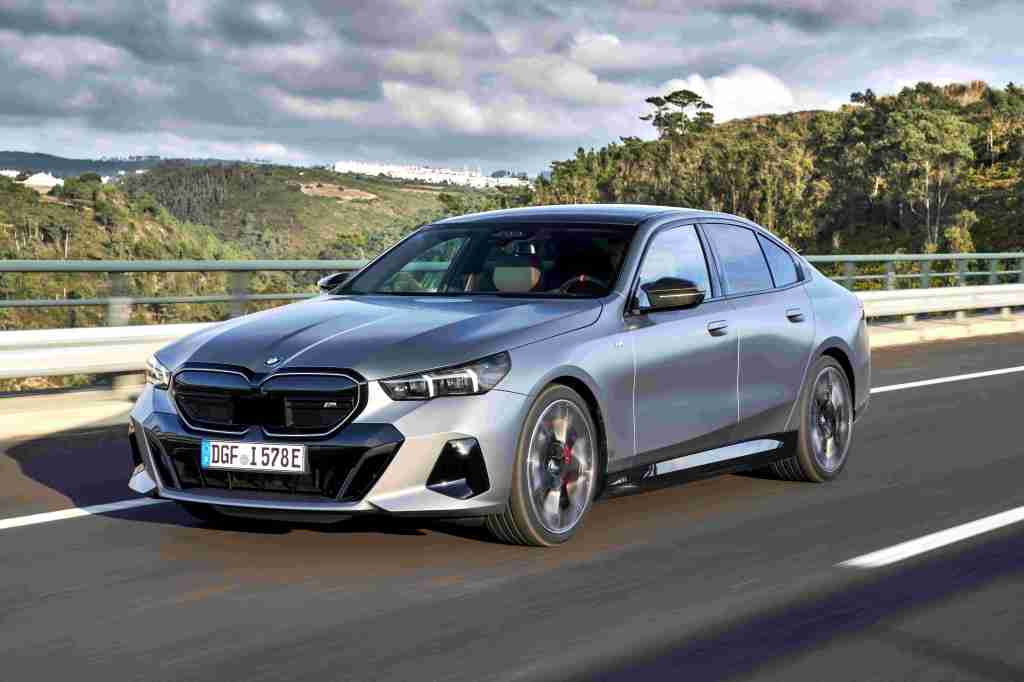
BMW i5: one of the electric vehicles in the company’s offerings–there are also the i4, i7 and iX. (Image: BMW)

Which is surprising given that in 2023 it delivered 45,417 EVs into the U.S. market.

That’s more than the GM EV sales and the Ford Lightning sales combined (38,003).

BMW 2023 EV sales account for 12.5% of its total sales.

If the number of plug-in hybrids BMW sold in 2023 (25,318) are added in to the EV number (so the number of “electrified vehicles”), it is 70,735 or 19.5% of BMW’s total sales in the U.S.

Those are some big numbers for BMW.

Seems like the lack of discussion isn’t keeping people from buying the company’s EVs.

Self-Driving Is Desirable. So Is Cake Without Calories.

By Gary S Vasilash

The “Consumer Attitude’s Around Autonomous Vehicle Technology Survey” indicates that there is a solid base of consumers who are ready to spend money to buy self-driving capability for their next vehicle.

Perhaps.

That is, there is a blur between advanced driver assistance systems (ADAS) and autonomous driving, even though the survey conducted for Ghost Autonomy, a developer of autonomous driving software, provides definitions of both, with ADAS including “automatic emergency braking, blind spot and pedestrian detection, lane keeping assist, surround view, parking assist, driver drowsiness detection and gaze detection” and autonomous driving technologies based on the SAE five levels, but claiming “L3-L5 is considered fully autonomous driving that does not require human backup,” which is not the case, because L3, while it lets the driver do other things, also requires that the driver be capable of reassuming, well, driving.

BMW Pesrsonal Pilot L3: yes, a driver is still required to regain control when needed. (Image: BMW)

For example, BMW has launched “BMW Personal Pilot L3,” which will be available to purchasers (adding 6,000 euros to the sticker) of the BMW 7 Series—in Germany only.

According to BMW this system provides “Level 3 capability as defined by the Society of Automotive Engineers,” and it “allows drivers to redirect their focus to other in-vehicle activities when travelling at up to 60 km/h (37 mph) on motorways with structurally separated carriageways.”

However, the driver “still has to be ready to reassume the task of driving at any time – i.e. as soon as the situation on the road requires them to or the stretch of road suitable for using the BMW Personal Pilot L3 comes to an end.”

In other words, “human backup.”

According to the Ghost Autonomy survey, 52% of those who have experienced self-driving (which arguably would be those who have ridden in a Cruise or Waymo vehicle, as FSD’s name notwithstanding, Tesla’s product isn’t self-driving, at least not within the existing classification, and it actually requires that the driver keep hands on the wheel) would “consider buying a car with full autonomy sooner if the technology was available today,” which is sort of a moot point because (a) it isn’t and (b) its not likely to be anytime soon.

What’s more, those “drivers who’ve experienced self-driving,” 78% of them, are willing to pay $5,000 or more upfront. Arguably this will be a lot more than $5,000 because the aforementioned BMW system would be about $6,600, and the Tesla FSD package (“Your car will be able to drive itself almost anywhere with minimal driver intervention and will continuously improve”) adds $12,000 to the sticker.

One finding in the survey that is certainly laudable is that when asked to rank the factors considered when they purchase their next vehicle they are:

  1. ADAS
  2. Keyless or phone-based entry and start
  3. Premium infotainment screen and sound
  4. Premium interior/exterior trim
  5. EV/battery powertrain

Yes, safety systems rank first.

But one wonders whether that answer isn’t analogous to what people say at the dentist office when asked about their brushing and flossing habits.

Who is going to say even on a survey that awesome audio is more important to them than safety?