Bugatti: From W16 to the V16

Yes, the company is going hybrid. . .

By Gary S. Vasilash

The Bugatti W16 Mistral, said to be the world’s fastest-ever roadster (453.91 km/h; 282 mph), is the last hurrah for the W16 engine, and the first of the last Mistrals has just been built at the Bugatti Atelier in Molesheim, France.

As the car produces 1,577 hp and has a starting price of about $5-million, most people on planet Earth won’t notice its absence.

This is what the W16 engine looks like:
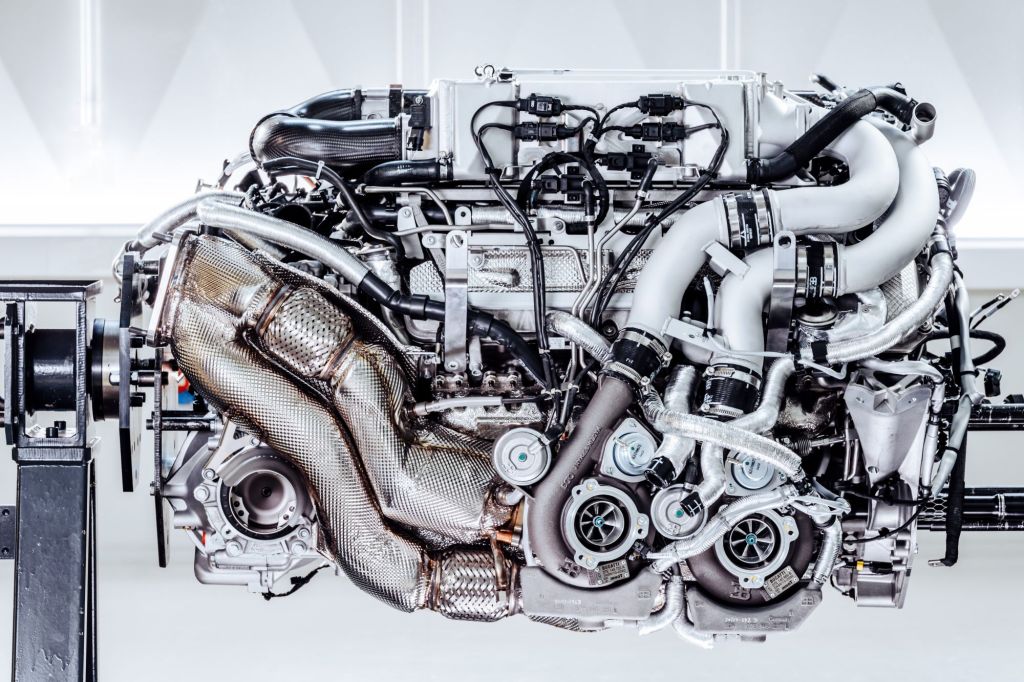
You might want to bookmark this because it is a Bugatti W16 engine, which will soon be a memory for most but otherwise housed in the garages of a handful of really rich people. (Image: Bugatti)

You might think that something with 16 cylinders and four turbochargers would be enormous, it is because of the W configuration—think of two Vs (as in V8s) side-by-side, but with the Vs having a very narrow angle. But in point of fact the engine is comparatively compact.

It has to be, given that the two-seater is 179 inches long, 80 inches wide, 47.6 inches high and has a 106.7-inch wheelbase.

So what follows the W16?

The Bugatti Tourbillon with a normally aspirated V16.

The output of that car is 1,800 hp.

It is a hybrid.

There are two 250-kW motors on the front axle and another 250-kW on the rear.

According to Bugatti it will accelerate from 0 to 62 mph in two seconds.

How fast is that?

Well, it is estimated that reading speed is 250 words per minute.

This sentence has been read in approximately two seconds.

Bugatti Centodieci in the Wind Tunnel

When you’re engineering a car to go fast, you don’t want the vehicle to suddenly—literally—take flight

By Gary S. Vasilash

The photo shows the Bugatti Centodieci. It is undergoing wind tunnel testing, determining how the vehicle will behave at high speeds.

Bugatti Centodieci undergoing wind tunnel testing. (Image: Bugatti)

When they begin the testing, they start at a mere 140 km/h (87 mph).

Start at.

Then they dial it up, making adjustments to the adjustable aero bits to make sure that the vehicle is stable when traveling at, say, 300 km/h (186 mph).

Other things the Bugatti engineers need to know about is whether the 1,600 PS (1,578 hp) 8.0-liter W16 engine gets enough air, and whether the brake cooling is sufficient to make sure the binders don’t bake.

You are likely not to be able to see a wind tunnel test. In this case, there is a propeller that is 26-feet in diameter that is powered by a 9,300 PS (9,173 hp) motor.

And you are not likely to see a Bugatti Centodieci.

The car stickers at 8 million euros, or about $9.45-million. (I don’t know about your neighborhood, but the houses cost a fraction of that, so clearly no one is going to be rolling along in a multi-million super sports car.)

What’s more (or less), Bugatti is building 10 Centodiecis.

So the odds of seeing one. . . .

Playing Pool Bugatti Style

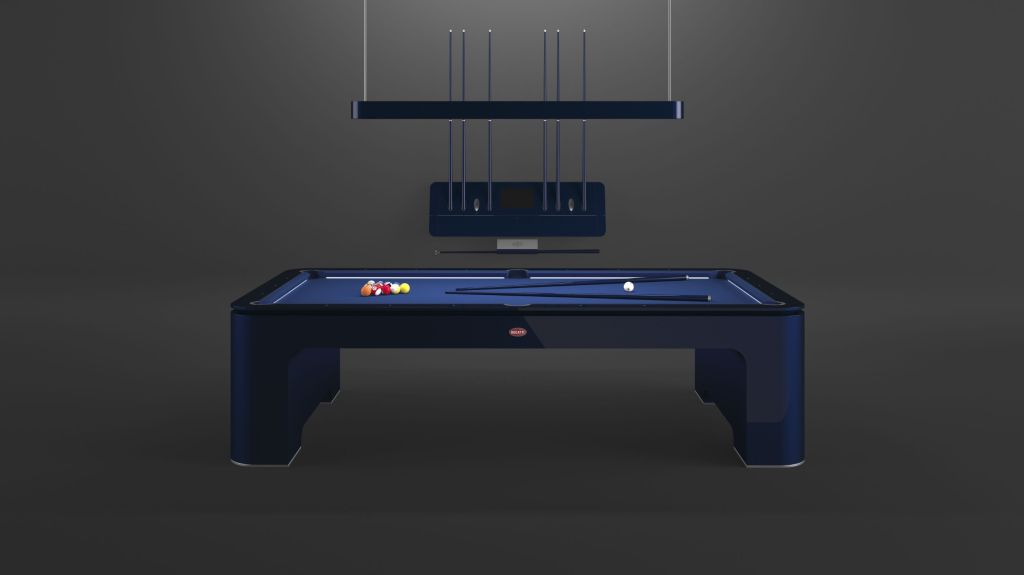
Who doesn’t need a carbon-fiber pool table?

By Gary S. Vasilash

Let’s face it: Sometimes driving that Bugatti Chiron becomes something of a bore, so it is time to, say, climb on board the yacht for a bit.

But at some point gazing at the Amalfi Coastline becomes tedious.

So it is time to go below to partake in a bit of pool.

Pool, anyone? (Image: Bugatti)

And the Bugatti Lifestyle collection has you covered with the “Bugatti Pool Table.”

It isn’t produced by Bugatti but a firm named IXO.

According to Pedro Sanchez, general manager of the firm, “When we started developing the Bugatti Pool Table project, we knew we had to be different and excel in all arears in order to be extraordinary. At IXO, good is never enough.”

He goes on, but you get it.

There will be a total of 30 tables—all with a carbon fiber finish and a machined aluminum and titanium frame—will be produced. Five this year.

This brings us back to the ship: There is an available servo-driven system that will adjust the legs of the table predicated on a gyroscopic sensor so if there is a bit of a swell, within five milliseconds the table is flat.

All in a day’s recreation.