Let’s say that you are interested in buying a car.
A car as a sedan. Not a crossover. A bread-and-butter car. (Yes, maybe you want to add some spicy tomato jam to it—spoiler, alloy wheels, etc.)
You go to the local Ford dealer.
And discover that the only car is a Mustang, which doesn’t qualify (i.e., two doors).
There happens to be a Lincoln store across the parking lot.
There are no cars, only crossovers of stair-step sizes.
You visit a Chrysler dealership and learn that Stellantis has stopped production of its long-in-the-market 300 at the end of last year, but they’ve got a Pacifica minivan, if you’re interested.
Buick perhaps? Again, no. Only crossovers.
Over at Cadillac things are better: of its seven models, two are sedans, the CT4 and the CT5. Given that the Q1 2024 sales for those are down 36.1% and 34.2%, respectively, how long they’ll be around may be in some question.
Chevy? An impressive array of crossovers and trucks. And one car, the Malibu.
The point is, buying a car is not as easy as it once was.*
Which leads to a thought about electric vehicles.
What if you went into one of these dealerships and discovered that they didn’t have anything on the showroom floor that didn’t have a plug?
What if that was pretty much the case up and down the street of the auto mall?
Clearly there would be an increase in the number of EVs sold out of those dealerships.
Maybe the numbers would be that good.
But they would be better.
Just as they’ve increased the number of models that aren’t cars and so have made buying a car tough, it could be that to help recoup some of the billions being spent on EVs they make buying an ICE tough.
Something’s got to move more of that lithium-powered metal.
(Of the 593,997 vehicles GM sold to customers in Q1, 16,169 were EVs. Not much of a business case there. And it sold twice as many Malibus ((32,749).))
*Interestingly, the Asian and European brands, in general, all have cars in their lineups.
If there is someone who is quintessentially American, that person has to be Dale Earnhart, Jr. It is hard to imagine how difficult it would be to live up to the legend that his father was, but Dale Jr. was able to make his own way into the annals that is NASCAR.
Like many former drivers, Earnhart owns car dealerships. One of them is Dale Earnhardt Jr. Buick GMC in Tallahassee, Florida.
Like many dealer websites, there is an array of vehicles for sale presented and an immediate pop-up that shows they are willing to engage pronto with prospective customers.
But there is something that is different than is the case on many dealer websites, which is a Q&A section.
And one of the questions that is presented and answered is:
“Is Buick American?”
And the answer begins:
“If you’re considering a new Buick vehicle as your next Thomasville, GA car or SUV, you may be wondering, is Buick American? The answer is yes.”
And it laudably goes on to acknowledge that the brand builds vehicles in places that aren’t within the U.S., like Bupyeong, South Korea (Encore GX), and Shanghai, China (Envision).
Yes, you read that right: the Buick Envision is built in China. Which is something to think about when the rhetorical question is raised: “Will Americans buy Chinese vehicles?,” as though this is some sort of question about the future. It isn’t. And the answer is yes.
The Buick Envista is also made in South Korea.
This leaves the Buick Enclave, which is made in the U.S., at the Lansing Delta Township plant in Michigan.
GM has been building vehicles in Lansing for a long time. Ransom E. Olds built a plant there in 1901. (Olds, unfortunately, ceased to exist in 2004.)
While some people wondered about the viability of Buick, here’s Duncan Aldred, vice president, Buick and GMC:
“As the fastest growing mainstream brand in the industry in the U.S.last year, 2024 promises more big things for Buick, spearheaded by the launch of the next-generation Enclave.”
Sketch of the 2025 Buick Enclave. No, it won’t have square wheels. (Image: Buick)
Last year Enclave sales, 39,411 units, were up 29.1% compared to 2022.
But Envision sales, 44,281 units, were up 71.2% and Encore GX, 64,149 units, were up 92.4%.
Which seems to indicate that at least so far as 2023 goes, they were busier in Bupyeong and Shanghai than they were in Lansing.
Perhaps the forthcoming version of the stylish Enclave will help boost things in Lansing.
And probably at Dale Jr.’s dealership in Florida, too.
Here’s something that you probably don’t know about Bob Boniface, director of Global Buick Design, even if you know Bob Boniface.
He began his career. . .working at a mutual fund in Boston after receiving his undergraduate degree. . .in psychology and economics.
Boniface did go to the College of Creative Studies in Detroit and while there was hired as an intern to work at Chrysler which led to a job offer from then-head of Chrysler Design, Tom Gale.
Buick Wildcat EV concept. If Buicks look like this, then the brand has a bright, electric future. (Image: Buick)
Boniface was to work at Chrysler for 12 years, during which time he worked on a variety of projects including the second-generation Dodge Intrepid, the Dodge Intrepid ESX (a diesel hybrid with wheel motors), the Stow ‘n Go seating for the minivans, the 300C, and the Jeep Liberty.
In 2004 Boniface moved across town to General Motors. The first thing he worked on was the GM Sequel—a fuel cell-powered vehicle. Then the gen-five Camaro.
Boniface says, on this edition of “Autoline After Hours,” that he was, in effect, employee #1 on the Chevrolet Volt.
Then he moved to Cadillac for six years. He worked on XT4, XT5, CTS, CT6 and. . .he says the best part was working on the V-Series, the CTS-V and the ATS-V. (He says one of the engaging parts of the V programs was the level of commitment across all the functions involved: by having everyone working toward making something special, the results is–something special.)
Boniface moved to Buick in 2016 and has worked on vehicles including the Enclave and the Envision.
He points out that a lot of his work involves overseeing the studios in Korea and China. The China market is huge for Buick—roughly four times that of the U.S. market, so that part of the world is important. He notes that a lot of developments in the interior space are occurring in that part of the world, and interiors are part of his portfolio.
But then there’s the Wildcat EV Concept.
Realize that Buick arguably gave rise to the whole notion of the concept vehicle with the 1938 Buick Y-Job. The brand has had a number of vehicles with striking designs since then, such as the Wildcat I and II of the 1950s to the Velite in 2004 to the Avenir in 2016.
Back in 2018 Boniface says that they went to work on developing not so much a new vehicle as a new design language. But that exercise gave rise to the Wildcat EV Concept, a 2+2 coupe that is an expression of the electric future of Buick and that expression includes a new face—although being new, it also includes a nod to the brand’s design paste (e.g., high lamps, body-mounted badge).
Again: it is the language that they created and the vehicles to come will be spelled with those words.
If you have any interest in automotive design over the past 30 years, then this edition of “Autoline After Hours” is must viewing.
Joining the discussion are Greg Migliore of Autoblog and Joe DeMatio of Hagerty Media.
Buick doesn’t always get the respect that it has earned, especially when it spent many years in the shadow of Cadillac. (If you can’t afford a Cadillac, then. . . .)
Now the company has switched to an all-SUV lineup. There are four. One is built in the U.S. The others are from South Korea and China. It is worth knowing that David Dunbar Buick was born in Scotland.
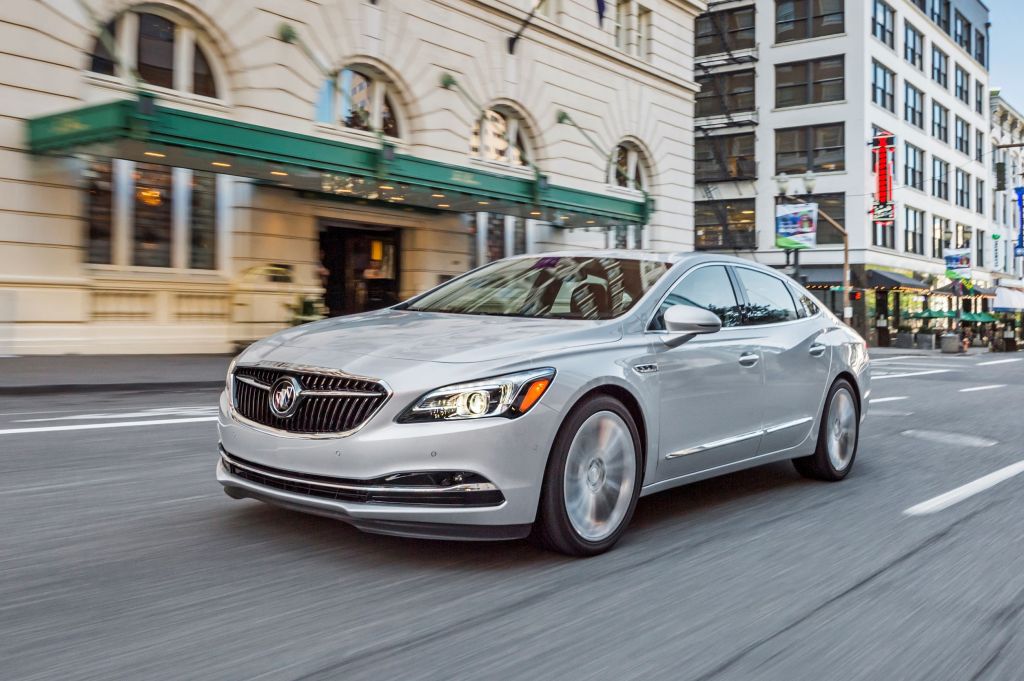
2019 Buick LaCrosse. (Image: Buick)
J.D. Power has released its latest Vehicle Dependability Study. This looks at how people feel about their vehicle’s performance after three years of ownership.
The top brand is Kia with a score of 145. The second-best brand is Buick, at 147 points. (As you may discern, a lower numerical score is better.)
Know that this means Buick beat out the likes of Lexus and Porsche and Lincoln and BMW and Jaguar and others—in many cases, rather handily.
Buick.
What is somewhat ironic is that in terms of vehicle categories, in Large Car Buick also came in second, with the LaCrosse. It no longer offers it.
In first place is the Chevrolet Impala. That is going away, too. (Last year in the U.S. GM delivered 750 Impalas.)
Alfred P. Sloan was the president, chairman and CEO of General Motors, a company that he was to come to after having been the president and owner of Hyatt Roller Bearing, which just goes to show you that even things like ball bearings can lead one to places you’d never imagine you’d go. Prior to building bearings Sloan had obtained an engineering degree from MIT, so the fact that when he was at GM he came up with an idea that changed vehicle marketing is somewhat remarkable.
That is, the accumulated portfolio that was General Motors was rationalized. The phase “a product for every purse and purpose” was the organizational approach. The “purse” portion is probably the most powerful in that line in that it led to a stair-step approach to the brand organization.
Simply put, it was about affordability and rising incomes.
One would start with a Chevy and work his or her way through to Cadillac.
Sloan figured that this approach would keep people within the GM family through their entire lives.
In this organizational approach Buick was one position below Cadillac. It offered big, comfortable sedans that were aspirational to the upper middle class. Back in the proverbial day, a model with a name like “Park Avenue” really meant that someone was (1) going places and (2) had arrived.
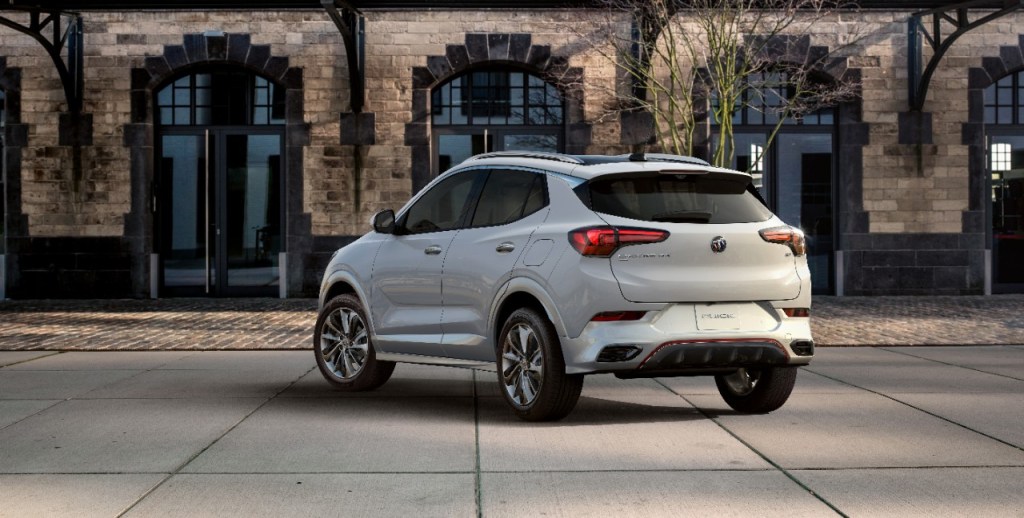
2020 Buick Encore GX. Premium small crossover with a competitive price. (Images: Buick)
Times change, and so has Buick. Whereas it was once all about plush, floaty sedans with accoutrements like seats covered with a velour-like substance and exterior bling like ventiports, it has become a brand that is all about the crossover.
Go to a Buick dealership right now and you’re faced with four vehicles, all of which are (1) crossovers and (2) begin with the letter “E.”
And these vehicles are Sloanism in action, as you start with the Encore, work up to the Encore GX, move to the Envision and arrive at the Enclave.
This all-crossover approach has a customer advantage in that it not only simplifies the shopping experience, but it allows the Buick designers and engineers to concentrate on one type of vehicle.
Focus is helpful.
What is odd about the Encore GX is that it is rather different than the Encore. This isn’t a different trim level. It is actually one of those Sloan steps within the brand.
Consider the dimensional differences between the two vehicles:
Encore GXEncore
Wheelbase 102.2 in 100.6 in
Length 171.4 in 168.4 in
Width 71.4 in 70.1 in
Height 64.1 in 65.2 in
Those are not trivial differences, especially the length and the width, as there are significant differences where it really counts: the interior.
The Encore GX offers 94.3 cubic feet of passenger room, while the Encore is at 92.8 cubic feet.
The Encore GX offers 23.5 cubic feet of cargo room behind the second row and 50.2 cubic feet if that rear seat back is folded down. The Encore is at 18.8 cubic feet behind the second row and 48.4 cubic feet max.
These are distinctively different vehicles.
(And I would argue that the fact that the Encore GX is both wider and lower made it a more attractive vehicle.)
While it shares the “Encore” with the Encore, the Encore GX is a different vehicle.
The standard powertrain for the Encore GX is a 1.2-liter turbocharged I3 that produces 137 hp; the vehicle I drove had the optional 1.3-liter turbo that produces 155 hp. It is mated to a continuously variable transmission. The vehicle as driven was FWD. Were it an AWD vehicle, then the transmission would have been a nine-speed automatic.
For a small SUV it has a lot on offer. Even with the options. . .
Convenience package (automatic parking assist with braking; wireless charging, rear camera mirror with washer; rain sensing windshield wipers)–$770
Liftgate package (hands-free power)–$520
Upgraded exterior paint–$495
Upgraded engine–$395
. . .the vehicle, including destination ($995) came in at $34,965.
On the one hand, it is a bargain. Yet on the other hand, it is a well-appointed, reasonably well handling and powered vehicle that is in a premium category.
According to Duncan Aldred, vice president, Global Buick and GMC, the Buick brand has been doing an excellent job of bringing in new customers, with 72% of those opting to buy from what is now an all-crossover lineup—Enclave, Encore, Encore GX and Envision—being new to the brand.
The 2021 Envision is the launch of the second generation of the compact crossover; it is competing in what Aldred describes as “one of the industry’s most competitive segments.”
Helen Emsley, executive director, Global Buick and GMC Design, says, “The new Envision has a more athletic presence that is full of character.”
Which is sort of the thing that one would say. After all, who wants a crossover that has a couch-potato presence with an undifferentiated persona?
All-new 2021 Buick Envision, shown here in Avenir trim. (Image: Buick)
That said, the designers took what is become a familiar shape (“most competitive segments” means that one hell of a lot of vehicles of this type are being sold) and put in some nice character lines on the bodyside as well created a highly styled but not fussy front fascia that provides differentiation.
What’s more, Emsley points out that the new Envision is lower and wider than the model it replaces, and while that, again, is the sort of thing that is often said, she really means it.
The first generation Envision is 72.4 inches wide and 66.8 inches high. The new one is 74.1 inches wide and 64.6 inches high, which is a visible, and substantial, difference, making the new vehicle look much more planted than its predecessor.
The vehicle is being offered in three trims: Preferred, Essence and Avenir, with the latter being the most luxe of the three and the preceding two being offered with a Sport Touring package.
The Avenir variant brings 20-inch wheels that have a Pearl Nickel finish. The Sport Touring versions of the other trims have darkened 20 inch wheels. That is a telegraphing cue of the approach. (There are also grille differences, but let’s face it: the wheels are a clear statement.)
The Envision comes with one powertrain choice: a 228-hp, turbocharged I4 mated to a nine-speed automatic. There are both FWD and AWD.
On the inside, there is Buick’s first 10.2-inch-diagonal color touch screen because, well, this is a new model and it would be unthinkable to go with something smaller.
One dimension is probably more notable to people who are going to take their Envision on a road trip, which is that for the cargo space. If the second row is in use, then there’s 25.2 cubic feet behind it. If the second row seatback is folded, then there’s 52.7 cubic feet. Nicely utile.
Here’s a feature that seems most timely: an air ionizer that includes an “air quality indicator.” It is standard on Essence and Avenir and available on Preferred. Here’s guessing it will be more engaging for Envision drivers than the Buick-exclusive Reese’s Book Club app. Were this, say, January 2020, it would probably be just the opposite.





 shinymetalboxes