Cadillac’s Clever Curation

If the buyer base is small, provide the opportunity to enhance the exclusivity so the smallness is a big deal

By Gary S. Vasilash

People who buy Cadillac CT5 models are in a comparatively small group.

That is, during the first half of 2025 Cadillac sold 8,168 of the sport sedans.

Presumably the number of those who purchased the CT5-V Blackwing variant is a smaller subset.

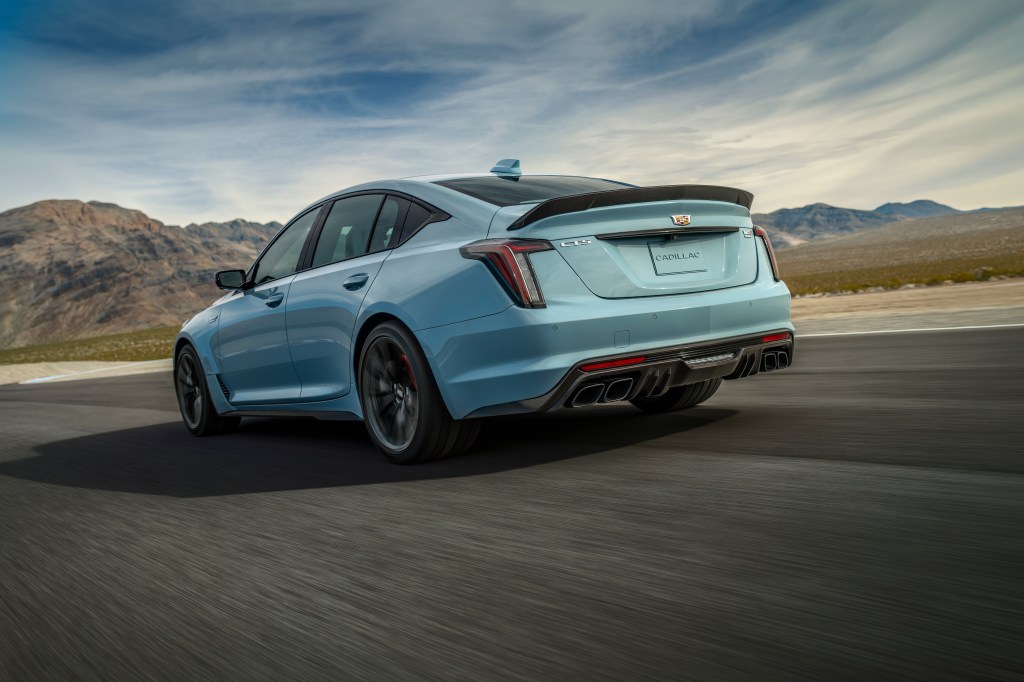
And perhaps because the folks at Cadillac realize there is something to be said for exclusivity, the 2026 CT5-V Blackwing—powered by a 668-hp 6.2-liter V8—will be offered in a highly specialized version: one that is crafted with the “Curated by Cadillac” program.
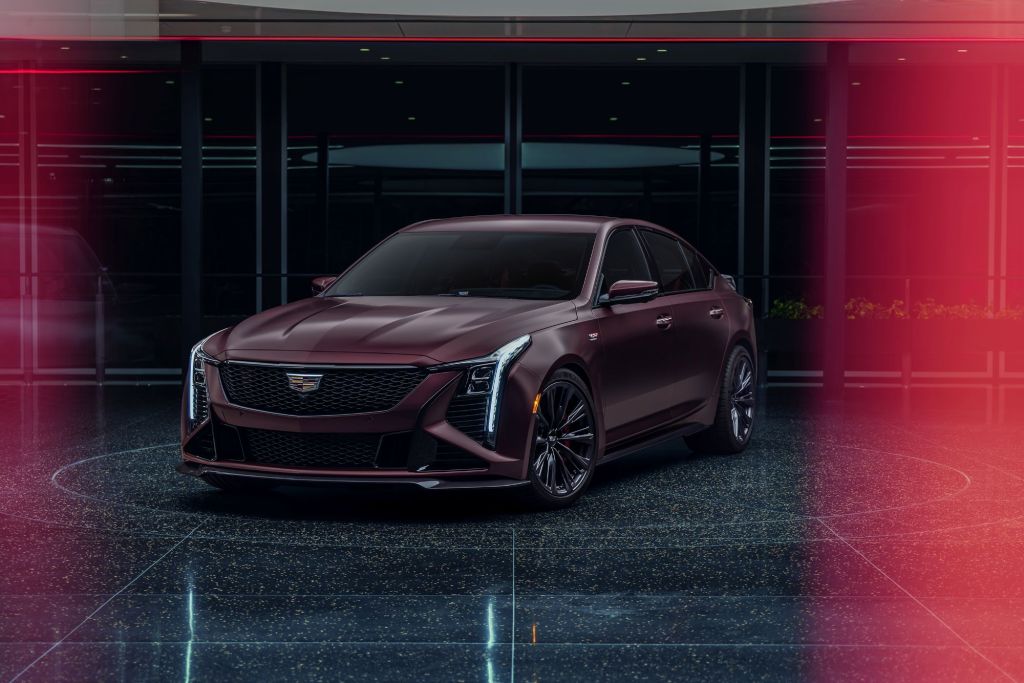
Curated 2026 Cadillac CT5-V Blackwing. (Image: Cadillac)

The term crafted is used deliberately because these cars will be hand-built at the company’s Artisan Center in Warren, Michigan, the same place the ultra-exclusive CELESTIQ is produced.

And while the term “hand-built” may be thought to be a bit of an exaggeration, it isn’t.

According to a Cadillac spokesperson:

“Within the Artisan Center’s walls, a selected team of highly talented artisan makers, united in their vision for perfection, will hand-build every client’s 2026 CT5-V Blackwing Curated vehicle from the ground up.”

Yes, they are creating these cars.

The company is taking advantage of the resources it has to make special vehicles.

The customers (called “clients”) will be able to choose from more than 160 exterior colors.

There are exclusive interior colors and materials, as well.

This isn’t a case where someone goes to a website and clicks on choices.

A concierge is assigned to each customer client.

Cadillac:

“Each concierge has a design background and is trained and equipped to work with each client to create their unique vehicle vision.”

Of course, all of this comes at a cost: The expected MSRP is $158,000.

To put that in perspective: a 2025 CT5 CT5-V Blackwing has a starting MSRP of $95,595.

Exclusivity isn’t inexpensive.

But it is to Cadillac’s credit that it is optimizing the limited buyer base by providing an opportunity to achieve greater exclusivity.
The Cadillac Optiq Going V-Series

Although you have likely not seen the vehicle in person yet, it is likely to become something that you see a lot of. And Cadillac has now announced a performance variant

By Gary S. Vasilash

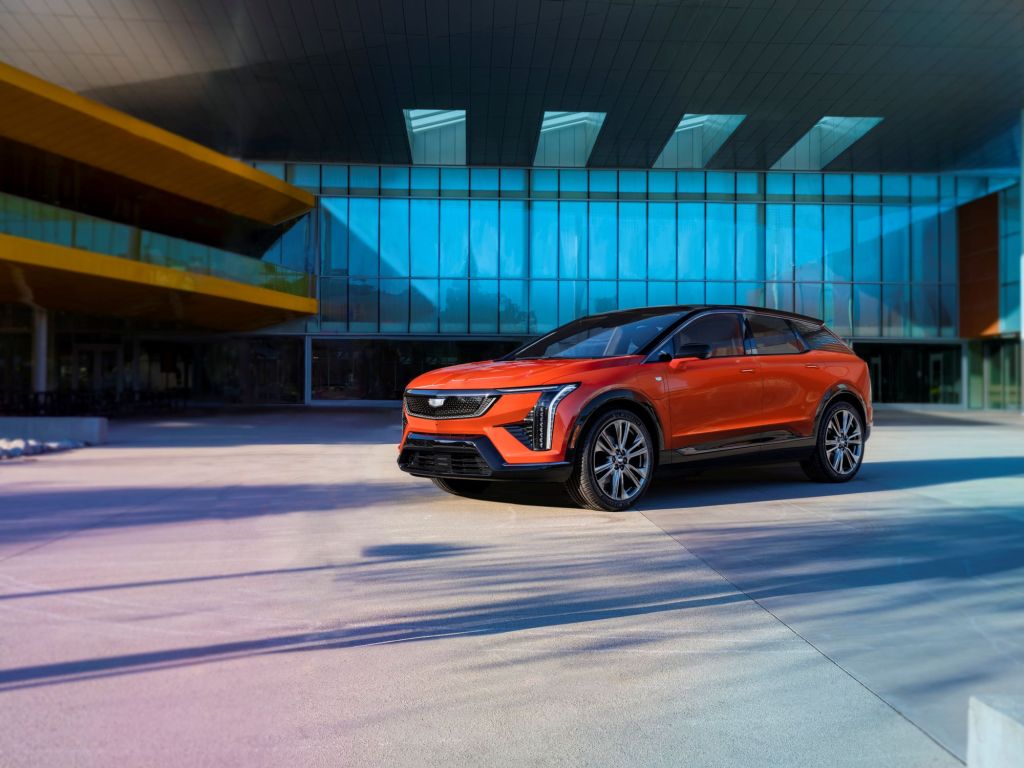
In the compact luxury EV crossover segment Cadillac has an exceedingly fine entry in its Optiq. (One problem it may have, however, is the name: might some people not find its pronunciation troubling and so as not to embarrass themselves, go to the Audi store that’s next door and ask about the Q4, instead?)

2025 Cadillac Optiq: a stylish compact crossover. (Photos: Cadillac)

The vehicle has a powertrain that provides 300 hp and an EPA estimated range of 302 miles.

It has an interior with an innovative freshness that undoubtedly will help skew Cadillac’s mature ownership numbers far lower.

And with the second row up it provides 26 cubic feet of cargo capacity—57 with it down—so there is actually more than a modicum of utility provided, an important consideration for one’s daily existence with a vehicle.

Right out of the box there were 1,716 Optiqs sold in the first quarter—502 more than the Cadillac CT4, so that’s saying something (although it is a bit of an apples-to-oranges comparison, as the CT4 is a sedan with an internal combustion engine).

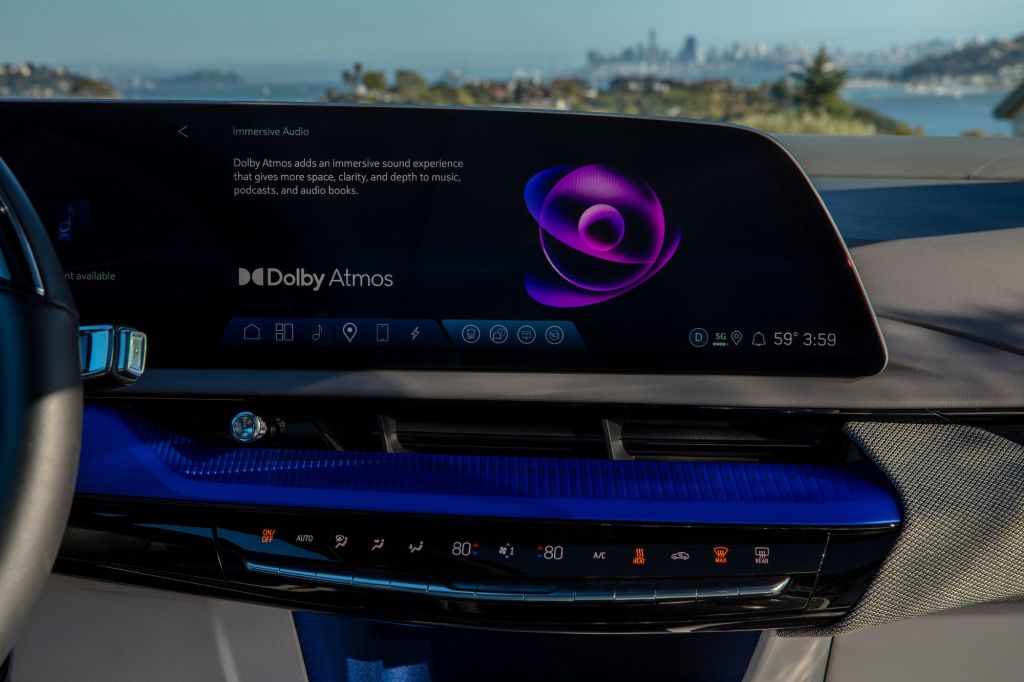
The interior is fashion-forward. Yes, it has a big screen (33-inches, diagonal) but the color and materials are much more impressive.

Undoubtedly planning to juice that number, today Cadillac announced there will be a 2026 Optiq-V series vehicle.

Details are, well, non-existent (beyond “Cadillac engineers delivered a unique package prioritizing precision, dynamic suspension and tight steering,” which is pretty much marketing-speak).

One thing that is likely the case is that the 2026 Optiq-V will have a non-trivial bump in its starting MSRP (according to Cadillac.com, the starting price for a 2025 Optiq is $52,895), not only because of what the Cadillac engineers have done, but because the Optiq is produced at a GM plant in Ramos Arizpe, Mexico.

Cadillac Back at Le Mans

Will the participation move the metal?.

By Gary S. Vasilash

The old line has it: “Win on Sunday, sell on Monday.”

Which basically goes to a point of why OEMs participate, particularly, in NASCAR.

This is a bit of a problem, however, for Chevrolet, as it races the Camaro in NASCAR and that vehicle has been out of production for a while, so fans of William Byron, Chase Elliott, etc. would be out of luck at their local Chevy dealers.

But another brand has hopes that seem somewhat quizzical because the relationship between what is available for sale and what is on the track is largely a logo.

“We’re thrilled to have Cadillac Racing return to the 24 Hours of Le Mans with four cars competing for the overall win in the Hypercar class,” said John Roth, vice president, global Cadillac.

Hypercars are to showroom Cadillacs what Wagyu beef is to dusty gas station beef jerky.

Roth continued: “After scoring our first podium finish at this iconic endurance race in 2023 and securing a top 10 finish last year, we look to build on that success and showcase the Cadillac V-Series.R’s technology, performance, and innovation with our 2025 entries.”

In 2023 Cadillac finished third and fourth.

In 2024 it qualified second and third in the Hypercar category and its best finish that year was seventh.

The cars have a special Cadillac 5.5-liter V8 developed by GM’s Performance and Racing Propulsion team that operated in Pontiac, Michigan.

The cars, designed and developed by Cadillac Design and Cadillac Racing, are constructed by Dallara.

Cadillac first went to Le Mans in 1950. Then skipped it until 2000. It raced in 2001 and 2002, too, before giving it a pass for a few years.

The 24-hour race will be contested June 14 and 15. The 15th is a Sunday.

What is the likelihood Cadillac dealerships will see a bump in buyers on the 16th?

This is actually one of the two Cadillacs the company campaigned at Le Mans in 1950. It was nicknamed “Le Monstre.” (Image: Cadillac

Cadillac VISTIQ: Architectural Lesson

Maybe they got their styles wrong. . .


By Gary S. Vasilash


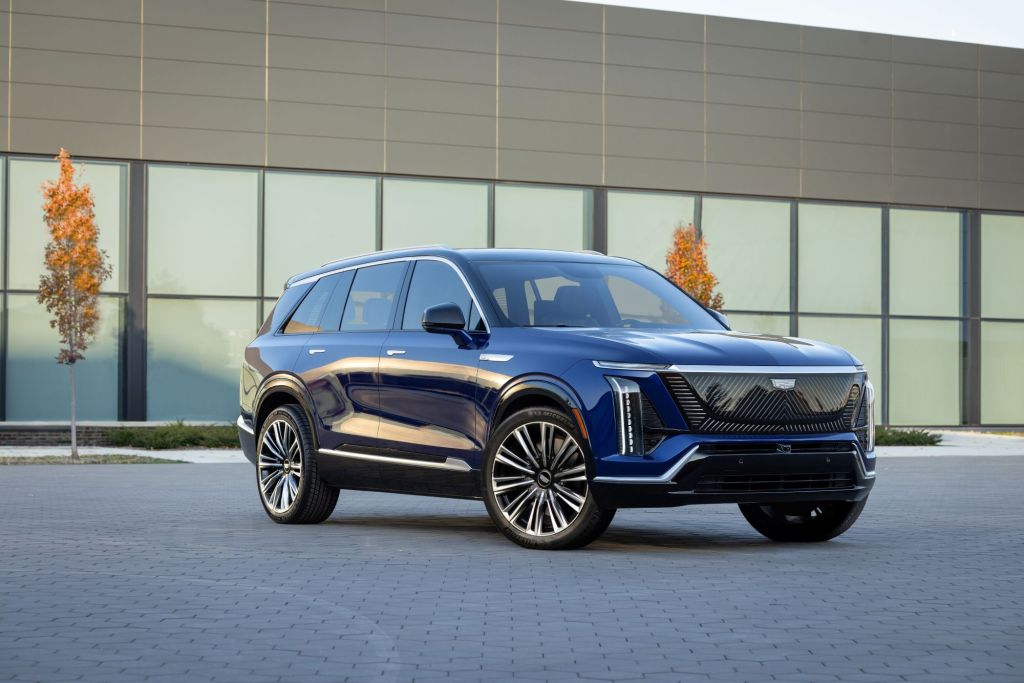
Cadillac has announced the VISTIQ, a three-row electric SUV.


It has a dual-motor system, which means all-wheel drive is standard. The motors provide 615 hp and 650 lb-ft of torque, which, according to the company, will provide a 0 to 60 time of 3.7 seconds when the Velocity Max performance mode is engaged.


The 102-kWh battery is expected to provide a range of 300 miles.


As Jeff MacDonald, North American chief engineer, for the vehicle puts it:


“From the start, it was our team’s goal to deliver a three-row SUV that provides exhilarating performance and intuitive technology, wrapped in the brand’s iconic design language.”

2026 Cadillac VISTIQ, three-row EV SUV. Jeff MacDonald, North American chief engineer, for the vehicle: “Bold, yet refined, the VISTIQ provides a comfortable ride while handling like a much smaller vehicle, delivering a sense of isolated precision.” (Images: Cadillac)


And of that design language, Brian Nesbitt, executive director, Global Cadillac Design, says:


“VISTIQ continues the Cadillac EV identity, including our signature vertical lamps front and rear, the illuminated pinstripe grille, a 33-inch diagonal high-resolution LED screen, and available 23-inch wheels, rendered in a proportionally stately and functional three-row SUV.”


But there is one odd thing in Cadillac’s announcement of the EV, which will have a starting MSRP of $78,790:


““The spacious interior seamlessly integrates with the elegant design, inspired by modern architectural contours and structure framework. The vertical banding is reflective of robust features in Brutalist architecture and helps frame elements in the interior, creating more refined lines and offering a balance of sophistication and practicality for modern luxury living.”

Inside the VISTIQ. Real wood. Recycled yarn. Carbon fiber. Authentic. Not Brutal.


Brutalist?


Writing in Architectural Digest, a place where they know a thing or ten about architectural styles modern and otherwise, Katherine McLaughlin explains:


“The style is often associated with socialist utopian ideas, which were regularly promoted by the buildings’ architects. Many early Brutalist buildings were affordable housing projects that sought to reimagine architecture to address modern needs.”


Brutalism got its start in post-World War II Britain where, McLaughlin writes,


“Spinning off the heels of the modernist movement of the day, architects were presented with a new set of challenges, namely limited resources, when designing in the post-war era.”

So they had to design buildings that were concrete-intensive and decoratively absent.


McLaughlin quotes Geddes, Ulinskas, principal of Geddes Ulinskas Architects:


“If modernism is about architecture being honest, Brutalist design is about architecture being brutally honest.”


Ulinskas goes on:


“Forms are as simple as can be and materials are stripped to be as bare and raw as possible.”


There is something to be said for honesty in materials in vehicles—if you’re going to have something that looks like wood, it should be wood, not plastic or an applique; the same goes for metal and carbon fiber. And this is what they’re doing inside the VISTIQ.


Yes, the materials are authentic inside. But they are undoubtedly not “as bare and raw as possible.”


Somehow Brutalism just doesn’t seem particularly “Cadillac.”

More Performance for CT5-V Blackwing

Perhaps not useful for your daily drive, but. . .

By Gary S. Vasilash

Cadillac, in 2003, decided to really strut its stuff on the world stage.

It looked at competitors—BMW with its M line, Mercedes with AMG—and decided it needed a performance line.

So it created “V.”

“Take that!” it said, while offering additional engineering in models to make them perform at higher levels.

Then it upped things when it introduced the CT6-V Blackwing in 2018, a vehicle deploying the twin-turbocharged V8 engine that was designated “Blackwing.” Those vehicles also came with various aero and suspension mods.

And now. . .

Earlier this year Cadillac introduced the 2025 CT5-V Blackwing.

Yes, it has a 6.2-liter supercharged V8 that pumps out 668 hp and 659 lb-ft torque.

Oh, and it’s a midsize four-door sedan.

Yes, you can drive it to Kroger.

One of the things that has happened in the U.S. in the era of V has been an increase in the number of private race tracks.

Rather than golf country clubs with lockers, these are special racetracks with garages.

Which probably goes a long way to explaining the 2025 CT5-V Blackwing Precision Package.

You could take it for a Sunday drive in the park—especially if it’s a private motorsports park: CT5-V Blackwing Precision Package. (Image: Cadillac)

Brandon Vivian, executive chief engineer, Cadillac:

“This new Precision Package will enable the CT5-V Blackwing to be incredibly light on its feet at all speeds — both on road and track.”

Odds are, this is not oriented for those who are going to get groceries.

This package is largely predicated on changes to the chassis including: increased spring rates. . .larger front stabilizer bar. . .new front steering knuckles and rear suspension toe links. . .recalibrated MagneRide dampers. . .carbon ceramic brakes. . . .

Yes, elements that make a difference when showing your stuff at the track on a Saturday afternoon.

But you’ll have to wait.

Production for the CT5-V Blackwing Precision Package will begin in early 2025.

Try to Buy a “Car”

By Gary S. Vasilash

Let’s say that you are interested in buying a car.

A car as a sedan. Not a crossover. A bread-and-butter car. (Yes, maybe you want to add some spicy tomato jam to it—spoiler, alloy wheels, etc.)

You go to the local Ford dealer.

And discover that the only car is a Mustang, which doesn’t qualify (i.e., two doors).

There happens to be a Lincoln store across the parking lot.

There are no cars, only crossovers of stair-step sizes.

You visit a Chrysler dealership and learn that Stellantis has stopped production of its long-in-the-market 300 at the end of last year, but they’ve got a Pacifica minivan, if you’re interested.

Buick perhaps? Again, no. Only crossovers.

Over at Cadillac things are better: of its seven models, two are sedans, the CT4 and the CT5. Given that the Q1 2024 sales for those are down 36.1% and 34.2%, respectively, how long they’ll be around may be in some question.

Chevy? An impressive array of crossovers and trucks. And one car, the Malibu.

The point is, buying a car is not as easy as it once was.*

Which leads to a thought about electric vehicles.

What if you went into one of these dealerships and discovered that they didn’t have anything on the showroom floor that didn’t have a plug?

What if that was pretty much the case up and down the street of the auto mall?

Clearly there would be an increase in the number of EVs sold out of those dealerships.

Maybe the numbers would be that good.

But they would be better.

Just as they’ve increased the number of models that aren’t cars and so have made buying a car tough, it could be that to help recoup some of the billions being spent on EVs they make buying an ICE tough.

Something’s got to move more of that lithium-powered metal.

(Of the 593,997 vehicles GM sold to customers in Q1, 16,169 were EVs. Not much of a business case there. And it sold twice as many Malibus ((32,749).))

*Interestingly, the Asian and European brands, in general, all have cars in their lineups.

Useful Info for Those Going Fast

By Gary S. Vasilash

Cadillac, undoubtedly having a cadre of people on staff who know that there is still a whole lot of interest in the market for luxury sport sedans with internal combustion engines (even if there aren’t necessarily a whole lot of buyers), have given the CT5-V and CT5-V Blackwing a bit of refreshing, although keeping the 360-hp 3-liter twin-turbo under the hood of the CT5-V and the 668-hp 6.2-liter V8 in the Blackwing.

One of the primary mods is the deployment of a 33-inch diagonal LED color touchscreen.

2025 Cadillac CT5-V Blackwing showing its 33-inch-diagonal LED color touchscreen display can provide some useful information for those who are driving their car on the track really, really fast. (Image: Cadillac)

Some implementations of large screens seem rather gratuitous, as though there isn’t certainty of what ought to be on the screens (e.g., does there really need to be pictures of things like album covers?), but seeming absolute certainty that the screen needs to be there, as large as possible.

But in the case of the CT-5 Vs, they are offering a Performance Data Recorder that provides a wealth of info for those who take their cars racing, with everything from a Lap Analyzer tool—which Cadillac claims is something that heretofore was the sort of thing that one would need a laptop to process—to a live data screen in the center stack, which isn’t so much for the driver, but for the passenger who can provide real-time coaching for the driver.

Clever, those folks at Cadillac.

Cadillac Escalade IQ and Places You Can Go

By Gary S. Vasilash

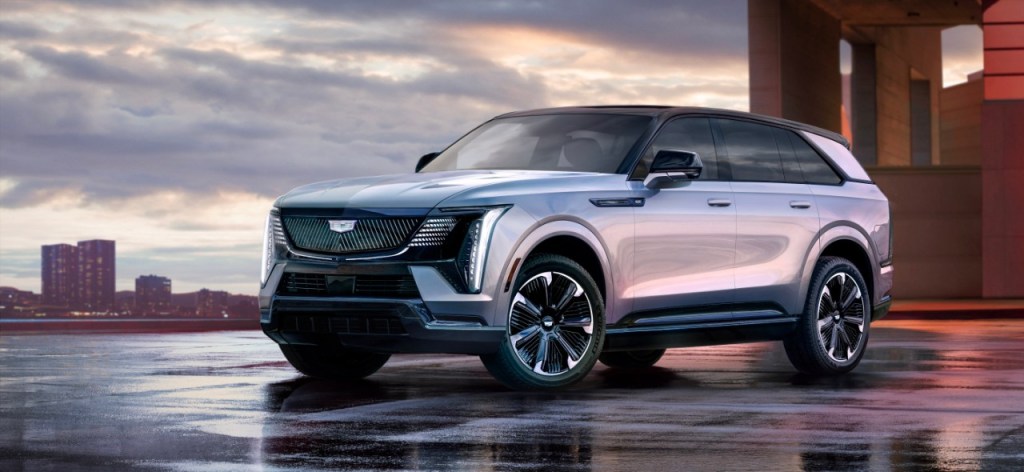
The most obvious thing about the forthcoming 2025 Cadillac Escalade IQ is that it is big—224.3 inches long, 94.1 inches wide (including mirrors), and 76.1 inches high—bad—here’s a vehicle rolling, out of the factory, on 24s—and in-your-face—people were enchanted with the lighting orchestration of the front fascia during the startup sequence of the Cadillac LYRIQ, which is like an iPhone screen to the Escalade IQ’s LED billboard.

2025 Cadillac ESCALADE IQ Sport: There’s no missing this. (Image: Cadillac)

This is monumental in scale. But unlike monuments that just sit there, this 750-hp, three-row vehicle can travel up to an estimated 450 miles on a single charge, which means you could possibly drive it from New York to Boston and back. This is largely predicated on the 200 kWh lithium-ion Ultium battery system.

But there’s one thing that needs to be taken into account.

For those who are using a Level 2 charger—the 240-Volt system that people are having installed in their garages—know that when the Escalade IQ is plugged in, it is getting 14.8 miles of range per hour. Which would get you from Boston to Walden Pond.

On one of those Level 2 chargers that you’ll find in the parking lot of many malls, it is 37 miles of range per hour, which means you could almost go from Boston to Gillette Stadium and back.

A DC fast charger gets up to 100 miles of range in 10 minutes, so in fairly short order you could get up to Manchester, New Hampshire, and make the return having spent 10 minutes of charging.

But here’s one thing to keep in mind.

Say you got a 682-hp, gasoline-powered Escalade-V. It has a 24-gallon tank. It gets 13 mpg combined.

So in less than 10 minutes, you could fill up the tank and drive from Boston to Woodstock (perhaps because you’re an aging Boomer who (1) can afford that vehicle and (2) often feel nostalgic for the festival you missed) and back in that similarly sumptuous vehicle.

While it isn’t the 450 miles of the fully charged Escalade IQ, there’s still something to be said for the cost of time, which plays to the Escalade-V’s favor.

Building Cars Is Hard

By Gary S. Vasilash

On September 18, 2021, this announcement was made by Rory Harvey, vice president, Global Cadillac:

“Today, reservations for the 2023 Cadillac LYRIQ Debut Edition sold out in just over ten minutes and we continue to see a lot of enthusiasm around the brand – both current product and in our all-electric future. The initial response for LYRIQ has been extraordinary. Since the show car unveiling last year, more than 200,000 people have expressed interest in learning more about the vehicle and our electric future.”

Deliveries of the electric SUV, which had obtained significant, deserved acclaim, began in July 2022.

The Cadillac LYRIQ: an impressive electric SUV that more people would undoubtedly like to be behind the wheel of. . .except production is rather limited. (Image: GM)

The LYRIQ is built in the GM assembly plant in Spring Hill, Tennessee. The factory originally built for Saturn. At the plant the Cadillac XT5, Cadillac XT6 and GMC Acadia are also produced.

LYRIQ went into production on March 21, 2022.

So keep in mind: production starts in March, deliveries start in July, and thousands of people wanted to get behind the wheel of Cadillac’s first electric vehicle.

Now admittedly all OEMs in 2022 had to deal with all manner of issues related to COVID and chips and supply chain snafus.

But here is something that is simply startling:

GM announced its U.S. deliveries for 2022.

All in, 2,274,088 vehicles, making it #1 in the U.S.

Cadillac LYRIQ: 122 vehicles.

How many of those LYRIQ “hand wavers” are going to put down their arms and go across the street to an Audi or Mercedes store?

And what about those who were part of the 10-minute sellout? How are they feeling about their decision?

Yes, building vehicles is hard.

But you would imagine that for a vehicle that is as important to Cadillac as the LYRIQ is, that would have been addressed and any speedbumps mitigated.

(Incidentally: while the LYRIQ was the vehicle with the fewest deliveries among all GM vehicles for 2022, the second lowest was another electric vehicle that sold out in 10 minutes when its reservations opened in October 2020 and is now said to be sold out for at least two years: the HUMMER EV. GM delivered 854 in all of 2022.)

Saving Cadillac

By Gary S. Vasilash

John F. Smith worked at General Motors at the same time that John F. Smith worked at General Motors.* The latter was to become GM CEO. The former was appointed by the latter to a number of executive positions within GM.

Perhaps the most notable was in 1997, when he was named head of Cadillac.

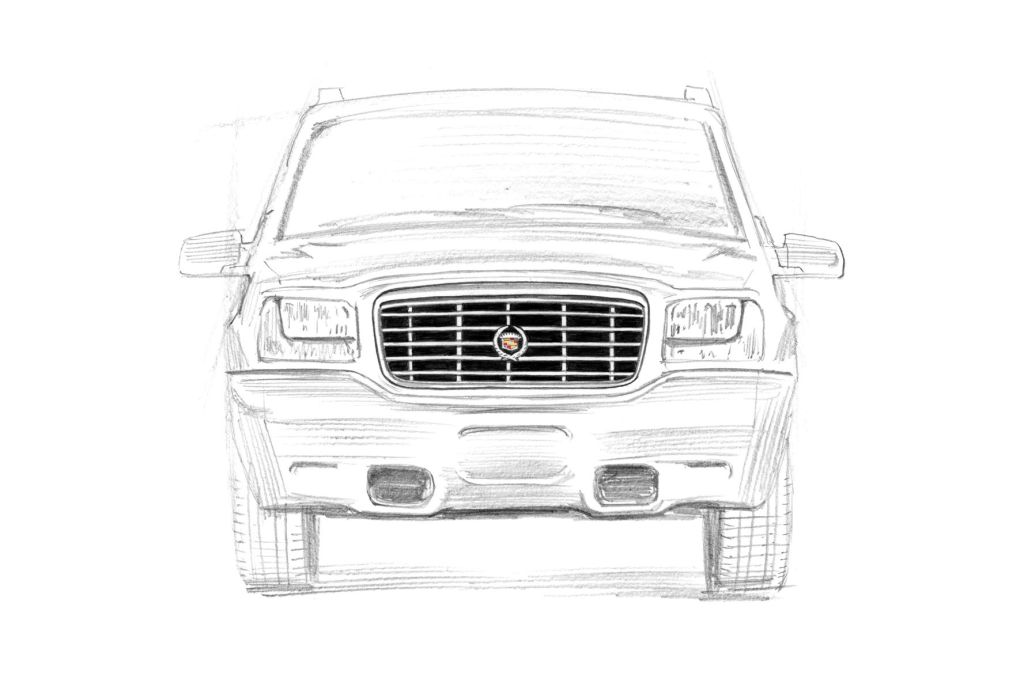
Things weren’t great at that brand back then. Hard to believe, but there was something that is now intrinsic to Cadillac that was absent: the Escalade, the massive truck-cum-SUV that has had visual presence on the road for a little more than two decades now.

The original Escalade. (Image: GM)

The Escalade was to come to be under John Smith’s period at Cadillac, helped into existence by the other John Smith, who was known as Jack.

John Smith talks about his career at Cadillac in this edition of “Autoline After Hours,” as well as a book he has recently had published about some of his adventures in the auto industry, Fin Tails: Saving Cadillac, America’s Luxury Icon (see how important Escalade was/is?).

Also on Smith’s resume are positions including vice president of Planning at General Motors International Operations in Zurich as well as president of Allison Transmission. Which is to say that he has a broad perspective on the auto industry, one broader than just Cadillac.

On this edition of “Autoline After Hours” Smith spends the hour talking with “Autoline’s” John McElroy, Doron Levin, who, among other things, writes about the auto industry at Saving Alpha and me.

And you can see it here.

*Given that “Smith” is the most common surname in the U.S., and “John” has been in the top 10 until 1987, this isn’t exactly surprising.