
How the Celestiq Can Help Address the Problem of Potholes

Smart sensors can lead to smoother roads. . . .

By Gary S. Vasilash

The Cadillac Celestiq—the hand-built electric vehicle that has a price in the $340,000 vicinity—is a lot of things, but one that’s surprising is, in effect, a test-bed for road maintenance personnel.

That is, the Celestiq is fitted with Smart Chassis Sensor technology developed by ZF.

Sensors—two in the front wishbones and two in the rear—are permanently mounted into the ball joints of the suspension system.
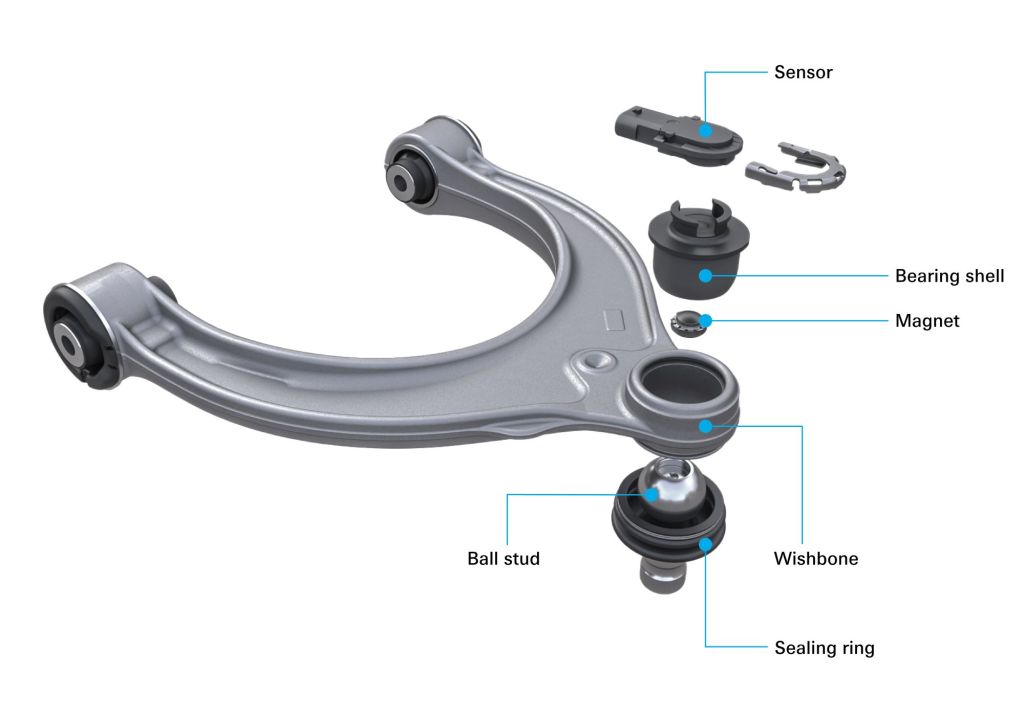
An important part you cant see are the algorithms. (Image: ZF)

These sensors and associated algorithms are used to do a variety of things, like control damping and provide headlight leveling.

Steffen Reichelt, Head of the Chassis Components Product Line at ZF, says, “With the help of evaluation algorithms, our sensor not only replaces conventional height sensors, it also significantly outperforms them in terms of the quantity and reliability of the data collected.”

It is that last bit—the data collected—that is germane to the beyond-Celestiq applications.

Reichelt: “The data collected by the sensor allows additional conclusions to be drawn about the vehicle, its surroundings and the road surface. These findings are particularly attractive for commercial vehicle users and fleet owners, but also for the maintenance of road infrastructure.”

So while most of us will never experience the smooth ride that is undoubtedly offered by the Celestiq, conceivably those who do could benefit the rest of us with the data that their vehicles can collect about the road surfaces.

Why Connecting Brakes to the Internet Is a Good Idea

By Gary S. Vasilash

Nowadays, more and more devices are being connected to the internet, from thermostats to doorbells to refrigerators to traffic signals to car brakes.

Brakes?

Yes, explains Rich Nesbitt, head of Product Management, Chassis Systems Control, Bosch, the brakes that the company is producing are ready to be connected to the ‘net. Whether they’ll be connected or not is a decision, of course, of the OEM deploying that brake capability.

(Image: Bosch)

Nesbitt says that the connectivity provides advantages during the development of the braking system, as information can be readily collected and then deployed by the engineers.

It can also provide benefits for the driver, whether it is monitoring the brakes so as to determine when service will be required or, taking advantage of vehicle-to-infrastructure connection, providing information about the road conditions ahead.

And it can provide benefit to the OEM, as this is still more data that can be harvested from vehicles for purposes of monetization.

Nesbitt talks about the hows and why of internet-enabled brakes on this edition of “Autoline After Hours” with “Autoline’s” John McElroy, Jack Keebler, journalist and consultant, and me.

In addition to which, McElroy, Keebler and I talk about a number of other subjects, including Ford’s recent recalls, vehicle affordability (or lack thereof), the consequences of high gas prices on sales of pickups and large SUVs, and other subjects.

And you can see it all here.