
Driven to Engineer

Credit to the folks who help make performance happen. . .

Car designers get a lot of attention, or at least more attention than anyone at OEMs who aren’t top execs.

Engineers—not much at all.

So it is impressive to see that General Motors had three engineers behind the wheels of the Chevrolet Corvette Z06, ZR1 and ZR1X at the Nürburgring Nordschleife to put the cars through their paces on the 12.9-mile track.

Vehicle dynamics engineer Drew Cattell took the electrified, AWD 1,250-hp ZR1X out and did the circuit in 6:49.275, making him the fastest non-professional racecar driver to make an officially recorded lap at the track.

Vehicle dynamics engineer Brian Wallace was behind the wheel of the 1,064-hp ZR1 and turned in a time of 6:50.763.

And vehicle performance manager Aaron Link took the 670-hp Corvette Z06 out and did a lap in 7:11.826.

Corvette Z06, ZR1 and ZR1X (back to front) at the Nürburgring Nordschleife in Germany piloted by engineers who helped develop the vehicles. (Image: Chevrolet)

GM President Mark Reuss noted of the accomplishment: “We have clearly shown there is no limit to what our GM engineers and vehicles can accomplish.”

Reuss added: “These are the best Corvettes in history, period.”

It is worth noting that with the exception of additional safety equipment required to run the Nordschleife these are all U.S. production-spec Corvettes, just like you can get through a Chevy dealer.

However, because the ZR1 and the ZR1X aren’t sold in Europe and the Z06 is a North American variant, the cars are categorized as “Prototypes/Pre-Production Vehicles” for the records.

Credit to all involved, but especially to these engineers that helped make these Corvettes the cars they are.
A Thought About the Corvette ZR1

Something to make Corvettes even more popular among the enthusiasts. . .

By Gary S. Vasilash

In the first half of 2024 Chevrolet sold 16,661 electric cars and crossovers. That includes the Blazer EV, Bolt EV/Bolt EUV and Equinox EV.

What is notable is that during the same period there was a vehicle in the dealership that outsold all of those EVs combined: The Corvette.

There were 17,914 Corvettes delivered in the first half.

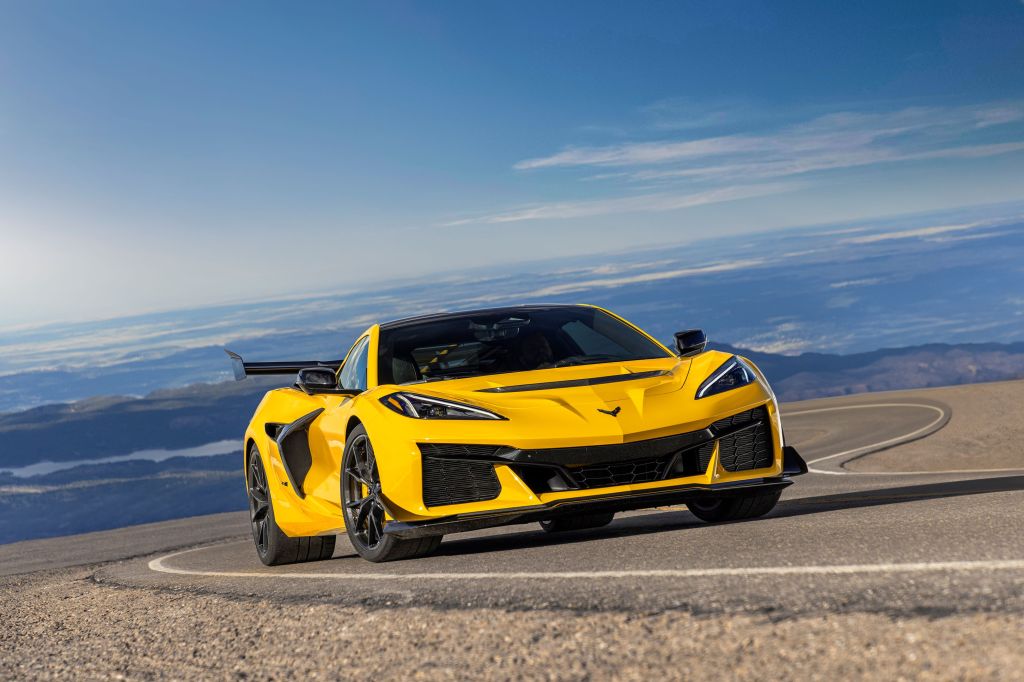
Corvette ZR1 Coupe: wicked fast. (Image: Chervolet)

And while it won’t be launched until next year—and “launched” is a good word for this vehicle, the ’25 Corvette ZR1, while undoubtedly something that will be produced in limited numbers, will likely drive interest in the more readily available Corvettes.

The ZR1 is a special model, with its 1,064-hp 5.5-liter, twin turbocharged, DOHC flat-plane crank V8.

The car will have a top speed of over 215 mph.

And while it looks and certainly is fast, it won’t launch to the sky as there is a carbon fiber aero package that produces in excess of 1,200 pounds of downforce when the ZR1 hits top speed.

Now there are electric vehicles that have higher top speeds, though not many, and not readily accessible as at a Chevy dealer.

And the instant torque of an EV may be more impressive than the impressive 828 lb-ft that the ZR1 LT7 generates—at 6,000 rpm.

But the ZR1 will provide a visceral experience as well as the one predicated purely on acceleration.

This sensory suite of sound and vibration is simply something that cannot be as genuinely obtained in an electric vehicle.

At some point, after a sufficient number of enthusiasts, the type of people who would consider paying what is estimated to be on the order of >$180,000 for a car, haven’t driven combustion-powered vehicles, things like the ZR1 will fall out of fashion, undoubtedly being perceived as having insufficient refinement because of the very characteristics that make it so exhilarating to drive.

But that is well ahead of us.