Survey Reveals OEMs’ Anticipation of EV Market Penetration

Well, optimism is always a good thing to have. . .

By Gary S. Vasilash

The Kerrigan Advisors 2025 OEM survey—which was conducted from December 2024 to March 2025, so it is pre-tariff—indicate that OEM execs are still bullish on the prospects for electric vehicles in the U.S. market.

Asked what their expectation is for EV market share by 2025—presumably that would be “by the end of 2025”—the largest cohort, 46%, answered 10% to 20%. While that bandwidth may have included a lot of 10%s and 11%, it still shows a certain sense of bullishness among these execs.

The second largest cohort, 40%, answered 7% to 10%.

So either way, there is a solid number of execs who see things growing, which is reasonable given the amount of new EVs that are being rolled out.

(The remaining 14% of respondents: 8% say 21% to 30% market share, 2% 31 to 40%, 3% 41% to 50%, and 1% greater than 50%. It would be interesting to know who that 1% is.)

That said, they are willing to admit that the EV transition isn’t happening as quickly as anticipated.

80% say that it is going slower than planned. 10% say faster than planned and 9% as planned.

Still, there is an evident stick-to-it-ness among the OEMs.

One question that might seem ominous—remember that in 2024 Elon Musk said that if Chinese EVs come into the U.S. market they would “pretty much demolish” U.S. OEMs—has it that 76% of OEMs “think Chinese OEMs will eventually enter the U.S. market.”

While “eventually” is possibly a long time, perhaps that recognition that it may happen will allow the U.S. OEMs to make the necessary countermeasures.
Where Do Displays Come From?

The answer to that question isn’t “around here” unless you live somewhere like Shenzhen

By Gary S. Vasilash

Any new vehicle worth considering—or so it seems—has a gauge cluster and accompanying infotainment screen that brings to mind all of the digital signage in Harry Reid International Airport (formerly McCarran) in Las Vegas touting everything from tired rock acts (which explains why they’re in “residence” rather than on the road: they’re tired) to shows that you would want to see but would have a hard time explaining once you returned from that business trip.

Omdia’s Automotive Display Intelligence Service has calculated that in 2024 there were shipments of 232 million automotive display panel shipments, an increase of 6.3% over 2023.

The firm attributes much of the growth to demand in China.

Speaking of which, it is surprising to see the companies that are global leaders in the auto display business: companies that you’ve probably not heard of.

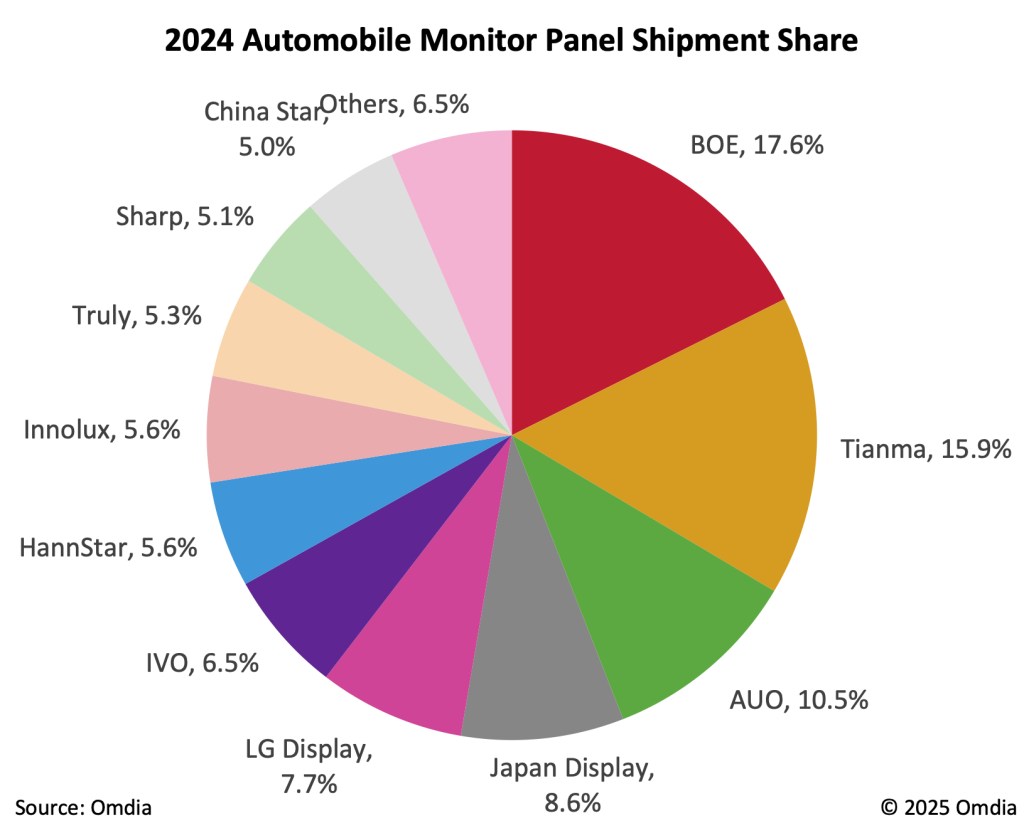
How many names do you recognize? (Image: Omdia)

The top producer is BOE, which had a market share of 17.6%. It shipped 40.9 million units.

It was followed by Tianma, with a 15.9% market share and shipments of 36.9 million displays.

A name with some familiarity, LG Display, was fifth, with a 7.7% share and 17.98 million shipments.

According to Stacy Wu, Omdia senior principal analyst, “Looking ahead, LCD fab capacity for automotive displays will become increasingly concentrated in advanced production lines, particularly G6 LTPS and G8 a-Si/Oxide fabs in China. While this shift enhances production efficiency, it also presents challenges in supply chain diversification as automakers and tier 1 suppliers navigate an increasingly complex global trade environment.”

Which probably means that the vast majority of displays used throughout the world come from China, and in places like the U.S., with the new tariff regime, they are likely to become increasingly expensive.

Enhanced production efficiency can get you only so far.

Tariffs and Trucks

There could be a big problem for GM if there are 25% tariffs on vehicles coming into the U.S. from Mexico

By Gary S. Vasilash

There is, of course, a whole lot of unknowns regarding what the forthcoming Trump administration is going to do vis-à-vis the auto industry.

This is not just a question of the elimination of the tax credit for EVs, which would undoubtedly have a huge negative effect on EV sales in the U.S. in 2025, but more troubling, the possibility of 25% tariffs on products from Mexico and Canada.

John Murphy, senior North American automotive equity research analyst at Bank of America, thinks that the 25% may be something of a negotiating tactic, not a hard-and-fast decision.

In a recent interview with Yahoo Finance, Murphy said the 25% tariff on parts and products is “unlikely to come through.”

But “unlikely” isn’t a definitive “no.”

So there could be a problem, especially for General Motors.

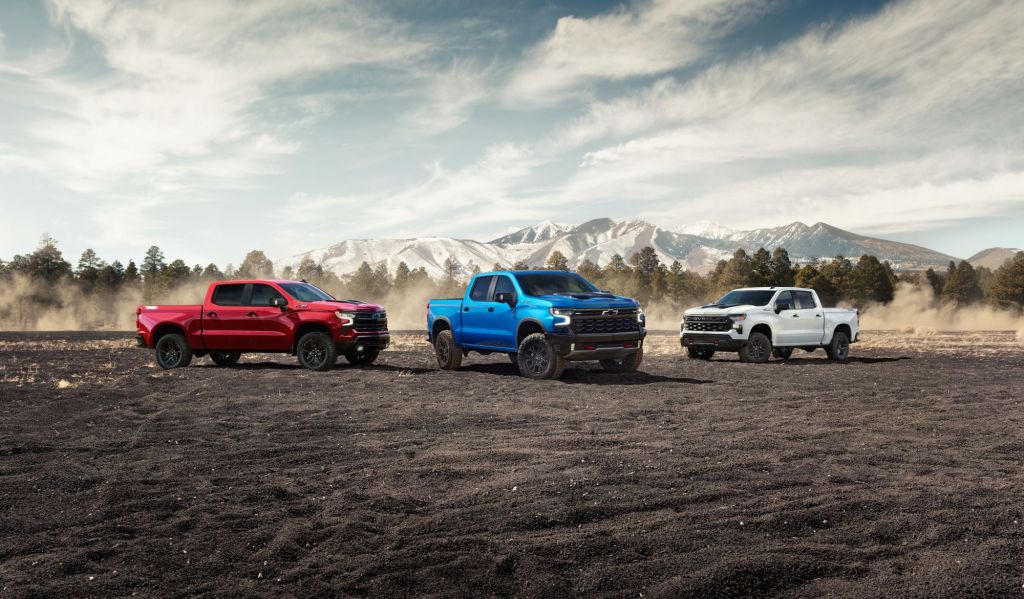
Mexcio is an important source of pickup trucks, including the Chevy Silverado, for General Motors. (Image: Chevrolet)

Murphy points out that nearly a third of GM products for sale in the U.S. come from outside the U.S., mainly Mexico.

Notably, there are Chevy Silverado and GMC Sierra pickups built south of the border.

“That creates real problems,” Murphy said.

“The question is how fast you”—or in this case, “GM”—“can react to that.”

After all, it is not as though there is some GM truck plant sitting idle in the U.S.

“They just can’t pick up and move.”

Which may be something that isn’t fully understood by politicians.

Murphy suggested that if the tariffs block the import of Chinese parts and vehicles into the U.S. that will be a “net positive” for the domestics, as well the Japanese and Korean manufacturers with an existing U.S. manufacturing footprint.

Some Numbers in China

Ever wonder why Western governments are concerned about their domestic auto manufacturers?

By Gary S. Vasilash

The U.S. is applying big tariffs on electric vehicles from China (as in 100%), and the European Union, moderately big (38%). (Apparently the Chinese are doing a bit of retaliation, as it has opened an investigation into pork products exported from the EU.)

Some numbers from GlobalData provide a sense of the sort of numbers associated with Chinese vehicle manufacture that are concerning to those in the U.S. and Europe.

Looking at sales of passenger vehicles in China from January to through April, there was an increase of 5.5% year-over-year to 6.3 million units.

But the red flag is this number: a rise in production by 9%, or 7.6 million units.

Simply: 1.3 million more passenger vehicles made than sold.

This means overcapacity. Which also means that companies are probably interested in finding markets where they can offload those excess vehicles.

And while the 7.6 million number  is all passenger vehicles, not just those with batteries in addition to the 12-V battery under the hood, in April there were 424,0000 vehicles exported from China, a year-over-year increase of 36.9%.

And those joint ventures. . .

Once, Western brands were almost giddy when it came to the opportunity to create joint ventures in China with Chinese companies. The market size was (and is) nothing short of amazing.

GlobalData finds that when it comes to NEVs—or “New Energy Vehicles,” which are the hybrids and full EVs—the penetration rate of Chinese local brands was close to 60% of the market, up 7% from the same period last year, while the joint venture brands have a penetration rate of 12%–still up from last year’s number. But only 1%.

So one can expect the Chinese OEMs that produce NEVs to up the production of those vehicles, which will undoubtedly lead to overcapacity there, too, which means they’ll have to do something to do with those vehicles.

And that something is probably exports.

Volkswagen in China: Big Plans

By Gary S. Vasilash

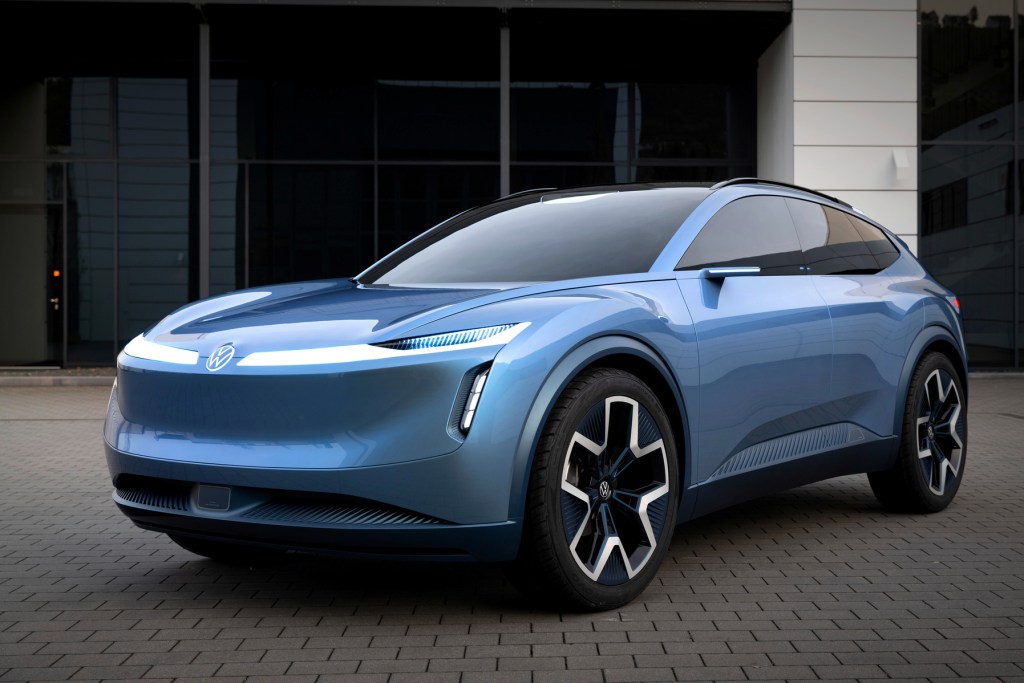
Volkswagen introduced a new electric concept at Auto China 2024, the ID.CODE. And while it is a concept—with a “newly designed living space on board. . .where the real and virtual worlds meet to create a new mobility experience” (no, I have no idea what that means, either)—it is likely to be something that will be coming out within the next few years.

Volkswagen ID.CODE concept developed for the China market. (Image: Volkswagen)

Listen to Oliver Blume, CEO Volkswagen Group, at the company’s China Capital Markets Day in Beijing:

Over the past 40 years, we have established a robust and very successful business in China. China is a very important market for us and will remain so. There are approximately 50 million of our vehicles on Chinese roads today, and we sell one in three cars worldwide in China. We are therefore proud to call China our second home market.”

So to stay in the game, the Group plans to launch 40 new models in China during the next three years, 20 of which will be electric vehicles, then by 2030 there will be at least 10 new EVs added to that.

To do this, in part, the Group is working with Chinese companies XPENG and SAIC.

It has developed what it calls its “China Main Platform” (CMP) which will be the underpinning for VW brand vehicles in China.

The CMP is engineered to allow the cost of vehicles by 40% by 2026.

It has developed the China Electrical Architecture that it says will further reduce costs.

It has established the Volkswagen Group China Technology Company (VCTC), an R&D center in Hefei.

Through VCTC it plans to reduce the time-to-market for China products by 30%.

While that’s for the Group (the company has divided its brands into Core: VW, VW Commercial Vehicles, Skoda, SEAT, and Cupra; Progressive: Audi, Bentley, Lamborghini, and Ducati; and Sport Luxury: Porsche), the brands have their approaches to the China market.

For example, the VW brand has established three pillars for the China market: a comprehensive vehicle offering; a design language specifically for the market; technical development with Chinese partners to accelerate innovation.

Hmm. . .

Volkswagen Group is betting big on China, which is actually its single-biggest market (it sells more units in Europe, but as a single country, China is the one).

While there is advantage engaging with domestic companies (it owns 4.99% of XPENG), a question is whether Chinese consumers might not have their own “In China, for China” strategy that will focus their purchases on vehicles from Chinese companies.

And to what extent the design approaches and technical developments that it is making in China will be useful in the rest of the world.

After all, should the Chinese consumer not be keen on VW’s “living space on board” and the like, then it surely is going to need to take that investment elsewhere.

Euro Auto Sales Fun Fact

In 2023 Nissan sold 343,891 vehicles in Europe, a 20.1% increase over its sales there in 2022, according to Inovev.

In 2023 Chinese brands sold 353,276 vehicles—“mainly based on BEVs”—in Europe, more than double their sales there in 2022.

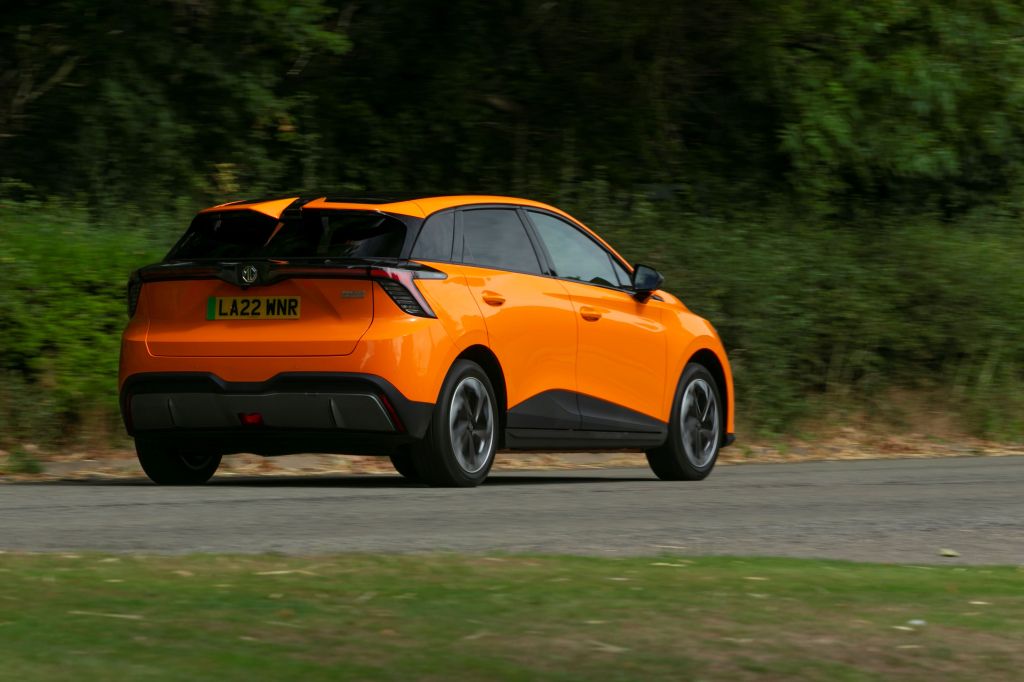
The MG MG4 EV: second only to the Tesla Model Y in U.K. 2023 sales. MG is owned by Shanghai-based SAIC Motor. (Image: MG)

Nissan, which has been around in the European market for a while (and had been affiliated with Renault until last year), is already surpassed by a phalanx of Chinese OEMs. (Yes, this is one company vs. several, but looked at from the point of view of sheet metal moved, it is still worth pondering.)

Maybe if you’re Stellantis or Renault or Volkswagen this isn’t a particularly fun fact.

And maybe this will portend things happening at some point in the U.S., as well.

Western Europe, China and EVs

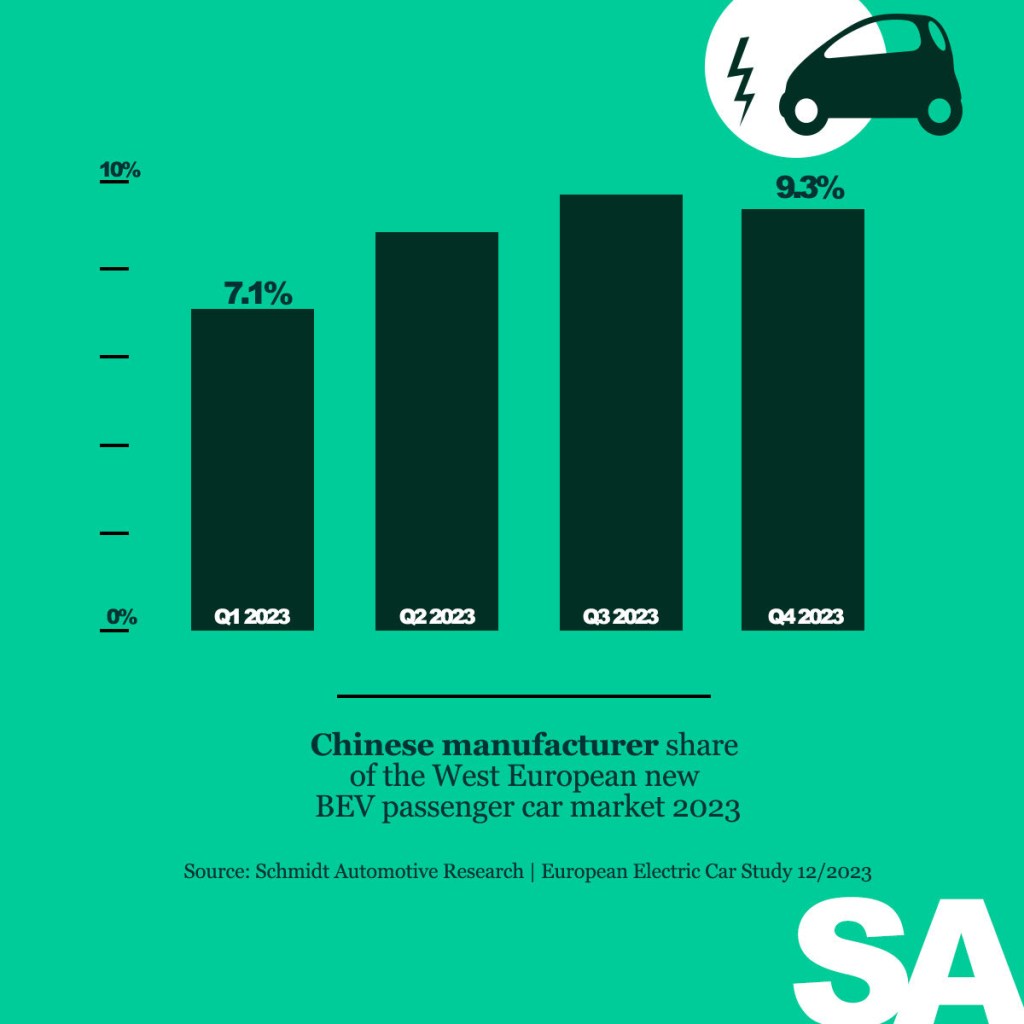
Although there was a seeming step-by-step, vehicle-by-vehicle increase in the under of Chinese battery electric vehicles registered in Western Europe last year, there was a bit of a stumble at the end, and Schmidt Automotive Research wonders whether there will be a cap of under 10% of the EV market in Western Europe for the Sino mobiles.

(Image: Schmidt Automotive Research)

As the chart shows, there was a noticeable decline in registrations in Q4. . .but then there are some reasons why this could be the case, including the increase in the amount of time it takes to ship vehicles from China to Europe while avoiding the Red Sea.

But the Schmidt study also points out some brands are offering discounts of up to €12,000, so you’d imagine that European consumers would be most interested in savings like that. . .especially as there may be higher import tariffs applied to Chinese vehicles coming into Europe this year.

Still, the fact that the Chinese OEMs have managed to gain that much of the European market in a comparatively short period of time says something about the appeal of their products.

Buick: Wouldn’t You Rather Have One?

By Gary S. Vasilash

If there is someone who is quintessentially American, that person has to be Dale Earnhart, Jr. It is hard to imagine how difficult it would be to live up to the legend that his father was, but Dale Jr. was able to make his own way into the annals that is NASCAR.

Like many former drivers, Earnhart owns car dealerships. One of them is Dale Earnhardt Jr. Buick GMC in Tallahassee, Florida.

Like many dealer websites, there is an array of vehicles for sale presented and an immediate pop-up that shows they are willing to engage pronto with prospective customers.

But there is something that is different than is the case on many dealer websites, which is a Q&A section.

And one of the questions that is presented and answered is:

“Is Buick American?

And the answer begins:

“If you’re considering a new Buick vehicle as your next Thomasville, GA car or SUV, you may be wondering, is Buick American? The answer is yes.”

And it laudably goes on to acknowledge that the brand builds vehicles in places that aren’t within the U.S., like Bupyeong, South Korea (Encore GX), and Shanghai, China (Envision).

Yes, you read that right: the Buick Envision is built in China. Which is something to think about when the rhetorical question is raised: “Will Americans buy Chinese vehicles?,” as though this is some sort of question about the future. It isn’t. And the answer is yes.

The Buick Envista is also made in South Korea.

This leaves the Buick Enclave, which is made in the U.S., at the Lansing Delta Township plant in Michigan.

GM has been building vehicles in Lansing for a long time. Ransom E. Olds built a plant there in 1901. (Olds, unfortunately, ceased to exist in 2004.)

While some people wondered about the viability of Buick, here’s Duncan Aldred, vice president, Buick and GMC:

“As the fastest growing mainstream brand in the industry in the U.S.last year, 2024 promises more big things for Buick, spearheaded by the launch of the next-generation Enclave.”

Sketch of the 2025 Buick Enclave. No, it won’t have square wheels. (Image: Buick)

Last year Enclave sales, 39,411 units, were up 29.1% compared to 2022.

But Envision sales, 44,281 units, were up 71.2% and Encore GX, 64,149 units, were up 92.4%.

Which seems to indicate that at least so far as 2023 goes, they were busier in Bupyeong and Shanghai than they were in Lansing.

Perhaps the forthcoming version of the stylish Enclave will help boost things in Lansing.

And probably at Dale Jr.’s dealership in Florida, too.

About EVs in China

“In 2020, 48% of all EVs on the road could be found in China — more than the combined figure for the US and Europe. China’s EV fleet will be 60% of the world’s total by 2030. Xi Jinping has extended both the sales tax exemption on EVs and subsidies for domestically built EVs to the end of 2022.

“China’s large domestic market, raw materials access, and favorable government policies mean it will continue to dominate the EV landscape and won’t be as disadvantaged by the lithium shortage. Xi Jinping has facilitated the growth of the domestic EV market, causing Tesla to lose market share in China to BYD. This is not only to cement China’s dominance in EVs but also to help meet the net zero target year of 2060.”– Amrit Dhami, Thematic Analyst at GlobalData

Interesting XPeng 2021 EV Sales Numbers

By Gary S. Vasilash

The numbers for Chinese electric vehicle manufacturer XPeng—not merely EVs, but “Smart EVs”—for 2021 are rather impressive, especially when looked at as a percentage basis compared to 2020.

As in:

  • 181% increase in the number of vehicles delivered in December 2021 vs. December 2020
  • 222% increase in deliveries in Q4 2021 vs. Q4 2020
  • 263% increase in total vehicles delivered in 2021 vs. 2020

But then when you drill down the numbers are somewhat less impressive.

  • 16,000 vehicles delivered in December 2021
  • 41,751 vehicles delivered in Q4 2021
  • 98,155 vehicles delivered in 2021

Still, directionally things are going well for the company.

XPeng P7 sport sedan. (Image: Business Wire)

The company offers both sedans and SUVs in the China market.  It is notable, as the interest in sedans in the U.S. is waning, that of its December deliveries of 16,000 vehicles, only 3,511 were SUVs—the largest share was taken by the sport and family sedans.

Another interesting thing about XPeng is that the company is building out a supercharging network—661 stations in all, located in 228 cities.

But even more notable is this: it has 311 retail outlets across 121 cities.

For a nascent company in the EV space, 311 is a lot of dealerships.

Tesla, for comparison, has about 170 galleries and showrooms in the U.S.