
Charging EVs With Green Energy

An invention that could make more people use environmentally benign charging for their electric vehicles

By Gary S. Vasilash

While some people buy electric vehicles because they are fashionable or because they like the performance or because they detest the smell of gasoline and beef jerky, some other people buy EVs because they are environmentally sensitive and have read studies or heard that guy in a Starbucks holding forth about how EVs are better for the environment than combustion cars.

While that is true—or so the studies and the guy in Starbucks seem to indicate—there is also an issue that these people need to take into account, which is that a lot of electricity is generated by activities like burning coal. Again, while in the long run the EV—even with the sketchy source of power—is better for the environment, there is better. . .and there is better.

And Jim Bardia of Change Wind Corp. has the proverbial better idea.

It is generating electricity for electric vehicles with wind and/or solar power.

While that in itself is not unique, the approach he is taking certainly is.

(The name of his unit isn’t particularly exceptional, however: Wind & Solar Powered Tower.)

He has designed a wind mill that, unlike the pinwheel style we’re all familiar with from charming postcards from Holland or those unsightly windfarms outside of Palm Springs, are axially oriented: think of a can with sections cut out that is centered on a post stuck in the ground that spins when the wind blows. More: the top of the setup is covered with photovoltaic cells that catch the sun. The post is hollow so all of the collected energy is sent down to the equipment at the bottom (including battery storage) that allows electric vehicle charging.

(OK: if you’re thinking about a can on a stick that somehow was engineered to generate electricity, that would be a scale that might work with a Hot Wheels car. Barida is talking about something that is, well, massive, for grown-up vehicles, as in generating 52.2 kW per hour and being capable of an output of 480-volt DC fast charging.)

In this arrangement the devices can be located in parking lots of everything from car dealerships to shopping malls to football stadia.

While it doesn’t necessarily need to be connected to the “grid” (which, as many people have learned this summer, isn’t exactly the most robust of things), Bardia says that it is beneficial to connect to it because excess power can be sold back to the utilities.

Bardia talks about this clever idea on this edition of “Autoline After Hours” with “Autoline’s” John McElroy, Chris Paukert of Roadshow by CNET, and me.

And Paukert, McElroy and I talk about a number of other issues, including whether Geely is one of the most interesting vehicle companies in the world, the Biden plan for 50% EVs by 2030 and the EPA regs that may make >30% EVs by 2030 a necessity for OEMs, and a whole lot more.

All of which you can see here.
About Charging the BMW iX3

It is quick. But that’s still slow

By Gary S. Vasilash

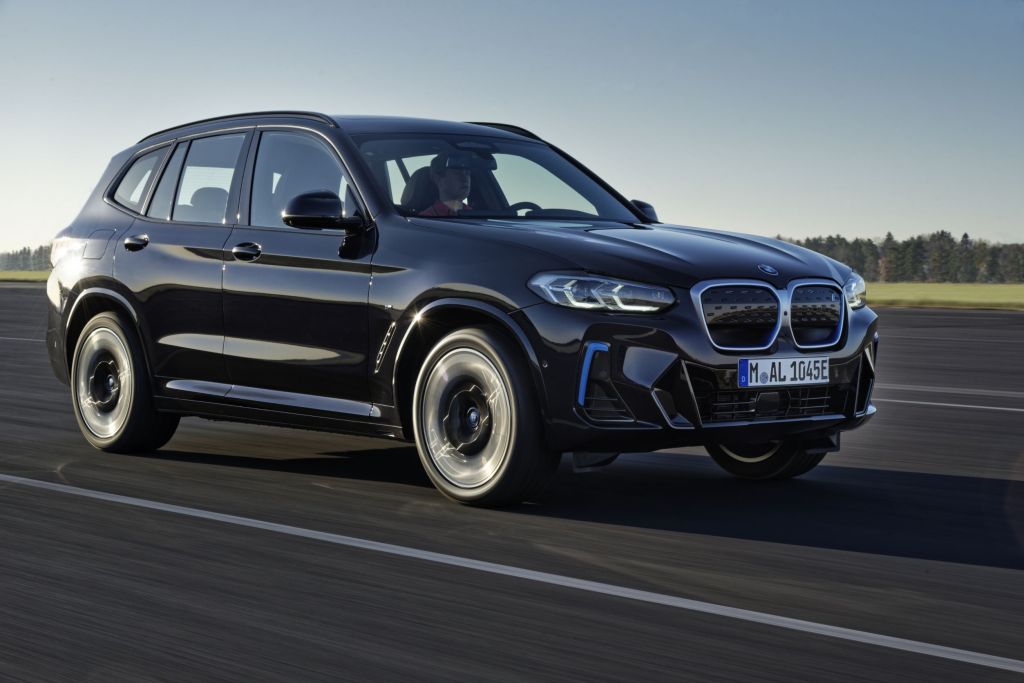
According to information about the new BMW iX3 (the UK version) we learn such things as the fact that there are 188 prismatic cells in the battery that have a gravimetric energy density that’s about 20% higher than that of the previous pack.

The new BMW iX3 has range on the order of 280 miles. (Image: BMW)

There is BMW’s fifth-generation eDrive technology that brings along a charging unit that provides power to both the 400V battery and the 12V on-board power supply.

As for the charging, when using AC it will permit single- and three-phase charging at up to 11 kW.

However, when plugged into a DC fast charger, it can charge at up to 150 kW. This means it can go from a 0% state of charge to 80% in 34 minutes.

There is another set of numbers that are striking. The BMW iX3 can charge the vehicle so that it can travel up to 62 miles (based on the WLTP test cycle, which is generally more generous than EPA figures) in 10 minutes.

While 10 minutes isn’t a whole lot of time, 62 miles of distance isn’t a whole lot of range.

According to the EPA, the average fuel economy for light-duty vehicles in 2020–cars, pickups, and cargo vans less than 8,500 pounds GVWR and SUVs and passenger vans up to 10,000 pounds GVWR—was 25.7 mpg.

The flow at your local gas pump (assuming you’re in the U.S.) is limited to 10 gallons per minute.  Which means that a light vehicle can get 257 miles of range in one minute.

Somehow people are going to have to get used to spending more time at a service station.

BMW Brings an Electric Scooter

And if you want one, make sure your digital account if full of digits

By Gary S. Vasilash

“The new BMW CE 04 is the link between the user’s analogue and digital worlds. It is both a means of transport and a means of communication for the big city commuter. With its forward-looking design thanks based on an innovative package, it sets out to redefine the scooter segment.”

That’s Edgar Heinrich, head of Design, BMW Motorrad.

The CE 04 is a scooter. An electric scooter.

Heinrich and the BMW CE 04 electric scooter. (Image: BMW)

How it is a means of communication is curious. And while its design has a shard aesthetic to it, which is about as far from the smooth lines characteristic of a Vespa, it isn’t entirely clear whether this is “forward-looking” or just “Blade Runner.”

It produces 42 hp. It has a maximum speed of 75 miles. It has a maximum range of an estimated 80 miles. It can carry two people (which would probably have an effect on the speed and range).

Its 147.6-volt lithium-ion battery pack recharges fairly quickly: from 0 to 100% in 4 hours and 20 minutes when plugged into a normal household outlet (Level 1). For a Level 2 charger (one of those units you’ve seen in parking lots, say, at Whole Foods) it is 1 hour and 40 minutes. If you charge the battery from 20% to 80% (which would presumably provide a range of 64 miles) on a Level 2 charger, it is just 45 minutes. Or the time to do a good shop at Whole Foods and a quick cappuccino.

But there is one number that is somewhat brake-applying for most people: It has an MSRP of $11,795.

For a scooter.

GM to Spend More Billions on EVs (and AVs)

Why spend $20 billion when you can spend $35 billion?

By Gary S. Vasilash

Yesterday General Motors announced that spending $20 billion between 2020 and 2025 on electric and autonomous vehicular tech, as it said it had intended to in March 2020, isn’t enough.

It announced that spending $27 billion during the same period, as it said it had intended to in November 2020, just doesn’t cut it.

So now GM says that it will spend $35 billion by 2025.

In other word, a 75% increase in spend from what it originally intended just 15 months ago.

Why?

Said Mary Barra, GM chair and CEO: “We are investing aggressively in a comprehensive and highly integrated plan to make sure that GM leads in all aspects of the transformation to a more sustainable future.

“GM is targeting annual global EV sales of more than 1 million by 2025, and we are increasing our investment to scale faster because we see momentum building in the United States for electrification, along with customer demand for our product portfolio.”

The Bolt EV is presently the GM electric vehicle. In the first quarter GM sold 9,025 of the compact electric vehicles.

Yes, that is a 53.7% increase over Q1 2020, but that was Q1 2020.

The increase in Corvette sales Q1 to Q1 was 73.1%. While only 6,611 of those vehicles were delivered, odds are GM makes more on each Corvette than Bolt.

GM does have more EVs coming, like the HUMMER EV pickup and the Cadillac LYRIQ crossover. And there will be an electric Silverado and other vehicles to boot.

GM will be building two EVs for Honda, one for Honda brand and one for Acura. And it is supplying Navistar with its HYDROTEC hydrogen power fuel cells for heavy trucks that are to be launched in 2024.

And while it doesn’t get a whole lot of attention compared to EVs, Cruise is continuing its efforts to achieve higher levels of autonomy. It has been given the go-ahead to provide a public service sans driver in California. It has been named the exclusive autonomous rideshare provider in the city of Dubai. It will be receiving Cruise Origin vehicles—jointly developed by GM and Honda, and scheduled for production in GM’s Factory ZERO Detroit-Hamtramck Assembly Center in 2023.

No question that GM is making a huge commitment.

A thought

Here’s something that needs to be taken into account. According to the U.S. Dept. of Energy, as of approximately right now there are 42,664 charging stations in the U.S. and 103,654 charging outlets available to the public.

People who live, say, in southeast Michigan tend to travel up I-75 to northwest Michigan every holiday in numbers that make a chain out of the vehicles, trailers, boats, etc. Somehow, unless there is access to chargers that are going to allow recharges in minutes, not large fractions of an hour (or more), it is going to take one EV-intensive holiday weekend to have some exceedingly sour people.

When people are used to spending a quick time at a gas station, sitting in a long line waiting for access to a plug may have a big effect on the overall acceptance of EVs.

The Cost of “Refueling”

Turns out that EVs are significantly less expensive to power

By Gary S. Vasilash

Although electric vehicles tend to be more costly than comparable gasoline-powered vehicles, when it comes to “refueling,” EVs can save a whole lot of money compared with gasoline-powered vehicles, according to the U.S. Department of Energy.

As much as about 60%.

The agency developed what it calls an “eGallon.”

That is a comparison of what it would cost to buy equivalent energy to power an EV the same amount as it would cost a gasoline powered vehicle to travel on one gallon of gas.

So, based on the national average of $2.85 for a gallon of gas (as of March 31) and the equivalent price of electricity at a national average of $1.16 for an eGallon, this means the average fuel savings of approximately 60%.

In Washington state the difference was much larger: the cost of a gallon of regular was $3.13 and the cost of an eGallon was $0.89, so the fuel cost savings was about 72%.

So for those who pay attention to what they’re paying for their miles per gallon, it appears that EVs may be advantageous.

Of course, it takes longer to recharge an EV than it does to fill up a tank with liquid fuel.

So if time is money. . . .

How Many EV Chargers in the U.S.?

If you live in California, there is a reasonably large number. Of course, there is also a reasonably large number of electric vehicles. Chicken or egg?

By Gary S. Vasilash

According to the U.S. Department of Energy, there are now 25 states that have at least 1,000 non-residential electric vehicle charging units. This means that if you had an electrician come over to your garage and wired it up for a Level 2 charger, it doesn’t count.

Yet for some reason, public and private chargers are counted.

No surprise that California has the most. 36,913 chargers.

Alaska has the least: 69.

Large yet comparatively out-of-the-way states have low numbers, too: 116 in North Dakota and 134 in South Dakota.

Even a small out-of-the-way state, Hawaii, has more than those two continental states combined: It has 784 chargers.

While the number of chargers is on the increase, the whole charging infrastructure is still a challenge for the acceptance of electric vehicles.

And this isn’t even taking the amount of time it takes to charge the average EV in relation to how long it takes to fuel a vehicle that runs on gasoline.