
2021 Ford F-150 Raptor Released

Tom Liu said it had to be “instantly recognizable.” He also said that he was influenced in the exterior design of the vehicle, which he helped create, by the F-22 Raptor, which, ironically enough, is a stealth fighter, which is, by its design, not to be seen (OK, at least not by sensors).

There was also a convenience to this: Liu was talking about the design of the 2021 Ford F-150 Raptor, the third generation of the vehicle that is built to be able to perform off road and fast—desert racing, in particular, as Carl Widmann, Ford Performance chief engineer, said, “Raptor is rooted in Baja 1000 racing,” and added, “And like a trophy truck, every aspect of Raptor has been engineered to deliver precision capability when your foot is flat on the floor, way out in the middle of nowhere roaring across the desert.”
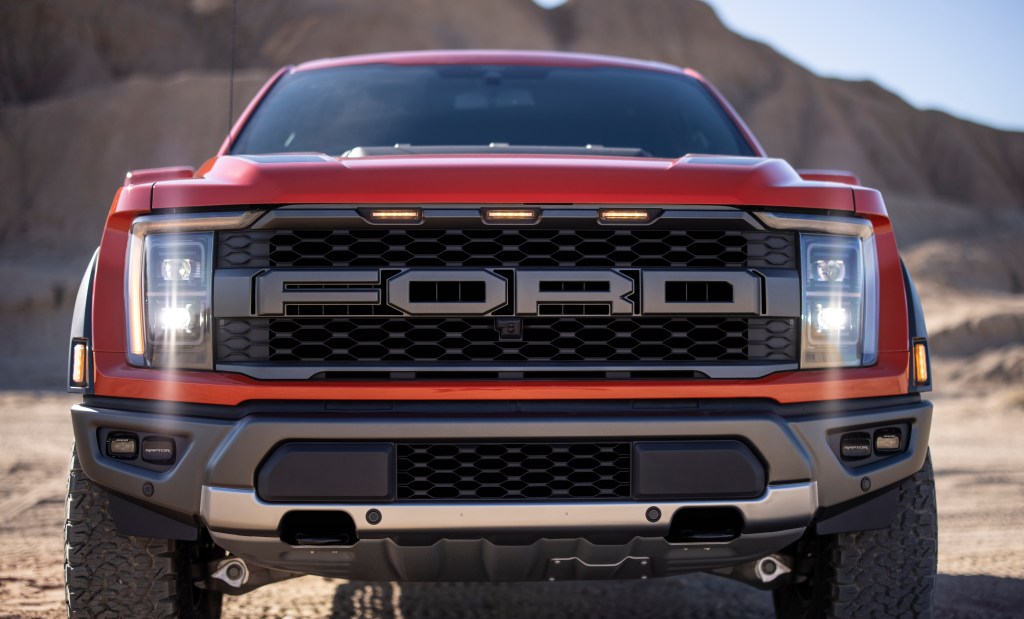
What “menacing” looks like. (Images: Ford)

To the point of Liu and the Raptor the fighter jet and Raptor the truck that is literally engineered to catch air during some of its off-road exploits, he said that like the aircraft, the truck is “Fast, nimble and technologically advanced. It is American power and performance. It is packed with technology—and it looks menacing.”

So there are things like a heat extractor on the power dome hood and functional side vents at the top trailing edges of the front fenders that are to provide a visual nod to the air intakes on the F-22. There are shear surfaces that are stealth-like. And adding to the menace are aspects including the blacked-out grille, blacked-out taillights, massive steel front and rear bumpers, and a massive front skid plate.

It looks fit for purpose and its purpose probably isn’t making a run to the store for a gallon of milk. (Not that you couldn’t, of course.)

///

The F-150 Raptor is based on the F-150 that contractors and others who are not likely to do much in the way of rock crawling in. It is built on the same assembly line at the Dearborn Truck Plant in Dearborn, Michigan (or about 2,400 miles from Ensenada, where the Baja 1000 starts: there isn’t a whole lot of desert around Dearborn).

But it is an F-150 that has been built to take a whole different set of parameters in terms of what it is likely to encounter: for example, while they start with the heavy payload, fully boxed steel frame from the “regular” truck, Jack Cooper, architecture engineer for Ford Performance, said that they’ve modified and reinforced it.

A notable difference truck-wise is the chassis. There is a newly developed five-link rear suspension that features extra-long trailing arms, a Panhard rod, and 24-inch coil springs. “We couldn’t find it in the parts bin,” program manager Tony Greco says of why they had to devise a new rear suspension. The front suspension has been redesigned, as well. One of the key aspects of the suspension for a vehicle like a Raptor is wheel travel. The suspension for this third-generation vehicle is 14 inches in the front and 15 inches in the rear.

The shocks are FOX Live Valves. These internal bypass shocks feature electronic control technology that permits damping rate adjustments at a rate of 500 times per second; the shocks, which have 3.1-inch diameter anodized aluminum bodies, feature base valves that provide 1,000 pounds of damping per corner at racing speeds.

While the standard Raptor runs on 35-inch tires, it can be equipped with a package that brings it up to 37 inches, or what Ford says are the largest factory-fitted tires on a light-duty full size pickup.

///

Among the tech aspects of the new Raptor are:

  • Terrain Management System: dial in adjustments that change the steering feel, transfer case behavior, stability control, active valve exhaust, active damping, throttle mapping, shift points, and digital display. There are seven modes: Slippery, Tow/Haul, Sport, Normal, Off-Road, Baja and Rock Crawl.
  • Trail 1-Pedal Drive: In situations that call for two-pedal driving like crawling rocks or negotiating trying trails, this function allows throttle and brake modulation through the brake pedal. The driver gets acceleration by pushing down on the throttle and braking by lifting.
  • Trail Control: Cruise control—for off-road situations.
  • 360-degree camera package: This option, in addition to providing an all-around view, provides a real-time tire track overlay for the front view, which means that the path ahead of the wheels can be seen such that a spotter may not be necessary.

///

The Raptor has a 3.5-liter EcoBoost V6 engine with twin turbos. While the horsepower and torque numbers aren’t released as of this writing, Ford describes it as a “high-output engine delivering torque low in the rev range where it counts,” so presumably it has the stuff to deal with the sand as well as that to skim over it. And on the subject of driving hard, it has high-power fans built into the cooling system. The compression ratio is 10.5:1.

What to do with a Raptor.

The engine is mated to a 10-speed automatic which, in turn, is attached to a torque-on-demand transfer case.

There are standard electronic locking rear diff and an available Torson front limited-slip differential. They are fitted with 4:10 final drive ratios.

There is something that seems a bit odd about the powertrain system. There is a 36-gallon gas tank. It is recommended that it be filled with premium unleaded.

Do they have premium in the desert?–gsv

Ford & Google, Part 2

Here’s something to consider about the relationship announced yesterday between Ford and Google. The companies indicated their collaboration “This may include projects ranging from developing new retail experiences when buying a vehicle, creating new ownership offers based on data, and more.”

The word that doesn’t appear in the announcement is monetization.

As in “data monetization.” As in getting a return from the data that is associated with the owner, driver, passenger of a vehicle.

You know: the sort of thing that drives the valuation of companies like, well, Google.

A question is “who owns the data”? While you might think that you do, again, look at the valuation of Alphabet (or Facebook): where do you think the value comes from?

Let’s say for example that the value for the data from a given vehicle is $5.

Let’s further say that the two companies split it. (That’s what “partners” do.)

In 2020, a not particularly good year so far as vehicle sales goes, Ford sold 2,044,744 units in the U.S.

So if the value per vehicle is $5, and each gets half, then $2.50 x 2,044,744 = $5,111,860 each. If it is $10 per vehicle (remember, they’re also talking about using this during the “retail” portion of the transaction, so sliding in a few bucks is not necessarily going to be all that noticeable), then that would be $10,223,720 each.

Pretty soon it is evident it is real money.

Google & Ford: When Is a Customer a Partner?

Until December 13, 2016, what is now known as “Waymo,” the company that is developing “fully autonomous” vehicle technology, was known as the “Google Self-Driving Car Project.” In the four years since, Waymo has gone far beyond something that would be described as a “project.” What’s more, it has raised a few billion dollars in outside investment so it is no longer a Google—or more appropriately, an Alphabet—solo undertaking.

Alphabet is a huge company. A company with a market cap on the order of $1.29-trillion. It doesn’t break out the Waymo numbers, but it is now estimated that the company is worth some $30-billion.

Ford has a market cap of $42.6 billion.

Which puts it ahead of Waymo but way behind Alphabet.

And what’s interesting to note is that while Ford has had the number-one selling pickup truck for 44 years running—and sold 787,422 last year alone—Waymo has sold 0 anything.

However, Ford and Google announced that they’ve entered into “a unique strategic partnership.” I wonder how much this is like when an OEM comes out with a new vehicle and calls it the “First-ever [fill-in-the-name].” Of course it is the first-ever. There hasn’t been one.

(Image: Ford)

So Ford doing something extensive with Google is “unique” because they haven’t done it before.

Ford is buying space on the Google Cloud. This brings with it all sorts of opportunities in terms of data analytics and AI and, well, all that those giant clouds bring. Here’s one: it will help Ford “Fast track the implementation of data-driven business models.” Of course.

There will be a “new collaborative group” named “Team Upshift” that “will push the boundaries of Ford’s transformation, unlock personalized consumer experiences, and drive disruptive, data-driven opportunities.”

Ford will start using the Android operating system as the OS for its vehicles starting in 2023.

Ford president and CEO Jim Farley: “As Ford continues the most profound transformation in our history with electrification, connectivity and self-driving, Google and Ford coming together establishes an innovation powerhouse truly able to deliver a superior experience for our customers and modernize our business.”

Sundar Pichai, CEO of Google and Alphabet: “From the first moving assembly line to the latest driver-assist technology, Ford has set the pace of innovation for the automotive industry for nearly 120 years. We’re proud to partner to apply the best of Google’s AI, data analytics, compute and cloud platforms to help transform Ford’s business and build automotive technologies that keep people safe and connected on the road.”

To be sure, this is a big deal for Ford, especially as General Motors announced a similar(ish) deal with Microsoft a couple weeks ago. Perhaps the third shoe will fall and someone will announce a partnership with Amazon.

As for Google, well, they like customers partners. After all, how else to get to a valuation of over $1-trillion?–gsv

General Motors Embraces E-Commerce

The Cadillac LYRIQ, which is to become available in the first half of 2022, certainly looks promising as an electric, luxury SUV, one that may help the brand, which, let’s face it, has been struggling in the market for the past few years—here’s something that is not well known: although Acura is generally considered to be having a tough time of it in the U.S. market, in 2020 it outsold Cadillac, 136,983 vehicles to 129,495 vehicles; Acura also outsold Cadillac in 2019.

The Cadillac CELESTIQ, an electric sedan that takes luxury to levels that Cadillac hasn’t had on offer for, arguably, ever, combining hand-crafted materials with technology, such as a four-quadrant glass roof that allows individual selection of the level of transparency, is another arrow in the quiver of a transforming brand. Although it is still a concept vehicle, it is unlikely that General Motors would draw as much attention to it as it has (it was part of Mary Barra’s CES 2021 keynote) were it—or something damn close to it—not going into production.

That said, even though General Motors is investing $27-billion in vehicle electrification and automation, the most important launch, revealed during Barra’s presentation, is of a vehicle that none of us will individually own:

The EV600, an all-electric, purpose-built light commercial vehicle.

The LYRIQ and the CELESTIQ may be sexy, but logistics is where it is at and will drive the proliferation of electric vehicles in a way that it will take the consumer market a long time to catch up to.

The GM EV600, a purpose-built electric delivery van. The company has even started a logistics support business, BrightDrop. (Image: GM)

The owners of fleets of commercial vehicles—like FedEx, which GM worked with on the development of the EV600 (and the EP1, an electric rectangle on wheels that has a capacity of 200 pounds and a top speed of 3 mph)—do the math when it comes to vehicle acquisition. If it is going to be to their financial advantage to get EVs, then they’re not going to worry about things like available infrastructure, because they’ll build their own. They’re not going to have range anxiety, because they know precisely where their trucks are going and when.

(And it probably doesn’t hurt that it provides a green sheen to their brands by going EV.)

Consider:

–Amazon, which owns a piece of it, is having Rivian build electric delivery vans that are to be on the road next year at a number of about 10,000, perhaps going to 100,000 by 2030.

–Ford has announced the 2022 E-Transit delivery van that is going to be available later this year, and emphasized the benefits of the electric propulsion system vs. its own internal combustion offerings (with the scheduled maintenance of the E-Transit being an estimated 40% less over eight years/100,000 miles).

–And there are start-ups like Arrival, which companies including Hyundai and UPS have invested in.

Sure, we pay attention to LYRIQs and CELESTIQs.

But consider this: in an industry that seems to be shedding operations, General Motors has established a new business, BrightDrop, that is dedicated to delivery, not only vehicles like the EV600 and EP1, but even logistical software services.

This is a non-trivial commitment—and likely to be a prosperous one, as Mary Barra and her colleagues know that commercial companies do the math and need a whole lot less persuading to go electric.–gsv

Ford, Mahindra and FCA

“The global economy and business environment are not the same as October last year [2019].” That is what Ford spokesman T.R. Reid told Reuters as part of the explanation of why the automotive joint venture that Ford was going to be crafting with Mahindra and Mahindra Ltd. has been called off.

October 2019 was when the companies announced they would be forming a JV that would focus on the development of vehicles especially for emerging markets.

COVID-19 has had an effect on those markets as well as, well, all markets. Consequently, the no-go between the two companies.

Ford has operations in India including the Chennai Vehicle Assembly Plant, Sanand Vehicle Assembly Plant, Sanand Engine Plant and Chennai Engine Plant.

India is part of Ford’s International Markets Group (IMG), which spans “100 emerged and emerging markets.”

Ford plans to operate in a status quo mode in India for the time being.

It should be pointed out that Ford’s current approach is to evaluate its operations the world over; it is “allocating capital in ways that advance Ford’s plan to achieve an 8% company adjusted EBIT margin and generate consistently strong adjusted free cash flow.”

Which is a heavy lift, even in a non-pandemic world.

Mahindra did have some good news of late, in that in late December the International Trade Commission decided that the 2021 Roxor—off-road vehicle, as in one that is not street-legal—doesn’t infringe on the “trade dress” of the Jeep Wrangler.

FCA, not surprisingly is not happy. Also not surprisingly, FCA is going to appeal.