
2024 Toyota Corolla Hybrid XLE

Capability counts. . .

By Gary S. Vasilash

There are two things that someone who is buying a compact car wants, even though these two things aren’t written about a great deal.

One is size.

The second is performance.

Now admittedly, when someone is interested in a compact car, they want something, well, compact.

Not small.

Not tiny.

But not medium.

Not large.

This may be a financial consideration.

Or it simply may be that it makes sense.

A metric that I consider when behind the wheel of a compact car is whether I feel comfortable in it vis-à-vis the other vehicles on the road. And where I drive there is a high proportion of light-duty pickups and full-size SUVs.

There are few things worse that driving in congested traffic surrounded by giant vehicles—a Chevy Suburban is more than 18 feet long, 6.5 feet wide and over 6 feet high; an F-150 is 17 feet long, 8 feet wide and 6 feet high—and wondering whether you’re going to be seen.
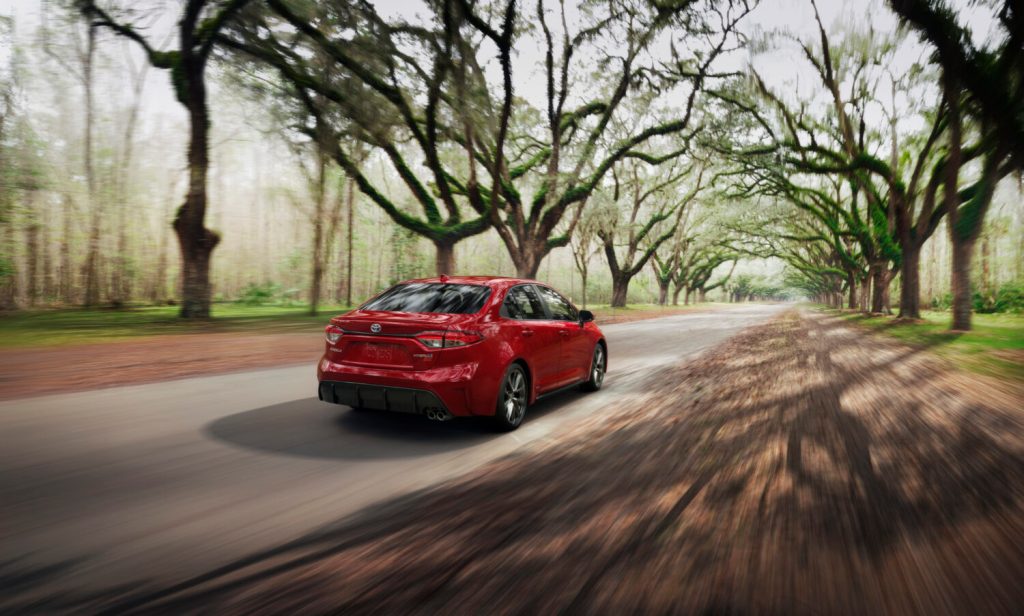
Toyota Corolla Hybrid: competent and capable. (Image: Toyota)

The Corolla Hybrid is 182.3 inches long (about 15 feet), 70.1 inches wide (just under 6 feet) and 56.5 inches high (under 5 feet).

And it seems as though it has the size to allow one to drive with confidence.

Then there is the issue of performance.

This is something that has to be considered in the classic “horses for courses” sense.

Meaning that the Corolla Hybrid is meant to drive people in their daily activities not the Nürburgring.

The Corolla Hybrid has a system horsepower (which means what it gets from the engine and the motor) of 138. Which is pretty much a meaningless number.

The “performance” characteristic is: Can the vehicle drive on a freeway and have enough oomph to be able to deal with everything from full-size sedans and semis—and do so at speed?

And so having spent time on I-75 with it, I found the answer to that question is “yes.”

No, I didn’t blow the doors off of anything.

But I was able to maneuver with sufficient alacrity such that I was able to keep moving at a brisk pace.

And then, of course, there is the fact that this is a high fuel-efficient vehicle.

The sticker has it at 53 mpg city, 46 mpg highway and 50 mpg combined.

My combined was 49 mpg (most of the miles were accumulated on the highway).

This means that I could have driven approximately 550 miles before having to stop for a tank of gas (it has an 11.3-gallon tank).

So while that is comparatively thrifty (with the national average of a gallon of regular being $3.50, that means 550 miles for under $40), there is nothing about the way the Corolla Hybrid operates, nor about its interior execution and amenities, that makes you think “econo-box.”

A good thing.
The Young & the Electric

They’re probably good looking, too. . .

By Gary S. Vasilash

When it comes to customers, auto companies like them young and well-heeled.

Young because if they get the customers early and they do a good job in at least meeting and ideally exceeding expectations, this increases the possibility that they’ll stick with the brand or go up a level (i.e., from Chevy to Cadillac; from Toyota to Lexus; from VW to Audi).

And as for having plenty of disposable income—well, that’s obvious. After all, those Platinum and Unobtainium trims don’t come cheap.

This is borne out by a study conducted by research firm Numerator on electric vehicles.

As for comparative youth, it found that 42% of EV owners are Gen Z’ers or Millennials. That’s in the context of those two cohorts representing only 30% of all vehicles.

As for wealth, there are at least a couple of indicators: 44% are said to be from high-income households. Only 30% of the average vehicle owners are in that stratum.

And 77% of EV owners live in households with two or more vehicles. This is compared to 68% of all households with vehicles.

What seems somewhat odd, however, is that EV owners are twice as likely to walk or bike to get around and are four times as likely to take public transit than the non-EV owners.

While it might be thought that these Gen Z and Millennial EV owners are all about the environment, Numerator found that only 48% of them cited the environment as why they opted to go electric.

Seventy-four percent said it was for cost savings on fuel.

To put some numbers around that:

According to the EPA, the average cost of a gallon of regular was $3.48 in 2023. Also, the average miles per gallon achieved in new vehicles in 2023 was 26 mpg. In its “Fuel Economy Guide” it estimates the average driver racks up 15,000 miles per annum.

So, 15,000 divided by 26 is 577. And multiplying that by 3.48 gets us to an annual outlay of $2,008, or $38.61 per week.

Not a whole lot, but evidently even the wealthy watch their wallets.

Don’t Be Fuelish

When I think “fuel economy” I think of, well, fuel. Liquid fuel. Gasoline. Things measured in miles per gallon, not miles per kilowatt hour.

So when I looked that the just-released “Model Year 2024 Fuel Economy Guide” from the U.S. Dept. of Energy I was more interested in seeing what the fuel economy ratings are for various vehicles, ignoring the full electric vehicles*, but giving attention to the plug-in and standard hybrids because in some cases, like minivans, there really is no option when consulting the “Fuel Economy Leaders”:

Minivans

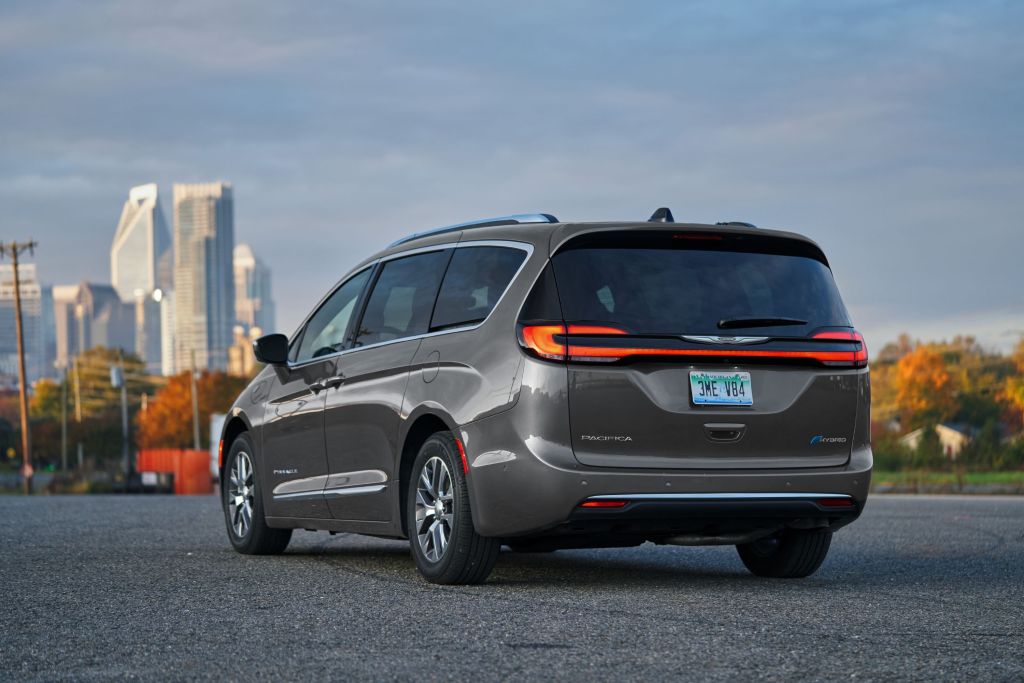
  • Chrysler Pacifica Hybrid (PHEV): 48 mpg combined
  • Toyota Sienna 2WD (hybrid): 36 mpg combined
Pacifica PHEV gets a combined 48 mpg rating. Impressive. (Image: Chrysler)

Other top performers:

Subcompact cars

  • Audi A3 (hybrid): 32 mpg combined
  • MINI Cooper Hardtop (2 and 4 door): 32 mpg combined

Compact car

  • Toyota Corolla Hybrid: 50 mpg combined

Midsize car

  • Toyota Prius (hybrid): 57 mpg combined

Large car

  • Honda Accord Hybrid: 48 mpg combined

Small pickup truck

  • Ford Maverick HEV FWD (hybrid): 37 mpg

Standard pickup truck

  • Chevrolet Silverado 2WD (diesel): 26 mpg combined

Small SUV

  • Kia Nio FE (hybrid): 53 mpg combined

Standard SUV

  • Toyota Grand Highlander Hybrid: 36 mpg combined

Something for everyone—especially those who don’t like to pay a lot at the pump.

*The whole MPGe ranking strikes me as being almost meaningless. While one could say the same for the mpg rating, I think that there is a notion that if a car gets 25 mpg and the average size of a fuel tank is at least 10 gallons (actually it is more on the order of 12.5, but that’s trickier math-wise), then 25 mpg means 250 miles. But unless someone knows the capacity of the battery and is able to do the math, the MPGe is a cipher.