2026 Genesis G90 3.5T E-SC MHEV AWD

This is so cool, it almost seems fictional. . .

By Gary S. Vasilash

If you ever wondered what car Bruce Wayne would but, this is your answer.

According to his backstory, Wayne traveled to the “Orient,” including South Korea, where he trained in martial arts under a master named Kururgi. He also went to Japan, China, Thailand, and Nepal, not for the cuisine, but to pickup fighting skills. Still, you’ve got to believe he picked up some of the local culture, such as that which has given rise to this highly impressive sedan.

(Note: this would be the Clooney Wayne. Not Keaton or Kilmer, certainly. Bale is marginal. Affleck would like to. Pattinson—well, maybe the next movie will make that clear.)

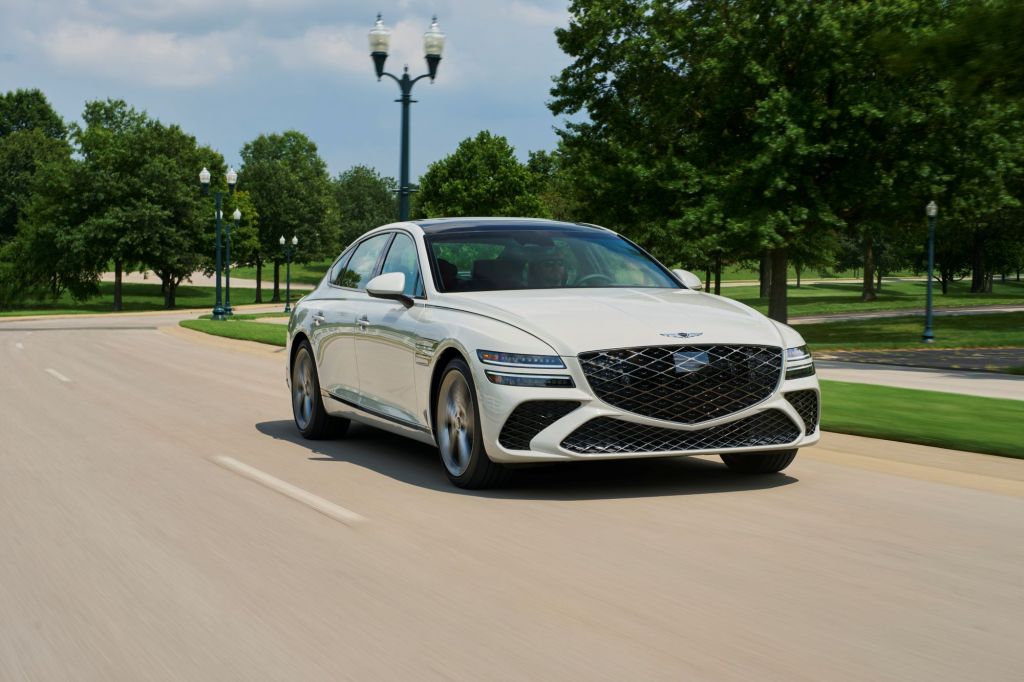
The G90 is long, low, powerful.

Details make the difference. (Images: Hyundai)

And the Prestige Black trim package makes this sedan something that seems like it would be seen in a movie, not in real life.

Yet there it is.

Impressive.

The exterior is in Vik Black, and black is the color of the 21-inch alloy wheels. The grille is dark chrome, as are accents and trims on the doors, fascias and elsewhere.

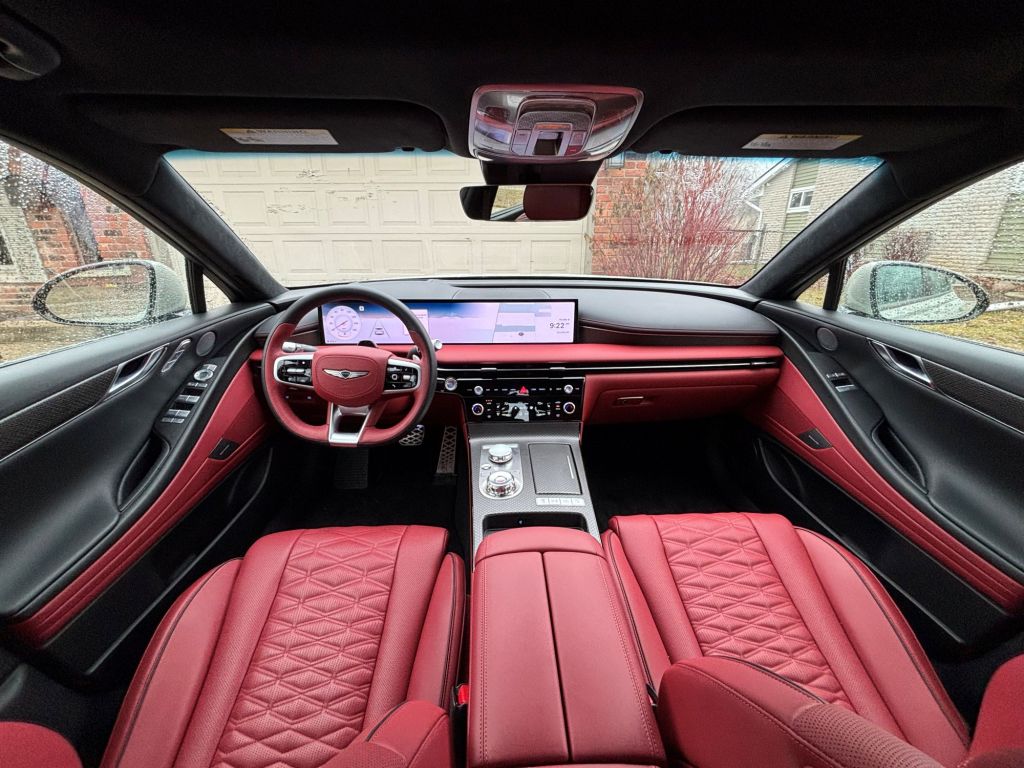
Inside, again, it is dark. In this case, Obsidian Black. The quilted semi-aniline leather seating is dark, as is the leatherette-wrapped upper instrument panel. And the microfiber headliner and A-pillars.

There is black ash wood trim on the doors with a “G-Matrix” pattern in brass color, an intricate design that goes to the point that this is something out of the ordinary.

It should go without saying there are screens (e.g., 12.3-inch HD infotainment screens), an impressive sound system (Bang & Olufsen), and wireless Apple CarPlay and Android Auto. But going back to something that is Batmanesque: there is fingerprint authentication, which allows the driver to start the G90 with a touch of a specific surface. (Yes, Alfred has stored the correct digital imprint so not just anyone can touch and go.)

And on the subject of going, the 3.5-liter V6 with an electric supercharger produces 409 hp and 405 lb-ft of torque, so you are moving in style and with alacrity.

An absolute Bruce Wayne feature is the electronically controlled suspension with road preview.

A camera surveys the road ahead and if any potholes or the like are detected, it signals the suspension controller that electronically adjusts the damping force of each wheel. It is always smooth.

Because this is a large vehicle—207.7 inches long, 76 inches wide, 58.7 inches high, and with a 125.2-inch wheelbase—there is rear-wheel steering that assists in maneuverability.

And while I suspect that the glass is thicker and the insulation more abundant, there is active noise control that makes use of the Bang & Olufsen audio system: microphones in the cabin monitor the noise and then the system sends out counteracting sound waves in real time so the unwanted sounds are canceled.

People often tell me reasons for electric vehicles over those with internal combustion engines are power and quietness. The G90 has both of those and when you depress the throttle you get more of a feeling of performance (perhaps the via slight, nearly imperceptible vibrations caused by all of those moving parts in the powertrain) than is the case in an EV.

And it must be admitted there is another reason why this is something of a Bruce Wayne vehicle: the MSRP, including freight, for this model is $107,895.

2026 Genesis GV70 3.5T AWD Sport Prestige

Paying attention to the things that matter. . . .

By Gary S. Vasilash

While this is probably not the first thing that anyone who is going to be in the market for a compact luxury SUV like the 2026 Genesis GV70 3.5T AWD Sport Prestige will think about, it strikes me as being a salient point about what the designers and engineers behind this model did and didn’t do.

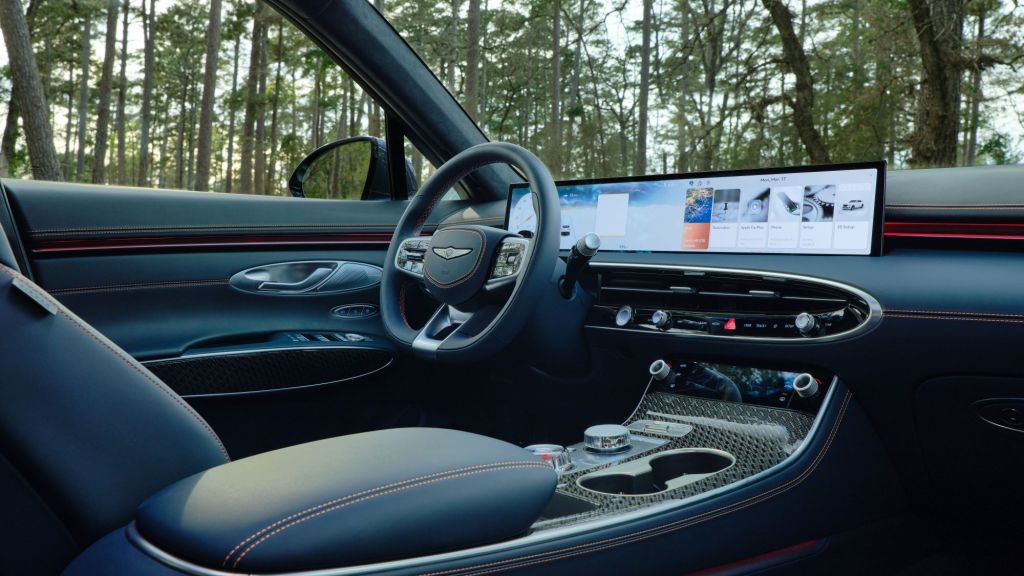
A comfortable cockpit. Tech is available without being overwhelming or calling attention to itself. Usability matters most. (Images: Genesis)

The vehicle features a 27-inch OLED screen. It stretches across the front of the driver and so has the cluster information necessary for vehicle control. But it also stretches into the area of the center of the instrument panel and so contains navigation, apps and audio control capabilities (AM/FM/HD Radio/Sirus XM (as long as you’re not in Alaska or Hawaii); as there is a Bang & Olufsen audio system you’re probably going to be listening to music, not news because the sound is really good).

The point is: this is as technical a setup as most any going out there.

Now this is a car that offers fingerprint recognition for operation.

It has the Genesis Digital Key 2 system, which means that you can use your phone or smartwatch to unlock/lock and start the GV70.

But rather than messing around with things that really don’t need fixing, it offers wireless Android Auto and Apple CarPlay.

If they thought they could do better they probably would have tried to replace them.

Instead they concentrated on making the drive experience a spirited and pleasant one.

///

As the name of the vehicle indicates, it has a 3.5-liter, 24-valve, DOHC, twin-turbo V6.

The engine produces 375 hp @ 5,800 rpm and 391 lb-ft of torque at 1,300 to 4,500 rpm.

It runs on premium fuel.

It is mated to an eight-speed automatic.

The transmission has paddle shifters.

This GV70 has all-wheel drive. That’s just as germane to the hard acceleration that may happen on occasion as it is to the slippery conditions that may be encountered.

///

2026 GV70: Style meets substance.

And then there’s the ride.

There are multilink suspensions front (MacPherson) and rear.

But there are a couple of other things that make a difference.

While you probably think not at all about the bushings in a suspension system—which are typically made with rubber or polyurethane and work to do such things as isolate vibrations and reduce noise—Genesis chassis engineers think a lot about them.

So for the GV70 they use “hydro bushings.” While the rubber and polyurethane types depend on elasticity of the materials to do their jobs, the Genesis hydro bushings use fluid that flows through an orifice, instead.

The difference? Genesis claims rear-seat passengers experience about 40% fewer vibrations.

Then there’s something more sophisticated.

There is a “preview” function of the electronically controlled suspension. It uses information from both the front camera and the navigation map.

Consequentially, if there’s rough road ahead, the system is ready. Adjustments are made as required. So the ride is smooth.

That’s clever.

///

Inside the seats are Nappa leather.

The front seats offer a four-way power lumbar.

There is an extension bolster that provides additional leg support.

The driver seat has an “Ergo Motion” function (a.k.a., massage).

The front seats are heated and cooled.

The rear seats are heated.

The steering wheel is leather-wrapped. And heated.

The instrument panel has “leatherette” (a.k.a., synthetic leather) wrapping.

The headliner is “microsuede” (a.k.a., synthetic suede that looks every bit like the real thing and is actually better from the standpoint of keeping it clean).

There is an abundance of carbon fiber trim. It is the real thing, not the result of wrapping or hydrodipping, as some OEMs do (a.k.a., synthetic carbon fiber that looks good only at a glance).

///

While the vehicle is technologically advanced, the execution is such that it doesn’t call attention to itself.

The model driven here is the top-of-the-line. It has a starting MSRP of $70,095 and it is so well equipped that adding things isn’t particularly likely.

2025 Genesis GV80 Coupe 3.5T E-SC AWD

Looks good. Drives well. And is full of high-quality materials and top-notch tech

By Gary S. Vasilash

All of that alphanumeric nomenclature isn’t particularly telling unless you happen to be a cipher expert and have the key necessary to decode it.

And one of the points that isn’t made in all of that but should probably be made clear is that, yes, the roofline, which swoops down toward the rear and resolves into a kick-up spoiler, is coupe-like.

But (1) coupes typically have two doors and this has two. And (2) coupes are generally cars and this is an SUV.

And what an SUV it is.

Genesis GV80 Coupe: presence and appropriate performance. (Image: Genesis)

Of the many vehicles I have driven of late, none has garnered the positive attention that this one has, from both strangers (I encountered a couple in a parking lot admiring the GV80) and relatives (a brother-in-law who has seen the panoply of vehicles I’ve driven and for the first time asked me to give him a ride).

Maybe it has something to do with the fact that, comparatively speaking, and especially in southeastern Michigan, Genesis vehicles overall are rare.

But likely it has more to do with the execution of exterior and interior design that is exceptional.

Outside

In the front of the vehicle there is the familiar crest-shaped grille, which is bold but not in-your-face. The headlamps are two lines (the two lines are a design theme of Genesis models) that seem to be much narrower than might be expected for the lights.

And it isn’t’ simply an issue of seeming: they’re using “Micro Lens Array” tech that allows the light to do their work yet in a form factor that is smaller than is ordinarily the case.

There is also restraint in the use of chrome trim on the body side, mainly used in the door undercut above and in the area below the rocker panels.

Inside

Nappa leather seating surfaces. Actual carbon fiber trim (and plenty of it). Microfiber suede headliner (no, not actual suede leather, but not only does it look like it, it also looks a heck of a lot better than tricot or other fabrics typically used).

There are power front seats. And power second row seats. The driver gets a power cushion extension, bolster, and massage function.

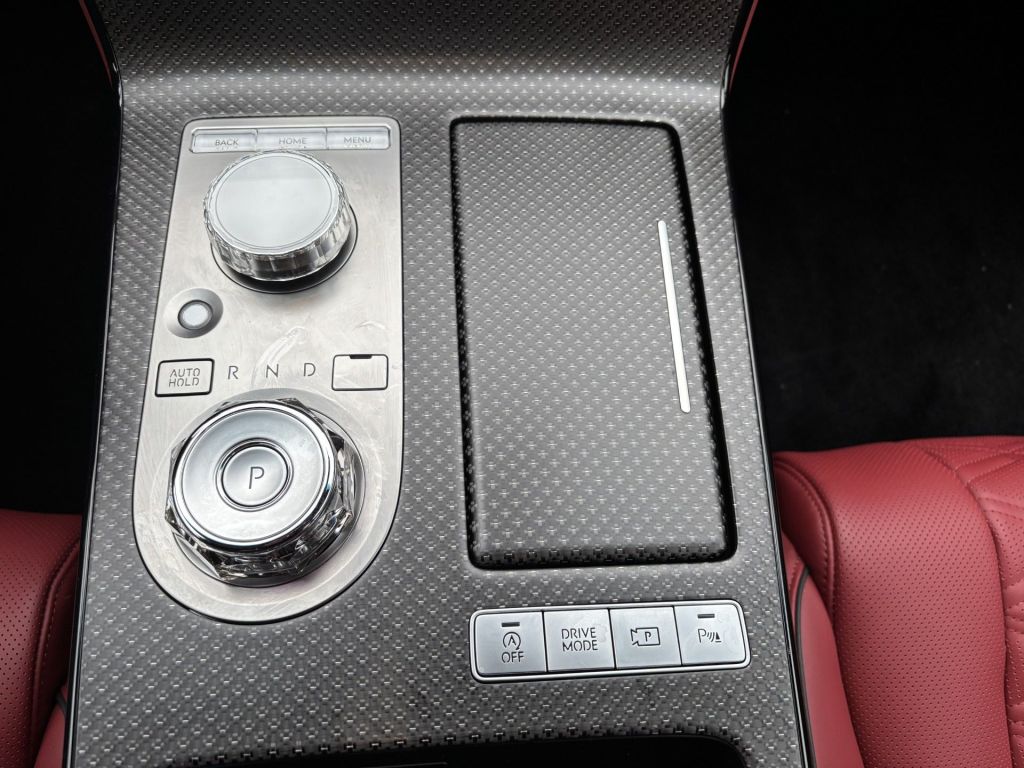
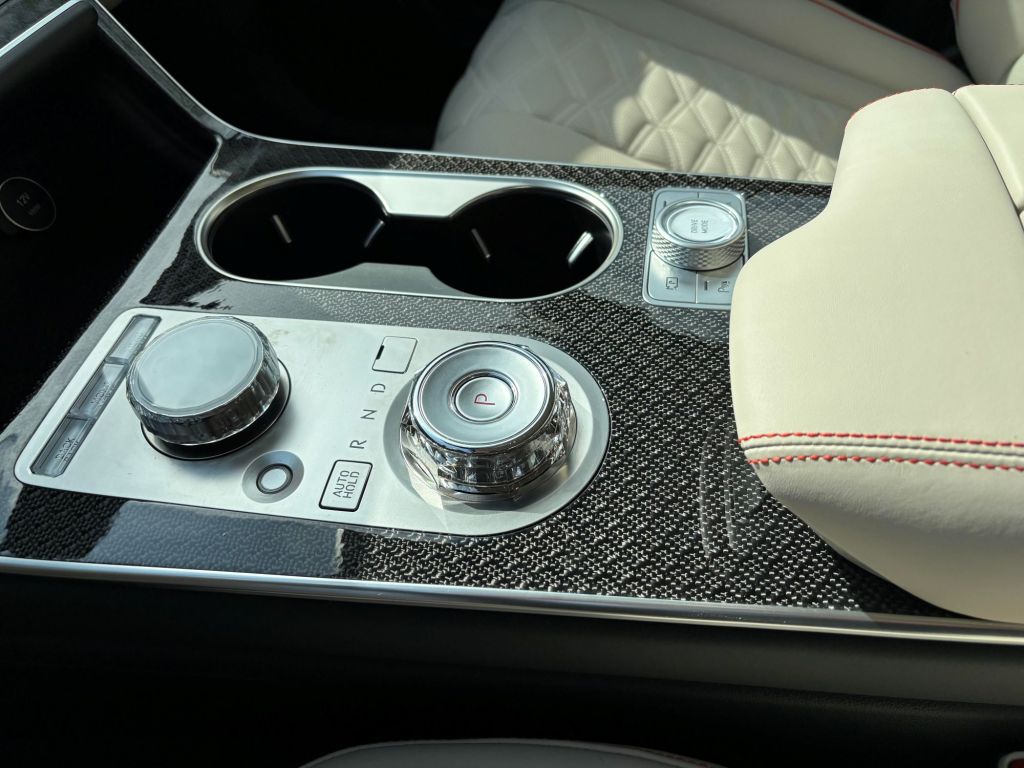
Note the carbon fiber and the color of the stitching—to say nothing of the knurled knobs that provide an interface to the infotainment system and gear selection. (Image: Vasilash)

Sometimes when there is a coupe design the second row suffers in terms of headroom. In the GV80 Coupe the front headroom is 40.2 inches and the rear is 37.6 inches. Two points about that: (1) I had a six-footer in the second row who was perfectly comfortable; (2) that second row measure is merely 0.8 inches less than the headroom in the non-Coupe GV80, so it is not like a lot is being given up.

Power

Here we get to the rest of the nomenclature in the name of the GV80 Coupe.

The powertrain is a 3.5-liter twin-turbo V6 with a 48-Volt e-Supercharger. (What’s that? An electric motor that compresses air and forces it into the engine intake, which improves combustion. This means it improves performance. It is more efficient than traditional mechanical superchargers or turbochargers. But, of course, it is more sophisticated.) It is mated to an eight-speed automatic. There are, not surprisingly, paddles on the steering wheel should you want to shift it yourself.

Tech

On the inside there is a 27-inch-wide OLED screen. What’s notable about this is that it is comparatively restrained compared to other vehicles in its class that have screens so big that they pretty much silently scream “Look at me! I am a giant screen!” The screen in the Genesis does everything necessary without digital ostentation.

The vehicle is “Cloud Connected,” which means everything from over-the-air (OTA) updates to dynamic routing in the navigation.

There is an 18-speaker Bang & Olufsen audio system.

Then there is the sensor-based functions ranging from cruise control with stop and go capability to parking avoidance assist (front/side/rear).

Price

One could say that this is a “total package,” and it is: the vehicle Driven, chock full of things that would otherwise be options on competitive vehicles, had a base MSRP of $85,750. It had two options: $650 for the paint and $30 for an NFC keycard (the size of a credit card, this card used Near Field Communication technology and provides a backup for the key fob or smartphone; it allows unlocking and starting the vehicle). The point is that while that may seem to be a steep(ish) price, again, there is so much in terms of high-quality materials and tech that were much of these things to be itemized, I’m sure the vehicle would be much more costly.

Genesis: Clever Exterior Color for Racing

Going fast. And paying attention to detail. . .

By Gary S. Vasilash

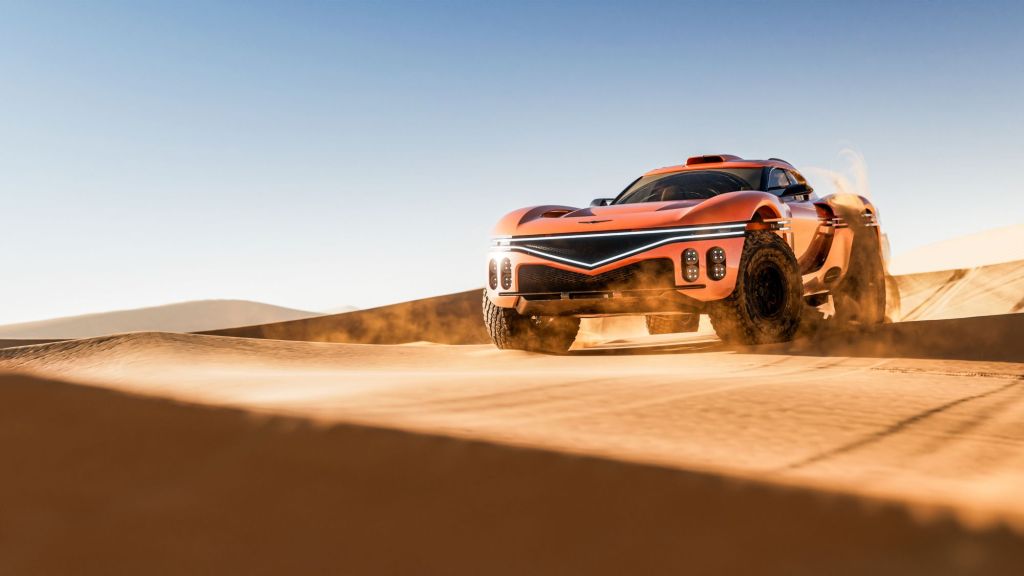
Because of the seemingly obligatory nature of being a luxury brand and having a racing team of some sort—in this case, Genesis Magma Racing participating in the 2025 European Le Mans Series with an objective to compete in the FIA World Endurance Championship (WEC) in 2026 and the IMSA SportsCar Championship (IMSA) in 2027—the company has developed a LMDh endurance prototype hypercar that is intended to be the precursor to a bona fide vehicle that will run in the WEC and IMSA events in the future.

Of the vehicle, which was designed at Genesis Design Europe, Luc Donckerwolke, Genesis Chief Creative Officer, said, “The GMR-001 Hypercar, like every race car, is a sculpture designed by the constraints of efficiency and performance – combined with the design DNA of Genesis – the brand with the Two Lines.”

The two lines mentioned are the lighting signatures, both front and rear.

Genesis gets creative with color. (Image: Genesis)

While there was particular attention paid to making the vehicle as aerodynamic as possible, there are a couple of interesting non-aero design elements worth noting:

  1. The paint. The primary color is “Magna orange.” The color starts bright at the front of the vehicle then becomes darker as it moves toward the rear. There it is deep red. This is to indicate both the engine (i.e., red hot) as well as sound: The Doppler effect. That is, the sound is a higher pitch when the object—like a race car with a twin-turbo V8—approaches you and then becomes lower as it moves away. So brighter to darker, higher to lower.
  2. The use of Korean Hangeul lettering spelling “Magna” integrated into the design 마그마.

In both cases, it is indicative of the attention to detail that you can find in vehicles at your local Genesis dealership—vehicles that aren’t going to compete in any race series, but which do have the Two Line lighting.

2025 Genesis G80 3.5T Sport Prestige AWD

Why this model deserves serious consideration. . .

By Gary S. Vasilash

Genesis was launched as a stand-alone brand in the U.S. in 2015.

In 2008 Hyundai started selling large, lux models in the U.S. that were labeled “Genesis.” Like the “Hyundai Genesis” model.

The thing is, Hyundai was largely recognized back then as a purveyor of economical vehicles, whether it was the entry-level Accent or the sporty Tiburon.

The design revolution that was launched by the Hyundai Sonata didn’t happen until the sixth generation, starting with the model year 2011 car.

The success of that car led to a transformation of the perception of the brand from frumpy to forward.

But still, there was the association of value with Hyundai. Certainly not a bad characteristic, but most luxury buyers probably aren’t worried about whether the vehicle they buy have “America’s Best Warranty.”

The situation was not unlike that experienced at U.S. Volkswagen dealerships from 2004 to 2006, when the $70,000 Phaeton was available.

Imagine taking that car into the service department and seeing a 1978 Beetle (the last year the original was available in the U.S.) covered with Deadhead stickers up on a lift.

Somehow the exclusivity just wasn’t there.

A similar situation would be between an Accent and a Genesis

So the decision was made to make Genesis a brand onto itself.

The first two models offered in the U.S. in 2016 were the G80 and the G90.

Both sedans.

As you may recall, 10 years ago there was a real upswing in demand for lux SUVs.

But Genesis didn’t have one.

And it followed the G80 and G90 with the G70 in 2018—another sedan.

The GV80, an SUV, was launched in the U.S. in 2020.

Dealers must have sighed with considerable relief.

But the company continues to produce sedans. Including the G80.

The thing is: when the first G80 was brought on the U.S. market it was received with a “How are they able to do that?” with the “that” being producing a vehicle with features and amenities that were then primarily associated with the German marques, yet with a sticker price that the Germans had only on their entry-level vehicles.

Genesis designers and engineers have kept at it. They have made improvement after improvement to the interiors and exteriors, to the tech and to the powertrains.

2025 Genesis G80: Style and substance. (Image: Genesis)

The 2025 G80 3.5T Sport Prestige AWD starts at $77,000.

You climb inside it, sit on the quilted Nappa leather seats, look at the actual carbon fiber surfaces, assess the information on the 27-inch OLED instrument cluster and infotainment system, and you know this is something special.

You depress the Start button and the 375-hp turbocharged V6 makes a subdued rumble.

You turn the rotary shift knob located on the center console to put the car into gear, and the car moves with alacrity.

You smile.

Genesis now has a full suite of SUVs. The GV60, GV70, Electrified GV70, GV80, GV80 Coupe.

Yet it still has sedans, like this one.

At some point, I think, people are going to go into a dealership planning to get an SUV, take a sedan like the GV80 for a spin, and forget about that SUV.

2024 Genesis G90 3.5T E-Supercharger AWD

Driving large in luxury. . .

By Gary S. Vasilash

When people talk about the advantages of electric vehicles over those that explode gasoline in their cylinders typically included are:

• Quiet
• Powerful

The first is obvious. An electric motor has nothing exploding, just rotating at high speeds on some exceedingly slick bearings.

And the second is pretty much predicated on the torque, which is the measure of the force that is generated by said motor. A simple way to think about this is in relation to a food blender. You can push the “10” button and the blades whiz to that speed from a standing stop without any delay in going through the digits beyond zero.

Genesis G90. Moves with comfort and authority. (Image: Genesis)

One thing occurred to me when I drove the Genesis G90.

It is arguably quieter than many EVs because I suspect that there is an array of countermeasures taken to mitigate any sound intrusion into the cabin.

And when you depress the accelerator there is the kind of propulsion that might otherwise be achieved in an EV. It is worth noting that this is a different kind of acceleration experience than is achieved in, say, an ICE-powered sports car, which typically has the perceptible shift moment. The eight-speed in the G90 is fully smooth.

While this is certainly not an electric vehicle, as it is powered by a 3.5-liter V6, it does have a 48-V e-supercharger which kicks in at low speeds such that there isn’t lag.

Of course, that the powertrain has an output of 409 hp, that isn’t something that you would expect, anyway.

But the point of the G90 isn’t speed. It is more about no-compromise confidence.

The G90 was the original flagship model when Genesis was launched in the U.S. in 2016. That leading status within the brand has been maintained as the vehicle has evolved, but what hasn’t changed is that it is large and luxurious.

As for the size, it is 207.7 inches long, 76 inches wide, 58.7 inches high and has a 125.2-inch wheelbase.

As for the lux, the vehicle is, simply, loaded. The vehicle driven here had a single option: $650 for special paint. Standard are features including Nappa leather seats, power front and rear seats with massage (yes, the rear is room and quite comfy), microfiber suede headliner and pillars, 12.3-inch high-def infotainment screen, Bang & Olufsen audio, and carpeted mats that are so thick you might want to sit in the car barefoot.

There are the obligatory assist features, from lane-keeping to safe-exist assist. There is even remote smart parking assist.

And there is the striking yet sophisticated exterior design that telegraphs the performance of the vehicle as well as a higher level of luxury, indicated by a tasteful touch of chrome trim.

But the G90 comes at a cost. The MSRP of the vehicle driven here is $99,500, which puts it in the space with vehicles like the BMW 7 Series and the Audi A8. Which brings something to mind: the 7 Series was first introduced in 1977 and the A8 in 1994. So both have something of a pedigree, something that the G90 lacked. Presumably the designers and engineers at Genesis realized that if they were going to get into that space it wasn’t a matter of equaling the competitors but bringing something more.

Which they have.

2025 Genesis GV80 3.5T Prestige AWD

Where style is tied with technology. . . .

By Gary S. Vasilash

A colleague and I were sitting in a new vehicle, an SUV. A premium vehicle. We were checking it out, looking at the surfaces, the way they met, the textures, the fabrics. We looked at the infotainment system and gauge cluster. Where they were positioned. How they were integrated into the overall IP. We adjusted the HVAC louvers. Opened and closed the glovebox.

We gave the interior a solid inspection.

“Does this look like the interior of an $80,000 vehicle?” I asked.

My colleague pondered for a moment.

“Well, it surely isn’t like the interior of something like a Genesis GV80,” he responded.

“Yes, I know. I’m driving one right now.”

And I didn’t make that scene up.

The interior of the GV80 has a lot of tech but it is executed in a way that is more about comfortableness rather than “Gee whiz—look at me! (Images: Genesis)

///

A couple weeks later J.D. Power released its 2024 U.S. Tech Experience Index (TXI) Study.

Kathleen Rizk, senior director of user experience benchmarking and technology at J.D. Power, said one determination that they made of the study is: “A strong advanced tech strategy is crucial for all vehicle manufacturers, and many innovative technologies are answering customer needs.”

Genesis ranks highest in the study for innovation, not only in the premium segment that it is included in, but with its score of 584 on a 1,000-point scale, highest overall, including mass market brands.

In the premium segment it is 49 points ahead of Lexus (at 535) and BMW (at 528).

The study looks at four categories: convenience; emerging automation; energy and sustainability; and infotainment and connectivity.

So clearly Genesis pays sufficient attention to these things in order to take the top position.

And it should be worth noting that this makes it four times in a row that Genesis has taken the top spot in TXI.

So within that GV80 not only is there an interior that is comfortable, but an array of infotainment technology.

Which makes it a proverbial double win for those who are within the cabin of the crossover.

If the impressive exterior styling is taken into account, then this means that the vehicle wins a trifecta.

///

For the 2025 model year GV80 there was a focus on upping the interior.

While the interior designers followed a design approach they describe at “Beauty of White Space,” it isn’t at all some sort of minimalist execution, not something that makes you think you are sitting in the capsule of a space ship.

Yes, there is a 27-inch wide OLED screen which is as technological as any you’ll find.

But the sumptuous, quilted available Nappa leather seats, the use of real wood and real aluminum for trim, the ergonomic arrangements of the interfaces all make this something that brings to mind a comfortable study more than a department at the local BestBuy.

///

The GV80 is powered by a 375-hp 3.5L twin turbo engine that is mated to an eight-speed automatic with paddle shifters.

The 2025 GV80 features a new front end with the “Two-Line Crest Grille” that accents the “Two-Line” headlamps.

It has multi-link suspension setups with high-performance gas shock absorbers all around.

It rides on 20-inch aluminum wheels.

///

The whole GV80 package is something that could be characterized as being an “executive car.”

It is stylish but not flashy, powerful but restrained.

It is in a space that used to be wholly inhabited by German marques.

But it more than holds its own compared with them.

2024 Genesis GV60 Performance AWD

It can cause envy. . .

By Gary S. Vasilash

I had the interior designer from another car company in the 2024 Genesis GV60.

He looked at that glowing orb embedded in the center console of the vehicle that recently won the J.D. Power U.S. Automotive Performance, Execution and Layout (APEAL) study in the small premium SUV category.

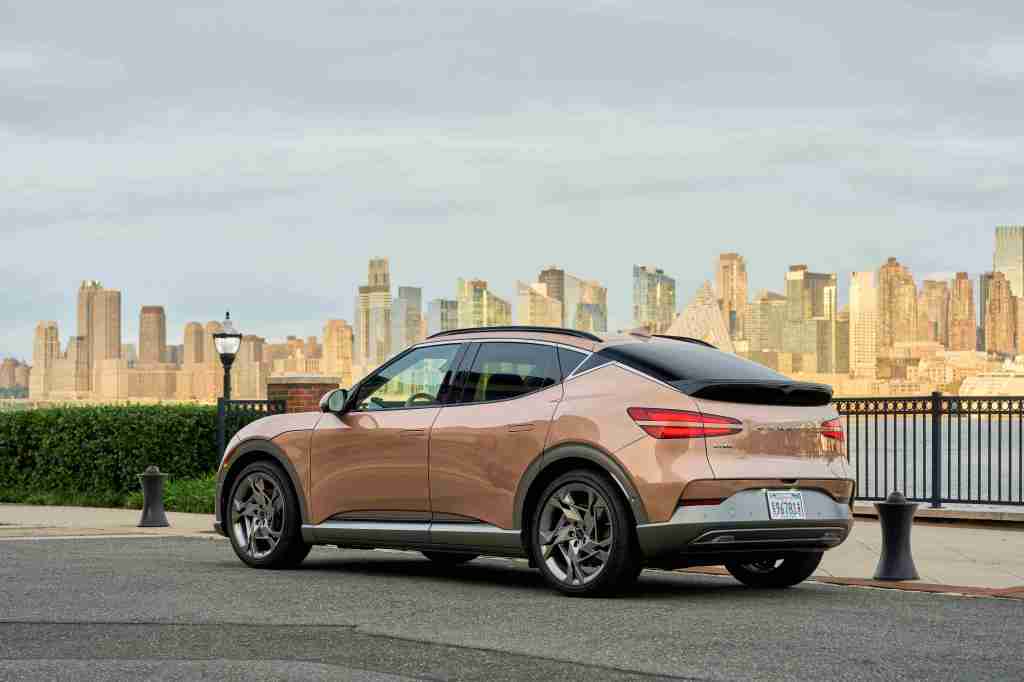
Yes, that is a glowing orb in the center console. (Images: Genesis)

That orb is actually called the “Crystal Sphere.”

It glows.

When the vehicle is started the sphere rolls over and exposes a dial that allows the gear selection (which is perhaps not as accurate a term given that the GV60 is an electric vehicle, and while EVs do have gears, they don’t have traditional transmissions with multiple gears that have to be run through for motive power, which explains, in part, why EVs have that torque from the get-go and why they are more efficient than ICE vehicles because there aren’t the mechanical losses).

The designer was intrigued by the Crystal Sphere, which I suppose is why it exists in the vehicle, although I think that the fit and finish—as well as execution and layout—of the rest of the interior is sufficiently interesting in and of itself, as in things like the patterns on the seating surfaces (which, like other items in the interior, are made from eco-friendly materials, but materials that seem like they are leather, for example).

Intriguing, all.

He told me that he thought that it was quite cool.

But then he began wondering aloud about the level of difficulty of fixing it were it to go wrong.

And then going back and forth, weighing the pluses and minuses, he finally concluded:

“We would never be able to use anything like that.”

And I could detect a bit of regret in his tone.

Elementary. . .

It’s the first dedicated EV model from Genesis.

When it was introduced, Luc Donckerwolke, chief creative officer of Genesis, said: “The GV60 is a symbolic model that materializes the unique values and the sensibilities that Genesis stands for. It offers a satisfying experience to our customers who want something valuable, but different.”

It can be opened with your face. (There is a near infrared camera in the B-pillar.)

It can be started with your fingerprint. (Further underscoring the notion of this is more than a crossover, but a highly sophisticated, comfortable, computer on wheels.)

It has two 160 kW motors, one in the front, one in the back. Which means 320 kW or 429 hp.

It has a 77.4-kWh battery that can be charged on a fast charger (>250 kW) from 10 to 80% in 18 minutes.

It—as in the model in question here—does have eco-friendly, but the seats are Nappa leather, which comes from things with four legs.

It has a 14-way power adjustable driver seat that not only has power lumbar (four-way), but even a cushion extension. (Notably, all trims have this seat.)

It has an infotainment system accessed via a 12.3-inch LCD display. The “tainment” portion is predicated on a 17-speaker Bang & Olufsen sound system.

It can tow. 2,000 pounds.

It has 101.1 cubic feet of passenger volume (think five people but two happier ones if they’re not joined by a third in the back seat).

It has 24 cubic feet of cargo volume behind the second row.

It has a 0.71-cubic foot frunk (think small microwave oven).

It has an EPA estimated range of 235 miles.

It has a starting MSRP of $69,550.

EV Sales Elsewhere

Seems like the EV slowdown is happening elsewhere, too

By Gary S. Vasilash

The South Korean-based brands—Hyundai, Kia and Genesis—are producing some of the most-appealing electric vehicles available in the U.S. market.

Award-winning Kia EV9 (Image:Kia)

Consider, for example: for the 2024 North American Car, Truck and Utility Vehicle of the Year Awards, the Hyundai Ioniq 6 was one of the three finalists in the Car category. The Genesis Electrified GV70, Hyundai Kona/Kona EV, and Kia EV9 were the three finalists; the EV9 received the award.

And, of course, these products (and others, too) are available to Korean consumers.

GlobalData has run numbers for how well electric vehicles are doing in the home market of those companies, and finds that through April 2024, zero-emissions vehicle sales in Korea, 97% of which are EVs and the balance fuel-cell vehicles, are down 17% compared with April 2023.

Meanwhile, hybrids (including plug-ins) are up by some 45%.

Why are EVs not doing so well? GlobalData suggests:

  • Early adopters have gotten them. The majority isn’t buying yet.
  • And on the subject of buying, there is the comparative higher costs of EVs.
  • Charging is a concern.
  • Residual value decreases make an EV purchase less appealing.

GlobalData points out that while there had been dismissiveness expressed by some pundits regarding hybrids as being a bridging technology between internal combustion engine vehicles and EVs, the numbers are showing that that is indeed the case.

The good news for Hyundai, Kia and Genesis is that they offer compelling hybrid products as part of their global portfolios, too.

2024 Genesis G70 AWD 3.3 Sport Prestige

An impressive starting point. . .

By Gary S. Vasilash

It has a 3.3-liter twin-turbo V6 that produces 365 hp and 376 ft-ft of torque. Which is to say that it is a robust engine that doesn’t need the Active Sound Design feature that allows you to hear a more full-throated engine note. But this is the sort of thing that Genesis provides in its vehicles, which is to say a lot of things even if some of them you never use, which is the opposite of what some OEMs do.

G70: Confident in appearance and you’ll feel confident driving it. (Image: Genesis)

Now it should be pointed out that the sport sedan of interest here is the top-of-the-line variant of the vehicle that is the entry way into the Genesis lineup. Including the $1,250 for “freight” (hey, it is a long way from Namyang, South Korea, so that’s a deal), the total price for the sport sedan is $57,750, and know that this is for an absolutely loaded vehicle.

Such as:

•        19-inch alloy wheels

•        Power trunk (this one is sort of silly: I mean the trunk isn’t that high to simply reach up and close, but it is an indicator that this is an elevated vehicle brand-wise)

•        Power-folding outside mirrors that project the Genesis logo on the ground at night when approaching the vehicle with your fob

•        Nappa leather seats (the driver has a power bolster and cushion extension as well as four-way power lumbar, which the passenger gets, too). And they are both heated and ventilated.

•        Microfiber suede headliner (interrupted by a large sunroof) and pillars (while you may not pay much attention to the fabric up top and on the sides because it generally doesn’t deserve attention, but when you have this material you do)

•        Leather and aluminum trim

•        Smart cruise control

•        10.25″ navigation system

•        Lexicon Premium Audio (that provides AM/FM SiriusXM/HD radio)

•        Apple CarPlay and Android Auto

•        Genesis Connected Services

•        Various types of “Assist” (e.g., Forward Collision-Avoidance, Lane Keeping, Lane Following, Rear Cross-Traffic Collision-Avoidance)

And this could go on. And on.

As it is a sport sedan there are MacPherson struts in the front and a multilink rear suspension in, well, the rear. As this is a premium sport sedan, the suspension is electronically controlled. And because when you go quickly you generally need to stop quickly, as well so there are Brembo brakes (and if nothing else, the calipers that can be seen through the wheels telegraphs that this is a bona-fide sport sedan).

As it is a Genesis, the exterior styling of the vehicle is superb. Genesis has gotten to the point in its short existence where it is confident in what it is putting out with its winged-badge affixed. It isn’t the case where it is trying to out-Europe the Europeans or trying to meld in with the other Asians (i.e., Lexus, Acura).

Although sport sedans are becoming a less-important part of the lineup for many OEMs, those that have continued to produce the models have, overall, realized that in order to attract the decreased number of buyers they have to elevate their offerings. Add to that the fact that Genesis is still something of a challenger brand, and it has to step up to the Euros and other Asians and then step a bit beyond.

What’s more, as mentioned, the G70 is the least-expensive model in the Genesis lineup (it starts at $41,500), the company wants to make sure that what may be a consumer’s first experience a good one, so it is making sure that the G70 is more than simply worthwhile.