Which Vehicles Might Take NACTOY Trophies for 2025?

Four North American Car, Truck and Utility Vehicle of the Year jurors talk about the semifinalists for the awards in a lively discussion. . .

By Gary S. Vasilash

The North American Car, Truck and Utility Vehicle of the Year (NACTOY) Award has been around since 1994. Back then, of course, utility vehicles, by and large, weren’t what they are now, vehicles, to borrow a phrase from Alfred Sloan, for every purse and purpose. So there was no category for CUVs/SUVs at the start.

But in 2017 the decision was made to add the Utility category.

That year there were three finalists:

  • Chrysler Pacifica
  • Jaguar F-Pace
  • Mazda CX-90

Oddly, the Pacifica won. (Not that it didn’t deserve an award and it is not like minivans aren’t the most package-efficient architectures, but if were to run the elementary school test, wherein you’d show a picture of a Pacifica and a Wrangler to a 10-year-old and say, “Which is the sport utility vehicle,” odds are the Pacifica wouldn’t get the nod.)

Nowadays, the Utility category is the most-contested, by far.

The Jurors

You might be wondering just who picks the winners.

Obviously, the MotorTrend Car of the Year is selected by that publication. And there is no mistake the Car and Driver 10 Best are selected by the journalists for Car and Driver.

In the case of NACTOY, there are 50 journalists from the U.S. and Canada, a mix of people working in all types of media, from ink-on-paper to YouTube to radio.

Clearly there is an array of opinions generated by this group.

Three of the current NACTOY jurors are Henry Payne, car critic for the Detroit News (yes, he reviews trucks and utilities, too), Mark Phelan, who reviews vehicles for the Detroit Free Press, and auto writer Greg Migliore.

Oh, and I am a juror, too.

I brought the three of them together to talk about the “NACTOY Best of 2025,” a.k.a., the semifinalists, on “Autoline After Hours.”

That group of vehicles will be winnowed down to three finalists in each category. The finalists will be announced in LA on November 21, and the winners at the Detroit Auto Show on January 10, 2025.

The Vehicles

The vehicles in question at the moment are:

Cars

  • BMW 3 Series
  • BMW M5
  • Cadillac Celestiq
  • Dodge Charger EV
  • Fiat 500e
  • Honda Civic Hybrid
  • Kia K4
  • Mercedes-AMG E Class
  • Porsche Panamera
  • Toyota Camry

Trucks

  • Ford Ranger
  • GMC Sierra EV
  • Ram 1500
  • Rivian R1T
  • Toyota Tacoma

Utilities

  • Chevrolet Equinox EV
  • Honda Prologue*
  • Volvo EX90
  • Hyundai Ioniq 5 N
  • Hyundai Santa Fe
  • Jeep Wagoneer S
  • Lincoln Nautilus
  • Porsche Macan EV
  • Toyota Land Cruiser
  • VW ID. Buzz

So if you’re thinking about getting a new vehicle, you might want to watch the show.

If you’re interested in a lively discussion of the offerings made by the auto industry, you certainly want to watch it.

And you can see it here.

By the way: Henry Payne goes out on the proverbial limb and names the vehicles that he thinks will win the awards. While you could simply slide that fast-forward dot on YouTube and bring it toward the end of the show to see Henry’s predictions, you’ll want to watch the whole thing to see his reasoning to get to those conclusions.

Cadillac LYRIQ: Hitting All the Right Notes

An up-close look at the exterior and interior design of what will undoubtedly become the flagship of the Cadillac lineup (sorry, Escalade)

By Gary S. Vasilash

The Cadillac LYRIQ is certainly the most important Cadillac vehicle to be launched since the Cadillac CTS appeared in 2003. Arguably the LYRIQ, an electric vehicle, is one of the most important products that General Motors is putting on the market because it truly marks a commitment to contemporary EVs that it has announced are coming.

The 2023 LYRIQ, which will be on the market in the first half of 2022, is the real thing.

The fresh face of Cadillac. (Images: Cadillac)

Yes, it will be beaten to showrooms by the GMC HUMMER EV, but that is arguably a niche vehicle. A niche vehicle with people with deep pockets: the first edition, for which all of the reservations have been spoken for, has an MSRP of $112,595.

The LYRIQ will start at $58,795. The reservations for the first edition of the crossover were full. In 10 minutes.

The LYRIQ has an estimated range of over 300 miles from the 100.4-kWh Ultium battery pack. It is a rear-drive vehicle. The Ultium drive unit will provide ~325 hp.

On the inside there is a 33-inch diagonal screen that stretches across the instrument panel, a 19-speaker AKG Studio audio system, eight-way power driver and front passenger seats, and other accoutrements that are characteristic of a vehicle that is a showcase for the brand.

An interior so well crafted, you might not want to leave when your trip is complete.

On the exterior there is a illuminated black crystal front grille that illuminates in an orchestrated manner, a grille that is certainly a signature of not only the vehicle, but of the level of creativity, imagination and technology that may become known as what Cadillac is all about.

On this edition of “Autoline After Hours,” we learn about the LYRIQ, inside and out.

We—“Autoline’s” John McElroy, Henry Payne of The Detroit News, and me—are joined by Brian Smith, Cadillac exterior design director, and Tristan Murphy, Cadillac interior design manager.

What is notable about LYRIQ, even if you put aside that it is an EV, is that this is a vehicle that was a total clean-sheet design. They were creating something absolutely new, something that wasn’t a variation on a theme.

The charter was to create a vehicle that would not only show the world of electric vehicles that Cadillac has arrived, but the world that drivers live in too: This is meant to be a vehicle that not only will people like driving, but be one that they’ll be proud to be seen in.

Three of the words that Smith and Murphy use to characterize what the LYRIQ represents are performance, technology and craftsmanship.

The best of right now with the attention of detail that often seems to be lost.

===

Then, for the second half of the show, McElroy, Payne and I, all jurors for the North American Car, Truck & Utility of the Year (NACTOY) awards, talk about the vehicles that we had the opportunity to drive earlier in the week, all semifinalists for the 2022 awards.

The vehicles include:

  • Audi A3 and S3
  • Cadillac CT5-V Blackwing
  • Genesis G70
  • Honda Civic
  • Mercedes S Class
  • VW Golf and GTI
  • Ford Maverick
  • Hyundai Santa Cruz
  • Nissan Frontier
  • Toyota Tundra
  • GMC HUMMER EV pickup
  • Rivian R1T
  • Ford Bronco
  • Genesis GV70
  • Hyundai Tucson
  • Jeep Grand Cherokee
  • Jeep Wagoneer & Grand Wagoneer
  • Kia Carnival
  • Nissan Pathfinder
  • VW ID.4

And you can see it all here.

Does Tueor Technologies Have a Better Idea for Vehicle Control Systems?

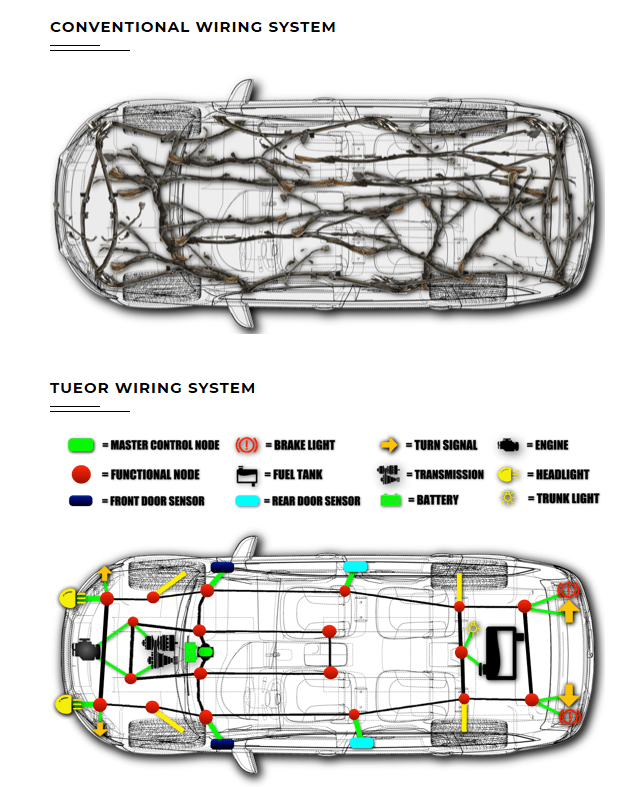
Although one of the claimed benefits of the Digital Current System (DCS) developed by Tueor Technologies is that it is “hack-proof,” what is possibly more compelling is that according to Dan Greene, chief operations officer for the company, is that it eliminates from 80 to 90% of the wiring needed for a vehicle’s electrical control system.

Just one loop of coaxial cable. It carries power. It carries data. It combines grounding and feedback.

There is a master control node running the system. There are sensor nodes, switching nodes and slave nodes. Each of the nodes has a varying level of intelligence, from obtaining information to essentially doing a single task, such as locking and unlocking a door.

Tueor’s simple, safe system. (Image: Tueor Technology)

Should the cable break, the DCS keeps working, Greene says.

The unhackability is predicated on the fact that it is a closed system and should there be an update necessary—over-the-air or otherwise—it cannot be loaded into a vehicle system unless there is explicit permission given by the owner. And to prevent something non-desirable from piggybacking onto a valid update, Greene says a check-sum system can be setup so if something is supposed to be X and it is seen to be X + 1, then it will not be permitted to load into the system.

According to Greene, Tueor began its work on the system to address the ability to hack medical devices like pacemakers and insulin pumps. Then they moved on to satellites. Then to military vehicles, working with AM General on the Stryker armored vehicle.

Auto application?

Not yet.

Seems that OEMs and suppliers are not engaging with the Tueor team.

Greene and his colleague John Dinkel talk about the DCS on “Autoline After Hours” to “Autoline’s” John McElroy; Henry Payne, auto critic for the Detroit News; and me.

Then John, Henry and I discuss a number of subjects, with a particular focus on electric vehicles, as Henry is an enthusiastic owner of a Tesla Model 3 and as on the day of the show GM’s Mary Barra announced that the corporation plans to be carbon-neutral in both its operations and products by 2040. Part of that undertaking includes “an aspiration to eliminate tailpipe emissions from new light-duty vehicles by 2035,” which means an increase in the number of vehicles it puts on the road that don’t have internal combustion engines but possibly frunks under the hoods.

We talk about innovation and corporate cultures. And a whole lot more.

All of which can be seen right here.