
The facts and the feelings. . .
By Gary S. Vasilash
It is the sixth generation of the nameplate after a 25-year hiatus (2001 to 2026). (People talk about nameplates with pedigree: the first was a model year 1979, or 47 years ago.)
It is a compact coupe.
It is 178.4 inches long, 74 inches wide, 53.4 inches high, and has a 102.6-inch wheelbase.
It rides on 19-inch wheels.
It is a front-wheel drive vehicle.
It is a hybrid.
It is powered by a 2.0-liter Atkinson four-cylinder engine supplemented by a traction motor such that the total system output is 200 hp.
It has what is known as a “two-motor hybrid system” with the aforementioned traction motor and a generator motor. The generator motor produces electricity for the drive motor.
It weighs 3,261 pounds. This means the power-to-weight ratio is 16.3 lb/hp. That is better than the base fifth-generation Prelude (21.9 lb/hp) but not as good as the fifth-gen Type SH (15.2 lb/hp), but not off by a huge amount.
It doesn’t have a conventional transmission. It has a single fixed-ratio direct-drive clutch system instead. (The clutch comes into play when the engine is operating at higher speeds.)
It offers four drive modes that adjust functions including powertrain response, steering feel, suspension damping, and the graphics on the gauge cluster:
- Comfort: A smooth powertrain response; light steering; soft dampers
- GT (the default setting): Stronger powertrain response than previous; more-direct steering feel; firmer dampers than in Comfort
- Sport: Sharpest throttle response; heavier steering; firm suspension
- Individual: Select the powertrain, steering, damper, etc. settings
It has an S+ function that is accessed via a button that’s to the right of the gear selector buttons and ahead of the Drive Mode selector on the center console. It simulates a step-gear transmission and allows the driver, through the use of the shift paddles on the steering wheel, to do things like downshift and hold gears even though there aren’t any of those functions physically: it simulates the feeling of an eight-speed very well and supplements engine noises, to boot.
It has a dual-axis strut front suspension and a multi-link rear suspension.
It has Brembo brakes—13.8-inch rotors; four pistons—in the front and rear brakes from the Civic Type R, 12-inch rotors and a single piston sliding caliper. (The suspension is also shared with the Type R, as is the steering system.)
It is a four-passenger car (a.k.a., “2+2 coupe).
It provides a passenger volume of 84.6 cubic feet.
It provides a cargo volume of 15.1 cubic feet.
It is equipped with the Honda Sensing system, which includes an array of driver-assistance and ADAS tech including forward collision warning, lane departure warning, adaptive cruise control with low-speed follow, and traffic sign recognition.
///
Now you know a lot about it.
But you really don’t have a good sense of it.
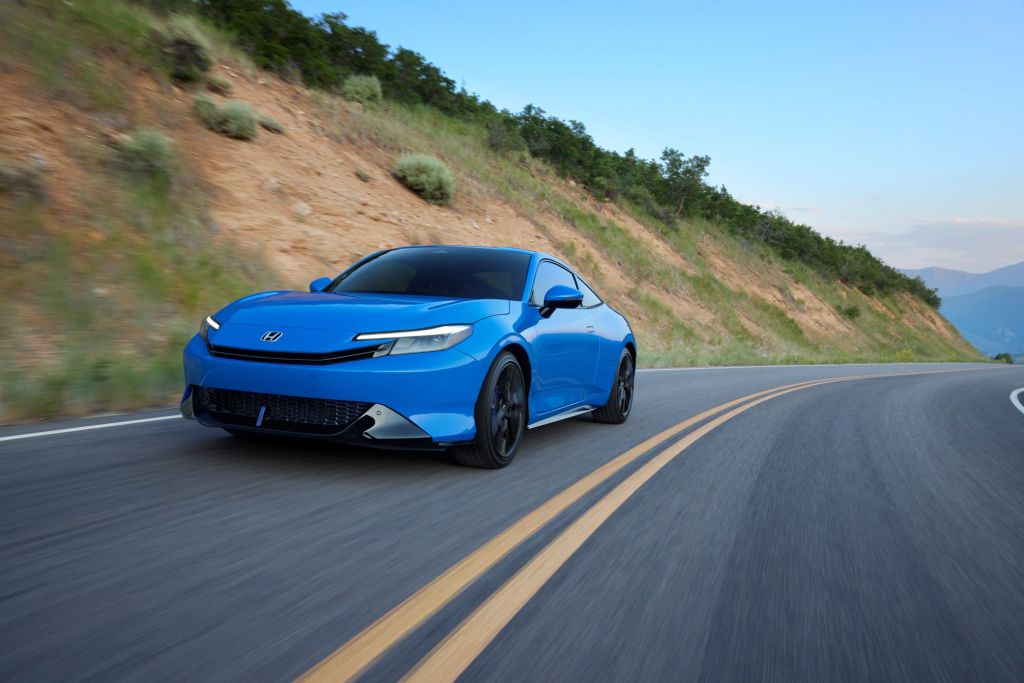
The first thing to know about the Prelude, which comes as a single spec through there are options that can be added, is that it looks great. The roofline is such that the vehicle appears—even when parked—as though it is going to spring forward.
This vehicle had not only lots of turned heads as I drove by, but comments from complete strangers about it. One guy who came to my front door trying to sell me fertilizer service spent more time telling me how much he loved the look of the Prelude than he did talking nitrogen, phosphorous and potassium.
In the current environment the fact that it is EPA rated at 46 city/41 highway/44 mpg combined—and those numbers are right on with what I experienced—is certainly a consideration for someone.
One of the things I think is important is not how any given vehicle drives in some ideal setting but on the everyday roads, including freeways. Sometimes smaller, sportier vehicles can make one feel like they’re going to be crushed like a bug by all of the full-size pickups and SUVs that are on the streets. This can be particularly disturbing when on freeways. But the Prelude comported itself just fine, whether it was on the potholed surface streets of southeastern Michigan or the autobahns freeways of the area.
While it could be an everyday driver, it strikes me that given its comparatively limited human and cargo capacities, it is more likely to be something of a weekend car.
The base MSRP is $42,000, which puts it well below the average transaction price for vehicles right now, but ahead of the starting price of a 2026 Accord Touring Hybrid ($39,495). While that is certainly not an apples-to-apples comparison, it sure does make that Accord look like a great deal even though it has a higher power-to-weight ratio than the Prelude (17.6 lb/hp) and probably won’t get as many positive comments from strangers.

