2024 Honda Ridgeline TrailSport

By Gary S. Vasilash

When the Honda Ridgeline was in its first year on the market, it received the 2006 North American Truck of the Year Award (it is worth noting that back then there wasn’t the Utility category, simply “Car” and “Truck,” and it was a good year for Honda, as the Civic took Car).

Then, when the second-generation Ridgeline, which is the basis for the current model, had its debut year, it took the 2017 North American Truck of the Year. The other two finalists were the Ford Super Duty (which won the NACTOY award in 2024) and the Nissan Titan (which is going out of production this summer).

The point of this is that the NACTOY jurors tend to be a picky lot (full disclosure: I am one of them), and for the Ridgeline to take its category the two times it has been eligible says a lot about the truck.
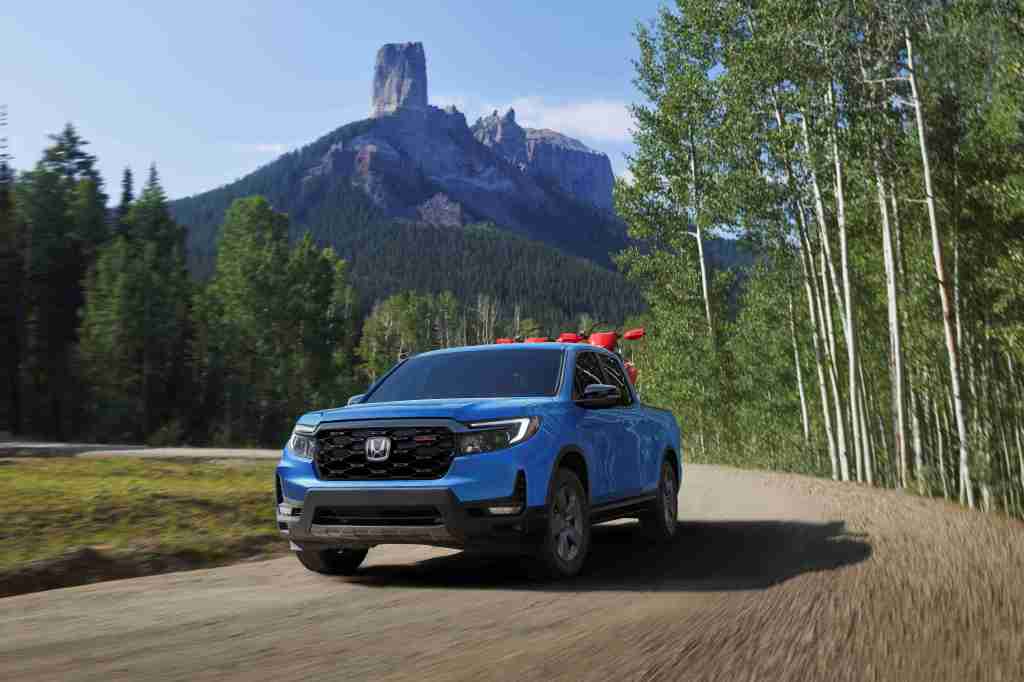
2024 Honda Ridgeline TrailSport: Yeah, it’s a truck. (Image: Honda)

One of the things that made some people dismissive about the Ridgeline being a “truck” is that doesn’t feature body-on-frame construction but is a unibody.

How dare Honda!

Clearly it was on to something because the U.S. pickup truck leader, Ford, introduced the Maverick in 2021 and it, too, is a unibody. (It took the NACTOY Truck category in 2022.)

(The Hyundai Santa Cruz is also on that type of platform.)

The Ridgeline has a box on the back: 64 inches long; 50 inches wide at the wheel wells, 51 inches wide at the D-pillar, 60 inches wide at bed walls.

The Ridgeline can tow: up to 5,000 pounds.

The TrailSport version has a total payload capacity of 1,521 pounds.

When driving the Ridgeline a friend took a look at the box on the back.

“I need a truck a few times a year.”

And it occurs to me that that is precisely the sort of person who might be inclined to get a Ridgeline rather than the other midsize trucks that are available, all of which are body-on-frame vehicles.

This is because the Ridgeline truly rides and handles like an Accord.

Let’s say for the sake of argument that my friend’s “few times” adds up to a solid month. Let’s say that he goes for one of those other midsize trucks.

That means for 11 months out of the year he’s driving something that doesn’t have anywhere near the ride and handling of the Ridgeline.

Seems to be quite a price to pay for hauling gear or gravel or whatever on occasion.

The TrailSport trim package is new for 2024. It has such things as a suspension tuned for offroad conditions and General Grabber A/T Sport tires (245/60R18), the first deployment of all-terrain tires on a Ridgeline. (Although they are big and chunky, the sort of thing you might imagine would generate all manner of road noise when not driving on a trail (which one might do “a few times a year”), somehow there isn’t a heck of a lot of noise from the tires in the cabin.)

In addition to which the TrailSport has a steal underbody protector for the oil pan.

On the inside there is the use of orange thread for the stitching on the steering wheel, door panels and seats; the front-seat headrests have “TrailSport” embroidered on them.

Just as there is capable rubber on the outside, there are serious rubber floor mats standard: if you’re going to use the truck to play in the dirt you might get dirty, so. . . .

The truck is powered by a 280-hp, 3.5-liter V6 that’s mated to a nine-speed automatic.

There is Honda’s torque-vectoring all-wheel drive system and there is “Intelligent Traction Management” for that system that allows the driver to select for sand, snow, mud, or paved roads. (Here’s betting that depending on where one lives, the last is the normal selection and the second occasional, assuming there are winter conditions.)

There are the now-obligatory infotainment features in the Ridgeline (e.g., nine-inch color touchscreen; Apple CarPlay and Android Auto), and what’s interesting is that Honda says that it has deployed a faster processor in its head-unit which means less lag.

According to Merriam-Webster, a pickup truck is “a light truck having an enclosed cab and an open body with low sides and tailgate.”

The Ridgeline certainly is that. And even more.

One more thing: Cars.com generates an “American-Made Index” each year for vehicles, taking into account assembly location, parts content, engine origin, transmission origin and U.S. manufacturing workforce.

The Ridgeline was designed and engineered in the U.S. It is manufactured in a plant in Lincoln, Alabama.

Of all vehicles—sedans, SUVs, minivans, hatchbacks, coupes, pickup trucks—there is only one truck in the top 10 of the most recent index: the Ridgeline.

Yes, according to Cars.com it is the most American of pickups.

So there’s that, too.

2024 Honda Passport Black Edition

By Gary S. Vasilash

While geography isn’t necessarily destiny, there is something about the Honda Passport being built in the company’s complex in Lincoln, Alabama. It seems somehow appropriate that a vehicle that is biased toward the outdoors would come from a locale that is not full-on urban (i.e., the population of Lincoln was 6,845 in the 2020 census; it is approximately 45 miles due east of Birmingham). I’m guessing that not long after one leaves the Lincoln city limits there is access to a number of driving surfaces that are less developed than, say, compared with the situation in Detroit (where the Grand Cherokee, a Passport competitor, is produced), so those putting the vehicle together have a good sense of what’s needed, and the Honda culture is such that the people who engineer the vehicle listen.

When the 2024 Passport was launched last fall, Lance Woelfer, assistance vice president of Honda National Auto Sales, American Honda Motor Co., said, “With more rugged off-road performance than ever before, the 2024 Honda Passport builds on our legacy of engineering rugged, capable and comfortable SUVs for active, weekend adventurers.”

(Image: Honda)

Somewhat off the beaten path

To be sure, some “weekend adventurers” are inclined to go to places that are far off the unbeaten path, but this two-row midsize crossover, while certainly more robust than you might expect a vehicle from Honda to be (assuming that you associate it with Accords and Civics), probably isn’t the ute that hard-core off-roaders would opt for. (For those so inclined, know that the ground clearance is 8.1 inches and the approach and departure angles are 21.1° and 24.3°, respectively.)

However, the standard in the Passport lineup is Honda’s i-VTM4 torque-vectoring all-wheel drive system that sends torque where it is needed, as much as 70% to the rear wheels, and then 100% of that can be shifted to the wheel that needs it, based on conditions (i.e., if the left wheel is off the ground or there is a slick patch beneath it, such as when stuck in the snow, the torque will be shifted to the right wheel to get things moving).

A superb characteristic of the i-VTM4 system is that things happen automatically: no knobs, buttons or levers required. (It seems to me that those who are occasionally dealing with uncharacteristically demanding conditions, such as when doing some weekend adventuring, probably have their hands sufficiently full (e.g., trying to avoid that downed tree and working to miss the jagged rock on the other side) without needing to do something else but piloting the vehicle.)

Big on black

The trim package driven here, the Black Edition, looks sufficiently aggro, but for someone who is trail-oriented would likely opt for the TrailSport version of the Passport

But the Black Edition, with trim added to the front fascia, blackout treatments on features front and back, and painted—black—20-inch alloy wheels, has an appearance that is particularly striking.

On the inside there is—no surprise—more black, such as the seats (the fronts are ventilated; the rear heated), though there is brightly contrasting red stitching that provides a brightening accent. What I found notable is that even the door opening lever is black, something that might otherwise go untreated: they are nothing if not thorough.

And while on the inside know there are an 8-inch color touchscreen and a 540-W audio system, CarPlay and Android Auto compatibility, two USB ports in the front (an A data port and a C charging port—and it should be mentioned there is a Qi wireless charger) and two for the backseat passengers (boy C charging ports).

Performance and people

The Passport is powered by a 280-hp V6 that generates 262 lb-ft of torque at 4,700 rpm. It is mated to a nine-speed automatic that offers paddle shifters. The vehicle uses regular unleaded, which is probably a good thing as its EPA numbers are 19/24/21 mpg.

The Passport provides room for people—EPA passenger volume 114.9 cubic feet—and objects—a maximum behind the first row of 100.7 cubic feet and 50.5 cubic feet with the second row up.

And to protect the people and objects, there the Honda Sensing array (with functions ranging from adaptive cruise to collision mitigation braking).

The MSRP for the ’24 Honda Passport Black Edition is $47,970.

The Ford 180

By Gary S. Vasilash

“Ford has shifted its electric vehicle strategy so it concentrates on smaller, lower priced EVs and electric work vehicles such as pickup trucks and full-size vans, Farley said. Any EV larger than a Ford Escape small SUV ‘better be really functional or a work vehicle.’”

That is from an AP story by Tom Krisher about a presentation Ford CEO Jim Farley gave to the Wolfe Research Global Auto Conference in New York on February 15.

Farley also talked about the relationship between Ford and the UAW in light of last fall’s strike.

Farley said, “Our reliance on the UAW”—it has more UAW members that either GM or Stellantis—“turned out to be we were the first truck plant to be shut down.”

He was referring to the Kentucky Truck Plant, Ford’s largest plant and where the highly profitable F-Series Super Duty, Ford Expedition and Lincoln Navigator are produced.

Ford has pretty much placed its production bets in North America on things like the F-Series.

The only car the company has on offer in the U.S. is the Mustang, not exactly what one would describe as a “family vehicle,” so arguably it is something of a niche at most. Trucks and utes are where it is at, it seems, for the Blue Oval.

In the smallish category there are the Escape and the Bronco Sport, which are both based on the same platform. And the Maverick pickup truck, which is also based on the same C2 platform. This extremely popular pickup is built at a Ford plant in Hermosillo,Mexico, so some of Farley’s USA! USA! USA! chest thumping needs to be adjusted a bit.

But his comment about where the sweet spot for EVs is going to be is somewhat puzzling.

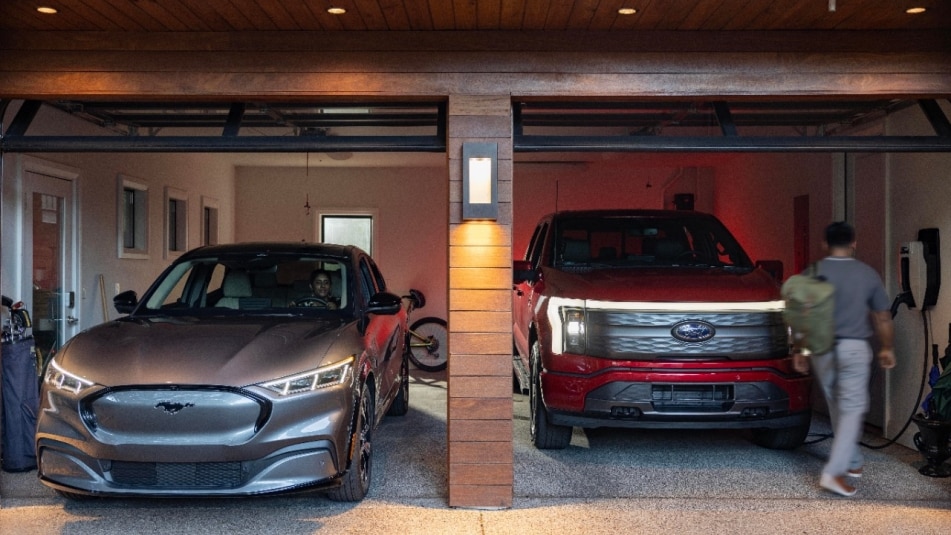
Right now Ford has three EVs, two for consumers and one for vocational use: the F-150 Lightning, Mustang Mach-E and E-Transit.

The Ford EVs for consumers: the Mustang Mach-E and the F-150 Lightning. (Image: Ford)

The first is, of course, a full-size pickup truck. The second trades on the muscle car performance of the Mustang. And the third is a vehicle for contractors.

Ford has been championing larger vehicles for the past few years for the simple reason that it is where it makes more money, so when it went EV it went big with the Lightning (and for power with the Mach-E).

It used to have the Focus to go up against the likes of the Honda Civic and Toyota Corolla, both of which still exist and do quite well in the market. Presumably neither Honda nor Toyota build those vehicles out of charitable impulses.

Ford used to have the Fusion to go up against the likes to the Honda Accord and the Toyota Camry, both of which. . . . Yes, same thing.

Ford—and it isn’t the only company in southeastern Michigan that has done this—has been messaging consumers that Bigger Is Better.

Suddenly Farley is talking about small vehicles.

Don’t get me wrong: small EVs, assuming that they can be made so that they are actually affordable for consumers and that provide a return to the OEMs, are undoubtedly a good idea to increase the number out on the roads.

Regardless of the size of the currently available EV (with the exception of Teslas) need to be sold to a still-skeptical public.

So there is that challenge.

And now Farley is doing a 180 and planning to go to the market with things that are small.

Which means he is going to need to convince people that on roadways populated with large F-150s and Explorers small Ford EVs are a good thing.

To which I say: Good luck.

Ford: Hybrids Should Be the Story

By Gary S. Vasilash

Much of the attention given to Ford’s Q4 2023 earnings call last week has been focused on CEO Jim Farley’s comment:

“[W]e made a bet in silence two years ago. We developed a super-talented skunk works team to create a low-cost EV platform. It was a small group, small team, some of the best EV engineers in the world, and it was separate from the Ford mothership. It was a start-up.

“And they’ve developed a flexible platform that will not only deploy to several types of vehicles but will be a large installed base for software and services that we’re now seeing at Pro.”

Somehow the inherent mystery of a “skunk works” has gotten people all excited.

Would they be so excited to know that the skunkworks methodology goes back to 1943 in the aircraft industry?

Yes, an 80-year-old approach.

Well, You’ve Got to Build It. . .

The other thing about this is that it is one thing for an R&D team operating independently to develop something and a whole other thing for that development to be engineered for and launched in production.

Launches have been something that Ford has been finding a bit troubling, so there’s that.

And it should be noted that the company also announced last week that its Ford e operation—as in the electric vehicles—lost $4.7 billion last year and the company anticipates losing $5 to 5.5 billion this year on Ford e.

The excitement of the skunk works project was certainly helpful from diverting some attention to that red ink.

What About This?

But what was largely overlooked was Farley’s comments on hybrids.

As in,

“Our global hybrid sales were up 20% last year, and we expect them to be up 40% this year.”

And:

“We now have the No. 1 and No. 2 best-selling hybrid trucks in the U.S. Maverick is No. 1. And we’re the No. 3 hybrid brand in the U.S. behind Toyota and Honda. But unlike them, our hybrids really sell best on trucks for our side.”

Given that Farley said “And margins on hybrids are closer to ICE, much higher than EV margins,” you’d think hybrids would be the headline going forward if for no other reason than the company can make money on them, something that it is not going to see on the EV side of the business until. . . . Well, that remains to be seen.

Maverick hybrid: Fuel efficiency and the energy to bust out the beats. (Image: Ford)

Not Exactly a Strong Third

While it is nice that Farley is so bullish about the company’s hybrid performance, it is worth really putting that into context.

Of course its hybrids “really sell best on trucks” because with the only hybrid Ford has without a box on the back is the Escape.

And as for it being number three, know that these are the number of hybrid sales for the three companies in 2023:

  1. Toyota:         523,664
  2. Honda:         293,640
  3. Ford:            133,748

In other words, it sold less than half of what Honda did and about a quarter of what Toyota did.*

So while the claim is factually true, one should perhaps not be too chuffed about the Ford hybrid performance.

About a quarter of Toyota and Honda sales are hybrids.

About 7% of Ford’s sales are hybrids.

Did I mention the skunk works. . .?

==

*It is worth noting that until recently Toyota was treated like some technological troglodyte for its continued support of hybrids and its not all-in approach to EVs. Not only do we see that Ford is reconsidering its positioning vis-à-vis hybrids and full EVs, but General Motors, which doesn’t have much of a record in the hybrid space, has announced that it, too, is going to bring hybrids to the U.S. market. Farley pointed out on the earnings call that consumers can quickly do the math on the fuel efficiency benefits of hybrids and, perhaps the most important factor: “they don’t have to change their behaviors.” It is surprising that there seems to be so many auto execs who ignore the long public charging time required for EVs compared with pumping gas: perhaps this is a case that when they get behind the wheel of their company vehicles someone else has done the charging.

Fuel Cell Market to Expand, But. . .

Fuel cells are having their moment again for various vehicle applications, from light-duty to big rigs.

How big a moment?

Seems not trivial according to a report by MarketsandMarkets, which products the automotive fuel cell market will grow from $200 million this year to $2.1 billion by 2030. It will have a compound annual growth rate of 48%.

Where will the largest market be?

Asia Oceana.

Given that the geographies covered in the firm’s report also includes Europe, North America and Rest of the World, presumably that Asia Oceana includes China, which could explain the biggest market.

(Image: Toyota)

That said, with companies including Toyota, Honda and Hyundai continuing their hydrogen fuel cell development efforts, Japan and South Korea can’t be counted out as players, and consumers, in this field.

However. . .the global battery electric vehicle market size right now is on the order of $500 billion and it is estimated to be about $1.5 trillion by 2030, so even with the impressive growth of fuel cells, they’re still approximately the size of a dandelion in a redwood forest.

Hybridized CUVs Matter

By Gary S. Vasilash

Here’s a fun fact: the Honda CR-V hybrid was the best-selling hybrid vehicle, bar none, in the U.S. market in 2023.

197,317 were delivered.

Honda CR-V Hybrid under its skin. (Image: Honda)

Meanwhile, over at Toyota, 161,125 RAV4 Hybrids were sold and an additional 26,073 RAV4 Primes, the plug-in hybrid, for a total of 187,198 hybrids.

GM has zero hybrids.

Ford has hybrid versions of the Escape, Maverick, Explorer, and F-150.

Combined, it delivered 133,743 hybrids.*

Ford sold 140,986 Escapes in 2023. That’s with all powertrain options.

Fewer than the Honda and Toyota hybrids.

Chevy sold 212,701 Equinoxes—none of which are electrified, and not all that many more than the CR-V hybrid (15,384, non-trivial, but when you take into account that Honda sold 361,457 CR-Vs in 2023, well. . . ).

Clearly, compact CUV hybrids are appealing.

Surprising GM is ignoring the market and Ford probably needs to ramp up its output.

Dodge has a hybrid version of the Hornet available, a crossover that launched last Spring, so its efforts are still nacent in this space. It sold a total 9,314 Hornets in 2023, of which 3,591 were the hybrid version, so there’s evidently some traction.

(Jeep has the Wrangler 4xe plug-in and the Grand Cherokee 4xe plug-in, of which it sold 67,429 and 45,684, respectively. Neither, of course, is likely cross-shopped with a CR-V or RAV4, but still nice numbers.)

*Here’s a big number–the electrified Toyotas sold in 2023: 565,800. With the exceptions of 2,737 Mirai fuel cell electric vehicles and 9,329 bZ4X BEVs, all hybrids.

Honda Motocompacto: Ridden

By Gary S. Vasilash

The starting price of an iPhone 15 Pro is $999.

Which puts the starting MSRP for the Honda Motocompacto electric scooter–$995—into some context.

Chances are, the kind of people who’d opt for that phone model would be ideal for the personal transportation device—and yes, it is more of a device than a traditional scooter, especially given that the Motocompacto can be folded into an easy-to-lug (it weighs 41 pounds, so while you’re likely able to carry it, it probably won’t be for a great distance, which is where the lugging comes in) rectangular (self-) container measuring 3.7 inches wide, 21.1 inches high, and 29.2 inches long: think of it is a narrow suitcase.

The scooter folds into itself so there is a tidy package ready to be put in the truck of a car (ideally a Honda or Acura, as dealers of those brands are where the scooter is sold) for the next last-mile journey.

You meet the nicest people on a Motocompacto. (Image: Honda)

But the point of the scooter is to provide quick urban transport, not to be transported (although that folding is quite clever).

It has a range of 12 miles, a top speed of 15 mph, and it can accommodate a rider who weighs 265 pounds.

Once the battery is exhausted, it takes 3.5 hours to recharge from a traditional plug in the wall.

The typical electric scooter is designed for the rider to be standing up when riding it.

The Motocompacto is designed so the rider is sitting.

This does a couple of things.

  1. It lowers the center of gravity, which facilitates balance
  2. It allows the rider to be able to use their legs to recover if they feel they’re going out of balance

If you’re standing and the platform under your feet is traveling at speed and something goes awry, it could be the makings of a serious tumble.

If you’re sitting on a Motocompacto that is moving along, it is far easier to maintain one’s physical composure (even though one may be thinking “Holy sh**!”).

Riding Is Easy

It really is. No instructions required.

Need for Speed

While 15 mph might seem snail-slow, when your posterior is comparatively close to the wide open ground, it is quick. The Motocompacto is FWD, and it can get to that top speed in 7.5 seconds.

You’ve Heard of Honda

According to data analysis company Tracxn, there are some 450 electric scooter manufacturers. Odds are you’ve heard of not many of them. And odds are you’ve seen reports of late that indicate some e-scooters are bursting into flames. Seems to me that it would be a better investment—even if that investment is higher—to go with a Honda than something built by a company that started up a few months ago and very well may cease to exist a few months from now.

Don’t Count Out Cars: Lesson from Honda August Sales

By Gary S. Vasilash

For those who think that cars—those lower-roofed vehicles with two or four doors that aren’t designed to be able to or pretend to be able to traverse Moon-like surfaces—have had their day, August sales results from Honda are instructive.

For the month Honda sold 17,661 Accords, which is a 52% increase over August 2022. The car sales are up 36.3% for the year compared to 2022.

(Image: Honda)

And Civic sales increased 133.1% in August over the previous year, 17,077 vehicles. For the year Civic sales are up 47.5%.

To be sure, Honda sold a lot more non-cars in August: 65,047 compared with 34,738.

However, there are five vehicles in the non-car category vs. two.

The CR-V crossover is the brand’s biggest seller, 30,991 units.

However, the closest sales number to either of the cars is achieved by the HR-V, which was at 11,404. That’s a third lower than Civic sales.

Sony Honda Mobility: Huh?

By Gary S. Vasilash

That Sony and Honda announced last fall that they were forming Sony Honda Mobility was certainly curious. Perhaps Sony execs felt a compulsion to get into automotive because its long-time rival Panasonic has been supplying electric vehicle batteries for the past several years, and it wanted to get into the vehicle space, as well.

And as for Honda—well, given that it is a comparatively small OEM, it needs to establish partnerships where it can, so having already signed up with GM, going with Sony is probably considered to be a useful thing for no other reason than the electronics manufacturer has lots of tech, and that’s certainly useful to an OEM.

AFEELA prototype: yes, a sedan. (Image: Sony Honda Mobility)

SHM revealed the name of its new brand, AFEELA, and a prototype vehicle to accompany it. While there are some who criticize the name, odds are people looked askance at “Trinitron” back in 1968 and “Acura” in 1986.

But here’s a curious thing about it:

The company says that it aims “to create a new mobility lifestyle by leading people’s hearts and minds towards an open, pleasant and exciting experience. To realize this, we aim to revolutionize the mobility space as a Mobility Tech Company, alongside like-minded people who are pioneering a new future with creativity, through cutting-edge technology, and with passion.”

And it introduced a car.

Somehow the goals and the delivery mechanism seem rather disconnected.

A car.

Two Fun Facts About Honda

By Gary S. Vasilash

  1. Although some think of Honda as a Japanese company—yes, that’s where its HQ is located, so there is that—in 2021 Honda produced 1,300,804 cars, trucks and SUVs in North America and just 615,587 in Japan. Or said another way: more than twice as many in North America.
  2. Honda opened two research facilities in the U.S. in 1975. One in Torrance, California, where American Honda is headquartered, and a test lab in Ann Arbor, Michigan. Even though it has a massive manufacturing footprint in Ohio—Marysville Auto Plant, East Liberty Auto Plant, Performance Manufacturing Center, Anna Engine Plant, Ohio Transmission Plant—the next facility it opened was in. . .Denver, Colorado, in 1980, an operation that focuses on high-altitude emissions tests and catalyst aging. The most recent: this year, in East Liberty, Ohio, HALO: Honda Automotive Laboratories of Ohio. It is a wind tunnel facility that performs aerodynamic, aeroacoustics and racing testing.

(Data from the 2022 Honda Digital FactBook)