The Honda Prelude, which first arrived in the U.S. in 1979, has always been a sporty coupe.
Since its introduction there have been five generations:
1979-82
1983-87
1988-91
1992-96
1997-2001
Yes, the run ended near the turn of the century.
An issue is simply that sport coupes are pretty much confined to a niche market.
The biggest sales year for the Prelude was back in 1986, when some 80,000 were sold.
Put that number against the number of Accords or Civics sold in a given year, and one might argue that Honda management was nothing if not supportive of the approach to spirited driving provided by the Prelude.
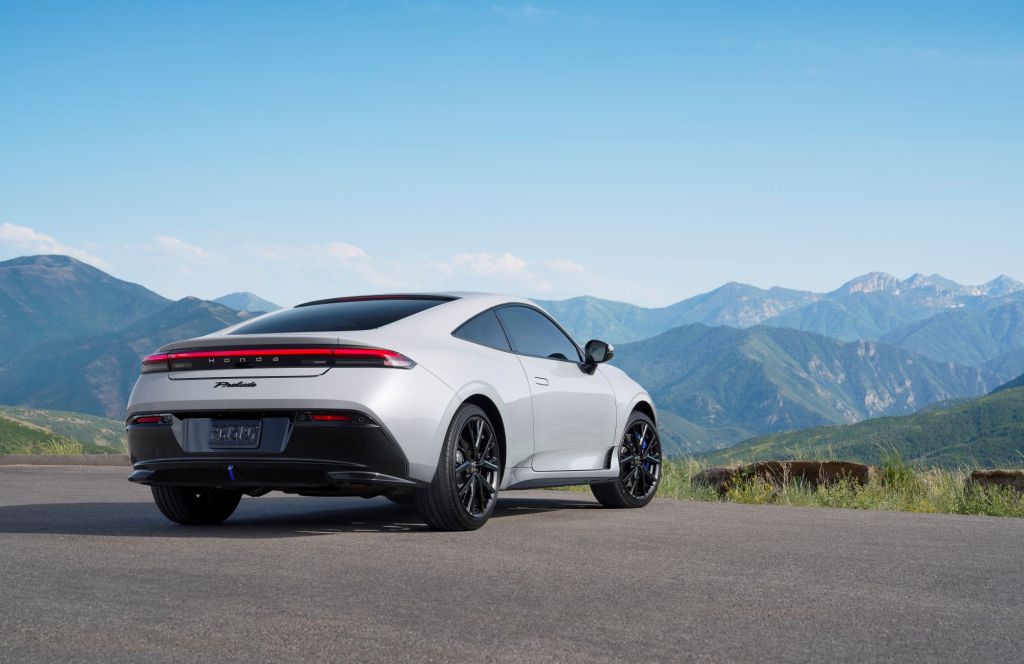
And that spirit will soon be back, as Honda has announced that later this fall the sixth-generation Prelude will go on sale in the U.S.
(Images: Honda)
Yes, it is still a sports coupe.
But what makes this one different is what’s found under the hood:
A 2.0-liter Atkinson cycle direct-injected engine that is supplemented by two electric motors. The result is a system output of 200 hp and 232 lb-ft of torque.
To help assure the kind of driving performance the Prelude has been known for:
A new development called “Honda S+ Shift.” This manages the coordination between the engine and the motors, including rev matching and gear holding, that is accessible through the paddle shifters.
The use of chassis hardware from the Civic Type R, including dual-axis strut front suspension and larger brakes 13.8-inch front rotors with Brembo monobloc four-piston aluminum calipers; 12.0-inch rotors in the back)
Enhanced Honda Agile Handling Assist, which integrates the powertrain, braking and steering for better control
Of course, sometimes people just want to have a pleasant drive, so there are three drive modes, including Comfort.
No surprise: the other two are GT and Sport.
To simplify things, the two-motor hybrid will be available in one trim.
Not only does this simplify the consumer buying experience, but it also means there is a single model to produce, thereby improving the scale of production, important when it comes to vehicles that aren’t likely to have Civic/Accord-type numbers.
Yes, it is built to take it. But how many are going to take it to places where that matters?
By Gary S. Vasilash
One of the consequences of the COVID pandemic, when people didn’t get on airplanes and go places and pretty much avoided people to the extent the could, was the “overlanding” phenomenon. The point of this was to climb into one’s vehicle and drive someplace where the odds of encountering other people up close was minimal at most. And if you did encounter them, you were outside, which meant wind was your friend, blowing the stuff away.
This gave the rise to more people buying vehicles that could take them places where their conventional SUVs wouldn’t take them because their SUVs were based on platforms that also underpinned cars, so they were insufficiently robust.
Solid Base
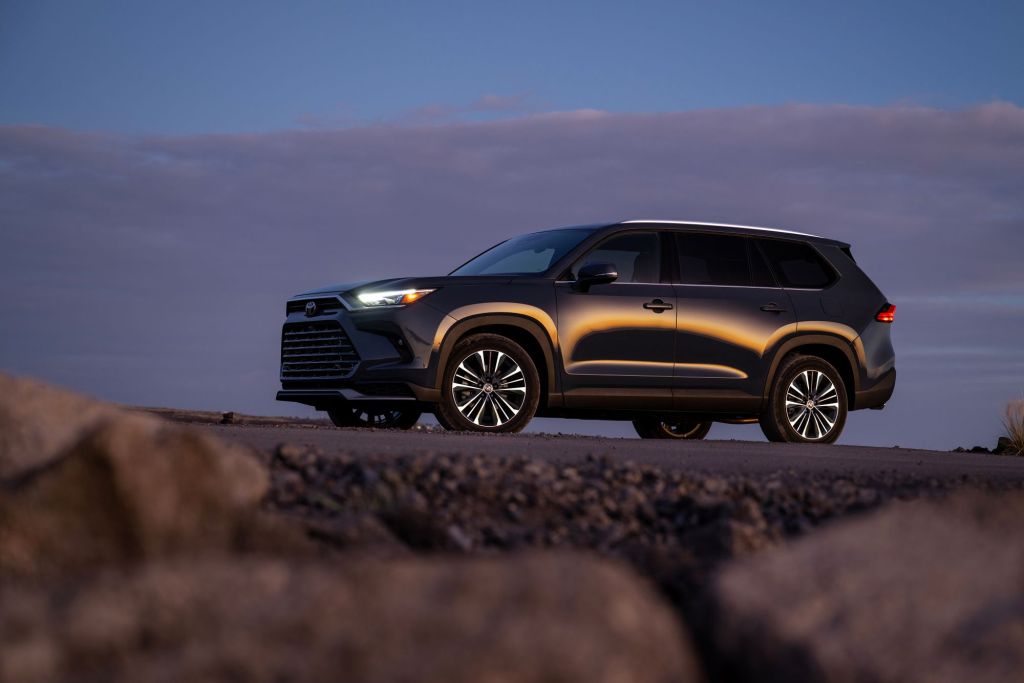
The Lexus LX 700h (as well as the other LX variants in the lineup) is based on the global Toyota GA-F platform. It has frame. It isn’t a unibody like those aforementioned SUVs.
The GA-F platform is also used for the Toyota Land Cruiser 300, Tundra, Sequoia, Tacoma, and 4Runner.
Those vehicles—especially the Tacoma and 4Runner—are often used in driving situations where even trails are left behind. And they take it.
Off-Road Enablers
So the LX has some fundamental bona fides when it comes to the ability to drive on surfaces that aren’t leading to the valet stand at the country club.
It has some 8.07 inches of ground clearance, an approach angle of 23 degrees and a departure angle of 21 degrees.
There are front and rear locking differentials.
There are Active Height Control and Adaptive Variable Suspension. Multi-Terrain Select (four modes when driving in four low (Auto, Sand, Mud, Rock) and five modes in four high (Deep Snow in addition to the others). There are Crawl Control—which is essentially like Cruise Control but when in four low—and Turn Assist, which facilitates a reduction in the turning circle of the vehicle when Crawl Control is on (though the driver does the turning).
There is a clever Multi-Terrain Monitor, that uses four cameras, the images from which are stitched together so that there is an image on the 12.3-inch display in the center console that allows the driver to “see” beneath the front of the vehicle, which is very handy when traversing terrain that is tough.
The vehicle rides on 33-inch tires and 18-inch wheels.
Hybrid Setup
The “h” in the nomenclature of the vehicle signifies that it is a hybrid.
There the powertrain uses a twin-turbocharged 3.4-liter V6 supplemented by motors so the system output is a stalwart 459 hp and 583 lb-ft of torque.
One of the benefits of the hybrid system for those doing overlanding (in addition to the stickered 19 mpg city/22 mpg highway/20 mpg combined) is that when Multi-Terrain Select is engaged the vehicle can be powered by the electric motors alone, sans engine, for more precise control of speed.
The nickel-metal hydride battery is packaged in a waterproof container that allows water fording of up to 27.5 inches.
What’s more, in the event that there is something awry with the hybrid system, the LX, unlike other Lexus hybrids, features an alternator and starter so the V6 can be operated on its own.
And they even addressed the Shore hardness of the foam used for the seats for the Overtrail, making it easier on the occupants when traversing trying terrain.
All of which is to say it is engineered to be considerably capable.
Design Cues
Arguably the exterior design of the vehicle was executed during the pandemic, taking into account the seeking of vehicles that have a stout appearance.
A special color, Earth, was developed for the Overtrail.
On the interior there are either Black or Stone Brown leather trim and Black open-pore wood accents.
All of that said. . .in this execution, the LX 700h Overtrail doesn’t seem like a Lexus.
There is something about the brand, with its vehicles generally combining luxury, technology and style. In this case it seems to be more about the mechanical from a technical point of view. The luxury is overwhelmed (sure the materials are first-rate on the inside) by what I found to be oppressive darkness.
The style of the exterior seems too much like a truck and the style of the interior seems somewhat pedestrian.
On the one hand, this is probably a means by which Lexus can garner a few more global customers for something with off-road credentials.
But on the other, Toyota has things like the Land Cruiser which is meant for those circumstances.
Sometimes extensions aren’t a good idea, but as they have the makings on hand, it probably won’t matter much, either way.
Lexus LX 700h Overtrail: You can play in the dirt with it. But would you? (Image: Lexus)
Lexus brings a small hybrid. But the styling could use some help. . .?
By Gary S. Vasilash
The good news about the Lexus UX300h F Sport is that it is a hybrid. And not just any hybrid system but the fifth-generation Lexus Hybrid System. Which doesn’t necessarily mean all that much at first. I mean, does anyone remember the second- or third-generation Lexus Hybrid System?
I didn’t think so.
But what this does mean is that the UX300h has a system that has been refined multiple times, more times than probably any competitive hybrid vehicle out there.
As for what that system consists of: it is a 2.0-liter four-cylinder engine that is supplemented by two motor generators via a planetary-type continuously variable transmission. There are front and rear motors and a 60-cell lithium-ion battery.
All of which means that there is a total horsepower of 196.
And a combined fuel economy of 43 mpg.
Which is a nice thing to have.
The thing to know about the hybrid system in this vehicle is probably this: you can simply ignore it. It just works. There is nothing that makes you think, “Hmm. . .I wonder what’s going on in there?”
In a word: seamless.
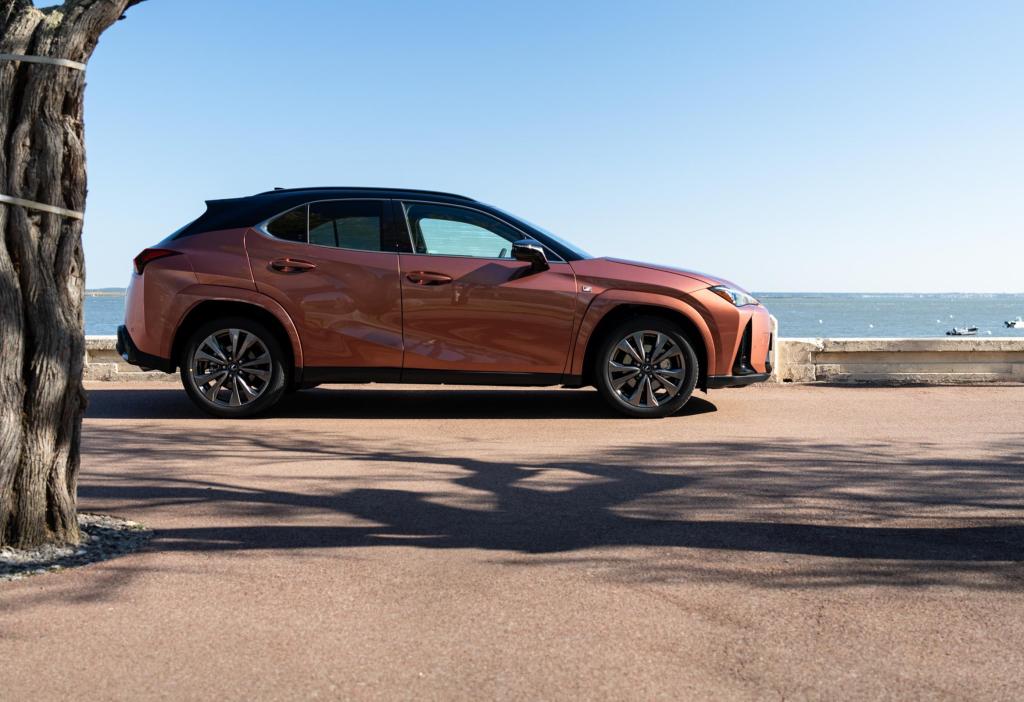
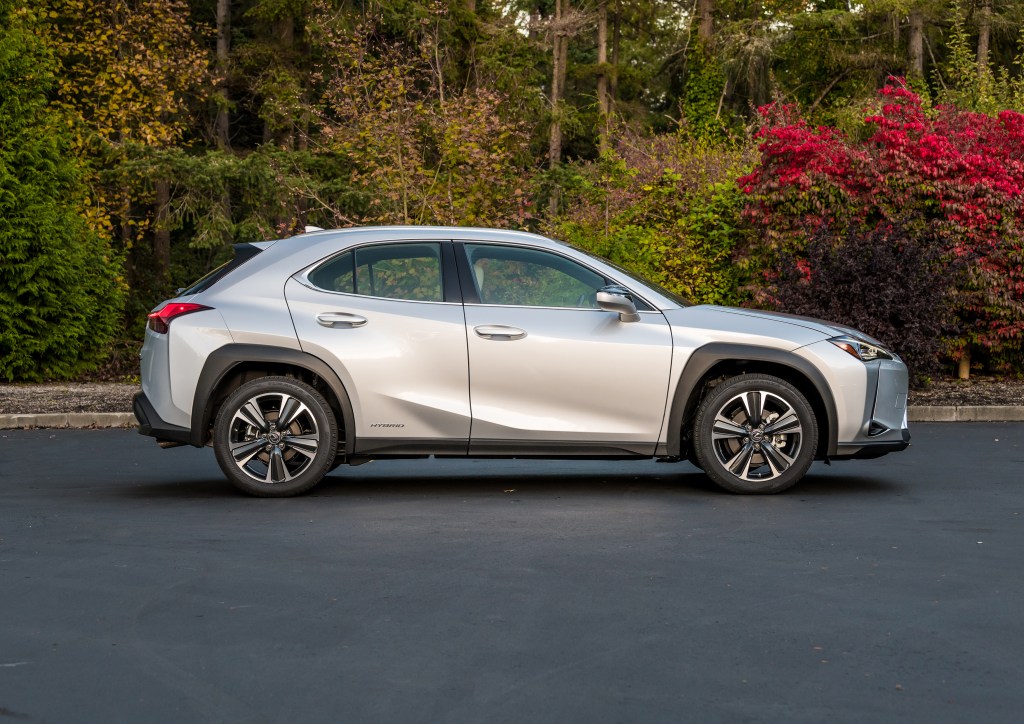
Lexus UX300h. The plus is that it is a hybrid. The minus is in that styling. (Image: Lexus)
The model driven here features the F Sport Handling package. Which means there is active variable suspension from a mechanical standpoint and an aluminum pedals and sport seats (among other things) from an aesthetic and functional perspective.
Regardless of the active variable suspension—as well as active cornering assist—the UX300h is not exactly the sort of thing you’re going to take to the local gymkhana and crush it.
Lexus says there is “the higher seating position and versatility experienced in a crossover.”
I suppose there is a higher seating position compared with, say, a Lexus RC, but while this is supposed to be a “crossover,” it is a diminutive one (176.97 inches long, 72.49 inches wide, 60.63 inches high, and a 103.94-inch wheelbase) and with a 6.3-inch ground clearance, this isn’t exactly something you’ll wonder about a running board for ingress and egress.
There is a 12.3-inch color touchscreen. There is the Lexus Safety System+ 3.0, which includes various collision prevention/mitigation technologies as well as driving enhancements.
The tech isn’t overwhelming in the UX.
But then there is the styling.
And this is something that I think is not only underwhelming for a Lexus, but underwhelming, period.
The cladding around the wheels doesn’t make the vehicle look robust. The creases in the body side unnecessarily break up the surface (i.e., this is a small vehicle, so it’s not like there is a giant slab that would require some sort of visual relief).
About the only thing it has going for it is the spindle grille, and that’s something that many people find to be off-putting.
The base UX300h MSRP is $36,340.
The one driven here has base MSRP of $47,647.
And that’s a problem, I think.
One could select the top-of-the-line Toyota RAV4 Hybrid and get a bigger, more powerful vehicle with a slightly smaller touchscreen (10.5 inches) and a bit less in the way of fuel economy (40 mpg combined)—and have a base price of $40,205 for the loaded-trim.
The Lexus CT200h became available in the U.S. market in 2011. It was a global vehicle, one that was a hybrid-only vehicle, albeit not the first Lexus to be such: there was the HS 250h that had gone on sale in 2009 in the U.S. The HS didn’t work out so well in the U.S. market, having been pulled in 2012. Arguably, the issue was that the HS 250h was pretty much just a compact four-door that was Lexus-nice, but not enough. The CT200h had a better run in the U.S. market—going until 2017—and it continues to have a level of appeal as it was a compact hatchback, making it somewhat special (the CT200h wasn’t the first Lexus hatchback: there was the IS hatch, which had a run from 2002 to 2005, but it wasn’t a hybrid).
The Lexus CT 200h hybrid: A charming hybrid circa 10 years ago. (Images: Lexus)
The CT200h came to mind—not the more similarly named HS 250h—when I drove the UX 250h, a compact crossover. The charm of the CT carries over to the UX.
Realize that Lexus offers the RX as a hybrid, as well as the NX. So it is big, smaller and compact with the addition of the UX. The other two are more SUV-like than the UX. It strikes me as a, well, compact hatchback. Yes, it is designed more like a crossover than an SUV, but if you squint. . .there’s the CT200h.
And like the other two, the UX is available as a gasoline-only-powered vehicle. The hybrid version brings AWD with it.
The vehicle is powered by a hybrid system that consists of a 2.0-liter inline four that is supplemented by a two-motor generator hybrid transmission—one motor serves as a generator to provide electricity that goes to the vehicle’s nickel-metal hybrid battery system (yes, NiMH) and to control engine speed while the other motor provides power to the wheels as well as performs regenerative braking. The total system horsepower is 181, which is suitable for an AWD vehicle with a 3,605-pound curb weight: You’re not going to be breaking any speed records and may not even be the first to go when the light turns green, but you’re also going to get an estimated fuel economy of 41 mpg city, 38 mpg highway and 39 mpg combined, which Lexus says makes it the most fuel-efficient crossover without a plug. (Who would have thought that Lexus would be the leader in fuel efficiency while providing a vehicle that is anything but frugal in its interior execution and amenities? This simply speaks to the proficiency that Lexus has in executing vehicles.)
Lexus UX 250h hybrid: Charm circa right now.
The vehicle “seats five.” With a moonroof the passenger volume is 88.5 cubic feet; it is 90.4 cubic feet sans. Trust me: you don’t want to be the fifth person in the vehicle regardless of the roof. The SAE cargo volume is 17.1 cubic feet: remember—this is a compact crossover, so you’re not going to be moving any fridges in it unless it is sized for a dorm room.
But the real thing about the UX is its charm. Which is something that isn’t often characteristic of vehicles nowadays. The 2020 UX 250h Luxury trim has a starting MSRP of $39,900, which makes it the most-affordable Lexus hybrid by a few hundred bucks: the NX 300h AWD starts at $40,160, and while it is a bit bigger, there is something about the UX 250h that makes it special.