This Hybrid Could Really Be “Super”

But somehow the math doesn’t make sense. . . .

By Gary S. Vasilash

Although not available in the U.S.—and not likely to be anytime soon—there is an array of vehicles coming from China-based brands that have some purported capabilities that are rather astonishing.

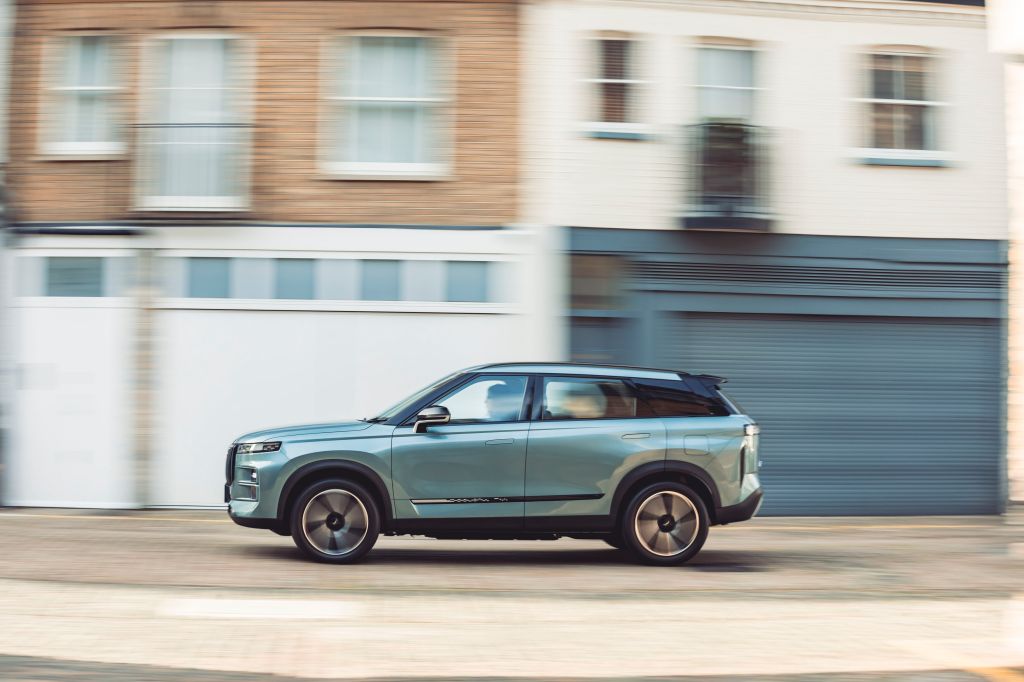
Take, for example, the forthcoming JAECOO 7 SHS, an SUV that is going on sale in the U.K. market.

This vehicle, a plug-in hybrid, is claimed by the company, which is part of the Chery Group, to deliver, on the WLTP test procedure, a fuel efficiency of. . .

403 mpg

The “SHS” in the name comes from “Super Hybrid System.”

If it gets 403 mpg, it really must be super.

Brits might forget what petrol stations look like they’ll be there so infrequently. (Image: JAECOO)

The range is stated at 745 miles.

The vehicle has a 1.5-liter engine that produces 143 bhp. The engine has six technologies the company says contributes to its efficiency.

They are: Deep Miller cycle; i-HEC internal combustion; i-HTM intelligent thermal management system; HTC efficient turbocharging; i-LS intelligent lubrication and HiDS high dilution.

I don’t know what they are, either.

Then there’s a transmission that has four technologies:

Quad-core dual electronic control MCU; IGBT double-sided water cooling; a high-efficiency dual motor; hydraulic split cooling.

Which is slightly more understandable.

And then there’s a 18.3-kW lithium iron phosphate battery pack.

It provides, according to the company, the ability to drive 58 miles on electricity alone.

The JAECOO 7 SHS has a starting price in the U.K. of £35,065 (~$43,000).

Here’s something that seems a bit mysterious, though.

It has a 60-liter fuel tank. That’s 15.68 gallons.

If it is rated at 403 mpg, then shouldn’t the 15.68 gallons of gas be good for 6,319 miles?

2024 Lexus LS 500h AWD

Dependable luxury. . .

By Gary S. Vasilash

One would assume that when buying a vehicle in the >$100,000 vicinity it will have a full suite of amenities, both infotainment and safety-oriented (a.k.a., “stuff,” albeit that being a somewhat plebian term), as well as comfortable (e.g., seats that could be utilized in an upscale house) and capable (as in all-wheel drive).

One thing that may not has as top-of-mind consideration as it probably should, something that may be taken for granted, is the level of dependability of the vehicle.

It is one thing to feel a bit of quiet satisfaction of dropping off one’s luxury vehicle with the valet at the front of the club. It is something else entirely to be waiting for the valet to return said vehicle because there happens to be a glitch in the lot.

Or it could be simply the issue of getting something to work (e.g., perhaps if you want to open the glove box you should simply, well, use the pushbutton-style mechanism to open the glove box, not have to find a button or something on a screen to do it—otherwise, it could be frustrating/annoying).

Which is to say that all luxury vehicles aren’t built with the same levels of quality and dependability as others.

And there is information to back this claim up.

The J.D. Power 2024 U.S. Initial Quality Study (IQS), which surveys owners 90 days after they’ve owned their vehicles. Presumably that is sufficiently long to get a sense of one’s vehicle and if something is going to break early, it has.

Lexus comes in second in the Premium category of the survey, behind Porsche (174 for Lexus and 172 for Porsche, with lower being better). Although one might argue that Lexus models and those from Porsche are largely different (but both are big in the SUV space), the most Porsche-like Lexus model, the LC, had the highest initial quality of any vehicle surveyed.

But there is another study that J.D. Power does, one that is more about the long run. It is the J.D. Power Vehicle Dependability Study (VDS). While IQS is after three months, VDS is after three years.

The categories VDS asks about include climate, driving assistance, driving experience, exterior, features/controls/displays, infotainment, interior, powertrain, and seats.

In the 2024 VDS Lexus comes out on top—by a considerable margin.

That is, the metric is “problems per 100 vehicles,” or PP100. A lower number is better.

Lexus has a score of 135 PP100.

Porsche came in second. It scored 175 PP100.

(Oddly enough, whereas Porsche came in first in the IQS but a Lexus was the overall highest in initial quality, in the VDS Porsche, second overall to Lexus, has the vehicle with the highest dependability, the 718.)

So one can feel confident that the LS 500h is something that is built with quality and dependability.

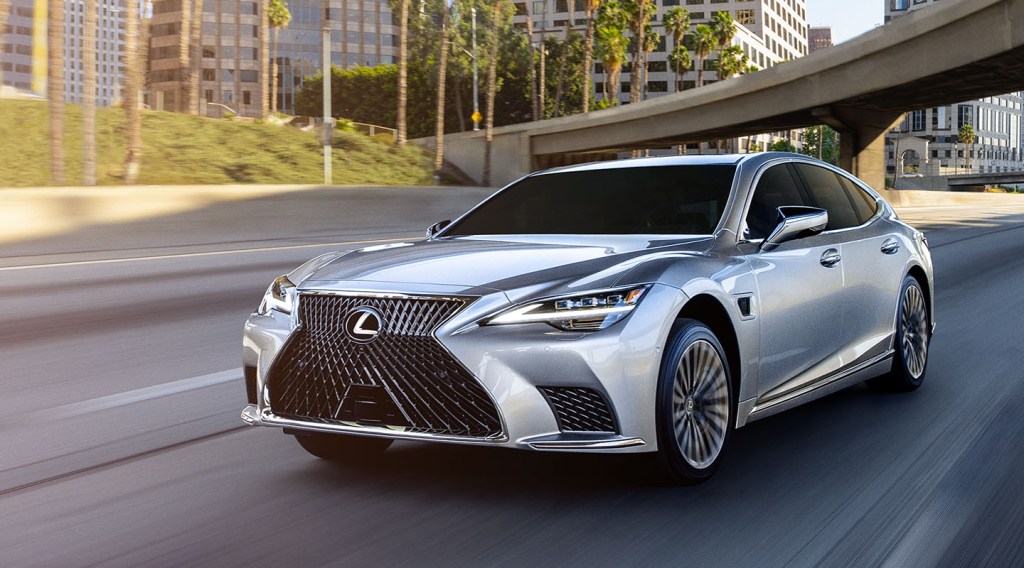
LS 500h AWD: Looks good. Drives well. Brings the amenities. And is built to be a quality vehicle. (Image: Lexus)

The Look

The sedan is low and lean. Specifically, 206.1 inches long, 57.5 inches high, and with a 5.8-inch ground clearance. It rides on 20-inch wheels. And the other obligatory specs are that it has a 123-inch wheel base and is 78.8 inches wide.

The Power

This is a big sedan, one might feel environmentally awkward driving it.

But this is a hybrid. There is a twin-turbo 3.5-liter V6 engine that is supplemented by electric motors so the total system horsepower is 354. This may not be the stuff of being pushed back in your semi-aniline leather seat when you push down on the accelerator (there are other LS trim levels for that), but it is something that results in a combined fuel economy number of 25 mpg, which is certainly outstanding for something of this scale.

(And going back to the issue of dependability, know that Toyota started building the Prius in October 1997, so it is undoubtedly the most capable producer of automotive hybrid powertrains by a long shot.)

The Interior

Luxurious. Sumptuous. Like that.

Leather is leather. Wood is wood. Metal is metal.

You’d think that’s, well, normal.

It’s not.

But it is normal in the LS.

Which is impressive.

(Although I must confess that when there’s white leather seating surfaces, I have some, well, concern. . . .)

The Tech

There is Lexus Teammate, a Level 2 advanced driver assistance system that provides the means for hands-off driving predicated on both a sensor suite (radar, lidar and camera sensors) and GPU processors. Eyes must be kept on the road and it works on highways that have been digitally mapped. Arguably, this type of system de rigueur for vehicles in this category, and in the case of Teammate, it provides the hands- and feet-free capability as would be expected.

A Thought

LS 500h AWD: All that is expected—and then some—in a reliable package.

Ford’s Latest Police Interceptor Utility

Things you probably don’t want to know about. . .

By Gary S. Vasilash

Here’s something you probably don’t want to experience: aspects of the standard features offered in the new 2025 Police Interceptor Utility:

Police Perimeter Alert. . . Police Engine Idle. . . Police Dark Car Feature. . . Rear Camera on Demand. . . H8 AGM Battery. . . Blind Spot Monitoring with Cross-Traffic Alert . . .Manual Police Pursuit Mode – Steering Wheel Switch Execution. . . Red/White Dome Lamp – Cargo Area. . . Rearview Camera with Washer Viewable in 8″ Center Stack Screen. . . Ford Pro Upfit Integration System. . . Keyless Entry with 4 Manual Keys. . . 6-Way Power Passenger Seat. . . Police Accessory Independent Timed-Release Output (PAITRO) – Output Tied to Liftgate Release Switch. . . Climate Control – Rear Aux A/C System. . . Updated Police Grade Cloth Trim Seat Material. . . 12.3″ Digital Instrument Cluster with Certified Calibration. . . Keyless Entry – Key FOB Only (Less PATS). . . Simple Fleet Key (w/o microchip, easy to replace: 4-keys). . . Two 50-amp power distribution junction box

The 2025 Ford Police Interceptor Utility. Departments looking for fuel economy can opt for a hybrid powertrain. (Image: Ford)

Seems like the only thing you’d really be interested in were you to find yourself in the back of one is that rear aux A/C system. And perhaps the seating material.

The rest of the stuff is germane to the professionals.

The Police Interceptor is based on the Explorer that you can find in a dealer near you.

But this vehicle isn’t simply an Explorer with additional lights and a profoundly different paint scheme.

It is engineered to be a police vehicle. It is being offered through Ford Pro, underlining that this is a commercial, not consumer, vehicle.

There are three powertrain options. There is a 3.3-liter V6 that produces 285 hp. A 3.0-liter EcoBoost V6 that produces up to 400 hp—but that’s if the vehicle is using Premium gas, which is probably not something that municipalities are in favor of.

And there is a 3.3-liter V6-based hybrid that produces a system output of 318 hp.

One of the arguments that Ford makes for the hybrid is that the onboard equipment operates even when the engine shuts off. This, it is calculated, means a savings of up to 838 gallons of gas per year because the engine isn’t idling so that various things in the vehicle work.

So, if gas is at $3.50 per gallon, this can translate into a savings of $17,500 over a six-year period.

Which matters as budgets at municipalities are stretched.

(Here’s something interesting: the new consumer version of the Explorer is not offered with a hybrid, something that had been available before the recent midcycle refresh. Given the popularity of that powertrain—as consumers budgets are being stretched—it seems likely Ford may rectify that. After all, they like fuel efficiency, too.)

EVs in the UK in May

Yes, more are being bought. By fleets. . .

By Gary S. Vasilash

Although the number of vehicles sold in a given month in the UK isn’t particularly large, from a percentage standpoint there are undoubtedly some people at US OEMs who wish they’d have the kind of EV registration numbers that exist in the UK:

According to the Society of Motor Manufacturers and Traders (SMMT), in May EVs have 17.6% of the market.

While the whole market was up 1.7% in May, SMMT figures show that EV sales were up 6.2%. Clearly, EVs in the UK are doing rather well.

Do British consumers know something that American consumers don’t?

Well, maybe not.

Turns out that consumer retail EV sales were actually down 2%.

The uptick in the EV market came from fleets.

In the UK there is something called the “Vehicle Emissions Trading Scheme” that mandates zero-emissions vehicles represent 22% of a manufacturers’ annual sales.

Apparently there are incentives available to businesses for getting EVs that are not open to consumers. The SMMT believes that it is necessary for “the next government to provide consumers with meaningful purchase incentives.”

Conservative leader Rishi Sunak, current UK prime minister, will square off against Labour leader Keir Starmer on July 4.

Mike Hawes, SMMT Chief Executive:

“As Britain prepares for next month’s general election, the new car market continues to hold steady as large fleets sustain growth, offsetting weakened private retail demand. Consumers enjoy a plethora of new electric models and some very attractive offers, but manufacturers can’t sustain this scale of support on their own indefinitely. Their success so far should be a signpost for the next government that a faster and fairer transition requires carrots, not just sticks.”

While of the subject of incentives and such, it should be noted that in May plug-in hybrids were up 31.5% are regular hybrids up 9.6%, both handily outperforming EVs.

And while the May ’24 market share for plug-ins is 8% and hybrids 13.2%, each below the EV’s 17.6%, combined they represent 21.2% of the market.

Evidently consumers aren’t against reduced emissions but are in favor (favour?) of the convenience and range provided by hybrids.

2025 Toyota Camry XLE

Shake it up. . .

By Gary S. Vasilash

It may seem that the most controversial move made by Toyota for the 2025 Camry—the  ninth generation of the midsize sedan—was to make all of them, be it FWD or AWD, LE, SE, XLE, or XSE trim, hybrids.

2025 Camry XLE. Stylish, well-equipped, and a hybrid. (Image: Toyota)

That’s right: Every Camry is a hybrid.

Under the hood across the board is a 2.5-liter, four-cylinder engine supplemented by electric motor generators such that the FWD version produces 225 net-combined horsepower (engine + motor) and the AWD 232 hp. This is Toyota’s fifth-generation hybrid system. Yes, they’ve been at it a while.

Depending on the drive configuration the fuel efficiency goes from a low of 44/43/44 mpg, city/highway/combined, for the XSE AWD (the top of the line) to 53/50/51 mpg for the LE FWD. To call 44 mpg combined “low” is, well, ridiculous.

Lots and lots and. . .

Realize that the Camry is the perennial best-selling car in the U.S. (22 years running), with the company delivering 290,649 units in the U.S. last year, units produced by Toyota in its manufacturing complex in Georgetown, Kentucky. (During the history of the plant, which opened in 1986, there have been more than 11 million Camrys built within those ever-growing walls. Yes, the expansion there has been notable such that today there is 9-million square feet under roof, which, according to Toyota, is equivalent to the size of 157 football fields.)

One might think that Toyota would not want to rock the proverbial boat, to make changes that might seem upsetting to what is clearly a loyal base of buyers. It’s not like there haven’t been hybrid powertrains in Camrys.

There have—since model year 2008 (calendar year 2007).

But it has always been a powertrain selection until now. You could get a Camry with or without electrification.

Yet the product planners at Toyota decided that the best thing to do was to go all in on hybrids.

Yikes! one might think.

The time is right

But broader market timing seems propitious, as there is the swerve away from full electric vehicles to electrified vehicles, a.k.a., hybrids. In 2023 Toyota Motor North America overall sales—including Lexus models, its bZ4X electric and Mirai fuel cell—included 29.2% hybrid models, up from 23.9% in 2023. One can only imagine the number when 2024 is calculated.

What I found to be surprising about the Camry XLE wasn’t under the hood but on the inside: there is trim covered with Dinamica, a microfiber, that has a quilted pattern. It is light gray. Black is available, as well.

Said another way: there is fabric covering surfaces on the door panels and dash board where you otherwise would see leather or plastic. The material is produced with recycled polyester without the use of organic solvents, so it is comparatively environmentally advantageous.

Yes, that trim is actually a fabric.

It is also surprising for those of us who are more used to seeing smooth materials that are naturally or mechanically grained.

A generational difference

However, when I showed the Camry to a Gen Z niece, she thought the interior was the most wonderful she’d ever seen. And when I explained that the car in question is a hybrid, it gained significantly more points in her book.

So what might seem like a risky move by Toyota is undoubtedly a correct one.

It is often said that a given generation doesn’t want to buy the type of vehicles that they’re parents had driven them in. In my niece’s case it was a Honda Odyssey and Ford Flex.

She and her husband presently drive a pickup for no reasons of utility.

But it seems that a sedan is on the table for her. And given what Toyota has done with the ’25 Camry, it is something that is of even greater interest.

And here’s another thing to consider: at her age she has a whole lot of vehicles in her future, so if she finds appeal in the Camry, odds are good that the company will get more business from her in the future. Given the reliability of Toyotas and given that the Camry is full of tech for purposes of entertainment and safety, it seems that the edge of style makes it all the more attractive.

Certainly a clever move by Toyota.

Are There Enough Exclamation Points for EV Sales?

By Gary S. Vasilash

This won’t garner any headlines:

78.81% of vehicle purchases in the U.S. in 2023 were for vehicles with gasoline engines, according to Experian’s “State of the Automotive Finance Market, Q4 2023.”

The number that will is:

8.55% of the vehicles purchased were electric vehicles.

But of that “purchase,” 30.7% of the EVs were leased, which is essentially renting with the option to buy, not outright obtaining (i.e., according to the Oxford English Dictionary, the verb purchase means “To acquire in exchange for payment in money or any equivalent; to buy.” And the way the Inflation Reduction Act is constructed, for many OEMs leases are the only way that consumers can get a $7,500 purchase incentive).

A number that also won’t get large type:

9.83% were hybrids.

That number alone is about 13% greater than the EV number.

But arguably the 2.02% of vehicles purchased in 2023 that were plug-in hybrids could be added to the hybrid number, which would go to 11.85%.

Odds are that hybrid number is going to continue to grow, as will the EV number, but even though it will continue to be higher than the EV number for the next several years, you can bet every rise in EV sales will continue to get outsized attention—until the novelty passes.

‘Consumer Reports’ on Top Models & PHEVs

By Gary S. Vasilash

Although the folks at Consumer Reports are finding increased interest in and performance of electric vehicles (EV), it seems as though plug-in hybrids (PHEVs) are really something of a sweet spot based on its annual top-10 vehicle list.

CR’s Jake Fisher, senior director of Auto Testing, points out that there are four key elements that go into the determination of what vehicles make the list—and make it to the top of the list, which are:

  • Road testing
  • Active safety and crash testing
  • Owner satisfaction
  • Predicted reliability

While the first two are objective and the last two are subjective, know that the nonprofit consumer organization bases the last two on more than 300,000 member surveys, so there are solid metrics behind them.

The Results

So here are the top 10:

  • Subcompact SUV: Subaru Crosstrek
  • Compact SUV: Subaru Forester
  • Small car: Mazda3
  • Midsize car: Toyota Camry Hybrid
  • Small pickup: Ford Maverick/Maverick Hybrid
  • Midsize SUV: Toyota Highlander Hybrid
  • Luxury SUV: BMW X5/X5 PHEV
  • Hybrid/PHEV car: Toyota Prius/Prius Prime
  • PHEV SUV: Toyota RAV4 Prime
  • Electric vehicle: Tesla Model Y

The PHEV Challenge

One of the challenges vis-à-vis people going to a PHEV rather than a conventional hybrid (HEV) or a full EV is, Fisher explains, their understanding of what a PHEV is and how it would fit into their driving regime.

RAV4 Prime: hybrid with a plug. (Image: Toyota)

To simplify things, CR has modified the way it provides information about fuel economy for PHEVs by treating the all-electric range provided as a “bonus” added to the results when the vehicle is operating in its “charge-sustaining mode” (a.k.a., simply driving on its engine).

A fascinating comparison that CR made is to put like-to-like vehicles up against one another with the differences being in their propulsion system—PHEV vs. ICE, HEV and full EV—and then how much it will cost the consumer based on both the vehicle price and the cost of energy. The assumptions are that the owners will plug in their vehicles that have plugs, drive 40 miles per day, and take four 500-mile trips annually.

While it may not be a surprise that the PHEV version of the BMW 330 is more cost-effective than the gasoline-only version, there are a couple of surprises:

The Hyundai Tucson HEV saves more money than the PHEV version.

And while it seems to be accepted wisdom that owning an EV means far less cost for energy, the Kia Niro PHEV is actually better for the pocketbook than the Niro EV.

Ford: Hybrids Should Be the Story

By Gary S. Vasilash

Much of the attention given to Ford’s Q4 2023 earnings call last week has been focused on CEO Jim Farley’s comment:

“[W]e made a bet in silence two years ago. We developed a super-talented skunk works team to create a low-cost EV platform. It was a small group, small team, some of the best EV engineers in the world, and it was separate from the Ford mothership. It was a start-up.

“And they’ve developed a flexible platform that will not only deploy to several types of vehicles but will be a large installed base for software and services that we’re now seeing at Pro.”

Somehow the inherent mystery of a “skunk works” has gotten people all excited.

Would they be so excited to know that the skunkworks methodology goes back to 1943 in the aircraft industry?

Yes, an 80-year-old approach.

Well, You’ve Got to Build It. . .

The other thing about this is that it is one thing for an R&D team operating independently to develop something and a whole other thing for that development to be engineered for and launched in production.

Launches have been something that Ford has been finding a bit troubling, so there’s that.

And it should be noted that the company also announced last week that its Ford e operation—as in the electric vehicles—lost $4.7 billion last year and the company anticipates losing $5 to 5.5 billion this year on Ford e.

The excitement of the skunk works project was certainly helpful from diverting some attention to that red ink.

What About This?

But what was largely overlooked was Farley’s comments on hybrids.

As in,

“Our global hybrid sales were up 20% last year, and we expect them to be up 40% this year.”

And:

“We now have the No. 1 and No. 2 best-selling hybrid trucks in the U.S. Maverick is No. 1. And we’re the No. 3 hybrid brand in the U.S. behind Toyota and Honda. But unlike them, our hybrids really sell best on trucks for our side.”

Given that Farley said “And margins on hybrids are closer to ICE, much higher than EV margins,” you’d think hybrids would be the headline going forward if for no other reason than the company can make money on them, something that it is not going to see on the EV side of the business until. . . . Well, that remains to be seen.

Maverick hybrid: Fuel efficiency and the energy to bust out the beats. (Image: Ford)

Not Exactly a Strong Third

While it is nice that Farley is so bullish about the company’s hybrid performance, it is worth really putting that into context.

Of course its hybrids “really sell best on trucks” because with the only hybrid Ford has without a box on the back is the Escape.

And as for it being number three, know that these are the number of hybrid sales for the three companies in 2023:

  1. Toyota:         523,664
  2. Honda:         293,640
  3. Ford:            133,748

In other words, it sold less than half of what Honda did and about a quarter of what Toyota did.*

So while the claim is factually true, one should perhaps not be too chuffed about the Ford hybrid performance.

About a quarter of Toyota and Honda sales are hybrids.

About 7% of Ford’s sales are hybrids.

Did I mention the skunk works. . .?

==

*It is worth noting that until recently Toyota was treated like some technological troglodyte for its continued support of hybrids and its not all-in approach to EVs. Not only do we see that Ford is reconsidering its positioning vis-à-vis hybrids and full EVs, but General Motors, which doesn’t have much of a record in the hybrid space, has announced that it, too, is going to bring hybrids to the U.S. market. Farley pointed out on the earnings call that consumers can quickly do the math on the fuel efficiency benefits of hybrids and, perhaps the most important factor: “they don’t have to change their behaviors.” It is surprising that there seems to be so many auto execs who ignore the long public charging time required for EVs compared with pumping gas: perhaps this is a case that when they get behind the wheel of their company vehicles someone else has done the charging.

Hybrids Still Matter

By Gary S. Vasilash

Japanese car shoppers are going to buy more hybrids in 2024—more than half of all sales will be the electrified powertrains—than any other type of propulsion system, according to Bloomberg Intelligence.

Tatsuo Yoshida, Bloomberg Intelligence senior auto analyst, said:

“In Japan, hybrids are popular because they’re affordable and reliable, since they don’t rely on the existence of strong charging infrastructure.”

Arguably, those same characteristics—affordability, reliability, and no dependence on the availability of electric chargers (at home or out in the world)—are important to consumers everywhere.

2024 Toyota Prius: Looks good. Travels far. (Image: Toyota)

Although Honda had a hybrid in the U.S. market, the Insight, before Toyota brought the Prius, it was literally just a matter of months—Insight December 1999; Prius June 2000—and Toyota has really become more associated with hybrid technology thanks to its persistence in bringing out hybrids, both as powertrain options to vehicles (e.g., the hybrid RAV4) and as hybrid-only offerings (e.g., the Toyota Venza).

In Japan Toyota has had the Prius available since 1997, so the vehicle, and hybrid tech, are certainly familiar to consumers there.

While the Prius design over the years transitioned from something frumpy to something that looked like the designers were spending too much time watching anime, the 2024 Prius, the fifth generation of the model, is absolutely stunning in looks and certainly not lacking in its efficient performance: the top-of-the-line XLE and Limited models with AWD offer fuel economy of 49 mpg city, 50 mpg highway, and 49 mpg combined. For those who have more frugality, there’s the LE FWD version which is rated at 57/56/57 mpg, which means that given its 11.3-gallon fuel tank (and it takes regular gasoline) it can travel some 640 miles on a tank. That is the definition of “convenience.”

(The 2024 Prius was named the MotorTrend Car of the Year and it is a finalist for the North American Car of the Year, which will be announced January 4.)

Hybrids are garnering more attention in the U.S. market. Not as much as in Japan, but more.

The Ford Maverick Hybrid continues to be a massive hit.

And when Ram brings out its Ramcharger Ram 1500 variant next year, although it will probably emphasize that it is an “electric vehicle,” it is really a hybrid (a series hybrid: there is a battery that powers the electric motor; when the battery gets close to depletion, the gasoline engine operates as a generator to recharge the battery, to keep the propulsion going).

And at an Automotive Press Association Q&A late last month, GM CEO Mary Barra acknowledged that the company has hybrid tech in its portfolio, even though it has no hybrids on offer in the U.S. market.

Arguably, if more Americans knew about the ease of using a hybrid and the efficiency the vehicles provide, they, too, would buy more of them.

Perhaps this will happen when the 2025 Toyota Camry is launched.

The Camry, the perennial best-selling car in the U.S., will be available only with a hybrid powertrain. Clearly, Toyota is that confident in the tech. (Of course, having been putting hybrids under hoods for more than a quarter of a century, it ought to be.)

Affordability, reliability, and no dependence on the availability of electric chargers.

This may cause consumers to pay more attention to hybrids in the U.S., too.

Hyundai and Hybrids

By Gary S. Vasilash

In reporting its October sales, Hyundai noted that the company that was once thought of mainly in the context of its style-setting Sonata sedan (remember when the 2011 model came out with its “Fluidic Sculpture” styling that made all other sedans seem as though they came from an earlier age?) had 81% of its retail mix in. . . SUVs.

Of course, that has a little something to do with the fact that in the car category there are the Sonata, Elantra and recently introduced IONIQ 6 EV sedan, while in the SUV category there are:

  • IONIQ 5
  • Kona
  • Nexo
  • Pallisade
  • Santa Fe
  • Tucson
  • Venue

(There is also the Santa Cruz pickup, for purposes of providing a look at the entire showroom.)

Hyundai Tucson PHEV (Image: Hyundai)

While there were 9,456 Elantras sold—an 11% increase compared with October 2022 sales—there were 9,700 Santa Fes sold—and that’s a decrease of 10% compared to last year and it still is more than the Elantra sales.

But what is more interesting in some regards is this observation from Randy Parker, Hyundai North America CEO:

“This was the best-ever October for total and retail sales for our segment-leading Tucson HEV, Tucson PHEV, Santa Fe HEV and IONIQ 5 SUVs along with our Elantra HEV.”

Yes, hybrids are doing increasingly well at Hyundai, though there is also that full battery-electric IONIQ 5.

Overall, electrified vehicles represented 21% of Hyundai’s October sales, a 49% year-over-year (YoY) increase.

In terms of the hybrid YoY increases:

  • Elantra HEV:          +15%
  • Santa Fe HEV:        +81%
  • Tucson PHEV:         +170%
  • Tucson HEV:           +14%

Odds are those OEMs that decided to deemphasize hybrids to promote full electric vehicles are giving their portfolio strategy a hard re-think.