Although there is a concern regarding fuel efficiency when it comes to petroleum-powered vehicles, when using alternative forms of “fuel,” like hydrogen, making sure that the most is made of it is arguably even more important—after all, the price of hydrogen in the U.S. is over $30 per kilogram, with a kilogram being approximately equivalent to a gallon of gasoline.
To that end, ZF has developed a hydrogen recirculation blower.
Essentially, it recirculates unused hydrogen back into the fuel cell by using a an electric motor that can operate at speeds up to 100,000 rpm to essentially blow the hydrogen back into the stack.
Because at the outgoing side of the fuel cell stack there is water (that’s the emissions from a hydrogen fuel cell: air contains oxygen, and as you recall from high school chemistry, hydrogen + oxygen form H2O) there is a water separator that not only keeps things from getting all wet, but serves as a coolant.
The recirculator has been engineered for use in commercial vehicles and will undoubtedly find application in Europe, where more fuel cell electric trucks are being introduced.
The price of hydrogen in Europe is competitive with the cost of fuels for thermal engines, and the amount of time it takes to refuel a hydrogen vehicle is approximately that of a liquid-fueled truck (compared to the l-o-n-g time to recharge a battery electric truck), so it makes sense that fleet operators would be interested in hydrogen as they lower their carbon emissions.
Just imagine how important this would be in places where hydrogen is exceedingly expensive compared to other fuels.
California wants carbon neutrality by 2045. This could help. . .
By Gary S. Vasilash
Symbio is an interesting company that you’ve probably not heard of, interesting for two reasons:
It is developing vehicles like hydrogen-powered trucks
It is jointly owned by Forvia, Michelin and Stellantis. Forvia produces a number of products, from automotive interiors to containment cylinders for hydrogen. Michelin is heavily involved in developing green mobility solutions, such as low rolling-resistance tires. And Stellantis, of course, is in the business of vehicle manufacture.
Big rig. Zero emissions. (Image: Symbio)
Symbio has developed a Class 8 truck that is powered by hydrogen, a demonstrator vehicle called the “H2 Central Valley Express.”
The name of the vehicle relates to where the truck will operate in California: a route between the Inland Empire and Northern San Joaquin Valley in California.
The truck’s 400-kW StackPack fuel cell system is said to be comparable to a 15-liter diesel engine.
There is a 70-kg hydrogen tank onboard. It gives the truck a range of 450-miles.
And unlike a diesel, there are no emissions.
The truck will go into operation later this week on a 400-mile route. On the route there are four different operating conditions, such as urban, high-speed, and hill climb and descent. The demonstration period is to last 12 months.
This isn’t some sort of engineering undertaking: the truck will be in revenue service for Total Transportation Services.
Odds are that things like the Tesla Semi notwithstanding, when it comes to commercial freight operations hydrogen is going to be the way to go to zero emissions.
Although hydrogen fuel cell enthusiasts are probably saddened by Shell’s announcement that it is shutting off the valves at its hydrogen refueling stations in California, there was some good news this week—albeit not exactly for those who are driving Toyota Mirais or Honda Claritys in SoCal.
Extreme E, the off-road FIA-sanctioned racing series in which electric vehicles are run, is transitioning to Extreme H, which will swap out battery power for fuel cells next year.
So Extreme E becomes Extreme H.
Racing with hydrogen. (Image: Extreme E. Soon to be Extreme H)
But the good news is that the series and Symbio have announced that the latter will become the “Official Hydrogen Fuel Cell” provider to Extreme H.
Symbio?
It is a Europe-based company established by Michelin, Stellantis and Forvia (each company owns a third) that is dedicated to fuel cell systems.
In December 2023 Symbio opened SymphonHy, a gigafactory in France that currently has the production capacity to produce 16,000 fuel cells. It expects to expand that number to 50,000 by 2026.
Notably, Symbio partner company Stellantis has announced that it is developing hydrogen tech for Ram brand pickups. It already offers hydrogen versions of Peugeot, Citroen and Opel commercial vehicles in Europe.
Using hydrogen for Ram could be a proverbial game-changer.
And speaking of games (OK, a sport): If nothing else, the affiliation with the Extreme H racing series will provide attention to the tech.
Extreme E is having a race in Phoenix this year, so assuming that goes well, the U.S. will be part of the series.
Perhaps Extreme H will make more people in the U.S. interested in the possibility of fuel cells in place of battery electrics.
And maybe those Shell hydrogen stations will be reopened or replaced.
Fuel cells are having their moment again for various vehicle applications, from light-duty to big rigs.
How big a moment?
Seems not trivial according to a report by MarketsandMarkets, which products the automotive fuel cell market will grow from $200 million this year to $2.1 billion by 2030. It will have a compound annual growth rate of 48%.
Where will the largest market be?
Asia Oceana.
Given that the geographies covered in the firm’s report also includes Europe, North America and Rest of the World, presumably that Asia Oceana includes China, which could explain the biggest market.
(Image: Toyota)
That said, with companies including Toyota, Honda and Hyundai continuing their hydrogen fuel cell development efforts, Japan and South Korea can’t be counted out as players, and consumers, in this field.
However. . .the global battery electric vehicle market size right now is on the order of $500 billion and it is estimated to be about $1.5 trillion by 2030, so even with the impressive growth of fuel cells, they’re still approximately the size of a dandelion in a redwood forest.
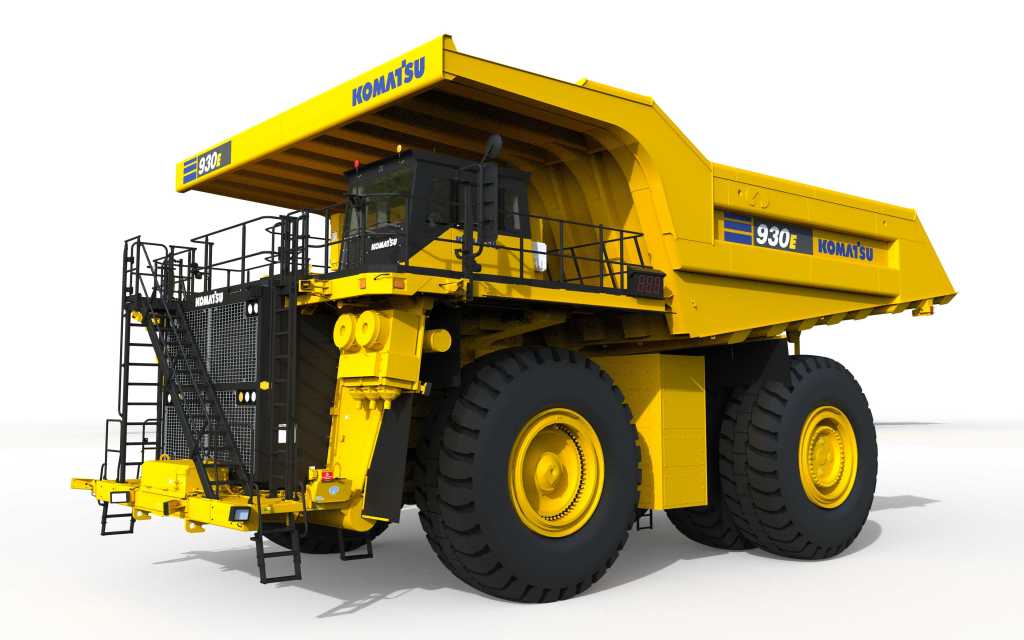
The nominal payload for a Komatsu 930E-5SE—an electric truck that is used in applications like mining—is 640,000 pounds.
Heavy-duty piece of mining gear going to GM fuel cell tech. (Image: Komatsu)
So when Charlie Freese, executive director of GM’s HYDROTEC business says that they believe that fuel cells “can play an integral role in a zero-emissions future, helping to electrify heavier-duty applications,” he’s talking about things like the 930E.
To that end, GM and Komatsu have entered into an agreement through which the companies will co-develop a hydrogen fuel cell power module—on the order of 2 megawatts—to power the 930E.
Dan Funcannon, Komatsu vp of North America Engineering and Development, says Komatsu has pledged to become carbon neutral by 2050.
Typically mining trucks and associated equipment aren’t powered by batteries, aren’t powered by fuel cells, but are powered by diesel fuel.
And diesel isn’t on the pathway to carbon neutrality.
GM HYDROTEC will develop the fuel cell modules, which they refer to as “power cells.” Komatsu will work on the mining truck.
The plan is to have the first prototype tested at the Komatsu Arizona Proving Ground with a few years.
While it may seem like a long time, as Komatsu has a truck and GM has a factory producing fuel cells, let’s face it: when you are on a mining site in the middle of nowhere, you want to make sure that the massive piece of equipment, approximately the size of a small building, works, day in, day out.
Although it seems as though GM execs can’t talk enough about the Ultium platform for battery electric vehicles (there seems to be an inverse relation, however, between talking about it and delivering vehicles based on it: through Q3 it delivered 5,334 Cadillac LYRIQs, 1,216 HUMMER EVs, and 18 Silverado EVs, for a cumulative 6,568 vehicles: you could park all of them at the Mall of America and still have 6,182 parking spaces left over), there is another electric vehicle technology that the company is pursuing that deserves more attention: HYDROTEC, its fuel cell technology.
It has developed what it calls “power cubes.” A cube contains >300 individual hydrogen fuel cells that combined produce 77 kW. (The cube also contains the necessary thermal and power management systems and controls.)
GM HYDROTEC fuel cell “power cube.” (Image: General Motors)
Today GM announced that it has signed a development agreement with Autocar Industries.
Autocar Industries doesn’t build cars. It builds trucks—although its tagline is:
“Some Build Trucks. We Build Tools.”
As in tools that are trucks that are used in vocational applications such as hauling trash or hauling trailers around freight yards.
Charlie Freese, GM executive director, Global HYDROTEC:
“EV propulsion systems like GM’s Ultium Platform are great solutions for electrifying passenger vehicles,* but larger vehicles like Autocar’s class 8 trucks, refuse trucks and terminal tractors require robust solutions that enable significant energy carrying capacity and fast refueling times.”
So they’re going to be developing, along with Triz Engineering, which specializes in commercial vehicle engineering, hydrogen fuel cell-powered vehicles that Autocar will manufacture in its plant in Birmingham, Alabama. The power cubes will be produced at a GM facility in Brownstown, Michigan.
The first vehicles to be built are cement mixers, roll-off trucks and dump trucks. The power cubes can be combined, so if 77 kW isn’t enough, then there can be 154 kW or 231 or. . .
If there is any question about the viability, capability and durability of fuel cells, applications like this one should put it to rest. Freese said that they put the systems through all manner of demanding tests—G-loads, temperature extremes, crashes—and the carbon fiber hydrogen tanks have been subjected to small-arms fire. (There are also military applications; the Autocar trucks aren’t likely to be taking fire.) These things are meant to get the job done.
(The thing about hydrogen for vehicles is that whereas people talk about the lack of infrastructure for electric vehicles, the infrastructure for hydrogen refueling is essentially non-existent except for some places in California. Consequently, building vehicles for the mass market doesn’t make a whole lot of sense now. Building vehicles for specfic applications–like what Autocar does–makes a whole lot of sense because users can create dedicated refueling without having to worry about pumps dotting a highway: they know where their equipment is going to be at the end of the day, so they can put the refueling equipment there. Still, perhaps when people start realizing that even fast-charging EVs will take about 20 minutes to get the battery charged 80% and hydrogen refueling is functionally and temporally the same as that at one’s local gas station (i.e., fill it up in <5 minutes), perhaps the demand for fuel cells for passenger vehicles will grow.)
Who wants to spend time cooling their heels at a charging station?
By Gary S. Vasilash
Although there is something to be said for electric vehicles (as in the previous post below), one thing that is a bit of a nuisance with EVs is not the driving but the charging.
Not even the fastest fast-charger is going to stuff electrons into a battery as quickly as gasoline goes through the nozzle at your local gas station.
What’s more, there is a bit of a problem with the whole notion of fast charging in that the faster you stuff those electrons in, the more the battery is affected, and not in a good way.
One of the alternatives to a battery electric vehicle is a hydrogen fuel cell electric vehicle.
Yes, a hydrogen fuel cell vehicle is an electric vehicle, too, with the battery being replaced by a fuel cell stack and a cylinder (or two or more) of compressed hydrogen. The hydrogen goes into the stack, is turned into electricity, and that powers the motors that drive the wheels.
And refueling a hydrogen vehicle is quite analogous to pumping gasoline.
As for time:
A 2021 Toyota Mirai went to a hydrogen pump at the Toyota Technical Center in Gardena, California, on August 23, 2021.
The tank was filled. It took five minutes. The tank was sealed with a sticker by the observer from the Guinness World Records.
Toyota evp Bob Carter, a Guinness certificate and the Mirai that earned it. (Image: Toyota)
Over two days of driving the two drivers drove around SoCal under a variety of conditions (yes, including the legendary traffic jams). When they returned to the start point, they had traveled 845 miles on that single tank of hydrogen.
A tank that was filled in 5 minutes.
Admittedly, the drivers are hypermilers (Wayne Gerdes and Bob Winger). Their driving techniques are not those that most of us—not even the most diligent of us—are likely to use with any consistency.
But it underscores the fact that hydrogen can get you much further with less time spent at a station than electricity can. Even for those with a lead foot.





 shinymetalboxes