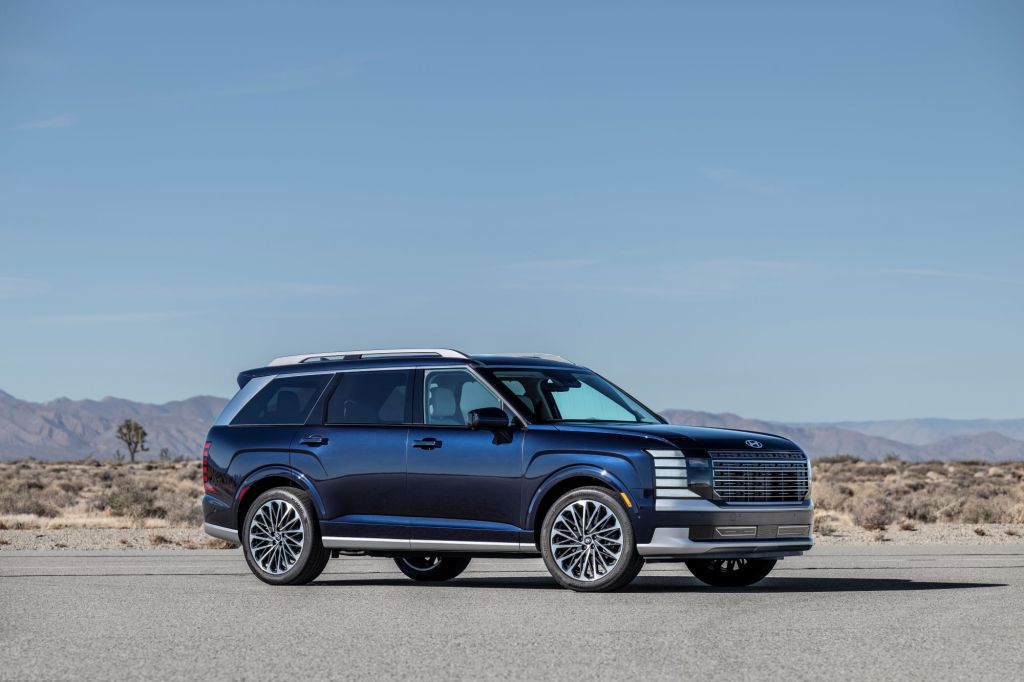
2026 Hyundai Palisade Hybrid Calligraphy

Some somewhat technical aspects of an immensely impressive three-row SUV. . .

By Gary S. Vasilash

The 2026 Hyundai Palisade Hybrid is the first deployment of the Hyundai next-generation hybrid system. Which is important to know simply from the standpoint that it has been offering hybrids in the U.S. market since 2011. It hasn’t stopped. And as this indicates, it has continued to work on the technology.

The Palisade Hybrid features a 2.5-liter turbocharged four-cylinder engine.  There are two electric motors, one that has the primary function of providing power to the wheels and the other, secondary, motor that supports starting and regenerative braking and power flow. All in, the result is system horsepower of 329 and 339 lb-ft of torque. The motors—know in the technical hybrid community as P1 (the starter motor, 17 hp) and P2 (the drive motor 72 hp) are integrated with the vehicle’s familiar—at least more familiar than Honda’s transmission-free two-motor hybrid system (there is a lock-up clutch deployed when needed) or the Toyota e-CVT—six-speed automatic transmission.
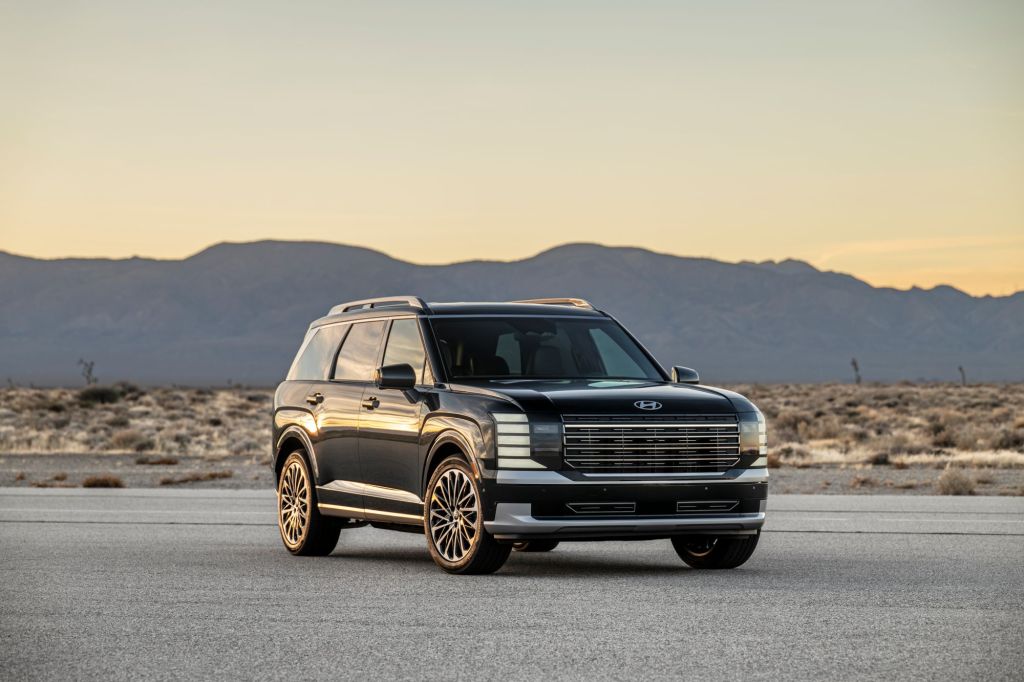
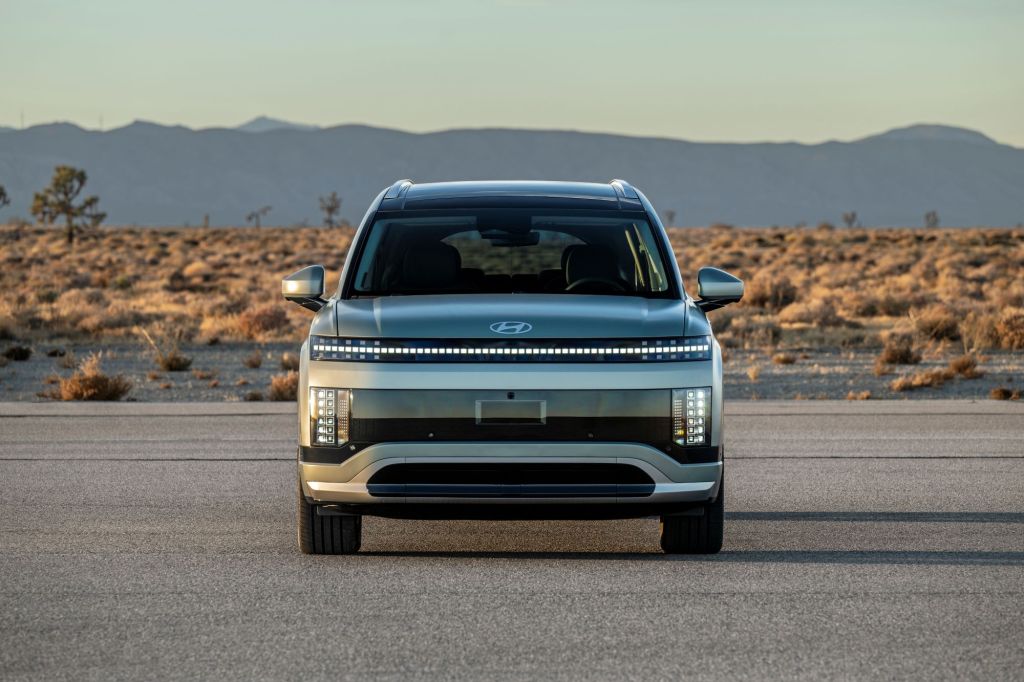
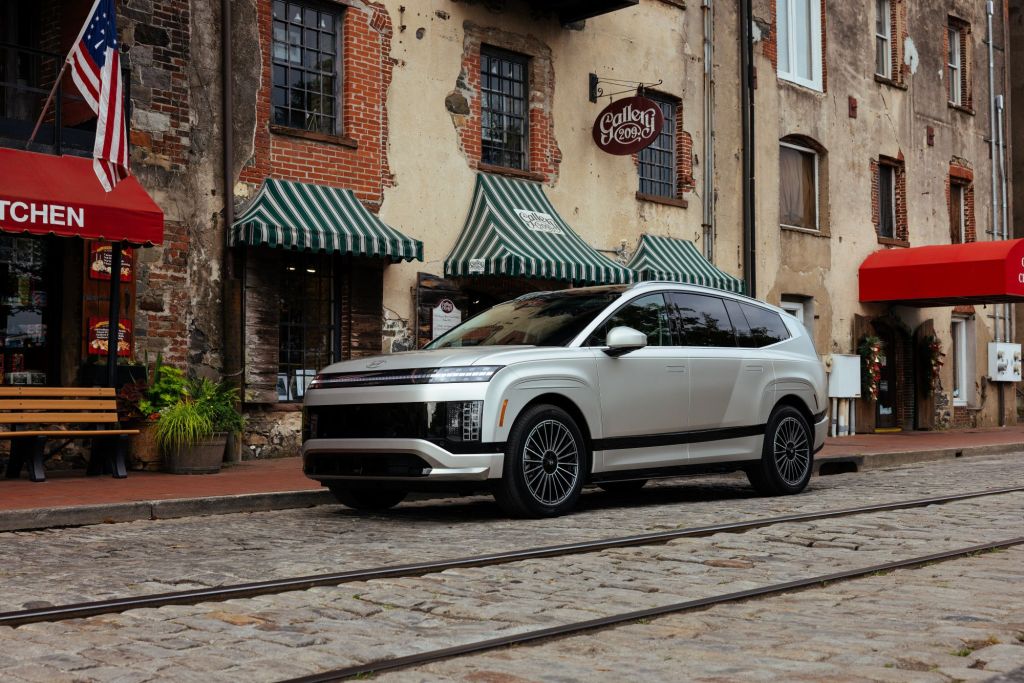
’26 Palisade Hybrid Calligraphy: looks great. Drive far (564 miles FWD; 528 miles AWD). (Image: Hyundai)

There are a couple things to keep in mind about what might seem to be an usual transmission choice.

One is that it provides a more natural driving “feel.” Odds are, even if you don’t think about it, you are used to discerning when a vehicle shifts gears when you accelerate (not so much when you decelerate). And it actually feels odd when you’re driving a vehicle with a CVT (now often with programmed steps to simulate a more natural, mechanical feel). (One reason why people driving an EV become surprised when they take it out for the first few times and look at their speedometer and see a high number is because there is linear acceleration: it just goes.)

Another is that they’re taking advantage of the mechanical advantage provide by the step-gear transmission. Know that the Palisade is a big vehicle. . .

  • 116.9-inch wheelbase
  • 199.2 inches long
  • 78 inches wide
  • 69.5 inches high

. . .that offers plenty of interior space. . .

  • 159.6 cubic feet of passenger volume
  • 19.1 cubic feet of cargo space behind the third row

. . .and provides the ability to tow 4,000 pounds.

As this is sort of techy with that P1 and P2, it is also worth knowing (even if it isn’t wholly understood) that the 2026 Palisade makes extensive use of third-generation steel (average strength 69.2 kgf-mm2). What this means is the structure of the vehicle is remarkably solid, which is helpful when it comes to minimizing any squeaks and rattles from the structure (they take care of things like road noise with an extensive use of sound-absorbing material and thicker glass on the windshield, front doors and tailgate).

Also, by using hot-stamped components (most stamping for vehicles is done at room temperatures, but some of the steels used in the Palisade have to be heated up to make them more ductile so they can be stamped—otherwise they might break the dies), the cage structure adds safety, which is an important thing for a people-mover.

The Palisade comes in a gas-only version. That has a 287-hp V6 and an eight-speed automatic. In the front-drive setup it provides 19/25/21 mpg city/highway/combined and 18/24/20 mpg for the AWD version.

The Palisade Hybrid provides 31/32/31 mpg in the FWD configuration and 29/30/29 mpg in AWD.

A significant difference. And a key reason why the Palisade Hybrid is a notable vehicle for today.

2025 Hyundai IONIQ 5 XRT

An EV that let’s you play in the dirt. But you can’t get too carried away. . .

By Gary S. Vasilash

The stylists who created the Hyundai IONIQ 5 pulled off a feat that is not at all easy to accomplish.

They devised a design that looks absolutely futuristic but—and here’s the tricky bit—doesn’t make one think that it is too advanced to be on the road with other vehicles that, well, don’t have appearances that would make them relevant in, say, 2030.

Realize that the IONIQ 5 was launched as a model year 2022 electric vehicle and is still striking.

So for MY 2025 they made a bit of a swerve with the IONIQ 5, a swerve that takes the vehicle off road.

Now we’re not talking Jeep Trail Rated terrain here.

Hyundai IONIQ % XRT. Yes, take it to the dirt. (Images: Hyundai)

But the XRT trim is more capable than the SE, SEL or Limited models.

For example, there is modified suspension tuning and the suspension is lifted by 0.9 inches—but lest one gets carried away, realize that this brings it to 7 inches. (The ground clearance for a Jeep Cherokee is 8 inches.)

There are off-the-beaten-path approach and departure angles: 19.8 degrees and 30 degrees, respectively.

There are red-painted recovery hooks on the front fascia that are said to be functional. (Those are something that you’re not likely to utilize in your daily commute unless your commute takes you through some tough territory.)

There is a composite cladding on the fascias, around the wheel arches and on the door panels that has a subtle pixelated camo pattern to provide a more-capable appearance. (The XRT wouldn’t look out of place driving on Mars thanks to this addition.) There are XRT black 18-inch wheels wrapped with 235 / 60 R 18 all-terrain tires.

As mentioned, the IONIQ 5 XRT is an electric vehicle. One of the aspects of this 2025 model (and the other trims) is that it comes equipped with the NACS port, standard, which means it can be used at the Tesla Supercharger network, adapter-free. (Which ought to annoy owners of the Tesla Model Y, given the aforementioned still-fresh design of the Hyundai and the aging Tesla exterior, Juniper update tweaks notwithstanding.)

It is worth noting that for those who aren’t using a Supercharger there is a CCS adapter that comes along for the ride.

And while this doesn’t matter as much as it did before the tax credits for EVs were pulled but is still non-trivial: the 2025 IONIQ 5 is built at the Hyundai Motor Group Metaplant America in Ellabell, Georgia.

Clever pixilation on the cladding.

The vehicle is, of course, all-wheel drive.

There is a 99-hp permanent magnet synchronous AC motor in the front. A 221-hp motor of the same type in the rear.

The system output is 320 hp and 446 lb-ft of torque.

It has a liquid-cooled 84-kWh battery pack. The peak DC fast charge rate is 250 kW, which means that the battery, on a DC fast charger, can be charged from 10 to 80% in 20 minutes. The EPA estimated range is 259 miles.

On the inside there are H-Tex seating surfaces (a synthetic leather that offers easy clean-up, because let’s face it: this trim wants to get dirty) featuring XRT-unique pattern and logo. And there are XRT badged all-weather floor mats (because you’re going to take this out in, well, all types of weather that you’re likely to bring into the vehicle with you when you go out in it).

Hyundai has some of the best screens in the business, with a 12.3-inch screen for the driver’s info and a 12.3-inch screen for infotainment. There are wireless Apple CarPlay and Android Auto and wireless charging. There is BlueLink+, the connected vehicle service that provides capabilities from remote starting to receiving diagnostic alerts to performing automatic collision notification and more.

And the BlueLink+ services are free, not for a trial period, but for as long as you own the vehicle.

While on the subject of costs, the MSRP for the 2025 IONIQ 5 XRT is $55,400. The one I drove had an optional paint color (Atlas White Matte) that added $1,000; carpeted floor mats for $210; and $1,475 for inland freight and handling, to a total sticker of $58,085, which is in keeping with average transaction prices for EVs.

2026 Hyundai Palisade Calligraphy AWD

It may be positioned as a mass-market three-row, but it is a whole lot more—arguably a segment above

By Gary S. Vasilash

In 2024 the auto industry spent some $29.5 billion on advertising. That’s about 9% of all of the ad spend from all categories and industries, making it one of the top categories.

One of the things the ads do is not only try to convince people to buy whatever, but to perceive whatever in the way that the advertiser wants us to.

Or put simply, if it is a truck the goal is to make sure the viewer understands that it is rugged and capable.

If it is a vehicle that is in the “luxury” category, then it must be presented in a way that makes the viewers realize there is something special about the vehicle that sets it apart from “mainstream” vehicles.

Of course, in the case of trucks they must be engineered to be rugged and capable.

And if it is a luxury vehicle, then there must be attributes—say top-notch materials used in the interior and an impressive infotainment system—that would make the implied purchase premium seem appropriate.

There are simply some things that are necessary to validate the positioning of the vehicle.

But one thing that this does is segments what people may look at.

Sure, someone who wants a truck may simply look at the overall architecture of the vehicle and determine that it is, indeed, a truck.

The lux part is what, at least in the context of the Hyundai Palisade Calligraphy, that has fuzzy borders.

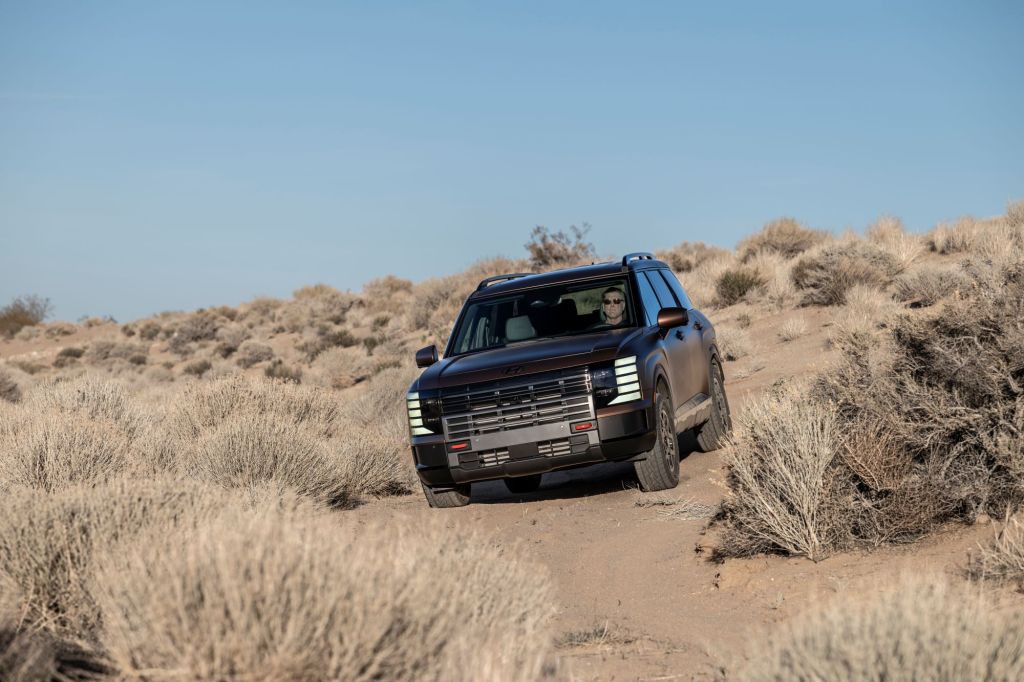
A three-row crossver with massive exterior styling. (Images: Hyundai)

While people would correctly perceive Hyundai to be a mainstream brand—and even the people at the Hyundai Motor Group decided that it would have a separate higher-end brand, Genesis—the Palisade Calligraphy interior is every bit as nice as any Cadillac, Lincoln, Lexus, Mercedes, etc. I have been in of late. And lately I’ve been in a lot (I was one of the jurors for the 2025 Wards 10 Best Interiors & UX Awards, and if you scroll down on this page you’ll see we were in a lot of interiors, and while you won’t see the Palisade on the list, that’s because it wasn’t available during our testing; I’m confident it will be there next year).

The materials, the design, the technology, the comfort, the convenience, and the attention to detail are all first-rate.

Comfort, space, and technology in quantity–and with quality.

Now it should be pointed out the Calligraphy is the top trim for the Palisade, which is available in five other trims, with the SE that has a starting MSRP of $39,435.

The Calligraphy driven here has a MSRP of $56,060, and with one option($245)—and this speaks to the fact that the vehicle as trimmed is absolutely rife with things that would likely otherwise be options—and inland freight and handling ($1,495) the whole thing comes to $57,800. (What is the option?, you wonder. Absurdly enough, carpeted floor mats.)

Recognize this is a seven-passenger, three-row all-wheel drive crossover that has heated/cooled, power-adjusting and reclining front and second row seats, as well as third row seats that also recline. A vehicle with a 12.3-inch infotainment screen and Bose premium audio. A vehicle with a total interior volume of 181 cubic feet of which 161.9 are devoted to passengers. (Max cargo is 86.7 cubic feet—and the folding of the second and third rows are done with a snap, not effort; with all rows in place it is 19.1 cubic feet). A utility that, yes, can tow (up to 5,000 pounds).

This is a big vehicle: 119.2 inches long, 78 inches wide, and 69.5 inches wide, with a 116.9 wheelbase. (One thing that should be noted is that the fidelity of the cameras and the fast-acting dynamic lines shown on the infotainment screen allow maneuvering in parking lots a whole lot easier than you might think.)

While I had the Palisade I was asked whether I would prefer it or the three-row Hyundai Ioniq 9, an electric vehicle with an award-winning interior.

Without question, the Ioniq 9 is a whole lot quicker and responsive thanks to its dual motors (talking about the long-range AWD version here) that produce 303 hp and 446 lb-ft of torque, compared with the 3.5-liter V6 in the Palisade that produces 287 hp and 260 lb-ft of torque (you’ve got to take into account, however, the Palisade is about 1,400 pounds lighter than the Ioniq 9).

The long-range AWD Ioniq 9 provides an estimated range of 311 miles. The EPA numbers for the Palisade are 18 city/24 highway/20 miles per gallon combined. It has a 19-gallon fuel tank. So that means a range, based on the combined figure, of 380 miles,

While 79 miles may not seem like a big deal, imagine using the Palisade, coming home from a holiday weekend, with the second and third rows being occupied by kids who were antsy not long after you pulled away from the cottage. Then recognize that the 79 miles could represent an hour more driving and that even though the Ioniq 9 can be charged from 10 to 80% in 24 minutes (which means you’d get 249 miles of range at 80%), the Palisade can be fully refueled—for 380 miles—in about five minutes.

I’d opt for the Palisade.

And for those shopping for a three-row crossover: a luxury brand or this one? I’d have a hard time determining why this isn’t the better choice.

Introducing the 2026 Hyundai Palisade

The next generation of the three-row SUV from Hyundai. . .

By Gary S. Vasilash

The Hyundai Palisade is now, with the 2026 model, in its second generation. The three-row SUV launched in the summer of 2019 as a 2020 model, and over the years has consistently gained plaudits and sales.

One notable thing about three-row SUVs is that they’re more popular than you might imagine.

2026 Hyundai Palisade: Style meets substance. (Images: Hyundai)

According to Hyundai figures, for the first half of 2025 there were 1,394,000 compact SUVs sold, which puts that category head and shoulders above everything else in the mainstream segment.

But three-row SUVs are in second place, at 754,277 vehicles sold.

Entry SUVs come in third, at 717,117.

But in the three-row space that the Palisade competes in there is a variety of choices, whether it is the Ford Explorer or the Jeep Grand Cherokee L, the Honda Pilot or the Toyota Grand Highlander.

In other words, Hyundai designers and engineers had their work cut out for them when they developed the first generation, and arguably even more work for the 2026 model year Palisade.

Premium Approach

When Soomin Choe, Exterior Creative Design Manager, Hyundai Design North America, talks about the development of the new model he repeatedly uses the adjective “premium,” whether he’s referring to the execution of the exterior design or how the interior is architected and adorned.

Another word he uses is “furniture.”

Here’s the thing: the ’26 interior is capacious for those who are housed in it.

The Space

Its interior volume, 181 cubic feet (that’s 161.9 for passengers and 19.1 for cargo behind the third row), is bigger than that of its competitors from Chevy, Kia, Honda, VW, Toyota, Ford, Subaru, Nissan, and Mazda.

So like a modern room, the Palisade includes comfortable seating, storage capacity for the stuff that you have when seated, premium materials on surfaces, and an impressive sound system (14-speaker Bose—which is likely better than what most people who buy three-row SUVs have in their homes.)

Soothing

And speaking of what people have in their homes, often times there are TV commercials for furniture stores touting massaging chairs. The Palisade has got an “Ergo Motion” driver’s seat and the front passenger and the second-row passengers have “relaxation” seating, which means there are powered tilt and recline.

(The third row does have power adjustable seating, but it isn’t to the extent of the other places. It is notable that the third-row seats are heated, which is unusual given that space is often a penalty box in vehicles. They even increased the size of the rear side windows so those in the back have a better view of their surroundings.)

Go the Distance

A word about the powertrain offerings. There is a 287-hp, 3.5-liter V6 mated to an eight-speed automatic. Given the nature of this being a family hauler, which can translate every now and then as “vacation vehicle,” the Palisade can tow up to 5,000 pounds. It is also available with all-wheel drive.

Then there is a hybrid powertrain, consisting of a 258-hp four that is mated with two electric motors that are mounted in the six-speed transmission case that increase the overall propulsion system output to 329 hp. What is particularly interesting about this is that even though this is, as previously mentioned, a large vehicle—199.2 inches long, 78 inches wide, 69.5 inches high, with a 116.9-inch wheelbase—it is going to be providing on the order of 34 mpg. (Let’s say for the sake of argument that someone gets only 30 miles per gallon. It has an 18.2-gallon fuel tank. So let’s posit someone wants to end up with at least 0.2 gallons in the tank. 30 x 18 = 540. That’s a lot of miles on a single tank of fuel.)

The ’26 Palisade comes in seven trims, from the entry SE to the top-of-the-line Calligraphy.

Special Trim

But there is one trim that is particularly interesting.

While the Palisade is certainly a refined vehicle, the Hyundai product planners know that especially in the U.S. market there is a non-trivial number of people who want vehicles that not only look rugged but are capable of performing at levels that suburban sleds can’t.

XRT PRO: Go play in the dirt. (Inside it is still well-appointed.)

So the designers and engineers came up with the XRT PRO model. It has thing like an electronic rear limited-slip differential. There is 8.4 inches of ground clearance as well approach (20.5°), departure (22.4°) and breakover (18.3°) angles that take the ground into account.

There are 18-inch dark-finish alloy wheels and the darkness theme carries through to the exterior trim.

Clearly, with the ’26 Palisade Hyundai is doing all it can to increase its share of the three-row SUV market.

2025 Hyundai Santa Cruz Limited AWD

Don’t be misled by the box on the back. This is far more than just a pickup

By Gary S. Vasilash

The Ford Maverick pickup and the Hyundai Santa Cruz both came out in 2022 and there was an immediate comparison made between the two vehicles because they both have boxes behind the cabin.

But this is a convenient but false comparison.

The Maverick is first and foremost a truck, a truck in more of the classic sense of being utility-first and everything else gravy.

The Santa Cruz is described by its marketers as a “Sport Adventure Vehicle.” And while no one outside of a Hyundai dealership is likely to describe the Santa Cruz as such, in one regard that is more accurate than calling it a compact pickup truck.

You may recall that when BMW launched its X3 SUV it didn’t want to merely call it an “SUV” because it is, after all, a BMW. So it coined the term “Sports Activity Vehicle.” Which, of course, hasn’t had a whole lot of resonance.

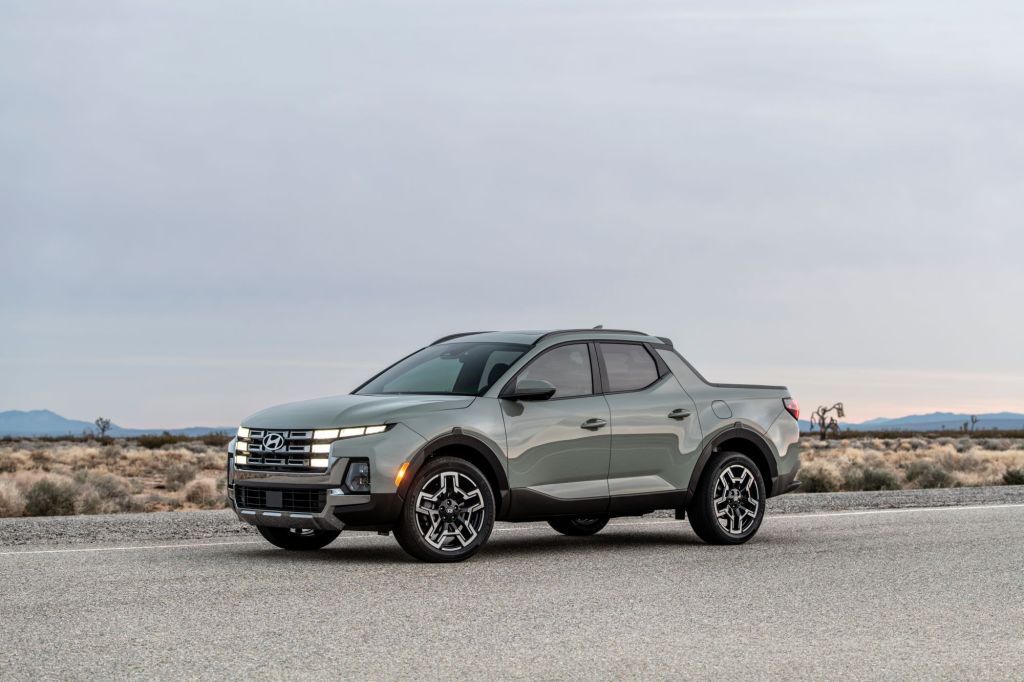
2025 Hyundai Santa Cruz Limited AWD: Style meets substance. (Images: Hyundai)

But the SAV that is the Santa Cruz is in someways closer to the SAV that is the X3 in that the Santa Cruz, certainly, is more like an SUV with a bed on the back than it is like the Maverick, which is like a “Honey, I Shrunk the F-150.”

The level of sophistication in the cabin of the Santa Cruz is simply in a completely different space than the DIY nature of the Maverick.

And while they both have beds, the Maverick’s is not only bigger (54.4 inches long vs. 52.1 inches; 20.3 inches deep versus 19.2 inches; 53.9 inches maximum width versus 53.3 inches; 33.3 cubic feet of volume versus 27 cubic feet), but it simply seems like the sort of thing you’d fill with landscaping material while the Santa Cruz would be more about mountain bikes.

It is a difference between utility and, well, weekend, low-impact adventure.

If there is any product in the Ford lineup that the Santa Cruz resembles, it is the Explorer Sport Trac, which had a run from 2000 to 2010: essentially a four-door Explorer with a box on the back. It was more Explorer than Ranger or F-150.

The Santa Cruz is like a Tucson with a box on the back.

When the refreshed Santa Cruz was revealed last year, José Muñoz, then-president and Global COO of Hyundai Motor Company and president and CEO of Hyundai Motor North America (he has since become president and CEO of Hyundai Motor Company), said, “The development goal for freshening Santa Cruz was to give it an even bolder, stronger design.”

While I agree with the “bolder,” I would quibble with the “stronger,” at least in the context of a vehicle with a box on the back. Usually when “stronger” is used in relation to truck-like vehicles, that means “boxier,” and the style of the front end of the Santa Cruz (or any Hyundai vehicle, for that matter, even the Class 8 Xcient tractor) doesn’t bring a T-square to mind. Rather, with it’s B-LED projector headlamps and LED daytime running lights it looks completely contemporary.

(There are also LED taillights, and LED cargo light on the rear edge of the roof, and LED bed lighting. This vehicle probably has more LEDs than most people have in their houses.)

The Limited is powered by a 281-hp 2.5L direct-injected turbocharged engine. There is an eight-speed wet dual-clutch automatic transmission (DCT). This vehicle can tow up to 5,000 pounds.

Inside there are such things as a powered 8-way driver seat and 6-way for the front passenger; both are heated and ventilated. There are leather surfaces on the seats. There is leather for the steering wheel and the shift knob.

That circle on the black rectagular surface is something you ordinarily don’t see in vehicles. It is a biometric interface: just like on smartphones, it is a fingerprint recognition system that allows the Santa Cruz to be started and it also loads the profile preferences for the person who is identified.

There is a 12.3-inch digital gauge cluster (i.e., what’s in front of the driver, with the speedometer, for example) and a 12.3-inch infotainment touch screen with the now-obligatory wireless Apple CarPlay and Android Auto.

Bose premium audio. Plenty of USB-C ports. Wireless charging.

There is Hyundai Digital Key 2 Touch, which allows a phone to be used in lieu of the fob.

There is even a fingerprint authentication system that allows a fingerprint to unlock the vehicle, start it, and load driver profiles.

There is BlueLink+ a connected vehicle service (remote start; lock-unlock; emergency assistance; etc.) that is. . .subscription free.

The point is, yes, the Santa Cruz may be truck-like because of the bed on the back, but it has contemporaneous amenities and style such that it really might make someone refer to it as a “Sport Adventure Vehicle.”

2026 Hyundai Ioniq 9 AWD Performance Calligraphy Design

Although it is big, some of the small details are most impressive

By Gary S. Vasilash

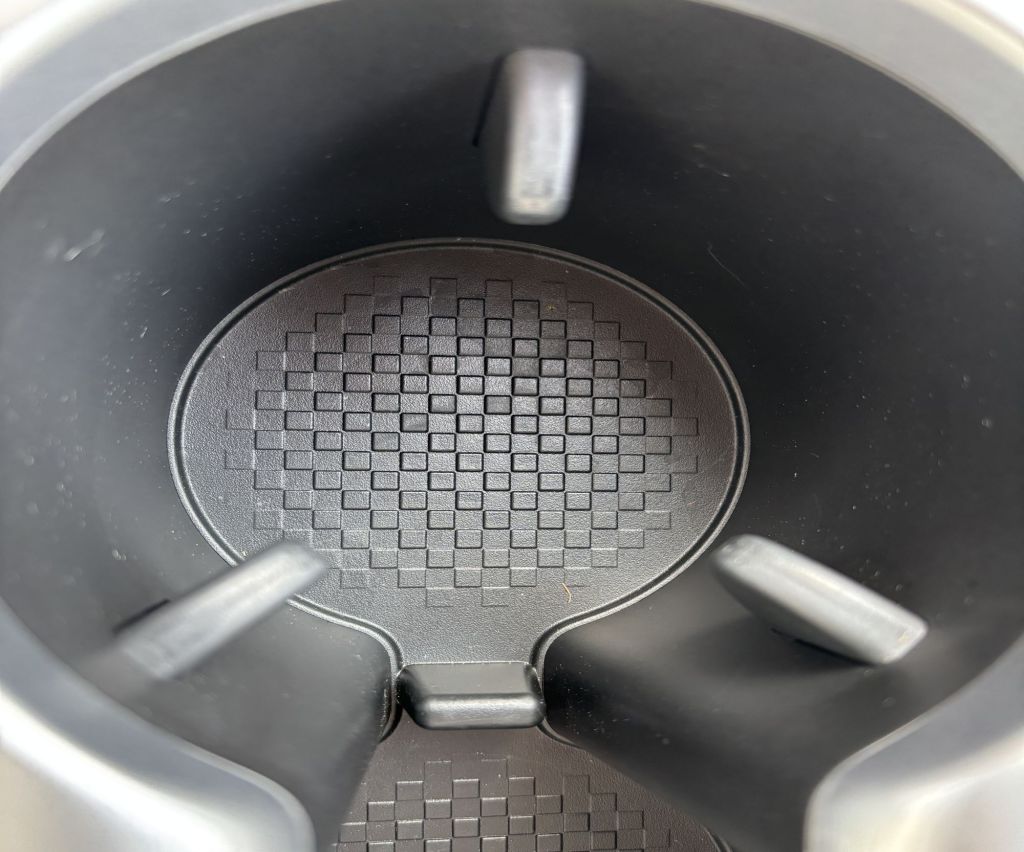
This is the bottom of the front cupholder on the Ioniq 9:

This is not the sort of thing that a review of a three-row electric vehicle that provides—depending on the powertrain setup selected—a range ranging from 311 miles to 335 miles typically opens with. In fact, it is unlikely that the bottom of a cupholder is even an issue.

After all, realize that this is quite a substantial vehicle, measuring 199.2 inches long, 78 inches wide, 70.5 inches high, with a 123.2-inch wheelbase. The top-of-the-line version tips the scales at 6,008 pounds. In the seven-passenger configuration (it can also be configured to seat six) it offers 163.4 cubic feet of passenger volume. With the third row folded it offers 46.7 cubic feet of cargo capacity. Leave it up and there’s 21.9 cubic feet.

But it is to make a point about the level of detail that the designers and engineers at Hyundai have taken in developing this vehicle.

Now the overall theme for the vehicle is one based on “pixelated design.” As in pixels, the individual square elements that make up images on digital screens. So as you can see from the bottom of that cupholder: pixels.

Hyundai designers use squares throughout the vehicle, both inside and out.

As in the front:

(Following images: Hyundai)

And back:

There is a remarkable consistency to this approach.

While it enhances the overall design, it also indicates that there is consistency and care in the creation of the SUV.

As legendary management consultant Tom Peters, the guy who co-wrote In Search of Excellence, put it:

“Small>>Big. Small Stuff Rules!”

Get the small stuff right and you’re likely to get the whole thing well executed.

And that is precisely the sense one gets from the Ioniq 9.

The AWD version driven here is a dual-motor arrangement that provides a total 422 hp, which means that as big as it is, the Ioniq 9 drives smartly. And while there is a RWD model on offer, which is the one that gets the 335-mile range, this model gets a respectable 311 miles.

And if you take it to a Supercharger, you can get from 10% state of charge to 80% in 40 minutes. If you are able to access a 350-kW DC fast charger, with the CCS adapter you can hit that 80% mark in 24 minutes.

But the thing is, when you have range of 300 miles+ the issue of range anxiety isn’t much of a thing—if it is a thing at all. Assuming you’re doing your pre-drive homework, you can take a road trip with several family members or friends in the Ioniq 9. If you’re just doing a daily drive, you probably won’t think much at all about charging.

Inside the vehicle there’s a lot more to it that nicely trimmed cupholders.

The driver and front passenger seats are both power 8-way adjustable, heated and ventilated. The driver gets 4-way power lumbar; the passenger 2-way. In the second row the captain’s chairs offer 4-way power adjustment and are heated and ventilated.

The seats are trimmed in the H-Tex material: a synthetic leather that looks and feels quite authentic.

In terms of technology, there is a 12.3-inch touchscreen. The gauge cluster is also a 12.3-inch screen.

And that is deserving of a word. There are some OEMs that, in vehicles that have a staring MSRP of $76,490 like this one does, figure that the more digital real estate they can throw on the IP, the better.

It isn’t.

While 12.3 inches times two certainly doesn’t go back to Peters’ “Small>>Big,” I would argue that the Hyundai approach to interface is a whole lot better than just adding screens.

It should be noted that the Ioniq 9 is counted among the 2025 Wards 10 Best Interiors & UX (full disclosure: I am one of the judges).

2026 IONIQ 9: Nine Things to Know

(Image: Hyundai)

Even if it wasn’t an electric vehicle it would be a most-impressive three-row vehicle. . . .

By Gary S. Vasilash

Roomy for Folks

The IONIQ 9 seats ether six or seven people in its three rows. And any way you configure it it is roomy: as in having passenger interior volume of 163.54 cu. ft. in the seven-passenger configuration. But like any vehicle, the third row is not as roomy as it is in the front or second row, but the IONIQ 9 has sufficient roominess in that third row such that the people who are back there won’t feel as though they are being punished, as is the case more often than not.

The seats are comfortable and that interior volume is such that occupants have a sense of space, as though they are in a room, not an SUV.

In fact, Hyundai interior designer Gary Lin uses a neologism to describe the cabin: “Aerosthetic Lounge.”

Speaking of Seats

What Hyundai calls “Relaxation Seats” are available for the first and second rows in the six-seat setup. These are seats that resemble those found in the First Class cabin of a transoceanic aircraft: They offer full recline—including leg rests.

Now here’s the clever part of the Relaxation Seats: People talk about how to kill time when having to recharge their EVs. But let’s face it: there are only so many nonperishable items you’re going to be buying in that Walmart that has a charging area.

So Hyundai is cleverly allowing people in the IONIQ 9 to get a comfortable place to wait it out.

Not a Long Wait

The IONIQ 9 has a 110.3-kWh lithium-ion battery.

According to Hyundai, using a CCS adapter and a 350-kW DC fast charger, the battery can go from 10% of charge to 80% in 24 minutes. If you go to a Tesla Supercharger, the same can be done in 41 minutes. At a 50-kW DC fast charger it is up to 109 minutes.

Presumably the choice might be predicated on how much you want to lounge.

When You’d Need to Recharge/Relax

There are three powertrain setups for the IONIQ 9.

The Long-Range RWD model features a 160-kW motor in the rear.

The Long-Range AWD model adds a 66.1-kW motor in the front. (This is something that EVs do that gasoline-powered vehicles can’t: want AWD, just add a motor. In gas-powered vehicle there are driveshafts and transfer cases or center differentials involved. Much simpler in an EV.)

Finally, there is the Performance AWD model, which has a pair of 157.3-kW motors.

So in that order the ranges are an estimated:

  • 335 miles
  • 320 miles
  • 311 miles

All of which is to say that the driver may not get to enjoy the full recline for a while.

The Utility Factor

Not only do people get big sport utility vehicles (and this vehicle is certainly sizable, measuring 199.2 in. long, 78 in. wide, 70.5 in. high, and having a 123.2-in. wheelbase) to move people, but also to move stuff.

So if all the seats are folded it can swallow 86.9 cu. ft. of stuff. 46.7 cu. ft. if the second row is in use. 21.9 cu. ft. behind the third row. (To provide some perspective: the trunk of a Sonata sedan measures 15.6 cu. ft., and it isn’t stingy on space.)

Yes, there is a frunk. For RWD models it measures 3.1 cu. ft. For AWD it is a diminutive 1.84 cu. ft.

Slippery, Too

One of the surprising things about the IONIQ 9 is that because it is large, you might think of it like pushing a large box through the air.

But, again, design and engineering have achieved a coefficient of drag that is nothing short of incredible.

That is, the coefficient of drag for a 2025 Corvette ZR1—the “fastest, most powerful Corvette ever,” according to Chevy—is widely reported to be 0.279.

The coefficient of drag for the IONIQ 9: 0.269.

Lower is more slippery.

In an Uncrowded Space

Back in 2023 Ford, which knows more than a little about such configurations, announced it planned to build a three-row electric SUV. A year later Ford announced that the vehicle planned to be launched in 2025 would be delayed. 2027, perhaps.

There aren’t a whole lot of EVs in this space.

Hyundai compares the IONIQ 9 to the Rivian R1S, which is reasonable. Except that the starting price for the Hyundai is $58,955 and the Rivian at $75,900. Not a trivial difference.

Hyundai also compares it with the Tesla Model X. Odds are Hyundai intends to sell more than the ~21,000 Model X’s that Tesla sold in the U.S. last year.

There is the Mercedes EQB that can carry seven, assuming that those who are relegated to row three are on the diminutive side.

And then there’s the Kia EV9. It is on the Electric Global Modular Platform (E-GMP). Just like the IONIQ 9.

Hush

Compared with vehicles powered by internal combustion engines, EVs tend to be quiet.

After all, there isn’t that series of explosions that occur as gasoline combusts in the cylinders because there are no cylinders, no gasoline in an EV.

But in some EVs there is a noticeable sound of whirring. And what’s more the case, there are noises from the outside of the vehicle, whether it is caused by the wind or the tires on the tarmac.

Hyundai engineers have addressed those noises in an impressive manner.

For one thing, there is acoustic glass used not only for the front side windows, but for the second row, as well. Many companies just opt for using the acoustic glass (which consists of a sandwich: glass/acoustic film/glass) in the front.

There are pads on the insides of the tires to absorb sound.

There is an array of foams and pads and insulation to mitigate unwanted sounds.

And if that’s not enough there is an active noise control system that uses the audio system to cancel out what you don’t want to hear.

Attainable

Let’s face it: electric vehicles are more expensive than vehicles that have gasoline engines.

According to recent numbers from Kelley Blue Book, the average transaction price for an EV was just shy of $60,000 while it was below $50K for a gas-powered vehicle.

Now make no mistake: the IONIQ 9 is—even if you look at it from the perspectives of size and amenities alone—an above-average vehicle.

Yet the starting MSRP for a RWD model is $58,955. (The vehicle is built at the amazing Metaplant outside of Savannah, Georgia, so it can qualify for the $7,500 tax credit.)

For all that it is and offers—nothing short of impressive.

Advanced Automotive Manufacturing—in Georgia

The Hyundai Metaplant America is the kind of manufacturing facility that other OEM manufacturing execs probably dream about. . .

By Gary S. Vasilash

I have seen the future of automotive manufacturing and it is in Savannah, Georgia. More specifically, it is in Ellabell, GA, but it is proximate (20 miles) to the more well-known locale.

The Hyundai Motor Group Metaplant America (HMGMA), which had its grand opening in late March, has been building Hyundai EVs since early October 2024. The first product is the IONIQ 5. It has since added the IONIQ 9.

The complex consists of 11 buildings with 7.5-million square feet under roof.

Hyundai has invested $12.6 billion in HMGMA as well as two battery joint ventures, one with LG Energy Solution and one with SK On.

The initial announced capacity was 300,000 vehicles per year.

Even before the launch is fully ramped the company announced it is going to increase capacity to 500,000 units.

HMGMA will not only be producing EVs for Hyundai, but products for sibling brands Genesis and Kia. And in addition to EVs, the plant will manufacture hybrid vehicles.

Shiny & Bright

To be sure there is something to be said for a new plant the way there is for a new car. Everything is bright and clean.

But HMGMA is exceptionally bright and clean—there are even skylights in the vaulted roof of the General Assembly building.

The epoxied floors shine with nary a smudge.

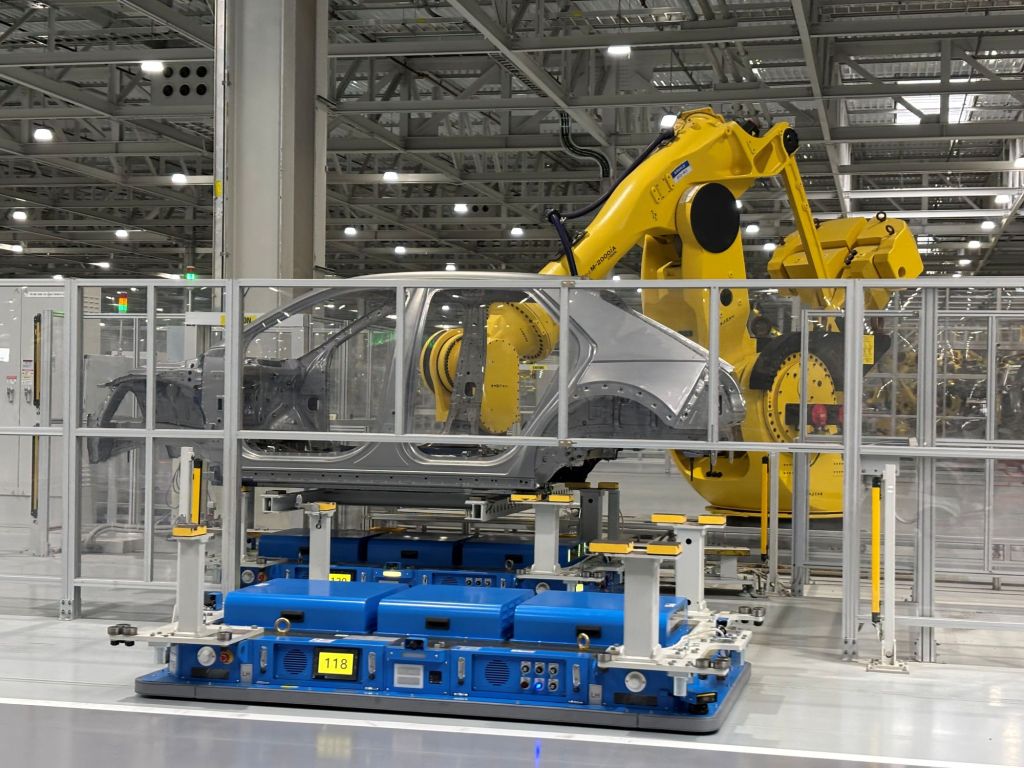
There are AGVs and robots throughout the HMGMA complex. (Images: Vasilash)

Advanced Manufacturing Tech

Hyundai operates the Hyundai Motor Group Innovation Center Singapore, where the company is developing smart manufacturing systems as well as producing vehicles with the hardware and software developed there (it has an annual capacity of 30,000 EVs).

The Singapore site is the testbed for the tech that is deployed in HMGMA.

While there is a significant number of robots working in the Weld shop—475—what is more impressive is the number of automated guided vehicles (AGVs) of various types, sizes and configurations that are autonomously running throughout the plant. These units are doing tasks ranging from parts delivery to actually lifting the finished vehicles at the end of the line and positioning them for subsequent inspection and tests.

The people working on the line—called “Meta Pros”—are not only walking on wood surfaces to make it easier on the legs during a shift, but tasks that might otherwise have them climb into a vehicle-in-process—such as installing a center console—are automated so as to relieve them of what might be ergonomically awkward conditions.

Hyundai owns Boston Dynamics, the producer of Spot, the four-legged robot shown here, performing an inspection task.

Investing Even More

Hyundai has announced that between 2025 and 2028 it will be investing $21 billion in the U.S. Part of that funding—as in $9 billion—will be to increase the total production capacity it has to 1.2 million vehicles. (It also has a plant in Montgomery, Alabama, Hyundai Motor Manufacturing Alabama, which builds the Santa Fe, Tucson, Santa Cruz, and Genesis GV70.)

When HMGMA is fully staffed there will be approximately 8,500 people working there.

The average salary for a Meta Pro is $58,105, not including benefits. Other workers in Bryan County, where the plant is sited, have an average wage of $47,000.

A good job in a modern facility for a good salary. That’s what bringing manufacturing to the U.S. is really about.

2025 Hyundai Elantra Hybrid Limited

This is an impressive package, especially for those who like to not frequent gas stations

By Gary S. Vasilash

The current-generation Hyundai Elantra, the seventh, is not what one might think of when pondering the sedan.

That is, you might think “Compact car,” with the bigger Sonata being “midsize car.”

But it turns out the Elantra, which measures:

  • Length:                            185.4
  • Width:                              71.9
  • Height:                            55.7
  • Wheelbase:                  107.1

is actually in the EPA “Midsize” segment. (And, yes, Sonata “Full-size.”)

The Elantra is a sizeable sedan (comparatively speaking, of course) and there’s plenty of interior room—as in 99.4 cubic feet in the passenger compartment—as well as adequate cargo-carrying capacity—14.2 cubic feet.

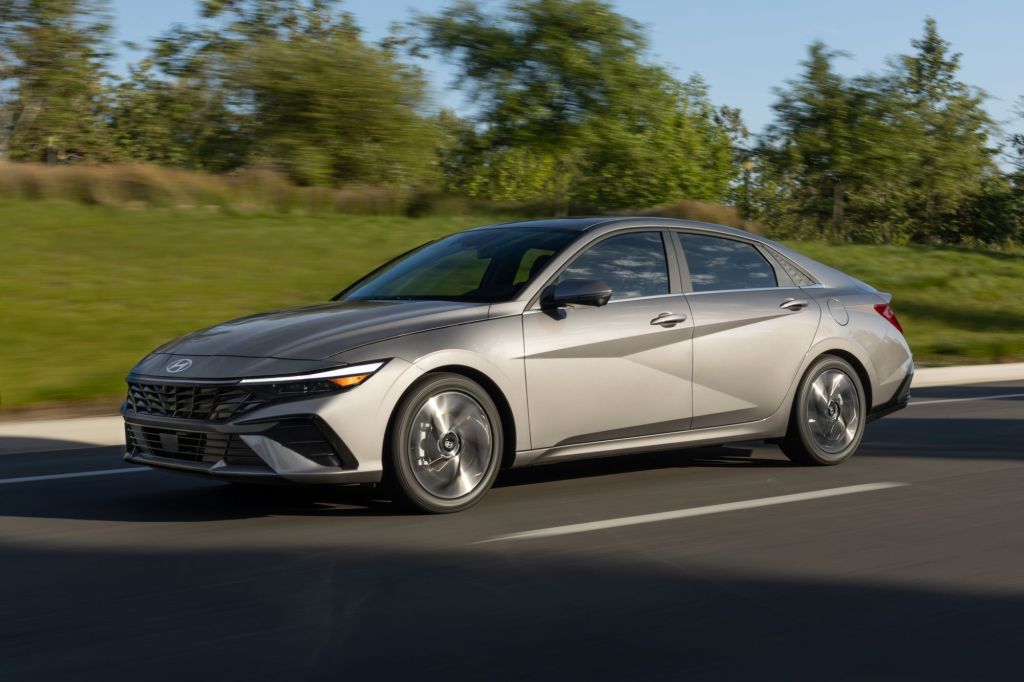
2025 Elantra Hybrid: stylish and with ~500 miles on a tank of gas, it is quite a compelling package (Image: Hyundai)

The exterior sheet metal has an array of creases and facets that make the car continue to have a distinctive appearance, even though model year 2021 is when the body styling first appeared on the car. Making something look fresh for that many years is no mean feat.

The interior has a clean look. Meaning that it is not overwrought. There are a 10.25-inch digital gauge cluster and a 10.25-inch infotainment screen. It is hard to imagine anyone needing any more digital real estate than that in a car. There are actual buttons to control the HVAC. There is a Drive Mode button that allows the selection of Eco, Smart or Sport; when making a selection the colors on the gauge cluster change (e.g., go Sport and there’s, of course, red).

The seats, covered with a simulated leather (H-Tex), are comfortable. The rear seats can accommodate adults, but odds are if you’re taking some colleagues, say, out to lunch, they’re going to be calling “Shotgun.”

One of my quibbles is the drive mode defaults to Eco. I would have liked it to stay in Smart because that adjusts the throttle and the transmission based on driving conditions.

“Sport?” you wonder.

Yes, there is a discernable difference in performance when making that selection.

But we’re talking about a hybrid here. It has a 1.6-liter Atkinson Cycle engine that produces 104 hp and 109 lb-ft of torque; with the 32-kW electric motor supplement the output is increased to 139 hp and 195 lb-ft. The Elantra Hybrid has a six-speed dual-clutch transmission (a transmission type that is becoming increasingly rare).

The point is, this is about fuel efficiency, not leaving the other vehicles behind when the light turns green.

And on the subject of fuel economy, the sticker says 49 mpg city, 52 mpg highway, and 50 mpg combined. I found my driving experience to be closer to the 49 mpg overall than the 50, though I did switch drive modes every now and then—yes, including Sport, which was handy in freeway driving.

The MSRP for the this top-trim hybrid is $29,450, It is quite an impressive package for the price for at least a couple of reasons.

First, there is the fuel efficiency that the hybrid provides. Consider that with its 11-gallon fuel tank it is good for about 500 miles before having to go to the local Shell station.

Second there’s the MSRP. For a not-very-large car payment, with the Elentra Hybrid you can get a lot of car. What’s not to like about that?

2025 Hyundai Kona Limited AWD

Considering the execution of the Kona. . .

By Gary S. Vasilash

During the development of the 11th-generation Ford F-150 (2004-2008) J Mays was the vice president of Design at Ford.

One of the briefs that the design team had was to improve the interior design of the truck.

During a presentation at the Ford design facility in Dearborn Mays pointed out that while the exterior sheet metal gets people in a vehicle—they go to the showroom, see it, and if they like it get into it—but the interior design keeps them there.

If you think about it, vehicle interiors are far more important than exteriors.

Yes, it may be that seeing whatever in your driveway puts a smile on your face whenever you go out to get into it.

But that lasts a few moments and when you are in the vehicle there are a whole lot of moments spent behind the wheel.

According to autoinsurance.com the average time spent driving to work in 2024 was 26 minutes. So that would be a roundtrip time of 52 minutes. Five days a week, then that’s more than four hours.

Yes, the interior environment in a vehicle matters. A lot.

The Vehicle Then & Now

Which brings me to the Hyundai Kona.

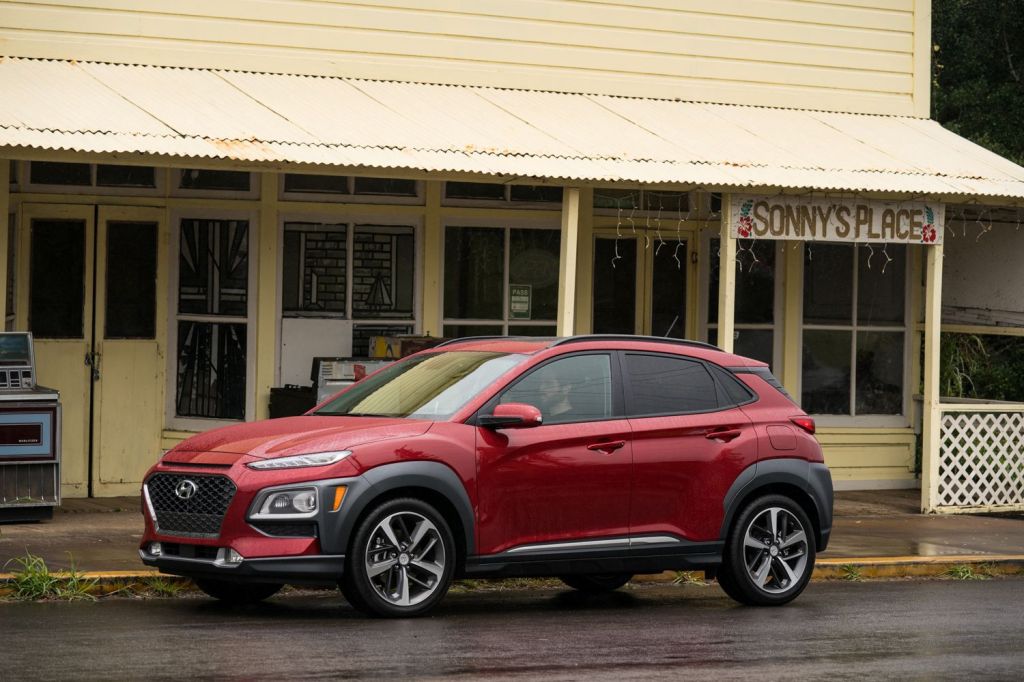
I am a fan of the exterior of the first-generation (model years 2018-2023) Hyundai Kona. It added significant amounts of style to the small SUV category, a category that was (and pretty much continues to be) dominated by designs that are readily forgotten.

Kona then–first generation. (Photos: Hyundai)

The exterior design is sporty. And at least in terms of cargo capacity, it is reasonably utile: 19.2 cubic feet of cargo space with the second row up and 45.8 cubic feet with the seat down.

But that was then and this is now.

Kona now–second generation.

The second-generation Kona was launched in model year 2024. Driven here is 2025.

And the exterior sheet metal is in my estimation less sporty and more, well, manhwa (i.e., the Korean term for “manga”).

Lots of Room

But the utility quotient is way up, with cargo capacity being 25.5 cubic feet behind the second row and 63.7 cubic feet with the seatback folded.

Similarly, the passenger volume is way up: it is 94.1 cubic feet (w/o sunroof) for the first-generation Kona; it is 101.2 cubic feet for gen two.

Lots of Tech

And the interior of the second-generation Kona is a nice place to be because it is exceedingly well done.

I just took a quick drive to the store in the Kona. While waiting behind a few cars to make a left turn, when the car ahead of the Kona moved and I didn’t immediately react, a “bing” and a message on the gauge screen pointed out that the car had moved way.

When I got home it pointed out that I should look in the rear seat as I had opened the rear door to put in groceries.

While that rear-seat notification is now common (according to the Alliance for Automotive Innovation, which organized voluntary commitments among its members in 2019 for rear-seat reminder systems, as of November 2024 there were 263 models available with the tech), the Leading Vehicle Departure Alert is rare.

And there’s Blind Spot View Monitor. Flick the turn signal to either direction and there is an appropriate live camera image of that side of the vehicle shown in the gauge cluster. While this is available only in the Limited trim, the Limited AWD driven here has an MSRP of $33,400.

“Smaht. Very Smaht.”

And for that you get a vehicle with that, remote smart parking assist (“Smaht Pahk” as the 2020 TV commercial with John Krasinski, Rachel Dratch and Chris Evans put  it), a 12.3-inch digital instrument cluster, another 12.3-inch navigation screen, heated and ventilated front seats, a heated leather covered steering wheel (and on the subject of leather: the seating surfaces are H-Tex, a faux leather which is convincing), a proximity keyfob with pushbutton start (keep the key in your pocket or purse: the door unlocks and you can start the vehicle), and an overall look of clean, contemporary design on the inside of the vehicle.

The vehicle is powered by a 1.6-liter turbocharged engine that produces 190 hp and 195 lb-ft of torque. It is stickered at 24 mpg city, 20 mpg highway and 26 mpg combined, which is pretty much what I got while driving it.

Thoughtful

One of the striking things about the Kona is that it has what I consider a “deliberate design.”

Sure, all vehicles have a design brief and to the extent that’s executed, their designs are deliberate.

But it seems there is a considerably stronger level of consideration applied here, both inside and out.

What’s more, the technology that are part of the package tends to be the sort of things that other OEMs put in vehicles that are much higher in price.