
Advanced Automotive Manufacturing—in Georgia

The Hyundai Metaplant America is the kind of manufacturing facility that other OEM manufacturing execs probably dream about. . .

By Gary S. Vasilash

I have seen the future of automotive manufacturing and it is in Savannah, Georgia. More specifically, it is in Ellabell, GA, but it is proximate (20 miles) to the more well-known locale.

The Hyundai Motor Group Metaplant America (HMGMA), which had its grand opening in late March, has been building Hyundai EVs since early October 2024. The first product is the IONIQ 5. It has since added the IONIQ 9.

The complex consists of 11 buildings with 7.5-million square feet under roof.

Hyundai has invested $12.6 billion in HMGMA as well as two battery joint ventures, one with LG Energy Solution and one with SK On.

The initial announced capacity was 300,000 vehicles per year.

Even before the launch is fully ramped the company announced it is going to increase capacity to 500,000 units.

HMGMA will not only be producing EVs for Hyundai, but products for sibling brands Genesis and Kia. And in addition to EVs, the plant will manufacture hybrid vehicles.

Shiny & Bright

To be sure there is something to be said for a new plant the way there is for a new car. Everything is bright and clean.

But HMGMA is exceptionally bright and clean—there are even skylights in the vaulted roof of the General Assembly building.

The epoxied floors shine with nary a smudge.
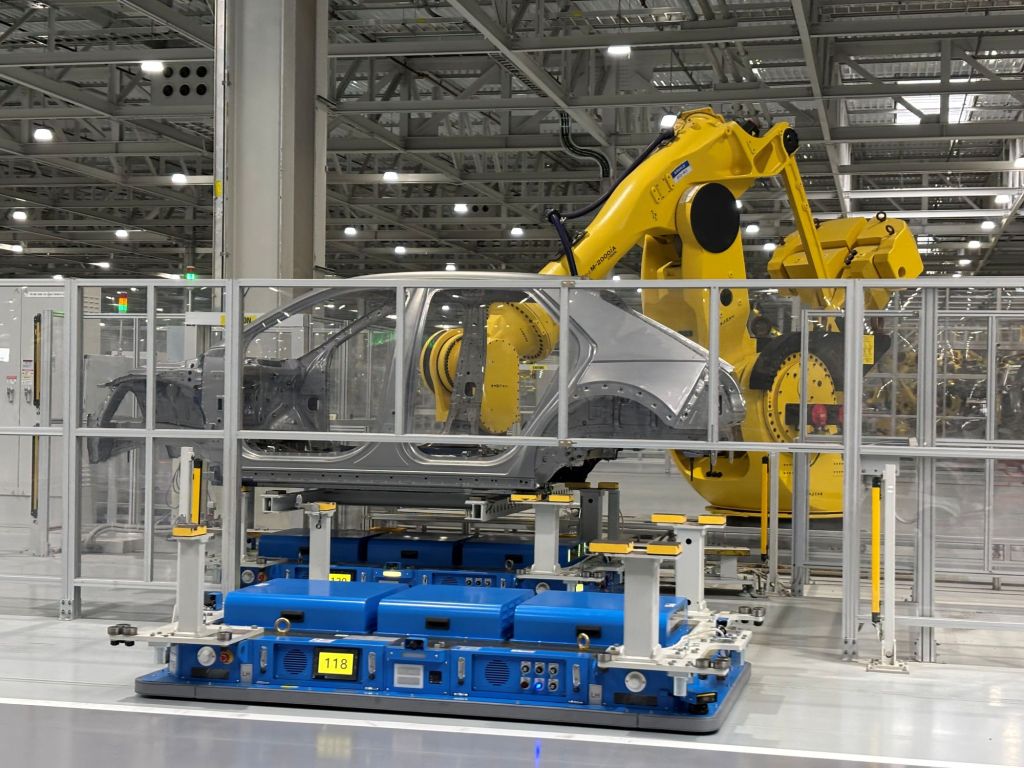
There are AGVs and robots throughout the HMGMA complex. (Images: Vasilash)

Advanced Manufacturing Tech

Hyundai operates the Hyundai Motor Group Innovation Center Singapore, where the company is developing smart manufacturing systems as well as producing vehicles with the hardware and software developed there (it has an annual capacity of 30,000 EVs).

The Singapore site is the testbed for the tech that is deployed in HMGMA.

While there is a significant number of robots working in the Weld shop—475—what is more impressive is the number of automated guided vehicles (AGVs) of various types, sizes and configurations that are autonomously running throughout the plant. These units are doing tasks ranging from parts delivery to actually lifting the finished vehicles at the end of the line and positioning them for subsequent inspection and tests.

The people working on the line—called “Meta Pros”—are not only walking on wood surfaces to make it easier on the legs during a shift, but tasks that might otherwise have them climb into a vehicle-in-process—such as installing a center console—are automated so as to relieve them of what might be ergonomically awkward conditions.
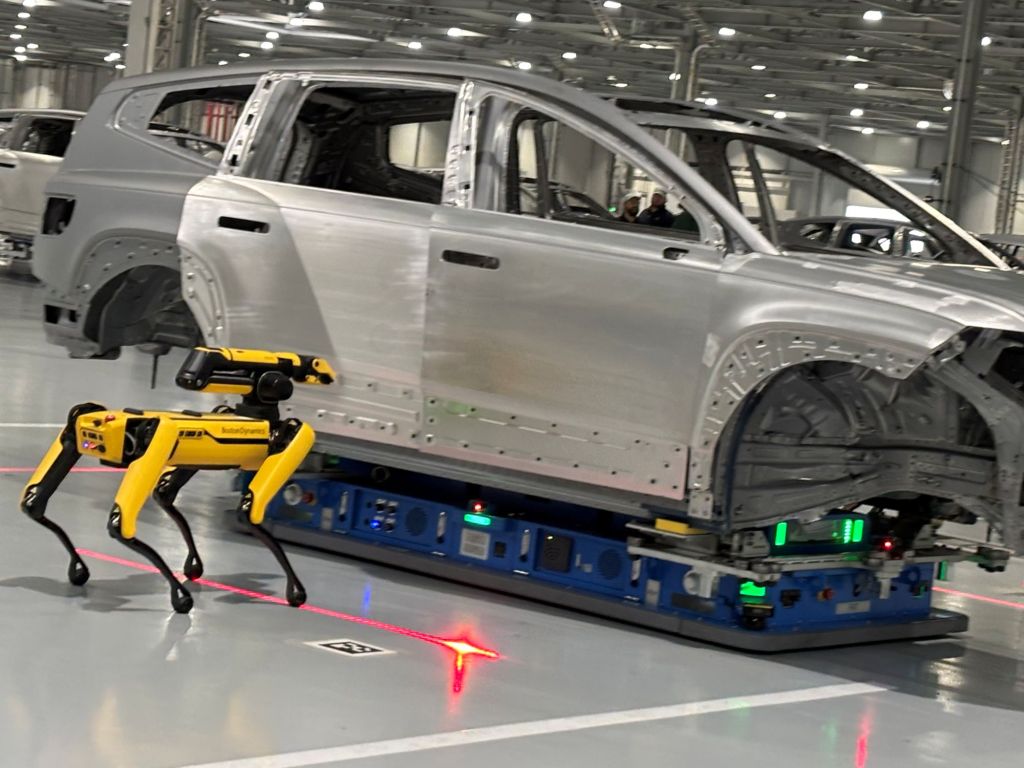
Hyundai owns Boston Dynamics, the producer of Spot, the four-legged robot shown here, performing an inspection task.

Investing Even More

Hyundai has announced that between 2025 and 2028 it will be investing $21 billion in the U.S. Part of that funding—as in $9 billion—will be to increase the total production capacity it has to 1.2 million vehicles. (It also has a plant in Montgomery, Alabama, Hyundai Motor Manufacturing Alabama, which builds the Santa Fe, Tucson, Santa Cruz, and Genesis GV70.)

When HMGMA is fully staffed there will be approximately 8,500 people working there.

The average salary for a Meta Pro is $58,105, not including benefits. Other workers in Bryan County, where the plant is sited, have an average wage of $47,000.

A good job in a modern facility for a good salary. That’s what bringing manufacturing to the U.S. is really about.
2024 Hyundai IONIQ 5 Limited AWD

By Gary S. Vasilash

Although Tesla seems to be in the sort of fix that one might expect a traditional OEM to have rather than it, maybe that is because Tesla is turning into something of a traditional OEM, yet it isn’t quite capable of making the transition, which exacerbates the problem.

Now to be fair, the EV market in the U.S. is still pretty much in two categories:

  • Tesla
  • Everybody Else

So when you look at the increase in sales of Everybody Else’s EVs you have to recognize that in terms of overall numbers, there are certainly models that have internal combustion engines in their lineup that may have percentage decreases yet, in terms of the overall number delivered, well above the EV.

However, one of the issues that Tesla faces and doesn’t seem to be particularly interested in addressing is that the technological heat seekers, those who are constantly on the lookout for What’s Next, have likely purchased a Tesla or two. Now this is not to say that they’re suddenly going to go buy an EV from someone else but, rather, to say that there is a set of those people and they’ve pretty much been saturated.

The upside in the EV market will be people who are interested in something advanced but not completely challenging.

Let’s face it: Although driving an EV is pretty much like driving any a vehicle with a combustion engine, there are differences that require some adjustment on behalf of the driver. So at this stage in the proliferation of the technology it is probably a good thing for OEMs to provide prospective EV owners with vehicles that progressive without being perplexing.

Which brings me at last to the Hyundai IONIQ 5, an EV crossover that could draw plenty of customers into Hyundai stores and if they drive off the lot with one they’re not going to have to study how to use it.

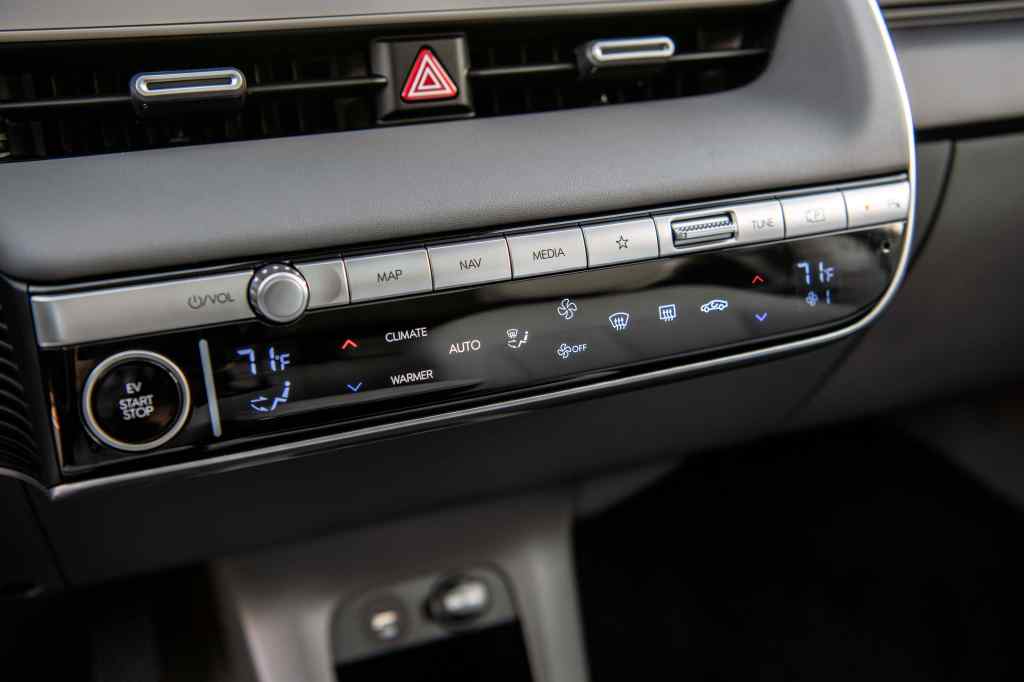
Quick: how do you adjust the temperature in the IONIQ 5? Some things make superior ergonomic sense. (Images: Hyundai)

For example: Want to adjust the HVAC? Yes, there is a 12.3-inch touchscreen. . .but more familiar, on a conductive surface, are red and blue arrows: touch them to get the job done. No searching required through the screen.

Yes, there are buttons and switches. A minimal but familiar assortment of things that can be adjusted.

The design of the IONIQ 5 is superb. There is the now seeming obligatory minimalism, but, more to the point, there is the addition of artistry in the patterns on some of the surfaces that are subtle and provide an overall sense of freshness. This is in contrast to the near-Brutalist approach that is taken inside a Tesla.

The exterior of the IONIQ 5—from the LED lighting up front to the LEDs around back—provides an appearance that is purposeful yet futuristic. I am puzzled by the apparent appeal of the bland front fascia of the Tesla Model Y: the front end of the IONIQ 5 appears as though it was created by a team of innovative engineers and artisans; the Model Y front appears as though the objective was to make a shape that could be readily released from the injection molding tooling.

The exterior is fresh and forward.

And the creases in the body side of the IONIQ 5 speak to a knowledge of forming metal in an aesthetic manner, something that, arguably, is lacking in something like the—admittedly not a competitor—Cybertruck which, again, seems to have been designed so that it could be formed with a press brake rather than a servo press.

The IONIQ 5 comes in RWD and AWD versions, with different motor and battery sizes.

The vehicle driven here is an AWD model; its permanent magnet synchronous motors (one in the front, one in the rear) produce a combined 320 hp. It has a SK Innovation 77.4 kWh lithium-ion battery that provides the vehicle with a range of 260 miles. The on-board charger is capable to being charged at a station with up to 800 v/350 kW; that means the battery charge can go from 10% to 80% in as little as 18 minutes.

People are catching on to the IONIQ 5. In March sales were up 58%. There were 3,361 delivered. The sales of the Hyundai Palisade—a bigger vehicle with an internal combustion engine—were also up 58% in March. There were 9,785 delivered.

The point being, there is a ways to go before there is greater consumption of EVs.

The IONIQ 5 is a vehicle that will help get more people there.