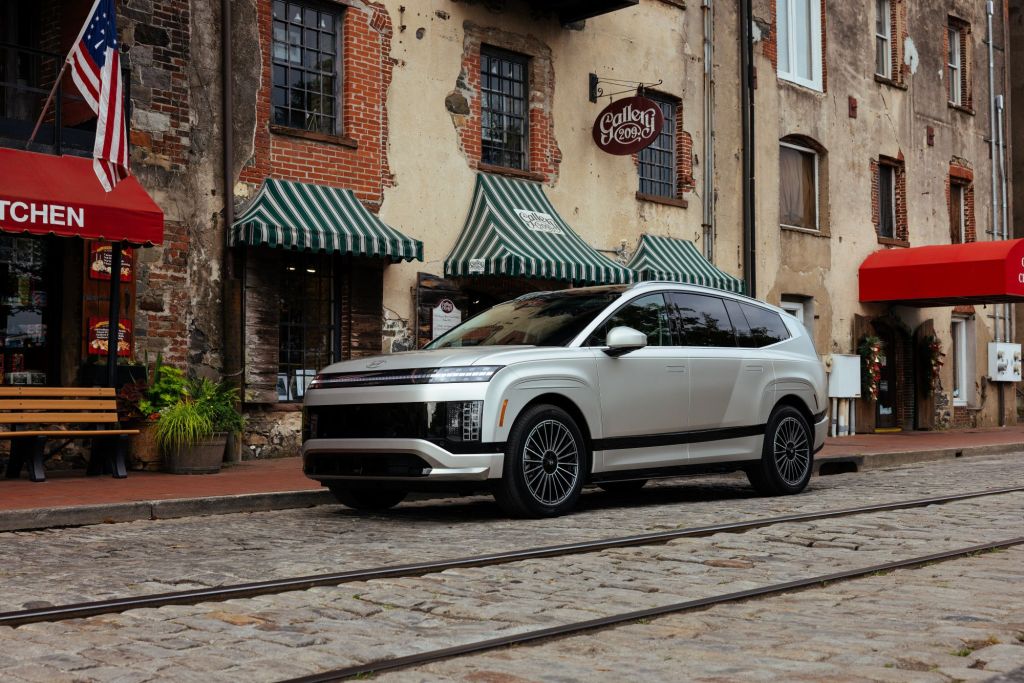
2026 Hyundai Palisade Calligraphy AWD

It may be positioned as a mass-market three-row, but it is a whole lot more—arguably a segment above

By Gary S. Vasilash

In 2024 the auto industry spent some $29.5 billion on advertising. That’s about 9% of all of the ad spend from all categories and industries, making it one of the top categories.

One of the things the ads do is not only try to convince people to buy whatever, but to perceive whatever in the way that the advertiser wants us to.

Or put simply, if it is a truck the goal is to make sure the viewer understands that it is rugged and capable.

If it is a vehicle that is in the “luxury” category, then it must be presented in a way that makes the viewers realize there is something special about the vehicle that sets it apart from “mainstream” vehicles.

Of course, in the case of trucks they must be engineered to be rugged and capable.

And if it is a luxury vehicle, then there must be attributes—say top-notch materials used in the interior and an impressive infotainment system—that would make the implied purchase premium seem appropriate.

There are simply some things that are necessary to validate the positioning of the vehicle.

But one thing that this does is segments what people may look at.

Sure, someone who wants a truck may simply look at the overall architecture of the vehicle and determine that it is, indeed, a truck.

The lux part is what, at least in the context of the Hyundai Palisade Calligraphy, that has fuzzy borders.

A three-row crossver with massive exterior styling. (Images: Hyundai)

While people would correctly perceive Hyundai to be a mainstream brand—and even the people at the Hyundai Motor Group decided that it would have a separate higher-end brand, Genesis—the Palisade Calligraphy interior is every bit as nice as any Cadillac, Lincoln, Lexus, Mercedes, etc. I have been in of late. And lately I’ve been in a lot (I was one of the jurors for the 2025 Wards 10 Best Interiors & UX Awards, and if you scroll down on this page you’ll see we were in a lot of interiors, and while you won’t see the Palisade on the list, that’s because it wasn’t available during our testing; I’m confident it will be there next year).

The materials, the design, the technology, the comfort, the convenience, and the attention to detail are all first-rate.

Comfort, space, and technology in quantity–and with quality.

Now it should be pointed out the Calligraphy is the top trim for the Palisade, which is available in five other trims, with the SE that has a starting MSRP of $39,435.

The Calligraphy driven here has a MSRP of $56,060, and with one option($245)—and this speaks to the fact that the vehicle as trimmed is absolutely rife with things that would likely otherwise be options—and inland freight and handling ($1,495) the whole thing comes to $57,800. (What is the option?, you wonder. Absurdly enough, carpeted floor mats.)

Recognize this is a seven-passenger, three-row all-wheel drive crossover that has heated/cooled, power-adjusting and reclining front and second row seats, as well as third row seats that also recline. A vehicle with a 12.3-inch infotainment screen and Bose premium audio. A vehicle with a total interior volume of 181 cubic feet of which 161.9 are devoted to passengers. (Max cargo is 86.7 cubic feet—and the folding of the second and third rows are done with a snap, not effort; with all rows in place it is 19.1 cubic feet). A utility that, yes, can tow (up to 5,000 pounds).

This is a big vehicle: 119.2 inches long, 78 inches wide, and 69.5 inches wide, with a 116.9 wheelbase. (One thing that should be noted is that the fidelity of the cameras and the fast-acting dynamic lines shown on the infotainment screen allow maneuvering in parking lots a whole lot easier than you might think.)

While I had the Palisade I was asked whether I would prefer it or the three-row Hyundai Ioniq 9, an electric vehicle with an award-winning interior.

Without question, the Ioniq 9 is a whole lot quicker and responsive thanks to its dual motors (talking about the long-range AWD version here) that produce 303 hp and 446 lb-ft of torque, compared with the 3.5-liter V6 in the Palisade that produces 287 hp and 260 lb-ft of torque (you’ve got to take into account, however, the Palisade is about 1,400 pounds lighter than the Ioniq 9).

The long-range AWD Ioniq 9 provides an estimated range of 311 miles. The EPA numbers for the Palisade are 18 city/24 highway/20 miles per gallon combined. It has a 19-gallon fuel tank. So that means a range, based on the combined figure, of 380 miles,

While 79 miles may not seem like a big deal, imagine using the Palisade, coming home from a holiday weekend, with the second and third rows being occupied by kids who were antsy not long after you pulled away from the cottage. Then recognize that the 79 miles could represent an hour more driving and that even though the Ioniq 9 can be charged from 10 to 80% in 24 minutes (which means you’d get 249 miles of range at 80%), the Palisade can be fully refueled—for 380 miles—in about five minutes.

I’d opt for the Palisade.

And for those shopping for a three-row crossover: a luxury brand or this one? I’d have a hard time determining why this isn’t the better choice.
2026 Hyundai Ioniq 9 AWD Performance Calligraphy Design

Although it is big, some of the small details are most impressive

By Gary S. Vasilash

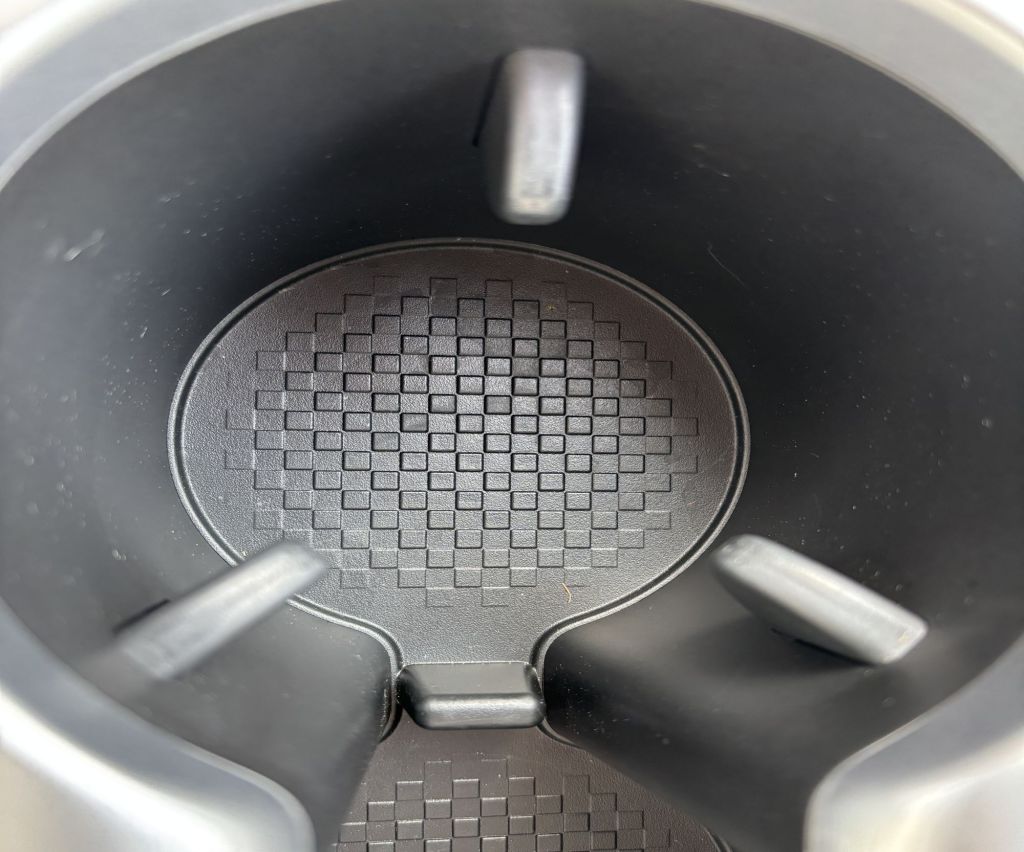
This is the bottom of the front cupholder on the Ioniq 9:

This is not the sort of thing that a review of a three-row electric vehicle that provides—depending on the powertrain setup selected—a range ranging from 311 miles to 335 miles typically opens with. In fact, it is unlikely that the bottom of a cupholder is even an issue.

After all, realize that this is quite a substantial vehicle, measuring 199.2 inches long, 78 inches wide, 70.5 inches high, with a 123.2-inch wheelbase. The top-of-the-line version tips the scales at 6,008 pounds. In the seven-passenger configuration (it can also be configured to seat six) it offers 163.4 cubic feet of passenger volume. With the third row folded it offers 46.7 cubic feet of cargo capacity. Leave it up and there’s 21.9 cubic feet.

But it is to make a point about the level of detail that the designers and engineers at Hyundai have taken in developing this vehicle.

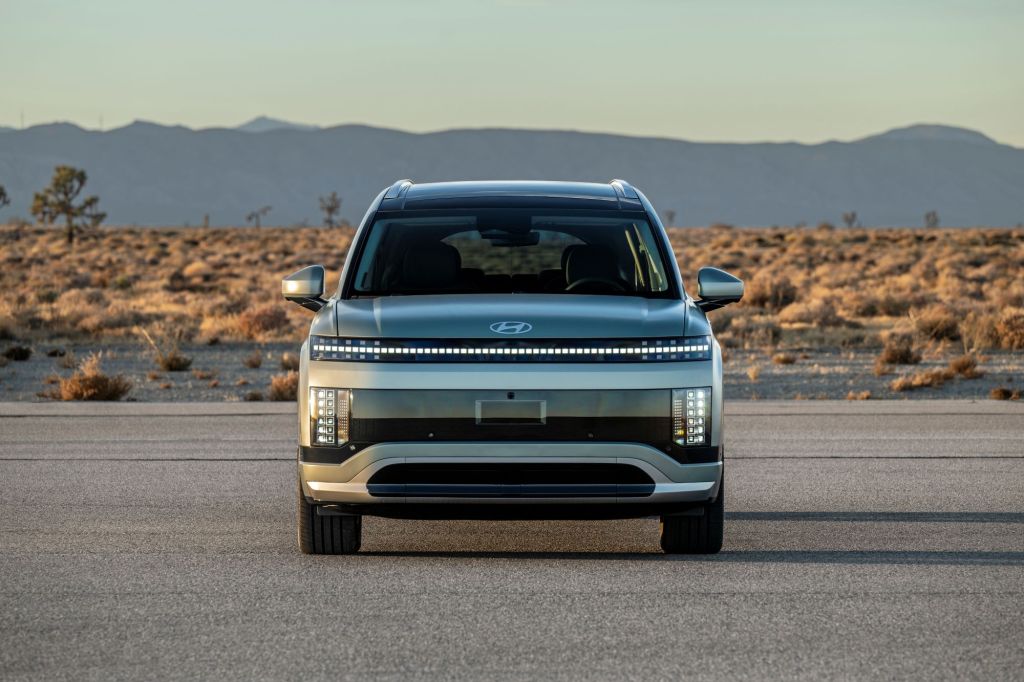
Now the overall theme for the vehicle is one based on “pixelated design.” As in pixels, the individual square elements that make up images on digital screens. So as you can see from the bottom of that cupholder: pixels.

Hyundai designers use squares throughout the vehicle, both inside and out.

As in the front:

(Following images: Hyundai)

And back:

There is a remarkable consistency to this approach.

While it enhances the overall design, it also indicates that there is consistency and care in the creation of the SUV.

As legendary management consultant Tom Peters, the guy who co-wrote In Search of Excellence, put it:

“Small>>Big. Small Stuff Rules!”

Get the small stuff right and you’re likely to get the whole thing well executed.

And that is precisely the sense one gets from the Ioniq 9.

The AWD version driven here is a dual-motor arrangement that provides a total 422 hp, which means that as big as it is, the Ioniq 9 drives smartly. And while there is a RWD model on offer, which is the one that gets the 335-mile range, this model gets a respectable 311 miles.

And if you take it to a Supercharger, you can get from 10% state of charge to 80% in 40 minutes. If you are able to access a 350-kW DC fast charger, with the CCS adapter you can hit that 80% mark in 24 minutes.

But the thing is, when you have range of 300 miles+ the issue of range anxiety isn’t much of a thing—if it is a thing at all. Assuming you’re doing your pre-drive homework, you can take a road trip with several family members or friends in the Ioniq 9. If you’re just doing a daily drive, you probably won’t think much at all about charging.

Inside the vehicle there’s a lot more to it that nicely trimmed cupholders.

The driver and front passenger seats are both power 8-way adjustable, heated and ventilated. The driver gets 4-way power lumbar; the passenger 2-way. In the second row the captain’s chairs offer 4-way power adjustment and are heated and ventilated.

The seats are trimmed in the H-Tex material: a synthetic leather that looks and feels quite authentic.

In terms of technology, there is a 12.3-inch touchscreen. The gauge cluster is also a 12.3-inch screen.

And that is deserving of a word. There are some OEMs that, in vehicles that have a staring MSRP of $76,490 like this one does, figure that the more digital real estate they can throw on the IP, the better.

It isn’t.

While 12.3 inches times two certainly doesn’t go back to Peters’ “Small>>Big,” I would argue that the Hyundai approach to interface is a whole lot better than just adding screens.

It should be noted that the Ioniq 9 is counted among the 2025 Wards 10 Best Interiors & UX (full disclosure: I am one of the judges).

2026 IONIQ 9: Nine Things to Know

(Image: Hyundai)

Even if it wasn’t an electric vehicle it would be a most-impressive three-row vehicle. . . .

By Gary S. Vasilash

Roomy for Folks

The IONIQ 9 seats ether six or seven people in its three rows. And any way you configure it it is roomy: as in having passenger interior volume of 163.54 cu. ft. in the seven-passenger configuration. But like any vehicle, the third row is not as roomy as it is in the front or second row, but the IONIQ 9 has sufficient roominess in that third row such that the people who are back there won’t feel as though they are being punished, as is the case more often than not.

The seats are comfortable and that interior volume is such that occupants have a sense of space, as though they are in a room, not an SUV.

In fact, Hyundai interior designer Gary Lin uses a neologism to describe the cabin: “Aerosthetic Lounge.”

Speaking of Seats

What Hyundai calls “Relaxation Seats” are available for the first and second rows in the six-seat setup. These are seats that resemble those found in the First Class cabin of a transoceanic aircraft: They offer full recline—including leg rests.

Now here’s the clever part of the Relaxation Seats: People talk about how to kill time when having to recharge their EVs. But let’s face it: there are only so many nonperishable items you’re going to be buying in that Walmart that has a charging area.

So Hyundai is cleverly allowing people in the IONIQ 9 to get a comfortable place to wait it out.

Not a Long Wait

The IONIQ 9 has a 110.3-kWh lithium-ion battery.

According to Hyundai, using a CCS adapter and a 350-kW DC fast charger, the battery can go from 10% of charge to 80% in 24 minutes. If you go to a Tesla Supercharger, the same can be done in 41 minutes. At a 50-kW DC fast charger it is up to 109 minutes.

Presumably the choice might be predicated on how much you want to lounge.

When You’d Need to Recharge/Relax

There are three powertrain setups for the IONIQ 9.

The Long-Range RWD model features a 160-kW motor in the rear.

The Long-Range AWD model adds a 66.1-kW motor in the front. (This is something that EVs do that gasoline-powered vehicles can’t: want AWD, just add a motor. In gas-powered vehicle there are driveshafts and transfer cases or center differentials involved. Much simpler in an EV.)

Finally, there is the Performance AWD model, which has a pair of 157.3-kW motors.

So in that order the ranges are an estimated:

  • 335 miles
  • 320 miles
  • 311 miles

All of which is to say that the driver may not get to enjoy the full recline for a while.

The Utility Factor

Not only do people get big sport utility vehicles (and this vehicle is certainly sizable, measuring 199.2 in. long, 78 in. wide, 70.5 in. high, and having a 123.2-in. wheelbase) to move people, but also to move stuff.

So if all the seats are folded it can swallow 86.9 cu. ft. of stuff. 46.7 cu. ft. if the second row is in use. 21.9 cu. ft. behind the third row. (To provide some perspective: the trunk of a Sonata sedan measures 15.6 cu. ft., and it isn’t stingy on space.)

Yes, there is a frunk. For RWD models it measures 3.1 cu. ft. For AWD it is a diminutive 1.84 cu. ft.

Slippery, Too

One of the surprising things about the IONIQ 9 is that because it is large, you might think of it like pushing a large box through the air.

But, again, design and engineering have achieved a coefficient of drag that is nothing short of incredible.

That is, the coefficient of drag for a 2025 Corvette ZR1—the “fastest, most powerful Corvette ever,” according to Chevy—is widely reported to be 0.279.

The coefficient of drag for the IONIQ 9: 0.269.

Lower is more slippery.

In an Uncrowded Space

Back in 2023 Ford, which knows more than a little about such configurations, announced it planned to build a three-row electric SUV. A year later Ford announced that the vehicle planned to be launched in 2025 would be delayed. 2027, perhaps.

There aren’t a whole lot of EVs in this space.

Hyundai compares the IONIQ 9 to the Rivian R1S, which is reasonable. Except that the starting price for the Hyundai is $58,955 and the Rivian at $75,900. Not a trivial difference.

Hyundai also compares it with the Tesla Model X. Odds are Hyundai intends to sell more than the ~21,000 Model X’s that Tesla sold in the U.S. last year.

There is the Mercedes EQB that can carry seven, assuming that those who are relegated to row three are on the diminutive side.

And then there’s the Kia EV9. It is on the Electric Global Modular Platform (E-GMP). Just like the IONIQ 9.

Hush

Compared with vehicles powered by internal combustion engines, EVs tend to be quiet.

After all, there isn’t that series of explosions that occur as gasoline combusts in the cylinders because there are no cylinders, no gasoline in an EV.

But in some EVs there is a noticeable sound of whirring. And what’s more the case, there are noises from the outside of the vehicle, whether it is caused by the wind or the tires on the tarmac.

Hyundai engineers have addressed those noises in an impressive manner.

For one thing, there is acoustic glass used not only for the front side windows, but for the second row, as well. Many companies just opt for using the acoustic glass (which consists of a sandwich: glass/acoustic film/glass) in the front.

There are pads on the insides of the tires to absorb sound.

There is an array of foams and pads and insulation to mitigate unwanted sounds.

And if that’s not enough there is an active noise control system that uses the audio system to cancel out what you don’t want to hear.

Attainable

Let’s face it: electric vehicles are more expensive than vehicles that have gasoline engines.

According to recent numbers from Kelley Blue Book, the average transaction price for an EV was just shy of $60,000 while it was below $50K for a gas-powered vehicle.

Now make no mistake: the IONIQ 9 is—even if you look at it from the perspectives of size and amenities alone—an above-average vehicle.

Yet the starting MSRP for a RWD model is $58,955. (The vehicle is built at the amazing Metaplant outside of Savannah, Georgia, so it can qualify for the $7,500 tax credit.)

For all that it is and offers—nothing short of impressive.