
2025 Hyundai Kona Limited AWD

Considering the execution of the Kona. . .

By Gary S. Vasilash

During the development of the 11th-generation Ford F-150 (2004-2008) J Mays was the vice president of Design at Ford.

One of the briefs that the design team had was to improve the interior design of the truck.

During a presentation at the Ford design facility in Dearborn Mays pointed out that while the exterior sheet metal gets people in a vehicle—they go to the showroom, see it, and if they like it get into it—but the interior design keeps them there.

If you think about it, vehicle interiors are far more important than exteriors.

Yes, it may be that seeing whatever in your driveway puts a smile on your face whenever you go out to get into it.

But that lasts a few moments and when you are in the vehicle there are a whole lot of moments spent behind the wheel.

According to autoinsurance.com the average time spent driving to work in 2024 was 26 minutes. So that would be a roundtrip time of 52 minutes. Five days a week, then that’s more than four hours.

Yes, the interior environment in a vehicle matters. A lot.

The Vehicle Then & Now

Which brings me to the Hyundai Kona.

I am a fan of the exterior of the first-generation (model years 2018-2023) Hyundai Kona. It added significant amounts of style to the small SUV category, a category that was (and pretty much continues to be) dominated by designs that are readily forgotten.
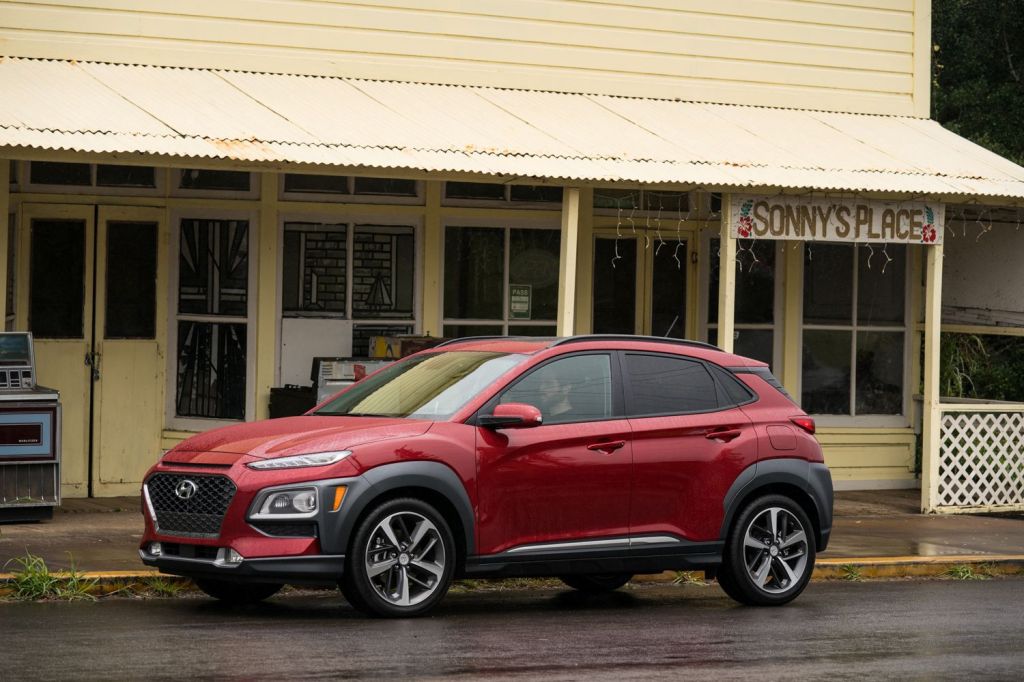
Kona then–first generation. (Photos: Hyundai)

The exterior design is sporty. And at least in terms of cargo capacity, it is reasonably utile: 19.2 cubic feet of cargo space with the second row up and 45.8 cubic feet with the seat down.

But that was then and this is now.

Kona now–second generation.

The second-generation Kona was launched in model year 2024. Driven here is 2025.

And the exterior sheet metal is in my estimation less sporty and more, well, manhwa (i.e., the Korean term for “manga”).

Lots of Room

But the utility quotient is way up, with cargo capacity being 25.5 cubic feet behind the second row and 63.7 cubic feet with the seatback folded.

Similarly, the passenger volume is way up: it is 94.1 cubic feet (w/o sunroof) for the first-generation Kona; it is 101.2 cubic feet for gen two.

Lots of Tech

And the interior of the second-generation Kona is a nice place to be because it is exceedingly well done.

I just took a quick drive to the store in the Kona. While waiting behind a few cars to make a left turn, when the car ahead of the Kona moved and I didn’t immediately react, a “bing” and a message on the gauge screen pointed out that the car had moved way.

When I got home it pointed out that I should look in the rear seat as I had opened the rear door to put in groceries.

While that rear-seat notification is now common (according to the Alliance for Automotive Innovation, which organized voluntary commitments among its members in 2019 for rear-seat reminder systems, as of November 2024 there were 263 models available with the tech), the Leading Vehicle Departure Alert is rare.

And there’s Blind Spot View Monitor. Flick the turn signal to either direction and there is an appropriate live camera image of that side of the vehicle shown in the gauge cluster. While this is available only in the Limited trim, the Limited AWD driven here has an MSRP of $33,400.

“Smaht. Very Smaht.”

And for that you get a vehicle with that, remote smart parking assist (“Smaht Pahk” as the 2020 TV commercial with John Krasinski, Rachel Dratch and Chris Evans put  it), a 12.3-inch digital instrument cluster, another 12.3-inch navigation screen, heated and ventilated front seats, a heated leather covered steering wheel (and on the subject of leather: the seating surfaces are H-Tex, a faux leather which is convincing), a proximity keyfob with pushbutton start (keep the key in your pocket or purse: the door unlocks and you can start the vehicle), and an overall look of clean, contemporary design on the inside of the vehicle.

The vehicle is powered by a 1.6-liter turbocharged engine that produces 190 hp and 195 lb-ft of torque. It is stickered at 24 mpg city, 20 mpg highway and 26 mpg combined, which is pretty much what I got while driving it.

Thoughtful

One of the striking things about the Kona is that it has what I consider a “deliberate design.”

Sure, all vehicles have a design brief and to the extent that’s executed, their designs are deliberate.

But it seems there is a considerably stronger level of consideration applied here, both inside and out.

What’s more, the technology that are part of the package tends to be the sort of things that other OEMs put in vehicles that are much higher in price.

2024 Hyundai Kona Electric Limited

Well, you can’t like everything. . .

By Gary S. Vasilash

To start with something completely subjective:

For the past few years it seems like there hasn’t been a Hyundai the exterior design of which I haven’t been most impressed by. Sedan or crossover, ICE or electric, the design team at Hyundai has been delivering in a way that I’m sure there are some at other OEM studios can only shake their heads at in wonder, admiration and jealousy.

Former head of Ford design J. Mays used to say, in effect, that it cost as much to stamp a boring body panel as it does an intriguing one. So given that. . . .

It does seem to be the case, however, that Hyundai’s competitors have watched the way the company is gaining market share, going from a brand that didn’t seem to be having much of an effect on the market* (in effect, just getting buyers on the margin) to one that is growing, step by step (i.e., in pre-pandemic 2019 Hyundai sold 668,771 vehicles in the U.S.; in 2023 that number was up to 801,195; 2024 sales through May show a 2% increase over 2023, not a big number by any means, but one that is still on the plus side). And what those competitors see is that people in non-trivial numbers like non-boring sheet metal, so they have, in an increasing number of instances, elevated their games.

Which is good for consumers.

That said, Hyundai design has persistently produced vehicles that are striking.

Which led me to fear that I was becoming too enamored with the marque.

A shift (and it has a single-speed reduction gear transmission). . .

But then I saw the rear of the 2024 Kona Electric and that fear became unfounded.

Rear of the 2024 Kona Electric (Images: Hyundai)

It strikes me—yes, yes, entirely subjective—as simply too slabby.

The rear of the original Kona, model year 2018, is something that I think is far more interesting. And as I spend time looking at photos of the earlier iteration of the Kona, I think its design is superior to the current one. The forms are much tighter.

Rear of the original, 2018, Hyundai Kona. I like this one better. Much, much better.

Of course, OEMs are interested in moving their current models, not ones from the past. (Interestingly, in terms of purchasing, the Cox Automotive 2023 Automotive Car Buyer Journey Study found that 68% of buyers considered both new and used vehicles and it is worth noting that there some 36 million used vehicles sold in 2023, more than double the number of new. For the consumer, used matters.)

OK. Now completely objective info.

Just the facts. . .

The Kona Electric is, well, an electric vehicle. It is powered by a permanent magnet synchronous motor that produces 150 kW (a.k.a., 201 hp).  The motor powers the front axle. There is a 64.8 kWh lithium-ion battery. According to the EPA this setup provides a range of 261 miles.

With DC fast charging the battery can go from 10% to 80% in approximately 43 minutes. With a Level II charger, using the 11 kW onboard charger, it can go from 10% to 100% in 6 hours, 14 minutes. (This is the sort of thing that can happen at home.)

The Kona Electric’s outside measurements are: wheelbase, 104.7 inches; length, 171.5 inches; width, 71.9 inches; and height, with roof rails, 62.2 inches.

The Kona Electric’s inside measurements are: passenger interior volume with sunroof, 96.8 cubic feet.

The Kona Electric’s cargo capacities are: behind the second row, 25.5 cubic feet; second row folded, 63.7 cubic feet.

The Kona Electric’s frunk capacity: 0.95 cubic feet. (Think of a place to store the charging cable.)

Not just the facts. . .

On the inside (now going back to the subjective mode with some numbers thrown in) there is the clean, contemporary look that Hyundai is bringing to all of its vehicles.

There is a 12.3 driver information screen and a 12.3-inch infotainment screen. While it doesn’t fake being one screen, for practical purposes this is 24.6 inches of screen, which is quite impressive. (Plus the visual appearance is first-rate.)

There is an eight-way power driver seat; the passenger has to adjust their own, xix ways. But both front seats are heated and ventilated and are trimmed out with “H-Tex” leatherette (a.k.a., pleather).

There are wireless Apple CarPlay and Android Auto and Bose premium audio.

There is Hyundai Digital Key, which means you can use your phone in lieu of the fob; the fob has proximity capability which means you can approach the locked vehicle and it will open when you tug the handle.

There is an array of safety tech (e.g., blind-spot collision warning; parking distance warning; navigation-based smart cruise control with stop and go; lane-keep assist). There is also something that is useful in regular driving: use the turn signal and there is a camera view in the driver information screen showing what’s along side the vehicle (yes, the sort of thing you can see in the side-view mirrors—but better).

So. . .

Drives well. (Somewhat) reasonable range (I am in the 300-mile club). Good tech and nice interior. Excellent MSRP for this loaded (Limted) model: $41,045.

But then there’s the back. . . .