Why this model deserves serious consideration. . .
By Gary S. Vasilash
Genesis was launched as a stand-alone brand in the U.S. in 2015.
In 2008 Hyundai started selling large, lux models in the U.S. that were labeled “Genesis.” Like the “Hyundai Genesis” model.
The thing is, Hyundai was largely recognized back then as a purveyor of economical vehicles, whether it was the entry-level Accent or the sporty Tiburon.
The design revolution that was launched by the Hyundai Sonata didn’t happen until the sixth generation, starting with the model year 2011 car.
The success of that car led to a transformation of the perception of the brand from frumpy to forward.
But still, there was the association of value with Hyundai. Certainly not a bad characteristic, but most luxury buyers probably aren’t worried about whether the vehicle they buy have “America’s Best Warranty.”
The situation was not unlike that experienced at U.S. Volkswagen dealerships from 2004 to 2006, when the $70,000 Phaeton was available.
Imagine taking that car into the service department and seeing a 1978 Beetle (the last year the original was available in the U.S.) covered with Deadhead stickers up on a lift.
Somehow the exclusivity just wasn’t there.
A similar situation would be between an Accent and a Genesis
So the decision was made to make Genesis a brand onto itself.
The first two models offered in the U.S. in 2016 were the G80 and the G90.
Both sedans.
As you may recall, 10 years ago there was a real upswing in demand for lux SUVs.
But Genesis didn’t have one.
And it followed the G80 and G90 with the G70 in 2018—another sedan.
The GV80, an SUV, was launched in the U.S. in 2020.
Dealers must have sighed with considerable relief.
But the company continues to produce sedans. Including the G80.
The thing is: when the first G80 was brought on the U.S. market it was received with a “How are they able to do that?” with the “that” being producing a vehicle with features and amenities that were then primarily associated with the German marques, yet with a sticker price that the Germans had only on their entry-level vehicles.
Genesis designers and engineers have kept at it. They have made improvement after improvement to the interiors and exteriors, to the tech and to the powertrains.
2025 Genesis G80: Style and substance. (Image: Genesis)
The 2025 G80 3.5T Sport Prestige AWD starts at $77,000.
You climb inside it, sit on the quilted Nappa leather seats, look at the actual carbon fiber surfaces, assess the information on the 27-inch OLED instrument cluster and infotainment system, and you know this is something special.
You depress the Start button and the 375-hp turbocharged V6 makes a subdued rumble.
You turn the rotary shift knob located on the center console to put the car into gear, and the car moves with alacrity.
You smile.
Genesis now has a full suite of SUVs. The GV60, GV70, Electrified GV70, GV80, GV80 Coupe.
Yet it still has sedans, like this one.
At some point, I think, people are going to go into a dealership planning to get an SUV, take a sedan like the GV80 for a spin, and forget about that SUV.
When the model year 2020 Hyundai Palisade first rolled out, it pretty much changed the nature of three-row SUVs.
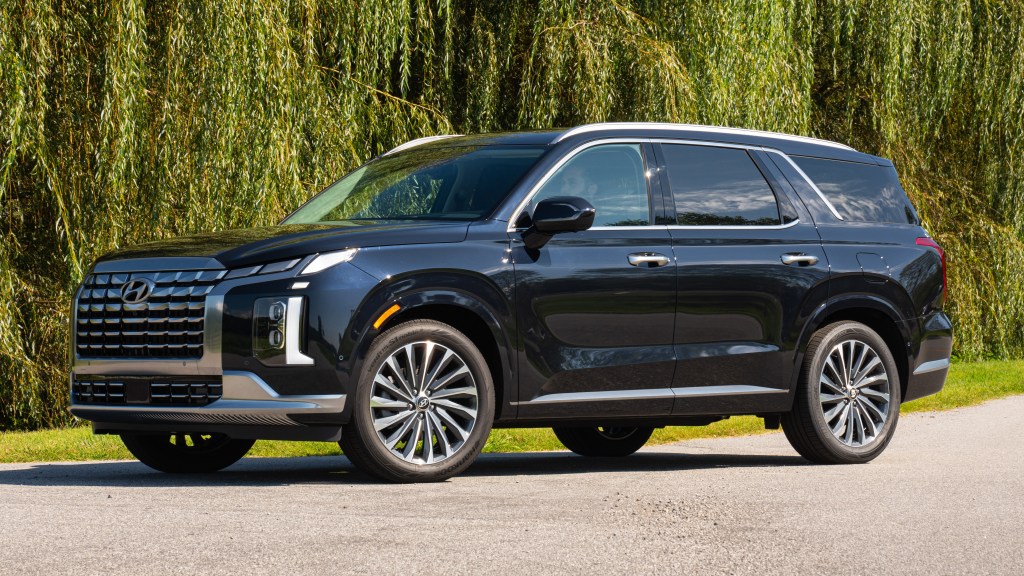
Hyundai Palisade: Three rows with style. (Image: Hyundai)
That is, whereas models in that category had tended to be more utilitarian in their styling (read: boxy and bland), with the Palisade it is almost as though Hyundai designers and engineers figured: “The others are solidly well established in this space, so if we’re going to wedge our way in, we’ve got to up the ante.”
And they did, inside and out.
Here is a vehicle that looks stylish while substantial, which is no mean feat. A vehicle that provides a sense of being in a comfortable environment (often, because vehicles are designed to transport people from A to B, the interior is executed as a waystation, something that’s temporarily engaged; here it is more like being in a room, and especially when taking long(er) road trips, that is highly desirable.)
Hyundai did a refresh of the vehicle for model year 2023 and as seems to be the case with this company, adjustments and improvements are made on a regular basis, not as some OEMs do, which is wait (sometimes too long).
Some Numbers
The Calligraphy trim is the second highest on offer, with a starting MSRP of $50,350—and given the level of amenities, the starting MSRP is probably going to end up being close to the finishing MSRP for many people. (Above Calligraphy? Calligraphy Night, for those who are looking for a blacked-out variant.)
The bigger choice that one needs to make is whether to opt for the front-drive version or the optional HTRAC AWD model, which is a price bump of $2,000.
Either way, there is a 3.8-liter V6 that produces 291 hp and 262 lb-ft of torque mated to an eight-speed automatic.
There is a 5,000-pound towing capacity.
It is 196.7 inches long, 77.8 inches wide, 68.9 inches high, and it has a 114.2-inch wheelbase.
Design Details
The Calligraphy has a unique front fascia that is largely predicated on a grille that consists of a pattern of individual metallic-appearing geometric elements, rectangular but with a create that results in three-dimensionality, that serve to accentuate the larger metallic pieces that frame the front end of the vehicle. It is a purposeful look.
Twenty-inch alloys are a key element for the body side design, as are a strong C-pillar and short front and rear overhangs.
The back has large vertical LED lamps and a wide horizontal skid plate that provide, in effect, a cubic solidity.
Pop that back hatch and there are 18 cubic feet of cargo capacity behind the third row and if you fold it and the second row down, there is 86.4 cubic feet for serious stuff.
Inside View
From the driver’s seat, the interior appears (because it is) large, but the execution of the instrument panel is more minimalist than exaggerated, than is the case in some other large vehicles. For example there is a long slot, going from just to the right of the steering wheel all the way to the passenger door panel that is the HVAC vent. Subtle, not fussy.
(Speaking of the door panel: it is quilted on the Calligraphy: again, something that is simply a nice touch.)
The seating—throughout—is comfortable and covered with Nappa leather.
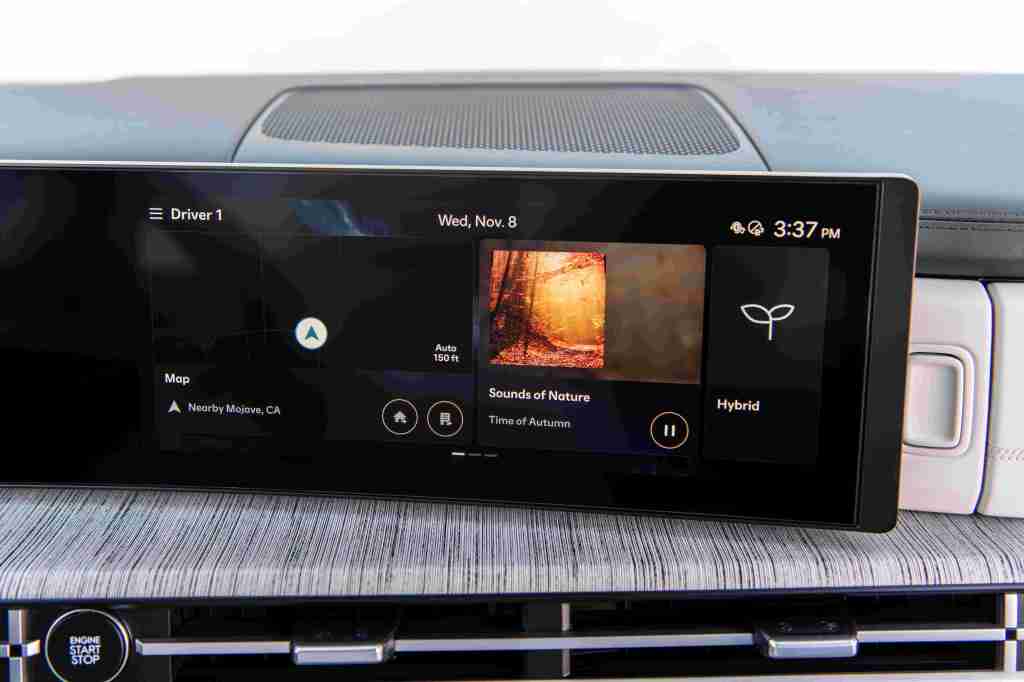
Yes, there is a 12.3-inch navigation screen with a horizontal orientation. (And on the subject of navigation, it is integrated with the smart cruise control which allows curve control, as in adjusting the speed when going into a curve.) The gauge cluster is also 12.3 inches. While the vehicle facilitates digital control of features, there are knobs and buttons for things like adjusting the temperature and cranking the volume on the 630-Watt Harman Kardon 12-speaker audio system.
One thing worth noting about things of an audible nature: generally if you have something large—and the total interior volume is 173.3 cubic feet—that is rolling on 20-inch wheels, it can be noisy. The vehicle uses acoustic glass on the side windows and windshield, and I’m guessing a non-trivial amount of other materials used for noise countermeasures. And because sometimes those in the front want to clearly communicate with those in the back, there is an in-car intercom.
As this is a “family” vehicle, and as keeping members safe it a key consideration, there is a full suite of safety tech, including lane keeping assist, lane following assist, blind-spot avoidance assist, high-beam assist. . . you get it. Lots.
Final Thought
Hyundai has plenty of SUVs on offer. There are Venue and Tucson, Kona and Santa Fe, Ioniq 5 and Nexo.
The Palisade is its top-of-the-line. And there is no question that it is. On the Hyundai retail website there are comparisons made with vehicles including the Ford Explorer, VW Atlas, Honda Pilot, Nissan Pathfinder, and Dodge Durango.
While there are comparable elements to all of those, and while all of those are mainstream brands, arguably the Palisade can compete in a class above and hold its own.
Seems like the EV slowdown is happening elsewhere, too
By Gary S. Vasilash
The South Korean-based brands—Hyundai, Kia and Genesis—are producing some of the most-appealing electric vehicles available in the U.S. market.
Award-winning Kia EV9 (Image:Kia)
Consider, for example: for the 2024 North American Car, Truck and Utility Vehicle of the Year Awards, the Hyundai Ioniq 6 was one of the three finalists in the Car category. The Genesis Electrified GV70, Hyundai Kona/Kona EV, and Kia EV9 were the three finalists; the EV9 received the award.
And, of course, these products (and others, too) are available to Korean consumers.
GlobalData has run numbers for how well electric vehicles are doing in the home market of those companies, and finds that through April 2024, zero-emissions vehicle sales in Korea, 97% of which are EVs and the balance fuel-cell vehicles, are down 17% compared with April 2023.
Meanwhile, hybrids (including plug-ins) are up by some 45%.
Why are EVs not doing so well? GlobalData suggests:
Early adopters have gotten them. The majority isn’t buying yet.
And on the subject of buying, there is the comparative higher costs of EVs.
Charging is a concern.
Residual value decreases make an EV purchase less appealing.
GlobalData points out that while there had been dismissiveness expressed by some pundits regarding hybrids as being a bridging technology between internal combustion engine vehicles and EVs, the numbers are showing that that is indeed the case.
The good news for Hyundai, Kia and Genesis is that they offer compelling hybrid products as part of their global portfolios, too.
For the past few years it seems like there hasn’t been a Hyundai the exterior design of which I haven’t been most impressed by. Sedan or crossover, ICE or electric, the design team at Hyundai has been delivering in a way that I’m sure there are some at other OEM studios can only shake their heads at in wonder, admiration and jealousy.
Former head of Ford design J. Mays used to say, in effect, that it cost as much to stamp a boring body panel as it does an intriguing one. So given that. . . .
It does seem to be the case, however, that Hyundai’s competitors have watched the way the company is gaining market share, going from a brand that didn’t seem to be having much of an effect on the market* (in effect, just getting buyers on the margin) to one that is growing, step by step (i.e., in pre-pandemic 2019 Hyundai sold 668,771 vehicles in the U.S.; in 2023 that number was up to 801,195; 2024 sales through May show a 2% increase over 2023, not a big number by any means, but one that is still on the plus side). And what those competitors see is that people in non-trivial numbers like non-boring sheet metal, so they have, in an increasing number of instances, elevated their games.
Which is good for consumers.
That said, Hyundai design has persistently produced vehicles that are striking.
Which led me to fear that I was becoming too enamored with the marque.
A shift (and it has a single-speed reduction gear transmission). . .
But then I saw the rear of the 2024 Kona Electric and that fear became unfounded.
Rear of the 2024 Kona Electric (Images: Hyundai)
It strikes me—yes, yes, entirely subjective—as simply too slabby.
The rear of the original Kona, model year 2018, is something that I think is far more interesting. And as I spend time looking at photos of the earlier iteration of the Kona, I think its design is superior to the current one. The forms are much tighter.
Rear of the original, 2018, Hyundai Kona. I like this one better. Much, much better.
Of course, OEMs are interested in moving their current models, not ones from the past. (Interestingly, in terms of purchasing, the Cox Automotive 2023 Automotive Car Buyer Journey Study found that 68% of buyers considered both new and used vehicles and it is worth noting that there some 36 million used vehicles sold in 2023, more than double the number of new. For the consumer, used matters.)
OK. Now completely objective info.
Just the facts. . .
The Kona Electric is, well, an electric vehicle. It is powered by a permanent magnet synchronous motor that produces 150 kW (a.k.a., 201 hp). The motor powers the front axle. There is a 64.8 kWh lithium-ion battery. According to the EPA this setup provides a range of 261 miles.
With DC fast charging the battery can go from 10% to 80% in approximately 43 minutes. With a Level II charger, using the 11 kW onboard charger, it can go from 10% to 100% in 6 hours, 14 minutes. (This is the sort of thing that can happen at home.)
The Kona Electric’s outside measurements are: wheelbase, 104.7 inches; length, 171.5 inches; width, 71.9 inches; and height, with roof rails, 62.2 inches.
The Kona Electric’s inside measurements are: passenger interior volume with sunroof, 96.8 cubic feet.
The Kona Electric’s cargo capacities are: behind the second row, 25.5 cubic feet; second row folded, 63.7 cubic feet.
The Kona Electric’s frunk capacity: 0.95 cubic feet. (Think of a place to store the charging cable.)
Not just the facts. . .
On the inside (now going back to the subjective mode with some numbers thrown in) there is the clean, contemporary look that Hyundai is bringing to all of its vehicles.
There is a 12.3 driver information screen and a 12.3-inch infotainment screen. While it doesn’t fake being one screen, for practical purposes this is 24.6 inches of screen, which is quite impressive. (Plus the visual appearance is first-rate.)
There is an eight-way power driver seat; the passenger has to adjust their own, xix ways. But both front seats are heated and ventilated and are trimmed out with “H-Tex” leatherette (a.k.a., pleather).
There are wireless Apple CarPlay and Android Auto and Bose premium audio.
There is Hyundai Digital Key, which means you can use your phone in lieu of the fob; the fob has proximity capability which means you can approach the locked vehicle and it will open when you tug the handle.
There is an array of safety tech (e.g., blind-spot collision warning; parking distance warning; navigation-based smart cruise control with stop and go; lane-keep assist). There is also something that is useful in regular driving: use the turn signal and there is a camera view in the driver information screen showing what’s along side the vehicle (yes, the sort of thing you can see in the side-view mirrors—but better).
So. . .
Drives well. (Somewhat) reasonable range (I am in the 300-mile club). Good tech and nice interior. Excellent MSRP for this loaded (Limted) model: $41,045.
When I first saw the 2024 Hyundai Sonata Hybrid I was surprised. Quite surprised. While Hyundai—at least since the introduction of the model year 2011 Sonata with the “Fluidic Sculpture” design language—has consistently been turning out vehicles with striking designs, (1) most of those vehicles of late are crossovers and (2) I’ve always been a greater admirer of the Hyundai Elantra, the Sonata’s compact kin.
But the Sonata has undergone a serious refresh for MY 2024.
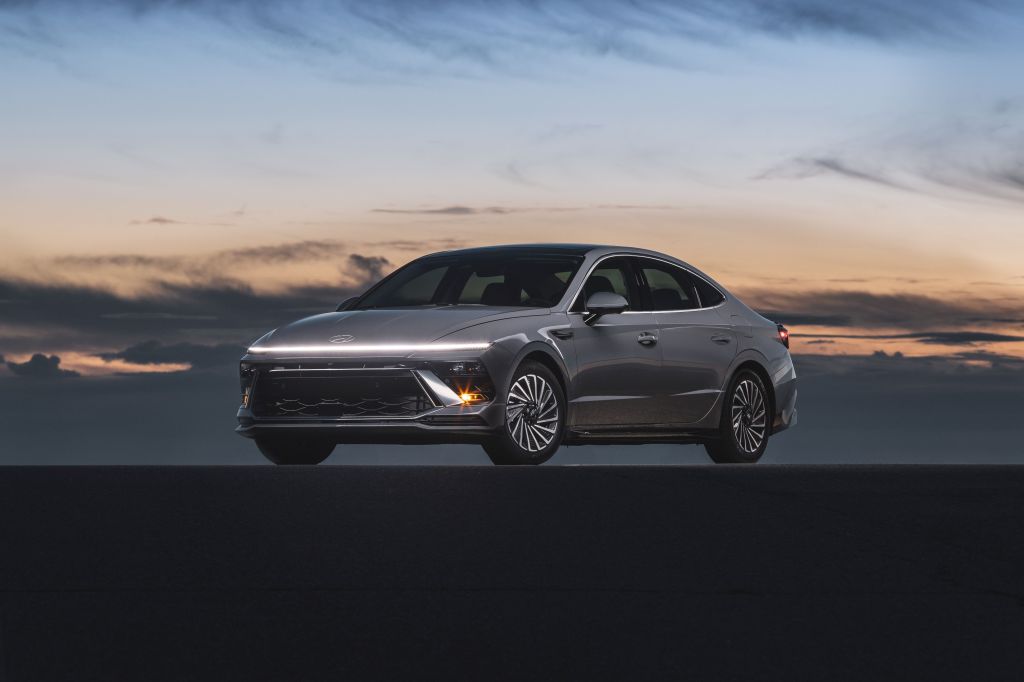
For most OEMs this would be a concept car. For Hyundai it is a midsize sedan that you can buy at a dealership near you. (Images: Hyundai)
When the vehicle was unveiled late last summer, Simon Loasby, head of the Hyundai Style Group at Hyundai Motor Company, said, “We wanted to give Sonata a more contemporary design statement,” which is an absolute understatement.
If Loasby considers that “contemporary,” then I think he must live in the future, because the lines on the vehicle, front, sides, back, and roof, contribute to a car that is striking and stylish in appearance.
Advance. Repeat.
It is almost as though the designers said to themselves, “OK, let’s design the most-advanced looking Sonata that we can.” They did that. Then started from that point and designed one that goes beyond that.
A slogan that has been around for a bit has it that “lighting is the new chrome.” If the LED lighting execution on the Sonata is chrome, it brings to mind William Gibson’s title “Burning Chrome” because it has an advanced appearance. (It also makes one wonder whether a generation raised in Suburbans and Grand Caravans might not find the Sonata aesthetic far more appealing.)
Comfort, Too.
And this innovative appearance continues into the vehicle, where there are seats that are comfortable (and I’d describe them as “contemporary” because I’m still waiting for the Aeron chair analog, and even though that was introduced in 1994, when it comes, it will be, apparently, the future), and an instrument panel that combines the digital and the analog (a.k.a., knobs and buttons) in a way that speaks to appearance and ergonomics (with too many going for the former and ignoring the latter).
According to Merriman Webster, ergonomics is “an applied science concerned with designing and arranging things people use so that the people and things interact most efficiently and safely.” Which is presumably something that Hyundai interior designers throught about when executing this interface, which includes buttons and knobs as well as the ability to have things touched and swiped.
There is a 12.3-inch screen for the driver that contains the obligatory operational information that butts up to another 12.3-inch screen for the driver and front passenger (though it is slightly curved in a bias for the driver) for purposes of infotainment. Below that second screen, in the center of the overall instrument panel, there are knobs and buttons for control of things like the audio and HVAC (few things are more annoying when driving than trying to control the temperature through a screen selection).
Drive. And Drive Some More.
But here’s the thing that I saw on the driver’s information screen that was even more striking to me that the exterior design:
585 miles
That was the estimated distance that the car could be driven prior to fill-up. And that estimation was predicated on how other people prior to me had driven the car, and I’m guessing that they weren’t exactly feathering the throttle.
It is worth noting that this is a car that is not anemic (192 hp is produced from the four-cylinder engine combined with an electric motor).
Here’s something interesting about that 585: it is what the available distance is based on getting 44.3 miles per gallon.
The Sonata Hybrid has a 13.2-gallon tank.
Now were it that people prior to me drove it in a more “normal” manner, odds are it would have been even higher: the EPA estimated numbers are 44 mpg city, 51 mpg highway, 47 mpg combined.
The range based on the combined average: 620 miles.
According to the Federal Highway Administration, the number of miles driven annually in the U.S., on average, is approximately 14,000 miles. So were you to be driving a Sonata Hybrid and getting the combined average, this would mean having to go to the gas station not more than twice a month. Which means about 10 minutes per month for a fill up.
For a car that is stylish, comfortable, and technologically up-to-date.
Although Tesla seems to be in the sort of fix that one might expect a traditional OEM to have rather than it, maybe that is because Tesla is turning into something of a traditional OEM, yet it isn’t quite capable of making the transition, which exacerbates the problem.
Now to be fair, the EV market in the U.S. is still pretty much in two categories:
Tesla
Everybody Else
So when you look at the increase in sales of Everybody Else’s EVs you have to recognize that in terms of overall numbers, there are certainly models that have internal combustion engines in their lineup that may have percentage decreases yet, in terms of the overall number delivered, well above the EV.
However, one of the issues that Tesla faces and doesn’t seem to be particularly interested in addressing is that the technological heat seekers, those who are constantly on the lookout for What’s Next, have likely purchased a Tesla or two. Now this is not to say that they’re suddenly going to go buy an EV from someone else but, rather, to say that there is a set of those people and they’ve pretty much been saturated.
The upside in the EV market will be people who are interested in something advanced but not completely challenging.
Let’s face it: Although driving an EV is pretty much like driving any a vehicle with a combustion engine, there are differences that require some adjustment on behalf of the driver. So at this stage in the proliferation of the technology it is probably a good thing for OEMs to provide prospective EV owners with vehicles that progressive without being perplexing.
Which brings me at last to the Hyundai IONIQ 5, an EV crossover that could draw plenty of customers into Hyundai stores and if they drive off the lot with one they’re not going to have to study how to use it.
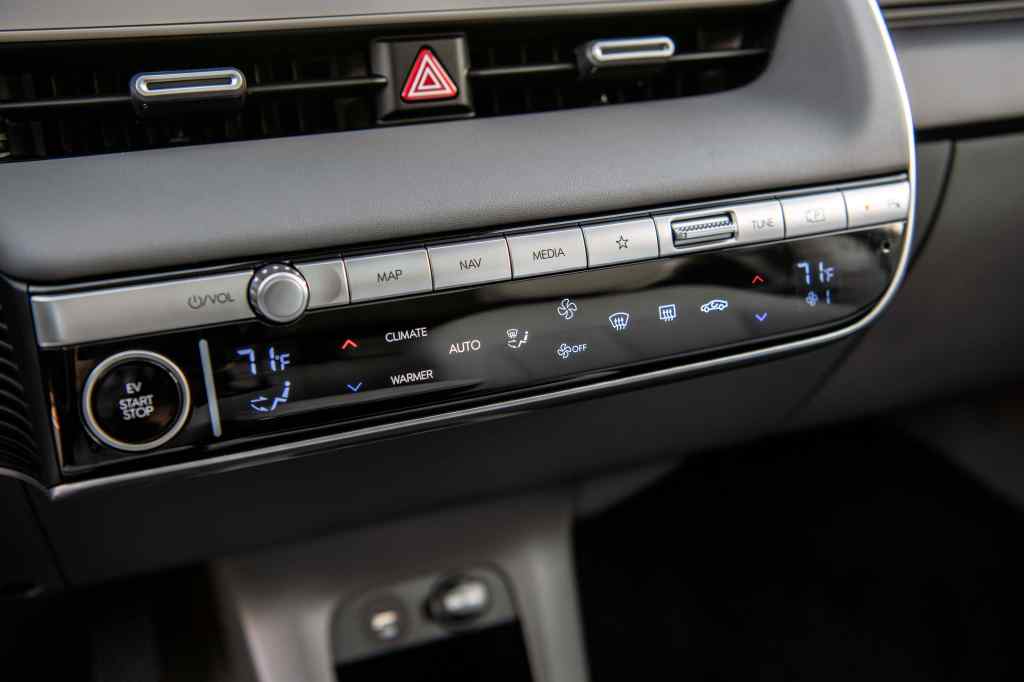
Quick: how do you adjust the temperature in the IONIQ 5? Some things make superior ergonomic sense. (Images: Hyundai)
For example: Want to adjust the HVAC? Yes, there is a 12.3-inch touchscreen. . .but more familiar, on a conductive surface, are red and blue arrows: touch them to get the job done. No searching required through the screen.
Yes, there are buttons and switches. A minimal but familiar assortment of things that can be adjusted.
The design of the IONIQ 5 is superb. There is the now seeming obligatory minimalism, but, more to the point, there is the addition of artistry in the patterns on some of the surfaces that are subtle and provide an overall sense of freshness. This is in contrast to the near-Brutalist approach that is taken inside a Tesla.
The exterior of the IONIQ 5—from the LED lighting up front to the LEDs around back—provides an appearance that is purposeful yet futuristic. I am puzzled by the apparent appeal of the bland front fascia of the Tesla Model Y: the front end of the IONIQ 5 appears as though it was created by a team of innovative engineers and artisans; the Model Y front appears as though the objective was to make a shape that could be readily released from the injection molding tooling.
The exterior is fresh and forward.
And the creases in the body side of the IONIQ 5 speak to a knowledge of forming metal in an aesthetic manner, something that, arguably, is lacking in something like the—admittedly not a competitor—Cybertruck which, again, seems to have been designed so that it could be formed with a press brake rather than a servo press.
The IONIQ 5 comes in RWD and AWD versions, with different motor and battery sizes.
The vehicle driven here is an AWD model; its permanent magnet synchronous motors (one in the front, one in the rear) produce a combined 320 hp. It has a SK Innovation 77.4 kWh lithium-ion battery that provides the vehicle with a range of 260 miles. The on-board charger is capable to being charged at a station with up to 800 v/350 kW; that means the battery charge can go from 10% to 80% in as little as 18 minutes.
People are catching on to the IONIQ 5. In March sales were up 58%. There were 3,361 delivered. The sales of the Hyundai Palisade—a bigger vehicle with an internal combustion engine—were also up 58% in March. There were 9,785 delivered.
The point being, there is a ways to go before there is greater consumption of EVs.
The IONIQ 5 is a vehicle that will help get more people there.
Kevin Kang talks about how global designers looked beyond the world of COVID to the one that we’re experiencing today—when more people want to get out in the world. Which have rise to the fifth-generation of the Santa Fe SUV.
(Images: Hyundai)
By Gary S. Vasilash
One of the things that COVID gave rise to is the design—inside and out—of the fifth-generation, 2024 Hyundai Santa Fe.
As Kevin Kang, Head of Department, Design, Hyundai Design North America, explains, the work on the project (code name: MX5) began in late 2019, and within a few months the design teams in the U.S., Korea and Europe were communicating with one another via digital means, including putting on virtual reality headsets (with individuals expressed as avatars) so the design-in-becoming could be viewed and manipulated.
Because they were all aware of the varying levels of lockdown that COVID was causing, the designers thought about the future, about what people would be interested in doing post-pandemic. And so research was conducted and it was determined, Kang recalls, that people would be more interested in getting out into the world.
Kevin Kang and his colleagues thought about a vehicle that would faciliate getting people out into the world with confidence and capability.
In some instances this going out would be a visit to Costco to load up on things rather than waiting for the Amazon truck to deliver. In other cases it would be spending some time at a camp site.
So they decided that they would work to develop a three-row, midsize SUV that would blur the boundaries between the two activities, combining create comforts with capability.
This led them to start at the back.
Kang explains that what makes an SUV an SUV is not how it appears from the front or the side, but it is all about the back. About the tailgate.
They maximized the opening.
Whereas the opening in the previous generation is 44.5 inches wide and 30 inches high, the ’24 Santa Fe’s opening is 50.2 inches wide and 32 inches wide.
The design team determined that the best place to start designing an SUV is from the hatch.
(One result of going so big and working to make it fully accessible: they had to lower the position of the brake lights.)
(One result of people working during COVID and using Clorox wipes with regularity on objects they’d have to hand: they put a UV sterilization tray above the glovebox: pop in your phone, close the lid and activate.)
The Best Box
To state the obvious, the ’24 Santa Fe is boxy. Both inside and out.
Kang: “We wanted to create the best-looking box ever.”
But this isn’t something that was done purely for reasons of styling.
Kang, again: “For me, a logical design is the superior one.”
(For those who might think that boxy on the outside rather than something sleek and swoopy means it is like trying to move a brick through the air, know that the drag coefficient for the new Santa Fe is 0.294. . .and the drag coefficient for the outgoing model is 0.33. And lower is better. However, it is worth noting that part of this aero efficiency is achieved through the use of something borrowed from the company’s IONIQ electric vehicles: active air flaps in the front fascia.)
Making Models
The designers who worked on the interior of the Santa Fe thought about things like what would be involved in going from home to a campsite. This would not necessarily be an A to B undertaking, but have intermediate stops that might be picking up kids from school, stopping at a supermarket, hitting a Starbucks. . .and then making it to the great out of doors.
All of which means acquiring things along the way and, in some instances, generating trash.
To figure this out in a logical manner the designers made one-fifth scale models of the interior of the vehicle as well as the stuff that would come along for the ride. This led them to creating spaces for things.
Like a large tray space in the center console that can be used to place things a fast-food to-go bag. (The shifter has been moved to the steering column and the cupholders moved back on the console.) And a drawer readily accessible to the second-row passengers (though it can be reached from the front) that could be used to toss trash.
And they addressed ergonomics, as well. For example, Kang says that they took a lesson from the cockpit of aircraft. In planes there are ledges around the screens for the instruments that the pilot can use to steady their hands during flight.
Providing a place to position one’s hand when using the touch screen.
So they designed what they call a “palm rest,” a trim piece that runs across the middle of the instrument panel with a slightly bigger surface below the infotainment screen: this allows someone to have stability when making selections from the screen.
Meanwhile, on the Exterior. . .
Going back to the exterior, Kang says that they worked to keep the greenhouse surfaces as flat as possible (again, the surface of a box). Of course, to provide a sense of ruggedness, there are fender bulges, though these are done in an interesting way: around the outer area of the flair there is a chamfer that goes into the surface of the vehicle which results in a more massive appearance of the surround as it bulges outward.
The trim in the rocker area of the Santa Fe is piano black, which is surprising on a vehicle that does have some offroad capabilities (there is an XRT trim that has a higher ground clearance than the other models—8.3 inches rather than 7.0 inches—which provides greater approach, departure and breakover angles, so for those inclined to go to campgrounds that are well off the proverbially beaten path, it is the trim to take). Kang says that while matte finishes might be preferable, consumers find that to look not particularly upscale: remember that the Santa Fe is designed for the daily suburban driver, as well.
The front of the Santa Fe has a horizontal LED lamp that stretches across the top grille, terminating in the headlamps. This forms a double “H” shape: the “H” that is formed where the horizontal bar meets the vertical lights on either side and an “H” that is formed by the headlamps that each have a pair of vertical lights.
Note the “H” shapes designed in the lighting and fascia.
Then on the fascia above the lower grille there is still another “H” formed with the body-colored material surrounded by darker trim.
While this reads as though it would be gaudy, it is actually more subtlety executed.
No Russian Dolls
Is this use of the “H” something that may show up on subsequent Hyundai vehicles?
Kang thinks not.
“We have collectively decided not to do the Russian-doll approach to design,” he says.
In the SUV lineup, for example, there is the Tucson smaller than the Santa Fe and the Palisade larger. But all three vehicles exhibit their own stylings.
Each vehicle has a design onto itself.
And this makes absolute sense. Globally, Kang points out, Hyundai has more than 60 different models.
Trying to make a family look for dozens of vehicles would probably be nothing more than an exercise in frustration.
While the first read on the ’24 Santa Fe may bring to mind the Land Rover Defender (arguably not a bad thing, especially as that vehicle starts at a price well above the sticker for the Santa Fe AWD hybrid with the top-of-the-line Calligraphy trim package), that sense quickly disperses as it is clear that given the detail outside and in, this is a vehicle that is clearly its own thing.
One thing that Olabisi Boyle, senior vice president, Product Planning & Mobility Strategy, Hyundai Motor North America, points out that is probably something that many people don’t know is this:
On a global basis Hyundai Motor Group (including Genesis and Kia) is the third-largest OEM. Not General Motors. Not Stellantis. Hyundai. Behind Toyota and Volkswagen Group.
In the U.S., the company’s sales have been growing with consistency:
In 2023 it had total sales of 801,000 vehicles, up 11% over 2022 sales (724,000)
Hyundai’s Boyle is working to expand ways that customers interact with the company’s products, well beyond the drive. (Image: Hyundai)
One of the areas that Boyle is keen on is the development of the market for what she terms the “early majority” for electric vehicles, moving beyond the “early adopters.”
Hyundai has long (comparatively speaking) been in the EV space and at present the brand offers the Kona Electric, IONIQ 5 and IONIQ 6.* (It also has the Nexo—which is a fuel-cell based EV.)
Massive & Flexible
Hyundai Motor Group is constructing what it calls “Metaplant America” near Savannah, Georgia, a complex on a 2,923-acre site that includes a vehicle assembly plant as well as a battery plant. Plans call for the $7.59-billion plant to go into production early in 2025. It will build the IONIQ 5, IONIQ 6, Genesis GV60 and Electrified GV70 vehicles, as well as the XCIENT class 8 fuel-cell truck.
Boyle says that the Metaplant, which will have an annual capacity of 300,000 vehicles, is sufficiently flexible such that if the demand dictates, it can also produce combustion engine-equipped vehicles.
Beyond Vehicles
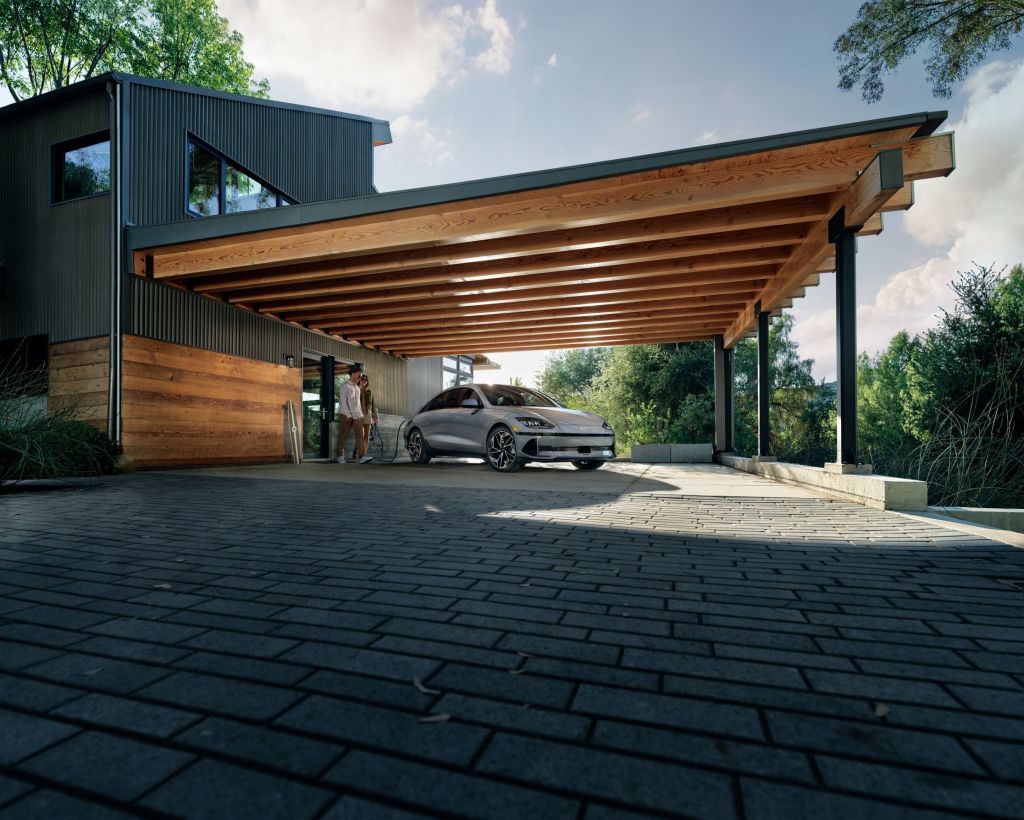
But Boyle’s view of Hyundai’s efforts in the mobility space go well beyond particular vehicles to something that can be thought of as an entire infrastructure. If it’s a gas-powered vehicle, then the ability to pay through the touchscreen of the Hyundai. If it is an electric vehicle, then the ability to work through the Hyundai Home Marketplace to get what’s needed for home charging. If it is a question of obtaining an EV for a short period (e.g., month-to-month), there is Evolve+ that makes this real. If it is a matter of finding and paying for parking, there’s an app for that.
Hyundai Home helps EV customers get what they need to equip their residences for seamless electric vehicle operation. (Image: Hyundai)
In other words Boyle and her colleagues are looking at a consumer’s engagement with Hyundai as something more than a transaction that occurs at a dealership once every few years. Rather, it is something that they are building out so that the company can provide things that are helpful, not intrusive, things that facilitate everyday activities, not complicate them.
They certainly want to grow the number of vehicles that are purchased.
But they recognize that there is a market shift going on, one that they are helping propel.
==
*And it also has “electrified” vehicles including hybrid versions of the Elantra, Sonata and Tucson, with the Tucson also as a plug-in hybrid.
Fuel cells are having their moment again for various vehicle applications, from light-duty to big rigs.
How big a moment?
Seems not trivial according to a report by MarketsandMarkets, which products the automotive fuel cell market will grow from $200 million this year to $2.1 billion by 2030. It will have a compound annual growth rate of 48%.
Where will the largest market be?
Asia Oceana.
Given that the geographies covered in the firm’s report also includes Europe, North America and Rest of the World, presumably that Asia Oceana includes China, which could explain the biggest market.
(Image: Toyota)
That said, with companies including Toyota, Honda and Hyundai continuing their hydrogen fuel cell development efforts, Japan and South Korea can’t be counted out as players, and consumers, in this field.
However. . .the global battery electric vehicle market size right now is on the order of $500 billion and it is estimated to be about $1.5 trillion by 2030, so even with the impressive growth of fuel cells, they’re still approximately the size of a dandelion in a redwood forest.
The announcement that Hyundai and Amazon have entered into a partnership agreement which will have Hyundai models sold through the Amazon interface will have repercussions in automotive retail the likes of which have probably never been experienced before— perhaps those inflatable gorillas and floppy men had a fairly big effect, or so the traditional car-buying model might have it.
Now this doesn’t mean that the dealership model is kaput. Well, at least not in 2024, when the availability of Sonatas and Tucsons can be configured on the site.
Dealers are still part of the picture.
Customers can search on Amazon for the Hyundai of interest, configure it, and even select their method of financing. The vehicle will then go through a dealership for delivery.
And it is likely that individual dealerships will be able to establish their own storefronts on Amazon the way the purveyors of an array of products do.
A Change Is Coming. Fast.
One of the arguments that is made regarding people purchasing cars on the internet and why it isn’t going to make a difference is that people like to take test drives. People like to see the sheet metal. People like physically see what it is that they’re going to be spending tens of thousands of dollars for over a few years.
True.
But consider this: one of the things that nearly knocked out Best Buy was “showrooming”: People would go to a store to check out that big-screen TV and then go home and buy it on Amazon.
They’d, essentially, kick the tires, and then complete the transaction elsewhere. Best Buy did the work. It didn’t get the reveune.
The incredibly friendly Amazon interface will undoubtedly make it all the easier for Dealer A to promote better deals than Dealer B, so if the Dealer B is where the customer did their showrooming, then A may come out on top. While people can check on individual dealer websites to see what’s available, this setup with Amazon will undoubtedly facilitate that.
And what of the salespeople? Will any given dealership need as many going forward?
Dealership value is undoubtedly going to change profoundly—and not necessarily for the better.
Something like this was bound to happen.
And now it has.
(One of the things that must be considered vis-à-vis this partnership is that Hyundai is clearly positioned as a company that sees how the world works. People buy lots of stuff online. People want convenience. So Hyundai is facilitating that. Many other OEMs are busy perpetuating past practices despite their pronouncements about the future. Those OEMs are like Nokia. Hyundai is like Samsung.)










 shinymetalboxes