Screen Gem

LG Display’s big display goes into production for Sony Honda Mobility. . .

By Gary S. Vasilash

The AFEELA 1 from Sony Honda Mobility is expected to have initial deliveries in mid-2026.

According to the company, the AFEELA 1 “pursues an interactive relationship between people and vehicles through the integration of advanced software and high-performance hardware, resulting in intelligent mobility.”

Presumably part of that “interactive relationship” is based on the screen that goes from A-pillar to A-pillar.

LG Display announced that it has started mass production of the 40-inch screen, which it says is the first of its type.

That’s a lot of screen. (Image: Sony Honda Mobility)

According to the company the screen “raises user convenience by allowing the simultaneous display of advanced infotainment functions, from a digital dashboard and navigation to climate control, movies, music, and even games – all without screen transitions.”

Of course, having a driver watch a movie while driving certainly isn’t ideal (and illegal). The screen features something called “Switchable Privacy Mode” that uses “viewing angle control technology.” This means the driver can’t see what’s visible on the screen to the front passenger.

And because energy conservation is something that is important for electric vehicles, the screen has “local dimming technology,” which reduces both heat generation and power consumption.

Who would have thought a screen in a car would generate heat?

Of course, who thought a screen in a car would be 40 inches long?

VW AG: Game On

Have a phone? You’ve got an in-vehicle game controller, too. . .

By Gary S. Vasilash

One of the features that some OEMs have offered in vehicles, once to help deal with bored kids, now to reduce the level of fidgeting among those who grew up playing video games and now find themselves spending too much time in their vehicles not going anywhere (perhaps waiting to pickup the aforementioned kids from school), is video games.

One of the issues that some of those deployments present is a vexing one: the game controllers have a tendency to do what happens to plenty of things in vehicles: disappear or break, and not necessarily in that order.

So Volkswagen AG (not Volkswagen of America), working with a Swiss company named “N-Dream,” is offering the N-Dream AirConsole gaming platform to its vehicles.

What’s notable about this is AirConsole uses smartphones as controllers.

The vehicle’s infotainment screen becomes the game console.

Look carefully at those game controllers: They’re smartphones. And Leo and Dennis are using those devices to play a game on the screen of a VW ID.7. (Image: AirConsole)

It is easy to pair the phones with the system: when the AirConsole app is opened a QR code appears on the screen. Scan it and it is ready to go.

Multiple players can participate in a given game.

However, play can only occur when the vehicle is in Park.

VW AG will begin offering AirConsole next month in the ID.7, ID.5, ID.4, ID.3 (from ID. software 4.0), the new Passat, the new Tiguan, the new Golf, and the new Golf Estate.

Odd are that this will make its way to this side of the Atlantic before too long.

Useful Info for Those Going Fast

By Gary S. Vasilash

Cadillac, undoubtedly having a cadre of people on staff who know that there is still a whole lot of interest in the market for luxury sport sedans with internal combustion engines (even if there aren’t necessarily a whole lot of buyers), have given the CT5-V and CT5-V Blackwing a bit of refreshing, although keeping the 360-hp 3-liter twin-turbo under the hood of the CT5-V and the 668-hp 6.2-liter V8 in the Blackwing.

One of the primary mods is the deployment of a 33-inch diagonal LED color touchscreen.

2025 Cadillac CT5-V Blackwing showing its 33-inch-diagonal LED color touchscreen display can provide some useful information for those who are driving their car on the track really, really fast. (Image: Cadillac)

Some implementations of large screens seem rather gratuitous, as though there isn’t certainty of what ought to be on the screens (e.g., does there really need to be pictures of things like album covers?), but seeming absolute certainty that the screen needs to be there, as large as possible.

But in the case of the CT-5 Vs, they are offering a Performance Data Recorder that provides a wealth of info for those who take their cars racing, with everything from a Lap Analyzer tool—which Cadillac claims is something that heretofore was the sort of thing that one would need a laptop to process—to a live data screen in the center stack, which isn’t so much for the driver, but for the passenger who can provide real-time coaching for the driver.

Clever, those folks at Cadillac.

Conti Demos Crystal Display

By Gary S. Vasilash

“With the Crystal Center Display as a key component, we want to turn the world of interior design on its head and create an innovative focal point for premium vehicles of the future – one that grabs attention and stirs emotions. We are moving away from the straightforward display of information and elevating it to a highly personalized user experience,”–Dr. Boris Mergell, head of the User Experience (UX) business area, Continental.

Conti’s collaboration with Swarovski. (Image: Continental)

Dr. Mergell is talking about an infotainment display that Continental has developed with crystal company extraordinaire Swarovski. Turns out that in addition to producing necklaces, rings, bracelets, and the like, there is another part of the company, Swarovski Mobility.

Continental developed a microLED display that is integrated into the crystal panel. The microLEDs provide the brightness and contrast for the 10-inch infotainment display. The information displayed seems to float in the slim crystal slab.

Seems like Conti is going for something of a Steampunk aesthetic for its displays: classic decorative crystal meets the cloud.

Infotainment Made Simple

Yes, once there were knobs. Knobs, buttons and things you would manually manipulate.

This is the “screen” of the SEAT 1400, a sedan introduced in 1953:

(Images: SEAT)

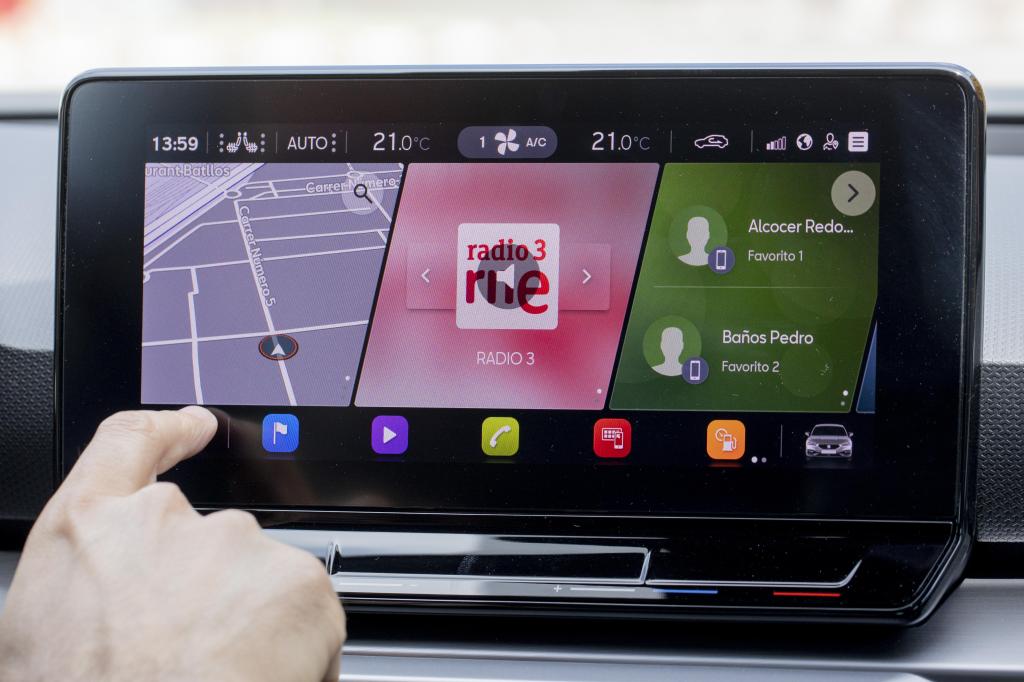
If nothing else, it is a reminder that somehow people were once able to get by without a 10-inch screen and 2,000 icons, which is the case in the current-generation SEAT Leon, the Spanish company’s best-selling vehicle:

No knobs.

There is something to be said for the simple charm of the 1953 approach.–gsv