
Chinese EVs in Europe

A growing number leading to growing concern. . .

By Gary S. Vasilash

While you’ve undoubtedly heard about some of the people in the European Union (EU) being rather agitated by Chinese electric vehicles showing up on the streets of Rome and Paris and elsewhere, French research firm Inovev provides some interesting statistics regarding those vehicles.

Notably, within the EU, the United Kingdom, Switzerland, and Norway, during the first quarter of 2024 Chinese EVs accounted for 8.5% of all the EVs sold during that period—approximately 50,000 out of 594,000 EVs.

But then there’s more.

For example, taking into account “European models imported from China”—as in Smart (a joint venture between Mercedes and Geely) and Dacia (part of Renault)—that 8.5% share grows to about 11%.

Then there are vehicles that are built in China by non-Chinese brands that are brought in, like the BMW iX3 and the Tesla Model 3.

Add them into the mix and the number rises to 17%.

And while some might think that European exports to China might offset some of this, Inovev, using Germany as an example, points out that German vehicle exports to China peaked in 2018 and have been declining since.

Part of this is because German brands are building vehicles in China that are sold there so there is no need to export.

But then there is this observation, which ought to make people in Wolfsburg, Stuttgart and Munich nervous: “Chinese customers are increasingly moving towards Chinese brand cars and are gradually losing interest in imported foreign cars, especially with the development of the BEV market.”
Euro Auto Sales Fun Fact

In 2023 Nissan sold 343,891 vehicles in Europe, a 20.1% increase over its sales there in 2022, according to Inovev.

In 2023 Chinese brands sold 353,276 vehicles—“mainly based on BEVs”—in Europe, more than double their sales there in 2022.

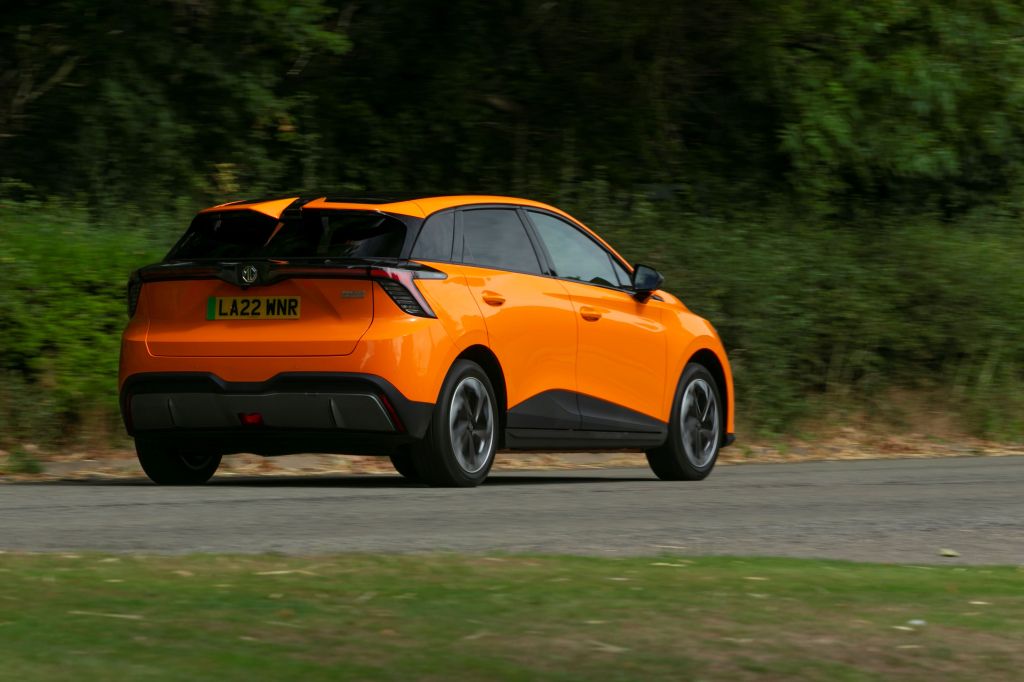
The MG MG4 EV: second only to the Tesla Model Y in U.K. 2023 sales. MG is owned by Shanghai-based SAIC Motor. (Image: MG)

Nissan, which has been around in the European market for a while (and had been affiliated with Renault until last year), is already surpassed by a phalanx of Chinese OEMs. (Yes, this is one company vs. several, but looked at from the point of view of sheet metal moved, it is still worth pondering.)

Maybe if you’re Stellantis or Renault or Volkswagen this isn’t a particularly fun fact.

And maybe this will portend things happening at some point in the U.S., as well.

Premium Vehicle Perspective: Depends Where You Look

When looking at charts developed by French auto analyst firm Inovev of the sales of premium vehicles in the U.S., China and Europe for the first 11 months of 2021, there are a few surprises.

As in sales of 2 million in the U.S., 3 million in China and 2.5 million in Europe.

It’s not surprising that the number is higher in China than in the other two regions. After all, it has a population of 1.4 billion.

It is a little surprising that the numbers break as they do, given that the population in Europe is 748 million, which is about half of that in China and slightly more than twice the population in the U.S. The 500K increments seem strange given that.

Clearly wealth is not evenly distributed, with the U.S. having a higher proportion of its population capable of affording a premium vehicle.

But the surprising thing is the relative sales of the premium brands in the three markets.

The five three brands in the U.S. during this period are BMW, Lexus, Tesla, Mercedes and Audi. Then there is a slight falloff in numbers.

The top five brands in China are BMW, Mercedes, Audi, then a big decline (Audi is at over 600,000 units) to Tesla (at 240,000) and Cadillac.

In Europe it is BMW, Mercedes, Audi, then a big drop to Volvo (Audi: >500K; Volvo: 245K) and Tesla.

While there is consistency with BMW, Mercedes and Audi, and while Tesla is certainly on a roll, Lexus is something of an outlier. It doesn’t show up at all in the listing of sales in China and in Europe it is in ninth position, behind Lancia and just ahead of Jaguar, all of which are well below 100,000 units.

Lancia doesn’t show up at all in the sales tracking for the U.S. and China, and in the U.S. Jag is in last place and it is third from last in China.

Seems as though the German brands are consistently solid around the world while for everyone else it is somewhat random.