
In which we wonder a bit about engine nomenclature. . .
By Gary S. Vasilash
As everyone doesn’t know, a Newton is the force required to accelerate a one-kilogram object one meter per second second. So a Newton meter is essentially the measurement of a forward push.
Another way of looking at it (which is similarly less helpful for understanding because unless you have a master’s degree. . .in Science! you are likely not to get this, either) is that a Newton-meter is the unit of torque in the International System of Units (SI).
In this part of the world, where we don’t much cotton to things of an international nature, we use foot-pounds instead when it comes to torque.
One Newton-meter is equal to 0.73756215 pound-force-feet.
Got that?
In March 2019, when internal combustion was still the thing and people weren’t concerned about kWh and the like, Cadillac, undoubtedly wanting to get its international bona fides in order, decided on a new nomenclature system for its vehicles predicated on torque figures in Newton-meters. But because some of those numbers can be somewhat awkward, a decision was made to round up to the nearest 50 so there would be a nice round number used on the exterior badging.
Guess it is hard to come up with things to name the various vehicles in your showrooms.
Generally speaking, there has been the use of engine names on vehicles with varying levels of success over the years. Ford using “EcoBoost” had its moment. GM’s “Ecotec” didn’t have much in the way of resonance.
The all-time champ, one that can still achieve knowing nods, is the Dodge HEMI.
Someone can have absolutely no idea of what a horsepower is, to say nothing of a Newton-meter, and still know that the HEMI badge means bad-ass performance.
Which is a roundabout way of getting to the Mazda CX-90 S Premium Plus, a three-row SUV built on Mazda’s electrified Large Platform.
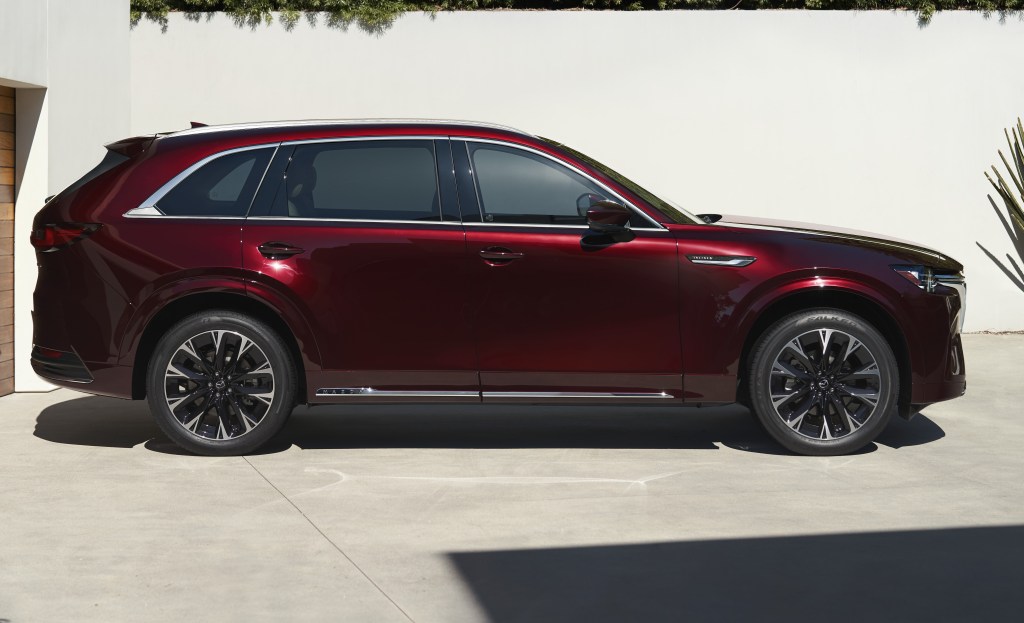
And if you think “Mazda” and something diminutive like the Miata (officially known as the MX-5), then the CX-90 may come as something of a surprise because it is nothing if not sizable: 122.8-inch wheelbase; 200.8 inches long; 78.5 inches wide; 68.2 inches high.
It provides 57 cubic feet of space for those in the front row; 51 cubic feet for those in the middle; 35 cubic feet for those in the rear (OK, a bit tight, but. . .).
And in terms of cargo capacity, there is 75 cubic feet with the second and third rows folded and 16 cubic feet if the seat backs are vertical.
But you’re wondering what all of that engine stuff at the start of this piece has to do with this vehicle. . . .
It’s this: For some reason known probably only to the marketing team, on the front quarter panel of the CX-90 there is a black and chrome badge that reads: “INLINE 6.”
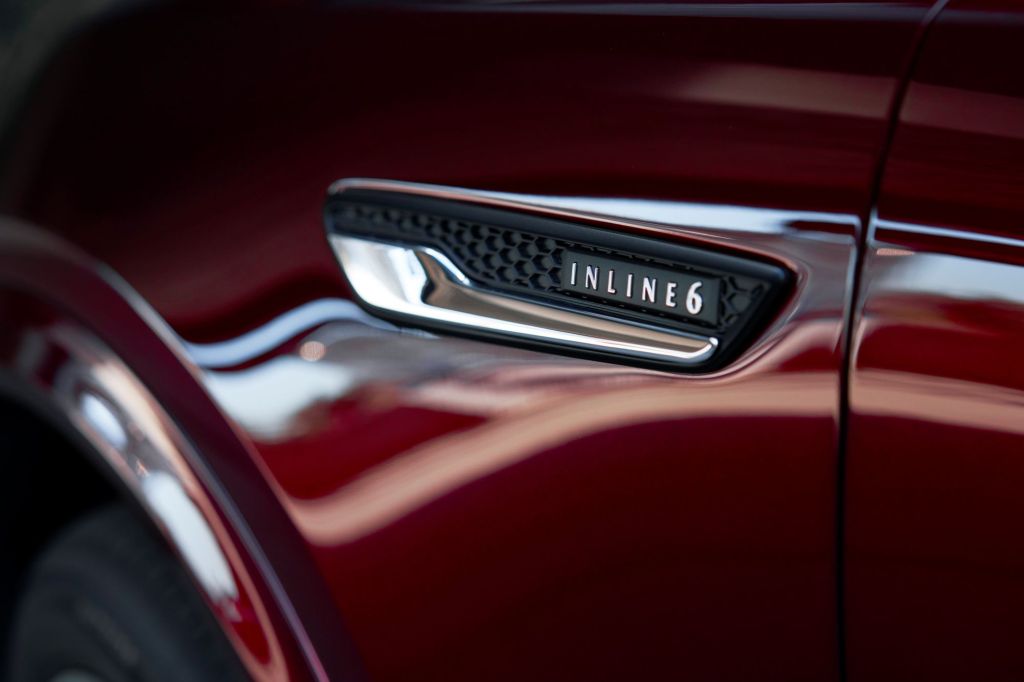
That’s right: the vehicle has a 3.3-liter, turbocharged, inline six-cylinder engine. Perhaps this is to differentiate the Mazda from something like a Chevy Traverse, which has an INLINE 4. (Though it doesn’t indicate that.)
From a performance point of view, the Mazda powertrain produces 340 hp and 369 lb-ft of torque (or, for those of you who are now SI mavens, 500 Nm, which is a fairly impressive number on its own, so maybe that would be a good moniker: CX-90 500).
The use of the word “powertrain” rather than “engine” is deliberate, for you may still recall the word “electrified” above.
The vehicle is fitted with what is called the “M-Hybrid Boost.” This is a 48-volt mild hybrid system, which means that it serves as a, well, boost, especially at starting from low speeds. It also helps with the overall efficiency, which is what I noticed in driving, as the low-speed boost was “meh,” but getting a combined 27 mpg for a vehicle weighing some 4,900 pounds with three rows and all-wheel drive is certainly satisfying.
Somehow I think it would have been cooler, if no more meaningful, to have “M-Hybrid Boost” on an exterior badge rather than INLINE 6. At least it would seem more future-oriented if no more clear to consumers.
Because the CX-90 is the top-of-the-line, the interior is well appointed with Nappa leather, streamline-design metal trim pieces, and a large piece of fabric on the IP with intricate stitching which appears as though it has more to do with high-fashion than Newton-meters.
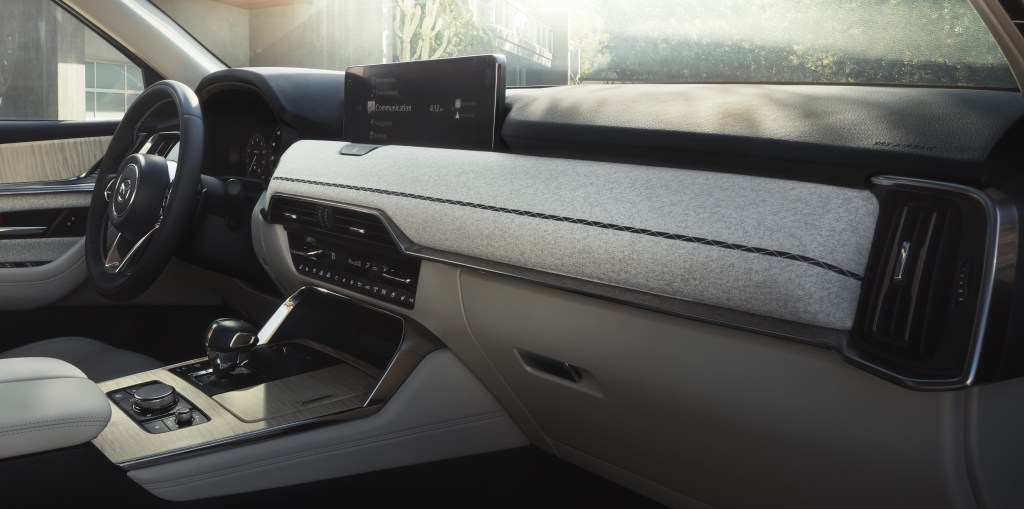
All, in, however, this model is an interesting alternative to the vehicles in this category that have been available for a longer period of time, especially as Mazda seems to be making a serious effort to get its foot in the proverbial door in the three-row SUV space so it is over indexing.
To the benefit of the buyer.

 shinymetalboxes