
Better Than Having the Mats Thrown In

Ford makes it easier for EV buyers to charge at home. What do Bronco buyers get?

By Gary S. Vasilash

Earlier this year the Boston Consulting Group released a report that says, in part, “perhaps the biggest challenge for OEMs is to produce the next generation of EVs profitably. We estimate that most OEMs currently lose around $6,000 on each EV they effectively sell for $50,000, after accounting for customer tax credits.”

Given that the current generation of EVs is what’s presently on dealer lots, that’s lots of money that the legacy OEMs are spending to move the metal.

But because of the billions of dollars they have spent on building out the capacity to produce EVs, they want to keep the production lines running.

Consequently, they are coming up with things that will make EVs more appealing to customers, the $6,000 be damned.
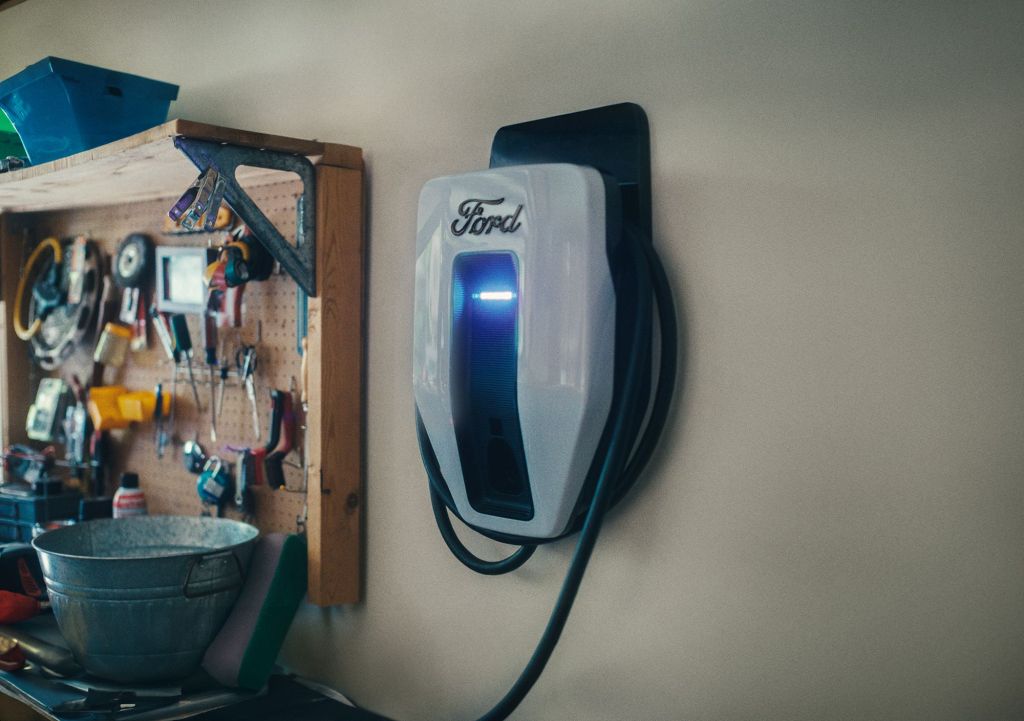
Buy an EV. Get a charger. (Image: Ford)

Earlier this week Ford CEO Jim Farley wrote, “Cheap lease deals on electric vehicles are popping up everywhere. Ford believes it will take more than jumbo rebates to truly break through with the estimated 19 million people in the U.S. interested in electric vehicles.”

Note that he writes “it will take more”—something additive. The rebates and incentives are still part of the game.

Farley goes on to provide details on how Ford is addressing this, through what they call the “Ford Power Promise.”

To provide ease of mind for people, this includes such things as complementary roadside assistance, expanded 24/7 advisor support, and the ability to use its Plug and Charge service that allows a driver to plug in at a charging station and have the electricity charged to the driver’s FordPass account.

But perhaps most significantly, Farley writes: “Buy or lease a retail Ford Mustang Mach-E, F-150 Lightning or E-Transit and take a complimentary home charger with you or have it delivered, and when you’re ready, an expert comes out to install it at no charge for a standard install.”

That’s right: Ford is paying for customers to have home charging capability, something that costs, on average, $1,000.

This could be a clever marketing approach to getting more people in Ford EVs now (the offer expires on January 2, 2025) and presumably next-gen EVs—after all, if the charger is there, people probably figure they might as well use it.

Consider that both the Mach-E and the E-Transit qualify for the IRA tax credit of $3,750 and the F-150 Lightning the full $7,500.

Go buy an Explorer or Bronco and the only tax-related thing will be the sales tax that you’re paying.

Seems that this EV transition is not only costing the OEMs an enormous amount of money, but let’s face it: the government isn’t magically making those credits appear, so all tax payers are kicking in, as well.

The Ford 180

By Gary S. Vasilash

“Ford has shifted its electric vehicle strategy so it concentrates on smaller, lower priced EVs and electric work vehicles such as pickup trucks and full-size vans, Farley said. Any EV larger than a Ford Escape small SUV ‘better be really functional or a work vehicle.’”

That is from an AP story by Tom Krisher about a presentation Ford CEO Jim Farley gave to the Wolfe Research Global Auto Conference in New York on February 15.

Farley also talked about the relationship between Ford and the UAW in light of last fall’s strike.

Farley said, “Our reliance on the UAW”—it has more UAW members that either GM or Stellantis—“turned out to be we were the first truck plant to be shut down.”

He was referring to the Kentucky Truck Plant, Ford’s largest plant and where the highly profitable F-Series Super Duty, Ford Expedition and Lincoln Navigator are produced.

Ford has pretty much placed its production bets in North America on things like the F-Series.

The only car the company has on offer in the U.S. is the Mustang, not exactly what one would describe as a “family vehicle,” so arguably it is something of a niche at most. Trucks and utes are where it is at, it seems, for the Blue Oval.

In the smallish category there are the Escape and the Bronco Sport, which are both based on the same platform. And the Maverick pickup truck, which is also based on the same C2 platform. This extremely popular pickup is built at a Ford plant in Hermosillo,Mexico, so some of Farley’s USA! USA! USA! chest thumping needs to be adjusted a bit.

But his comment about where the sweet spot for EVs is going to be is somewhat puzzling.

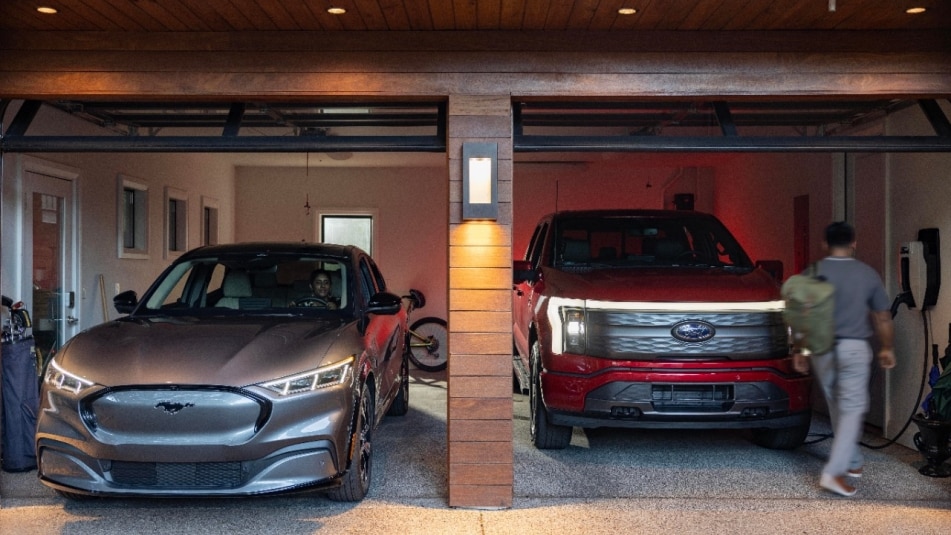
Right now Ford has three EVs, two for consumers and one for vocational use: the F-150 Lightning, Mustang Mach-E and E-Transit.

The Ford EVs for consumers: the Mustang Mach-E and the F-150 Lightning. (Image: Ford)

The first is, of course, a full-size pickup truck. The second trades on the muscle car performance of the Mustang. And the third is a vehicle for contractors.

Ford has been championing larger vehicles for the past few years for the simple reason that it is where it makes more money, so when it went EV it went big with the Lightning (and for power with the Mach-E).

It used to have the Focus to go up against the likes of the Honda Civic and Toyota Corolla, both of which still exist and do quite well in the market. Presumably neither Honda nor Toyota build those vehicles out of charitable impulses.

Ford used to have the Fusion to go up against the likes to the Honda Accord and the Toyota Camry, both of which. . . . Yes, same thing.

Ford—and it isn’t the only company in southeastern Michigan that has done this—has been messaging consumers that Bigger Is Better.

Suddenly Farley is talking about small vehicles.

Don’t get me wrong: small EVs, assuming that they can be made so that they are actually affordable for consumers and that provide a return to the OEMs, are undoubtedly a good idea to increase the number out on the roads.

Regardless of the size of the currently available EV (with the exception of Teslas) need to be sold to a still-skeptical public.

So there is that challenge.

And now Farley is doing a 180 and planning to go to the market with things that are small.

Which means he is going to need to convince people that on roadways populated with large F-150s and Explorers small Ford EVs are a good thing.

To which I say: Good luck.

Language and Leadership

Remember those radio commercials that included the line “People judge you by the language that you use”?

Well, an on-line tutoring firm, Preply, has taken that idea and applied it to making a determination of the “intelligence” of CEOs based on transcripts of public appearances available on YouTube.

The firm analyzed from 60 to 180 minutes of dialog and assessed the execs based on:

  • Vocabulary breadth: The extent of word diversity
  • Vocabulary sophistication: The complexity of words used
  • Textual readability: The complexity of sentence structures and ideas
  • Critical thinking: The quality of argument construction, deconstruction, and analysis
  • Contextual relevance: The speaker’s ability to interconnect the dialogue with broader contexts or other fields

That led to the scoring based on a 100-point scale.

And the auto CEOs included in the rankings don’t score in the top 10, not even Elon Musk.

Ranking first is Demis Hassabis, CEO of AI firm DeepMind, with a score of 87.33. Presumably he is exceedingly articulate (and/or has great speechwriters) because Stephen Schwarzman of investment firm Blackstone is in second place with a score of 74.33, a precipitous drop.

As for the people in auto, Musk is in 16th position with 64.33, behind Brian Chesky of Airbnb with 65.00 and ahead of Whitney Herd of Bumble, at 64.00. (Strange correlation with Airbnb and Bumble. . . .)

Mary Barra of GM isn’t far behind, in 20th position with 63.00.

There is one more U.S. auto exec on the list of the top 100: Ford CEO Jim Farley at 98, with a score of 32.00.

That just seems mean.

Ford & Tesla: Go Figure

By Gary S. Vasilash

Jim Farley, Ford CEO, said to the assembled audience on hand for the production launch of the all-electric F-150 Lightning on April 26, “We plan to challenge Tesla and all comers to become the top EV maker in the world.

“That’s something that no one would have believed just two years ago from us. They’re going to look at this truck and believe it.”

That’s something I have a hard time believing right now.

Not that Ford doesn’t have a shot at becoming the lead EV builder at some unspecified time in the future. It probably will. Electric pickups and full-size crossovers will undoubtedly roll out of its dealerships in huge numbers one Ford has them.

But that a company that has pretty much been synonymous with “auto industry”–as it was established in 1903 and has had factories churning out cars, trucks and crossovers the world over for more than a century–uses Tesla as the point of comparison.

This is not to diminish the accomplishments of Tesla in any way. In 2021 it delivered more than 936,000 the world over.

While Tesla doesn’t break out its numbers by country, Cox Automotive estimates that the U.S. sales of its vehicles were 352,471 in 2021.

Ford had one EV in 2021, the Mustang Mach-E. It sold 27,140.

It’s not like Tesla just started selling cars last year. It has been on the market for more than 10.

Yes, it started out small.

And so was ignored by the traditional OEMs like Ford.

But Team Tesla kept at it and the traditional OEMs kept doing what they were doing by and large their efforts toward producing EVs were simply to meet regulations, not customers.

Now these companies (and know that it isn’t just Ford and GM, but even other stalwarts like Mercedes and BMW) have recognized that not only is Tesla selling a lot of vehicles, but that customers really want them, which is a good characteristic for products to have in a market.

It is sad that Farley (yes, he gets something of a pass as he didn’t become Ford CEO until October 2020) has to compare what the Ford Motor Company will do with Tesla.

One would like to think that the company founded by a guy who was certainly more advanced than many of his contemporaries would be the one other companies would be comparing themselves to, not Tesla.

Google & Ford: When Is a Customer a Partner?

Until December 13, 2016, what is now known as “Waymo,” the company that is developing “fully autonomous” vehicle technology, was known as the “Google Self-Driving Car Project.” In the four years since, Waymo has gone far beyond something that would be described as a “project.” What’s more, it has raised a few billion dollars in outside investment so it is no longer a Google—or more appropriately, an Alphabet—solo undertaking.

Alphabet is a huge company. A company with a market cap on the order of $1.29-trillion. It doesn’t break out the Waymo numbers, but it is now estimated that the company is worth some $30-billion.

Ford has a market cap of $42.6 billion.

Which puts it ahead of Waymo but way behind Alphabet.

And what’s interesting to note is that while Ford has had the number-one selling pickup truck for 44 years running—and sold 787,422 last year alone—Waymo has sold 0 anything.

However, Ford and Google announced that they’ve entered into “a unique strategic partnership.” I wonder how much this is like when an OEM comes out with a new vehicle and calls it the “First-ever [fill-in-the-name].” Of course it is the first-ever. There hasn’t been one.

(Image: Ford)

So Ford doing something extensive with Google is “unique” because they haven’t done it before.

Ford is buying space on the Google Cloud. This brings with it all sorts of opportunities in terms of data analytics and AI and, well, all that those giant clouds bring. Here’s one: it will help Ford “Fast track the implementation of data-driven business models.” Of course.

There will be a “new collaborative group” named “Team Upshift” that “will push the boundaries of Ford’s transformation, unlock personalized consumer experiences, and drive disruptive, data-driven opportunities.”

Ford will start using the Android operating system as the OS for its vehicles starting in 2023.

Ford president and CEO Jim Farley: “As Ford continues the most profound transformation in our history with electrification, connectivity and self-driving, Google and Ford coming together establishes an innovation powerhouse truly able to deliver a superior experience for our customers and modernize our business.”

Sundar Pichai, CEO of Google and Alphabet: “From the first moving assembly line to the latest driver-assist technology, Ford has set the pace of innovation for the automotive industry for nearly 120 years. We’re proud to partner to apply the best of Google’s AI, data analytics, compute and cloud platforms to help transform Ford’s business and build automotive technologies that keep people safe and connected on the road.”

To be sure, this is a big deal for Ford, especially as General Motors announced a similar(ish) deal with Microsoft a couple weeks ago. Perhaps the third shoe will fall and someone will announce a partnership with Amazon.

As for Google, well, they like customers partners. After all, how else to get to a valuation of over $1-trillion?–gsv