
2026 Mazda Mazda3 2.5 S Premium Hatchback

An unexpected feature in this particular trim. . .

By Gary S. Vasilash

“(a) Rule required.—Not later than 1 year after the date of enactment of this Act, the Secretary, in consultation with the Administrator and the Federal Communications Commission, shall issue a rule—

(1) requiring devices that can receive signals and play content transmitted by AM broadcast stations be installed as standard equipment in passenger motor vehicles—

(A) manufactured in the United States for sale in the United States, imported into the United States, or shipped in interstate commerce; and

(B) manufactured after the effective date of the rule;

(2) requiring access to AM broadcast stations through the devices required under paragraph (1) in a manner that is easily accessible to drivers. . . .”

That is language from S.315 – AM Radio for Every Vehicle Act of 2025. The Senate bill, which has  bipartisan support, is still making its molasses-like way through Congress. Some OEMs for reasons ranging from electric vehicles producing electromagnetic interference with AM band reception to car makers figuring that there are few people who listen to AM on radios, so why not reduce costs?

It is probably not a good thing for fans of manual transmissions that there isn’t something like the National Association of Broadcasters lobbying of behalf of the continuation of manuals because they are decreasing.

There are about seven 2026 MY vehicles with stickers under $50,000 that have one.

The 2026 Mazda Mazda 2.5 S Premium is counted among that number.
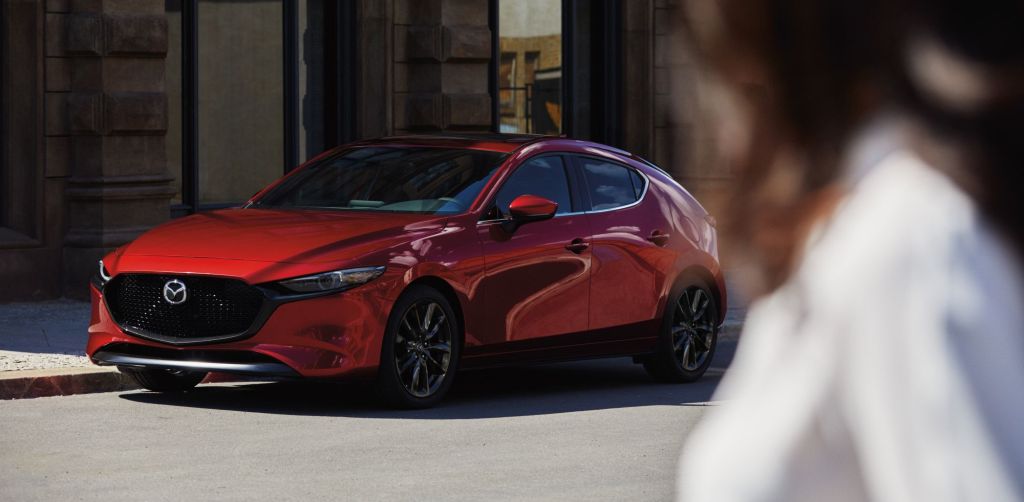
Another great feature: that superb styling (Image: Mazda)

What’s interesting is that there are six trims in the Mazda3 lineup and this particular model is the only one offering a six-speed manual transmission. (It is also notable that the Mazda3 is the only non-crossover in the Mazda lineup.)

It once was that an argument made on behalf of manuals was that better gas mileage could be achieved. (Funny thing is: that argument was made when gas was really quite cheap, and I don’t mean just in context of the current huge run-up at the pump.)

But in the case of the Mazda3 in question, which is a front-drive car, it is stickered at 25/34/29 city/highway/combined miles per gallon and a Mazda3 with an automatic transmission and the same 186-hp  engine is stickered at 26/34/29 mpg.

Yes, the automatic does a bit better when it comes to squeezing out the mileage.

(“But it is not as much fun to drive!” say the stick enthusiasts. True. But generally driving is if not bumper-to-bumper than traffic signal-to-traffic signal, so the rare moments of fun give way to tedium.)

Not surprisingly, because this is the sportier variant there are things like 18-inch black-finish aluminum alloy wheels and piano black side garnishes.

The front and rear lights are LED and the headlights have an auto-leveling function.

The vehicle is equipped with an “Active Driving Display,” which is generally called a “head up display.” No matter what you call it, it keeps the drivers eyes looking forward, where they should be looking.

The leather driver’s seat is 8-way power adjustable and heated.

And on the subject of seating, the vehicle offers 91.2 cubic feet of passenger volume, biased, of course, to the front passengers, though people can sit in the back.

There is an 8.8-inch color infotainment screen. It uses the large knob for controlling what’s on that screen called the “Multifunction Command Controller” (which is really a bit much for a knob). And on the subject of physical interfaces, the HVAC control is performed via dials, not embedded in the screen.

There is an abundance of safety tech standard including lane departure warning and lane-keep assist, radar cruise control with stop-and-go functionality, rear cross traffic alert, and more.

And there is a Bose 12-speaker premium audio system with aluminum speaker grilles, which add a nice touch to the already nice interior color and materials execution.

While there is a complementary three-month trial for SiriusXM, presumably there are some people who would prefer you listen to AM.

2024 Volkswagen Golf GTI 380

Something you actually need to drive—assuming you are one of the remaining few who knows how that third pedal works in an era being increasingly characterized by one-pedal driving

By Gary S. Vasilash

 “Wow! You should drive the wheels off that!”

Which isn’t the sort of remark that you’d ordinarily get when someone sees a parked car. Not even a muscle car.

2024 VW Golf GTI: Engineered to be driven. (Image: VW)

Especially not something when the guy saying it probably grew up watching muscle cars on Telegraph or Woodward.

It was clear that one look and he thought that it is a vehicle to be driven and everything else would just be icing on the cake.

He was looking at the VW Golf GTI.

In autodom in general the GTI is somewhat rare.

That is, it didn’t appear in the U.S. until 1983.

And while 41 years is a non-trivial number, there isn’t an abundance of the cars out there.

In 2023 Volkswagen of America delivered 7,451 GTIs.

Through Q1 2024 it has delivered 2,412, which is a 156% increase over Q1 ’23.

If it maintains the Q1 pace through the remaining three quarters it could reach 9,648 by the end of the year. As a percentage, a lot. But as tires on the ground, not so many.

And the reason is simple.

While the Golf in Germany* is still primarily a family car that is available with a variety of powertrains, the GTI is, quite simply, a car that it categorized by enthusiasts as a “hot hatch.”

The hatch configuration lends itself to, say, stocking up on things for the family. And with the rear seat folded the GTI offers 34.5 cubic feet of cargo capacity. Plenty.

But odds are Costco is not the destination for the car, especially not the Mk3 GTI 380, as it is equipped with a six-speed manual transmission.**

It is meant to have its wheels driven off. So to speak.

When the observation was made, even though the car was standing still the bright-red brake calipers seen though the gloss-black wheels inserted in the summer tires telegraphed the message that this car is meant to go.

And it does.

The transmission is mated to a 2.0-liter turbocharged engine that produces 241 hp and 273 lb-ft of torque.

It is a front-drive car. To help mitigate issues when getting on the accelerator therew is an electronically controlled torque-sensing limited-slip differential that keeps the car going where pointed.

There is something that strikes me as somewhat ironic about the GTI with the six-speed.

There are metal surfaces on the pedals. A massive metal dead pedal. It is a car that you have to, comparatively speaking, work at driving.

In effect, it is more “mechanical” that your run-of-the-road vehicle. And I mean that in a positive way.

Yet as this is a contemporary car it has, in the words of VW, a “technologically advanced cabin, which offers an integrated high-end digital experience.”

Yes, this means digital gauges for the driver and an infotainment system. Now obligatory.

But the thing that is amusingly odd that for being such a “mechanical” vehicle, the interfaces are not knobs and buttons but smooth, touch-sensitive surfaces.

If there is any car that really needs a large, knurled volume knob, it is the GTI.

//

*Whenever an auto plant is launched, politicians typically come out and make a speech. When the eighth-generation Golf went into production in Hall 12 of the Wolfsburg plant, Stephan Weil, Minister President of the State of Lower Saxony, made some remarks including, “I’m an absolute fan of the Golf and have myself been driving one for several years. For many people in Lower Saxony, the Golf is a piece of home and something they can identify with. Just like the VW Beetle was in the past, the Golf has been a symbol of mobility and freedom for decades. Since 1974, the Golf has made a significant contribution to the stability and growth of Volkswagen and industry in Lower Saxony.” During the past 50 years there have been more than 37-million Golfs sold around the world, of which more than half were produced in Wolfsburg. More of these cars are transportation vehicles rather than enthusiast cars.

**The GTI is also available with a seven-speed DSG automatic transmission with Tiptronic. The automatic is optional. Here’s something that seems, well, different. The MSRP for the GTI with the six-speed ranges from $32,685 to $40,825. But the MSRP for the vehicle with the optional seven-speed ranges from $31,965 to $40,505—less than the models with the manual. Presumably this has something to do with volume: something made in fewer numbers tends to have a higher price than something made in greater numbers. Or maybe it goes to the point that this is the final year there will be a manual in the GTI, so if you want it you’ve got to pay a bit more for the privilege.