
2026 Mazda CX-70 Turbo S Premium

How to make a precision vehicle

By Gary S. Vasilash

“Cars are primarily made from steel, and we need dies to produce the body parts. The precision of the die determines the quality of our cars. At Mazda, we use machine processing to create dies with high precision, but then our Takumi add the final touches by hand to achieve ‘KODO Design.’

“’KODO Design’ uses the play of light and shadow to create designs that make people feel like the car is a living being. To achieve this beauty, our dies must be perfect down to the micrometer level.”–Chiharu Saeki, a technical engineer in the Tool & Die Production Department, Mazda Motor Corporation

A couple things to think about regarding that quote:

  1. Stamping dies are used, of course, to produce body panels in presses that produce from 1,000 to 5,000 tons of force. The stamping dies that go within the presses are larger than the object being produced. For example, while a door might measure 1.2 meters by 1 meter, the die will measure 2.5 meters by 2 meters. The business portions of the dies (i.e., the areas where the forming occurs rather than the support structure) are made with extremely durable tool steels. And know that not only are they dimensionally big, but they are massive, generally weighing from 50 tons to 72 tons.
  2. A micrometer is one millionth of a meter. The width of a human hair is about 80 micrometers.

Certainly to make a die some serious machining is required at the start of the process in order to remove steel. Realize it starts with a rectangular blocks of steel that must have forms cut into both the female and male sides of the dies.

But precision machining notwithstanding, the Mazda craftspeople then look at the surfaces generated by the machining and make minor adjustments to those surfaces with hand tools.

One could argue that when dealing with micrometers this might not be noticeable to the end consumer of the product. But (a) “might not” doesn’t mean they don’t and (b) the people at Mazda think it important that they do their very best, so good isn’t good enough.

And while on the subject of things at the microscale, Mazda uses a painting process that its engineers developed that puts a precision reflective paint layer on the surface measuring about 5 micrometers, compared to the typical automotive layer that is 20 or more times thicker. By using the precision process Mazda creates what are some of the best finishes in the automotive world—and it helps that it is applied to surfaces produced by attention to the details of the die surfaces.

2026 Mazda CX-70 in Melting Copper. A young parking lot attendant provided an unsolicited enthusiastic response to the color, and let’s face it, he sees a lot of vehicles on a daily basis. (Image: Mazda)

Which brings us to the Mazda CX-70, which is built in the Mazda Hofu Plant, meaning a place where there are craftspeople, a.k.a. Takumis.

The CX-70 is a two-row crossover that is as long as the CX-90 three-row crossover (because it is based on the same platform. But because it doesn’t have the third row it provides second-row passengers with surprising legroom (39.4 inches) and capacious cargo volume: 39.6 cubic feet with the second row up and 75.3 cubic feet with it folded.

It is powered by a 3.3-liter inline six that produces 340 hp, with supplementation from a 16.6-hp electric motor that aids such things as performing a transparent stop-start (no, not all people are against these systems that serve to save fuel) and the acceleration after a stop. The electricity is provided by a 48-V mild hybrid system. There is an eight-speed automatic transmission. There is standard AWD.

The same level of care exhibited on the exterior is also evident on the interior, both in terms of the surfaces and interfaces that people touch and see and in the use of buttons for frequently used functions (e.g., HVAC; audio). On the subject of audio: Mazda has been working with Bose for literally decades and the sound quality shows what experience can do. (I would suggest the Mazda Design Department take a look at the graphics used by many other OEMs for their embedded navigation systems and borrow some cues.)

Compared to companies that offer competitive products—like the Honda Passport and the Jeep Grand Cherokee—Mazda’s US sales are significantly smaller.

But the thing is: what it doesn’t have in volume it more than makes up for in precision of execution, all the way to the level of microns.
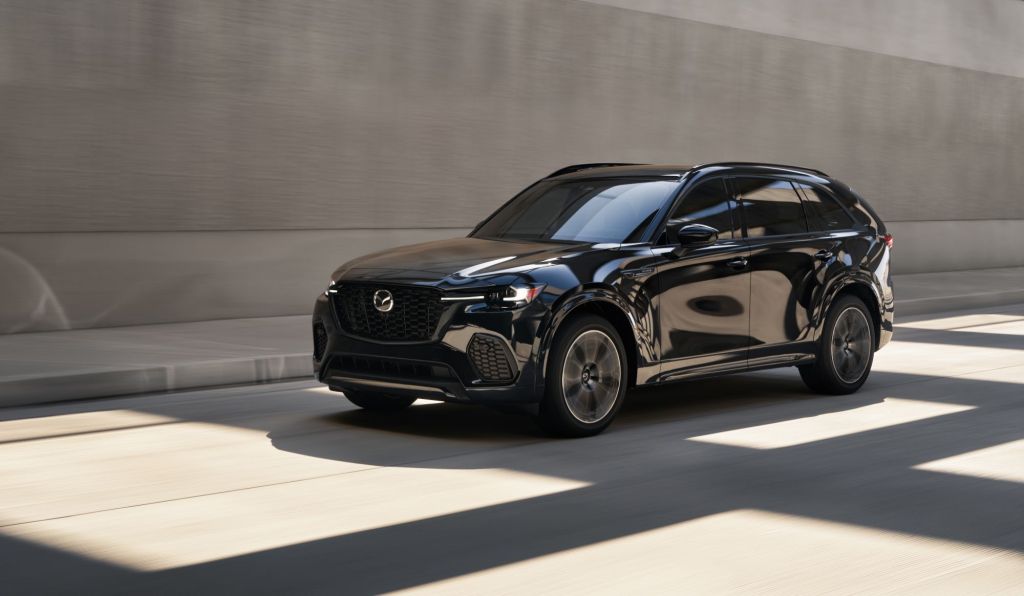
2026 Mazda CX-70 3.3 Turbo S Premium

What’s in a name? Plenty.

By Gary S. Vasilash

A slightly unusual aspect of the 2026 Mazda CX-70 3.3 Turbo S Premium is the name of the 2026 Mazda CX-70 3.3 Turbo S Premium.

Mazda CX-70: More styling than most two-row crossovers (Images: Mazda)

Not the CX-70 part because that’s the naming nomenclature that Mazda uses for its vehicles. Alphanumerics rather than names.

There is one exception. The Miata. Its “official” name is the “MX-5 Miata.” Initially the third-generation of the sports car was labeled simply “MX-5.” That didn’t last long and the word was reapplied.

But I digress.

No, the thing that seems odd about this handsome, two-row crossover’s name is that it includes a truncated designation for the vehicle’s engine.

The engine’s full name is the “e-SKYACTIV-G 3.3 inline six turbo.”

So the model includes the amount of displacement (3.3), which probably means very little to anyone who is in the market for a family-oriented crossover, and the fact the engine is turbocharged, which carries more meaning.

Perhaps this is in keeping with what, say, a BMW does with its naming approach, which also includes a number for displacement.

But the CX-70 is not the sort of thing that would get cross-shopped with a BMW.

It just isn’t.

And the Mazda that could be cross shopped with a BMW by an enthusiast, the MX-5, doesn’t stick to that approach. The name refers to “Mazda Experimental Project – Number 5.”

///

It might be a better idea if the name of the vehicle included “AWD,” as in “all-wheel drive.” All CX-70 models come with it.

I think that would be something to shout about.

No one cares.

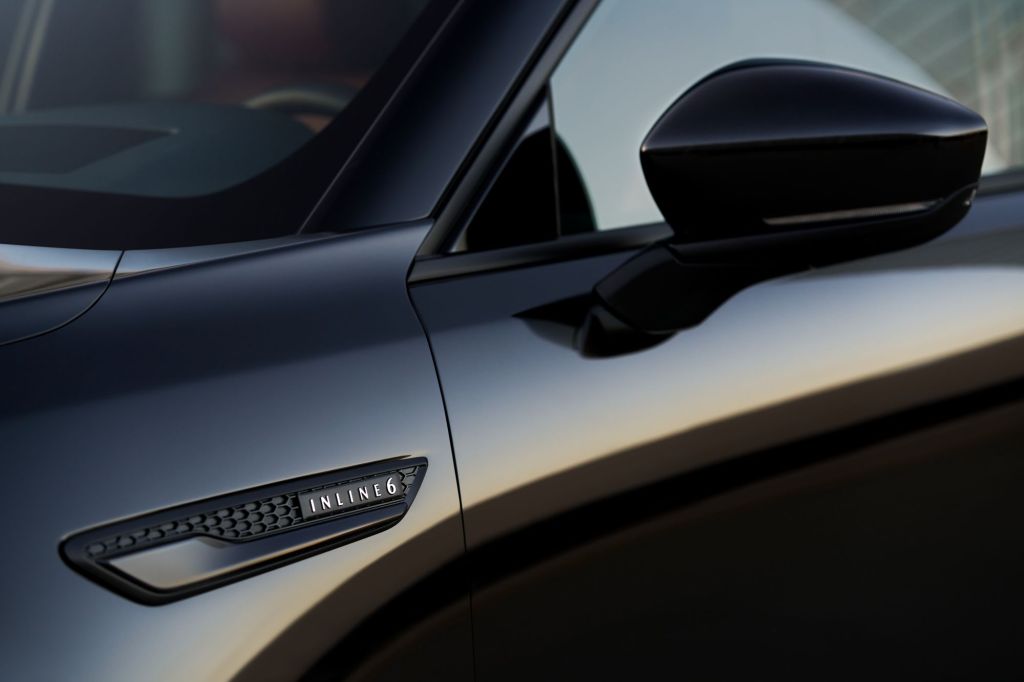
Instead, Mazda goes so far as to put an “INLINE 6” badge on the front left quarter panel.

Do people who are shopping for a midsize SUV know what that means?

Do they know that the long engine block provides for superior mechanical smoothness than a V-block?

Do they know there is an improvement in things including exhaust gas flow?

Do they care?

And if they do care, would they care more about AWD?

///

Another thing that’s not indicated by that name is that the 340-hp engine (non-S CX-70s produce 280 hp) happens to be a mild hybrid. It features “M-Hybrid Boost.”

Which is to say that it is a 48-volt system that supplements performance when accelerating from a stop and improves the smoothness of the engine restart during stops.

It also provides a bit of oomph at the other end: when you are on the throttle, hard.

And it is said to improve miles per gallon, which are EPA estimated 23 city, 28 highway and 25 mpg combined.

///

Unless the model you happen to be looking at is fitted with Mazda Genuine Towing Accessories you might not know that the CX-70 3.3 Turbo S Premium can tow.

Capacity: 5,000 pounds.

///

There is another number that would be important for someone in the market for a two-row, five-person crossover:

39.6.

That’s the number of cubic feet of cargo capacity with the second row in place for use.

Fold it down and there are 75.3 cubic feet.

Again, a displacement number may be of interest to a handful of people.

A cargo capacity number is of interest to a whole bunch.

///

One of the things about Mazda is that it has an earned reputation for nimbleness in ride and handling.

This is something widely hailed, especially by auto journalists.

The CX-70 is 200.8 inches long, 78.5 inches wide, and 68.2 inches high. It has a 122.8-inch wheelbase.

The multilink suspension system does its job well.

But this is not something you’re going to throw through corners like an MX-5 or even Mazda3 (a name that also has nothing to do with powertrain nor with anything someone outside of a carspotter would be interested in knowing about. Trust me.).

///

Another number to know about the 2026 Mazda CX-70 3.3 Turbo S Premium: base MSRP is $53,240.

///

The “Premium” part of the name designates that, especially on the interior, this is a model with the goods, standard.

Like Nappa leather seating that’s heated and ventilated up front. (In the back just heated.)

Bose 12-speaker audio.

A 12.3-inch infotainment screen that can be used for the wireless Apple CarPlay and wireless Android Auto.

There’s a vast suite of safety tech, including some that is not widely found, like “Smart Brake Support Rear with pedestrian detection”—yes, the sensors will alert the brakes should something untoward seem to be happening.

///

There is a vast array of branding companies out there that might add a little something to the name of this vehicle because looking at the vehicle and then looking at how it is doing in the market indicates to me that there are a whole lot of people who are overlooking a good thing.