Mercedes’ “Real-World” Performance

Impressive for an EV. . .but one that isn’t as real as a gas-powered one you can buy right now. . . .

By Gary S. Vasilash

Mercedes-Benz recently announced that it performed a “real-world” test of an electric vehicle—a “lightly modified” Mercedes EQS—for a distance run:

It went from Stuttgart, Germany, through Denmark, to Malmo, Sweden, without a stop for recharging.

This means it traveled 749 miles. What’s more, there were 85 miles remaining in the battery.

Now presumably “real-world” means that they performed the test in the world that we know, regular highways.

Because what isn’t “real-world” in the context of what we know is that the sedan was equipped with a solid-state battery system developed in cooperation with Mercedes-AMG High Performance Powertrains, the same operation that provides tech for the Mercedes Formula One team.

Most of us don’t have access to that kind of tech in our real worlds.
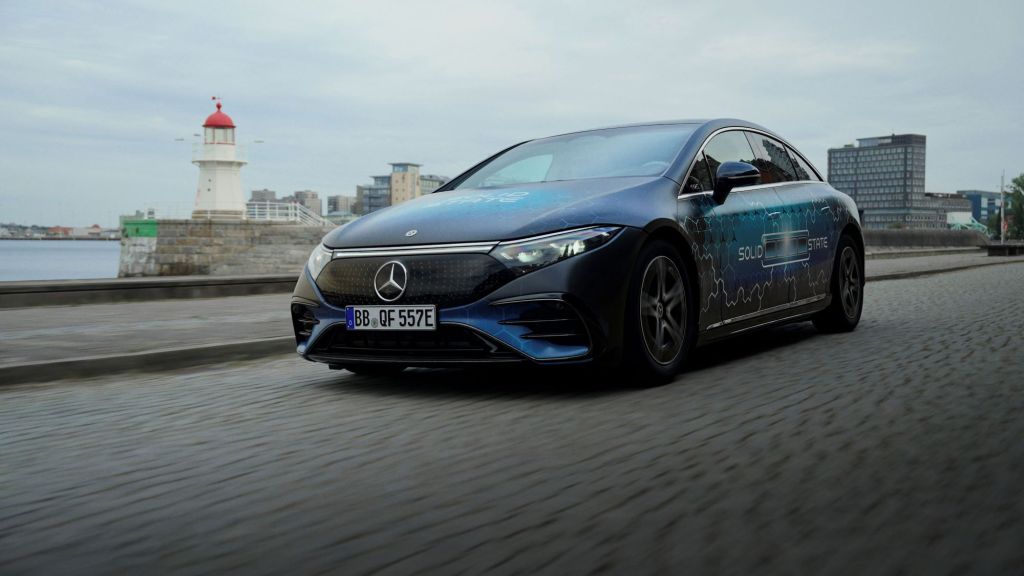
Mercedes “lightly modified” EQS traveled from Stuttgart to Malmo—749 miles—without needing to recharge the solid-state battery powering the vehicle. (Image: Mercedes)

The solid-state lithium-metal cells were produced by Factorial Energy, a Woburn, Massachusetts-based company that is working with Mercedes, Stellantis and Hyundai on the solid-state tech.

You can’t buy a vehicle (for now) in the real world that has a battery of this type, to say nothing of one that was developed with an F1 supplier.

According to Markus Schäfer, Member of the Board of Management of Mercedes‑Benz Group AG, Chief Technology Officer, Development & Procurement:

“The solid-state battery is a true gamechanger for electric mobility. With the successful long-distance drive of the EQS, we show that this technology delivers not only in the lab but also on the road. Our goal is to bring innovations like this into series production by the end of the decade and offer our customers a new level of range and comfort.”

Which is a fair point.

But back to the real world for a moment.

The Mercedes S 500 is not unlike the Mercedes EQS, although it is a gasoline-powered vehicle.

The S 500 fuel economy numbers are 21 mpg city, 31 mpg highway, 24 mpg combined.

The S 500 has a 20-gallon fuel tank.

So if we take the combined number, that gives it a range of 480 miles, which is short of the 749 miles from Stuttgart to Malmo.

Even though the route from Stuttgart to Malmo is mainly highways, if we take the 24 mpg number it only provides 620 miles of range.

However, one assumes that during a 749-mile drive there would be a need for at least one stop to attend to some personal issues.

During such a stop, a vehicle can be refueled in about five minutes. So let’s say that to be on the safe side someone stopped after using 450 miles of range, leaving 30 miles in the tank, and refueled.

That means there would be 299 miles left to go, but the full tank would provide 499 miles of range, or arrival in Malmo with 181 miles of range still in the tank.

And this is with a production vehicle you can get at your local Mercedes dealer today.

Isn’t smart Small?

Once small. Not anymore.

By Gary S. Vasilash

When it was first launched in October 1998 the smart Fortwo was small. 2,540 mm (yes, millimeters) long and with a 1,810-mm wheelbase. The name of the car explained the number of people who could fit.

But with time there has been significant inflation.

Speaking of the vehicles offered by the company that is a joint venture between Geely and Mercedes, that is.

(Mercedes designs what are now EV-only models from the marque; Geely does all of the development and engineering.)

And now this. . .

smart has introduced a new model, the #5, a mid-size SUV.

The smart #5. The once innovative purveyor of small city cars is now producing mid-size SUVs like every other company. (Image: smart)

It is 4,705 mm long and has a 2,900-mm wheelbase.

Or nearly twice as long as the original smart.

That increased size is handy in one regard—if you plan to sleep in the #5.

According to smart, the seats can be folded so that there is the ability to create a “king-size, queen-size or single mode sleeping space.”

The #5, which has a range of 740 km (460 miles)—on the China Light Duty Vehicle Test Cycle—could be the ideal choice for Uber drivers who essentially live in their cars.

Given that with the exception of things that have undergone shrinkflation increased size seems to be desirable, perhaps a larger smart is a smart idea. (The necessity of another midsize SUV, however. . .)

What To Do In Congested Traffic

By Gary S. Vasilash

“Traffic congestion occurs when demand for roadway travel exceeds the supply of roadways. As vehicular traffic builds, drivers, freight movers and bus riders lose time and spend fuel unproductively.”—INRIX 2022 Global Traffic Scorecard

INRIX calculated that U.S. cities were among those that had significant levels of congestion.

As in having five of the top 10 urban areas that have plenty of hours lost. What’s more, there is no other country that has more than one spot in the top 10.

The cities where people crawl along during commutes for too long a time are:

2. Chicago (155 hours lost)

4. Boston (134)

5. New York (117)

8. Philadelphia (114)

9. Miami (105)

So one assumes that people optimize their time as best they can by eating, applying makeup, getting in a few pages of War and Peace, and doing other things that probably aren’t ideal for the situation.

Mercedes has a better alternative. It has developed the MBUX Virtual Assistant that the company says “is in tune with customer needs and uses generative AI and proactive intelligence to make life easy, convenient and comfortable.”

Certainly better than stewing in traffic.

What’s more, Mercedes has created more apps for its cars, like the one named MBUX Collectables, which allows the driver to check in on the world of NFTs, like Mercedes’ own NXT Superdackel collection, a digital riff on bobbleheads and the like.

One slight issue might be that the interest in NFTs seems to have waned considerably, so perhaps they may be developing an app for those interested in philatey or other image-oriented exercises.

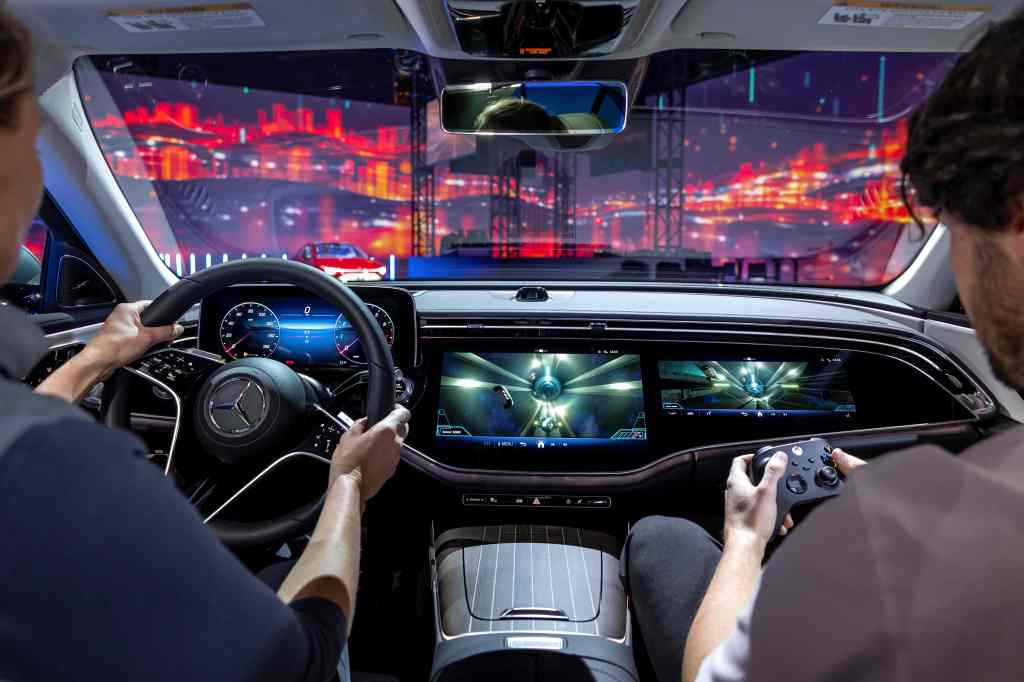
Bored? Mercedes has developed what it calls a “hyper-personalized user experience” that even allows a bit of game playing. (Image: Mercedes)

Mercedes-AMG also announced this week at CES MBUX SOUND DRIVE, an audio execution that “uses software that allows music to react to the way the car is being driven, creating a harmonious relationship between motion and melody.”

The company worked on the development of this system with will.i.am, who said of it:

“Imagine a world where your car can become an instrument creating musical journeys. MBUX SOUND DRIVE enhances driving and sound technology, letting motorists reshape music just by driving. I’m excited to see how composers, producers, and songwriters will harness this to create new works and reimagine classics for motorist to drive to. MBUX SOUND DRIVE is not only a new frontier for music creation, but also opens up fresh, exciting and interactive listening experiences for drivers.”

Although Las Vegas is way down on the INRIX list at 127, with 41 hours lost per year to congestion, given the traffic on the Strip most people would probably prefer if drivers were paying attention to their driving rather than using something that lets “motorists reshape music just by driving.”

Attending CES was somewhat convenient for will.i.am as the Black Eyed Peas played the Venetian for New Year’s.

Premium Vehicle Perspective: Depends Where You Look

When looking at charts developed by French auto analyst firm Inovev of the sales of premium vehicles in the U.S., China and Europe for the first 11 months of 2021, there are a few surprises.

As in sales of 2 million in the U.S., 3 million in China and 2.5 million in Europe.

It’s not surprising that the number is higher in China than in the other two regions. After all, it has a population of 1.4 billion.

It is a little surprising that the numbers break as they do, given that the population in Europe is 748 million, which is about half of that in China and slightly more than twice the population in the U.S. The 500K increments seem strange given that.

Clearly wealth is not evenly distributed, with the U.S. having a higher proportion of its population capable of affording a premium vehicle.

But the surprising thing is the relative sales of the premium brands in the three markets.

The five three brands in the U.S. during this period are BMW, Lexus, Tesla, Mercedes and Audi. Then there is a slight falloff in numbers.

The top five brands in China are BMW, Mercedes, Audi, then a big decline (Audi is at over 600,000 units) to Tesla (at 240,000) and Cadillac.

In Europe it is BMW, Mercedes, Audi, then a big drop to Volvo (Audi: >500K; Volvo: 245K) and Tesla.

While there is consistency with BMW, Mercedes and Audi, and while Tesla is certainly on a roll, Lexus is something of an outlier. It doesn’t show up at all in the listing of sales in China and in Europe it is in ninth position, behind Lancia and just ahead of Jaguar, all of which are well below 100,000 units.

Lancia doesn’t show up at all in the sales tracking for the U.S. and China, and in the U.S. Jag is in last place and it is third from last in China.

Seems as though the German brands are consistently solid around the world while for everyone else it is somewhat random.

Aston Martin Going Racing

Back in the early 1920s, Count Louis Zborowski, a “fabulously wealthy son of a Polish Count”—oddly enough, one born in Elizabethtown, New Jersey—“and an American heiress” who had “a fortune that in today’s money would comfortably class him as a billionaire,” according to Aston Martin, was fundamentally responsible for getting the British firm into Grand Prix racing, with the company’s first effort at the French Grand Prix in 1922, with the Count behind the wheel of one of the two cars entered into the event. Neither car finished.

Aston Martin Chassis TT1–the company’s original race car. (Image: Aston Martin)

Zbrowski? He joined the Mercedes team in 1924 and died racing in the Italian Grand Prix at Monza, colliding with a tree. His father, William Eliot Morris Zborowski, died in a racing accident in 1903, during a hill climb in France.

Lawrence Stroll, a Canadian billionaire, is the Executive Chairman of Aston Martin Lagonda. A consortium of investors he led put £182 million into the company last January, then reworked the agreement in March so that the group owns about 25% of the company.

Stroll has long been involved in racing. His son Lance is a driver. Stroll owns Circuit Mont-Tremblant in Quebec. He isn’t a mere spectator or fan. He is of the fabric of the sport.

And now he has revived the Aston Martin Formula One team.

According to AutoExpress, as of late October 2020 Aston Martin had delivered a total 2,752 cars and had an operating loss of £ 229 million.

Which makes one wonder about whether it makes a whole lot of sense to go racing, an undertaking that is notoriously cash-intensive.

Here is something of an interesting coincidence: Mercedes—remember Zbrowski’s car (and it seems that his father might have been piloting one up that hill in France)?—has entered into an agreement with Aston Martin through which it may be able to acquire as much as 20% of the company.