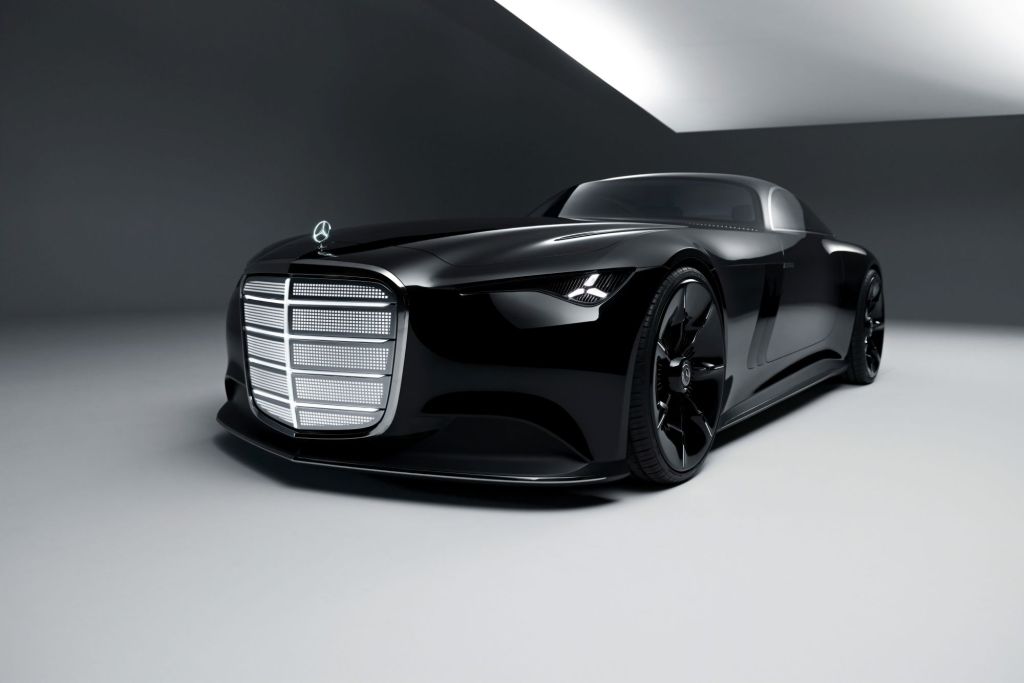
“Inspired by the golden era of automotive design of the 1930s, this show car embodies the pure essence of Mercedes-Benz. With its hood giving it a majestic presence, sculptural flowing lines and a touch of Art Deco, it rises to become a true icon of automotive beauty. The interior with its continuous bench seat and the elegant rear, evoking memories of the legendary 300 SL. Our Vision Iconic is more than just an automobile – it is a sculpture in motion, an homage to timeless elegance and a statement for the future. The symbiosis of traditional craftsmanship, state-of-the-art technology and an unmistakable design language makes it the ultimate expression of value, prestige and grace: the most beautiful, most prestigious kind of thing.”
–Gorden Wagener, Chief Design Officer Mercedes-Benz Group AG
Yes, this concept car may have all of those attributes from the hood to the flowing lines and so on.
But one thing it isn’t is “a true icon of automotive luxury.”
Something becoming an “icon” isn’t a matter of nomenclature (e.g., “Vision Iconic”).
It becomes an icon because there is cultural respect given to something over a period of time.
One could describe the Mercedes-Benz 300 SL, the gull-wing-door vehicle that came out in 1954, as “iconic.” That’s why Wagener is able to cite it as “evoking memories.”
The term “icon” is earned, not labeled.
BMW is eating Mercedes’ Mittagessen in a big way so far as sales are concerned. Perhaps a bit of humility and attention to getting more desirable product on the road now might help Mercedes even if those vehicles aren’t self-proclaimed icons.
At some point will it be analogous to buying Duracell, Eveready or Kirkland. . . ?
By Gary S. Vasilash
Compared with GM and Ford, the other company in the “Detroit 3,” Stellantis North America, which is still simply referred to as “Chrysler” in southeastern Michigan, is behind the curve when it comes to electric vehicles.
You can buy or lease an EV from GM or Ford.
But so far, with the exception of the exceptionally limited Fiat 500e (limited as in having a range of 149 miles, which is about half of what many people are interested in when thinking about an EV), there is no mainstream EV available from Chrysler, Dodge, Jeep, Ram, or Alfa Romeo.
But earlier this week it announced that NextStar Energy, a joint venture between Stellantis and LG Energy Solution, has started battery module production in its plant in Windsor, Ontario. Next year it plans to launch cell manufacturing.
The Dodge Charger, electric version. (Image: Dodge)
And the company also announced that it will be operating a demo fleet of Dodge Charger Daytona EVs with solid-state batteries from Factorial, a battery company that it has invested $75-million in.
What is interesting about the Factorial battery is that the company claims they’re working for a range of 600+ miles from a battery that is 33% smaller and 40% lighter than a conventional lithium-ion battery.
However, that fleet won’t go into operation until 2026.
So presumably if all goes well, it would still take some time before the Factorial tech makes its way into production vehicles, which explains why there is the production at NextStar Energy: they’re going to need something sooner rather than later.
Factorial is also working with Mercede-Benz. The two companies announced last month the development of a new solid-state battery technology, about which Markus Schäfer, Chief Technology Officer and Member of the Board of Management at Mercedes-Benz Group AG, said: “The Solstice solid-state battery technology represents another landmark milestone in our partnership with Factorial, which is a cornerstone of Mercedes-Benz’s strategy and commitment to leading the charge in battery development. Solstice offers further improvements in energy density and safety features that will help us develop electric vehicles that set new standards in range, cost, and performance.”
Note the future tense of “will.” Not now. But sometime.
In the meantime Mercedes gets batteries from companies including LG Energy Solution and CATL.
Mercedes, like Stellantis, has had a joint-development arrangement with Factorial since 2021.
So at some point in the future will the situation be that multiple OEMs will have access to the same battery technology and so there will be differentiators required other than charging time and range?
Opens recycling plant in Germany. But given the longevity of its vehicles, it may take a while for there to be an ROI, even with the cost of battery materials. . .
By Gary S. Vasilah
As is well known the battery in an electric vehicle is the priciest part of the vehicle.
That’s because of the raw materials that the battery is made of. Things like lithium, nickel and cobalt.
Contrast that with an internal combustion engine, which has a block made out of an aluminum alloy or an iron variant. The cost of a pound of nodular iron to produce an engine block is about 10 cents and an aluminum alloy for a block about twice that.
The cost of the aforementioned battery materials are much, much higher.
So while recycling of iron and aluminum is common—after all, there are literally billions of light-duty vehicles that have been built in the last 20 years alone, so there’s a lot of recycle—it is still early stages for recycling electric vehicle batteries.
To that end, Mercedes-Benz has just opened a battery recycling plant in Kuppenheim, Germany.
Inside the Mercedes battery recycling plant in Germany. (Image: Mercedes-Benz)
It is based on something called “an integrated mechanical-hydrometallurgical process” that is said to have a material recovery rate of >96%.
Apparently the mechanical part includes shredding, sorting and separating. The hydrometallurgical process separates out the cobalt, nickel and lithium.
Compared to the pyrometallurgic process that is used by others in Europe, the Mercedes’ approach is said to be less energy-intensive and because green electricity is used to power the plant, it is also net carbon-neutral.
The plant has an annual capacity of 2,500 tonnes that results in materials that can be used to produce 50,000 battery modules.
According to Mercedes it has invested “tens of millions of euros” to build the plant.
In reporting its 2024 third-quarter earnings the company noted: “The market environment for battery electric vehicle (BEV) sales remained subdued with competitive pricing in important markets.” Globally, the group has sold 148,500 electric vehicles so far this year.
Clearly this integrated mechanical-hydrometallurgical process is part of the long game, because it will take a while for the Mercedes EVs to be taken to the scrap yard in considerable numbers.
“Mercedes-Benz EVs accounted for 13% of our total group sales volume in Q1,” Dimitris Psillakis, president and CEO of Mercedes-Benz USA, said, reporting how the marque is doing so far in 2024.
Which, on a percentage basis, is quite good.
Ford, which describes itself as “America’s No. 2 electric vehicle brand,” had Q1 EV sales of 3.9%.
Mercedes has three EVs in its U.S. showrooms:
EQB, of which it sold 671
EQE, 5,113
EQS, 2,552
That is a total of 8,336 of the 66,570 passenger vehicles it sold in Q1.
(To be fair to Ford, it sold 508,083 vehicles in Q1, of which 20,233 were EVs.)
But here’s something interesting about the Mercedes sales: It sold 15,096 GLE SUVs.
The Chinese Belt and Road Initiative was launched in 2013 by Xi Jinping. BRI is a means by which China, though investments and development projects around the world, aims to have increased global influence. According to the Council on Foreign Relations (certainly not something you’d imagine would be cited on a site like this):
“China’s overall ambition for the BRI is staggering. To date, 147 countries—accounting for two-thirds of the world’s population and 40 percent of global GDP—have signed on to projects or indicated an interest in doing so.”
What’s more, CFR points out:
“Beijing could seek geopolitical leverage over BRI countries. A 2021 study analyzed over one hundred debt financing contracts China signed with foreign governments and found that the contracts often contain clauses that restrict restructuring with the group of twenty-two major creditor nations known as the ‘Paris Club.’ China also frequently retains the right to demand repayment at any time, giving Beijing the ability to use funding as a tool to enforce Chinese hot button issues such as Taiwan or the treatment of Uyghurs.”
All of which is to say that the Belt and Road Initiative is somewhat controversial in places other than Beijing.
CFR quotes French president Emmanuel Macron saying during a 2018 trip to China that BRI could result in the countries that have signed up for the loans and/or development programs becoming “vassal states.”
Which makes it odd to see this headline on a recent news release:
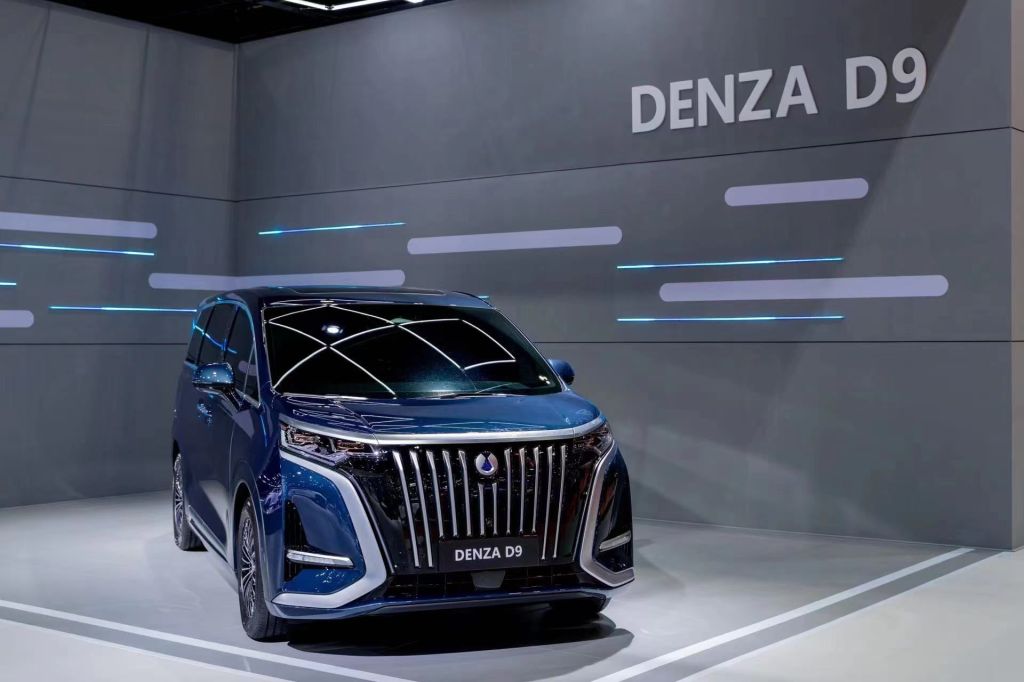
Deepening “Belt and Road” Initiatives: Remarkable Global Expansion for DENZA in 2023
DENZA is a car brand that was established in 2010 by Chinese company BYD and Mercedes-Benz. While it started out as a 50:50 joint venture, last year Mercedes sold all but 10% of its share to BYD.
(Image: DENZA/BusinessWire)
The original announcement about the company noted it would combine BYD’s capabilities in vehicle electrification (BYD is a world leader in that space) and Mercedes’ capabilities in providing luxury and quality. A sensible approach for a startup: the best of both worlds.
While DENZA has been somewhat quiet over the past several years, the company describes 2023 as its “inaugural year on the international stage.”
And then there’s this from the news release:
“With a steady and orderly international expansion, DENZA has not only won the hearts of global media and customers but has also laid a solid foundation for becoming a leading international high-end brand, poised to be the ‘business card’ of Chinese new energy luxury cars, redefining China’s automotive industry and introducing DENZA to a global audience.”
Which, going back to the Belt and Road Initiative, really sounds rather, um, ominous, given the methodical approach that is being taken, especially in contrast to the less-consistent execution by some Western OEMs (i.e., from being all-in on EVs to being sort-of-in to. . .). DENZA has a plan and they’re working it.
And seeing more business cards being passed out by several other Chinese EV companies goes to explain, in part, why the European Union launched an investigation this past Fall into whether Chinese EV OEMs, which are gaining considerable traction in the European market, are benefitting from what could be considered “unfair” government subsidies.
This could cause a considerable concern for European OEMs given the importance of the Chinese domestic market to them and the possibility that the Chinese government could retalitate to things like the imposition of tariffs on Chinese EVs coming into the EU by making it more difficult for EU-based OEMs in the China market.
For example, through Q3 2023 Mercedes-Benz Cars sold the following number of vehicles:
Germany: 172,900
U.S.: 216,700
China: 570,600
Presumably the folks in Stuttgart aren’t going to want to agitate any issues with their biggest market by volume, and they aren’t the only ones.
Somehow the auto industry is becoming as much political as it is technical.
Although there is increasing rhetoric about the U.S. economy being bad, you really couldn’t come to that conclusion based on the Q2 2023 sales of Mercedes-Benz in the U.S.
It achieved some impressive figures, such as sales in its “Top-End” segment of 26,927 units, or a 40% increase compared to Q2 2022.
A standout for the brand in that segment is the G-Class, that seriously geometric vehicle that seems as though it could bash through brick walls without a scratch while driving up hill in sand towing a full-size Airstream trailer.
G-Class sales were up 553%.
There were 3,088 of them sold in Q2.
It starts at ~$140,000.
And over on the electric vehicle side of things, the EQS, which starts at $104,400, was delivered 2,456 times, for a 25% rise compared with Q2 ’22.
It is worth knowing that the non-electric S-Class had sales of 3,164, a comparative decrease of 19.3% from Q2 ’22, which could be interpreted as those who have some serious money to spend on vehicles are going electric.
“To accelerate the shift to electric vehicles, we are dedicated to elevating the entire EV-experience for our customers – including fast, convenient, and reliable charging solutions wherever their Mercedes-Benz takes them. That’s why we are committed to building our global Mercedes-Benz High-Power Charging Network, with the first sites opening this year.”
So said Ola Källenius, Chairman of the Board of Management Mercedes-Benz Group AG.
Mercedes will be opening in North America a “High-Power Charging Network” that will include more than 400 charging hubs and more than 2,500 high-power chargers.
This won’t all be up and running until the end of the decade. Some will open this year.
Källenius went on to say, “In parallel, we are also implementing NACS in our vehicles, allowing drivers to access an expansive network of high-quality charging offerings in North America.”
Yes, Mercedes is signing on to the Tesla Supercharger network—more than 12,000 Superchargers (considerably more than the 2,500 Mercedes plans to have in some six years). Starting next year, they’ll be equipping their vehicles with the socket and software to take the Tesla juice.
So now there are Ford, General Motors, Volvo, Rivian, Mercedes, and probably more by the time you read this all planning on having their vehicles charging at the network created by what is arguably the world’s most desirable electric vehicle company (how else to explain the market dominance it continues to have—and when you hear about how its market share is declining, realize that the market is getting bigger, so while its slice may be smaller from a percentage standpoint, the real thing to pay attention to is the number of vehicle it is selling vis-à-vis the other companies).
This strikes me as something analogous to Apple in its early days saying that it would offer Windows as the operating system and then trying to persuade users to switch to its OS.
What would be the point?
These OEMs are taking a short-term gain and will experience a long-term disadvantage.
If someone buys a Mercedes rather than a Tesla it is probably because they think the Mercedes is a superior vehicle.
And there’s Mercedes saying, “Yes, our vehicle is great but our charging system isn’t, so go use the system from the other brand.”
Isn’t that admitting that the other brand is technologically more capable?
Everyone wants to have their cake and to eat it, too.
And said cake will be delicious. And although said cake will have an exceedingly high number of calories (after all, it is delicious), there will be no added weight to everyone who eats their cake.
Are electric vehicles ecologically oriented or are they performance vehicles?
Well, given that performance numbers are something that Tesla has been able to post, many people think both.
Of course, going Plaid also means going to the Supercharger more frequently. And the electricity that comes out of the units doesn’t get generated by magic.
Still, people are snapping up Teslas to the extent that the traditional purveyors or luxury vehicles can only look on with sublimated horror and try to determine what it is that they can do to get their piece of the market.
And the answer seems to be to opt for performance.
Nice green background, eh? (Image: Mercedes)
Or as Philipp Schiemer, Chairman of the Board of Management of Mercedes-AMG GmbH, puts it about the forthcoming Mercedes-AMG EQE sedan:
“With the new model, we are expanding our range with a purely electrically powered performance vehicle and are thus addressing additional target groups. The AMG EQE focuses on sportiness and impressive driving dynamics. And that’s not the end of our Future of Driving Performance: After performance hybrids and all-electric AMG derivatives based on EVA2, stand-alone AMG electric vehicles will follow in the not too distant future. These are based on AMG.EA, our new, completely in-house-developed platform.”
The Mercedes-AMG EQE with the AMG DYNAMIC PLUS package produces 677 hp and 738 lb-ft of torque. It is said to be able to go from 0 to 60 in 3.2 seconds and has a top speed of 149 mph.
Mercedes has AMG in its portfolio, so it might as well use it wherever and whenever it can.
What’s more, there is something to be said for getting more electric vehicles on the road so as to increase the public’s level of comfort with the technology.
And while the two permanently excited synchronous motors that the car uses are certainly more efficient than an equivalent gasoline engine would be, let’s face it: The only green this car is about is the color of the traffic signal when the accelerator is mashed.
Perhaps the person who buys an AMG EQE can feel noble about their environmental footprint. Perhaps.
When you think “Mercedes Benz,” presumably it is in the context of something like the S-Class, a swanky motor vehicle.
And you wouldn’t be wrong, because a new S-Class was launched in 2021 and not only is it swanky, but it is chockfull of so much tech that it is probably like most PCs that people own: there are so many possible programs that one is unlikely to ever use all of them or even a few of them to their full capabilities.
And people clearly find it appealing because S-Class sales in 2021 were up 66.3% in 2021 over 2020, or 14,282 units.
Actually, in the car space, that was Mercedes top performer in 2021. Although it moved more C-Class cars, 30,815, on a percentage basis the C-Class was up only 17.2% from the previous year.
And while there were more E-Class vehicles sold than S-Classes—20,947—on a percentage basis that is down 22.7%.
In fact, there were a lot of minus signs in Mercedes’ 2021 results.
Fortunately for it, there are the “G” vehicles, crossovers, where, not surprisingly, the action was. For example, the GLE, with sales of 65,074 had a stellar performance, as it was up 35.1% compared with 2020. (The GLE has a variety of variants, so that undoubtedly was beneficial for those going into the showroom.)
Mercedes-AMG GLE 63S Coupe (Image: Mercedes-Benz)
But the bottom line for the Mercedes-Benz passenger vehicles shows an increase of just 0.4% compared to 2020. Yes, positive territory. But then, 0.4%.
However, Mercedes has something else, something that you probably don’t think about, something not stylish and swanky:
Vans.
Things like the Sprinter and Metris Vans.
Van sales in 2021 were up 4.8% compared with 2020. A total of 53,472 units.
If nothing else, you’ve got to give General Motors credit for naming the jv company it is running with LG Chem for electric vehicle battery development “Ultium,” because it sounds like something from the Marvel Universe, which isn’t an entirely bad thing when it comes to attracting younger buyers for the EVs GM will have in dealerships.
Contrast that name with a Europe-based battery company, one that had been established by Stellantis and TotalEnergies (the company that used to be simply named “Total” before it recognized the need to expand its portfolio beyond petroleum) and has now been joined by Mercedes-Benz:
Automotive Cells Company.
Hope no one stayed up too late at night trying to come up with that.
They should have had the packaging designers work on the name because it is suitably of-the-moment. (Image: ACC)
ACC is also being supported by the French, German and European authorities because they don’t want Europe to be left behind when it comes to battery tech.
The company is still young, having been established in August 2020. With the addition of Mercedes, the investment is on the order of seven billion euros. Each company has a one-third equity stake.
By 2030 it may be making 120 GWh’s worth of batteries.
Given that both Stellantis and Mercedes have aggressive EV plans, they’re going to need capacity.





 shinymetalboxes