
2025 Toyota Sienna XLE AWD, Woodland Edition

The question is: why wouldn’t you if you transport people and their stuff?

By Gary S. Vasilash

I once owned a Toyota Tercel. A subcompact. A vehicle that was as stylish as a pair of orthopedic shoes.

There were three reasons why I had the Tercel:

  1. I needed a car to get to work
  2. I could afford it
  3. It was available

All of those reasons are fairly pragmatic, more about needs than desires.

On Maslow’s Hierarchy of Needs, the Tercel was at the base level. It was far from the Self-Actualization that many people imagine they achieve when buying a vehicle.

But is that the case? Really?

Sure, we all like to have something that reflects who we think we are, which explains why we buy particular shoes (ideally not orthopedic) or phone. Those objects send a message to those we encounter. But arguably, unless those objects are rather egregious—like wearing clown shoes or using a Jitterbug phone years before AARP membership kicks in—odds are there is less of a message being sent than we would like to imagine.

Which brings me to the Toyota Sienna XLE AWD minivan.

Suddenly the word “minivan” causes in some people a reflexive reaction like what happens when a doctor taps your knee with a little hammer: you can’t stop it.

But unlike that reflex, which physiologically occurs without involving the brain (the reaction goes straight through the spinal cord), the reaction to “minivan” is a social construct.

“I’m not a minivan person” or “I just wouldn’t feel right driving a minivan” or “What would it say about my sexuality if I was behind the wheel of a minivan?”

OK. No one says the last one out loud. But that’s what plenty of people are thinking.

For some reason, when people are buying a crossover or SUV, none of those things arise.

They do have to run some quick calculations like why I needed that Tercel. What’s more, they have to determine whether there is the sort of functionality that they will need. Toyota, for example, has 11 crossovers and SUVs to choose from, each with its own suite of specs. If you have multiple family members a Sequoia will work in a way that a RAV4 doesn’t. If there are just a few of you, the RAV4 works in a way that the Sequoia would be just overkill.

So there are at least a couple of proverbial back-of-the-envelope decisions that need to be made in terms of what the vehicle can do to meet your needs: how many people might you want to bring along with you; how much stuff do you generally carry of a nature that a pickup truck wouldn’t be right for?

So let’s take the stuff part of the equation.

The Toyota Sienna minivan offers 33.5 cubic feet of cargo space behind the third row, 75.2 cubic feet with the third folded, and 101 cubic feet with the second and third rows folded.

While those numbers may not mean a whole lot, know that they translate into Big, Bigger, Biggest.
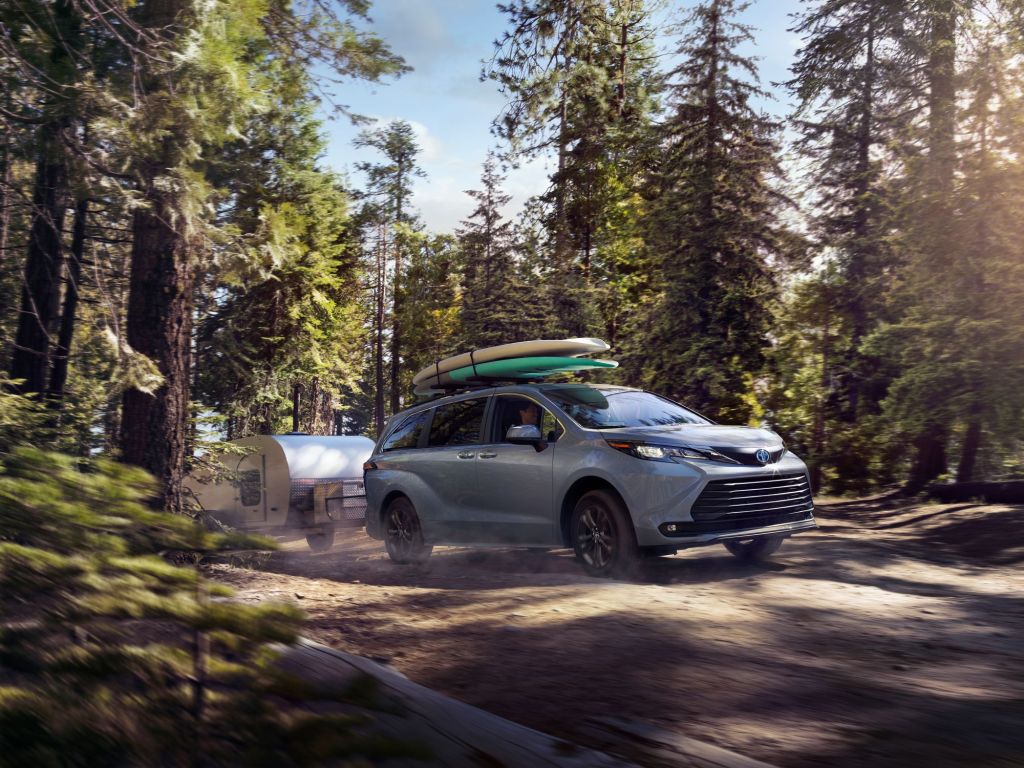
Toyota Sienna Woodland: yes, you don’t need an SUV to do things like this. (Image: Toyota)

And if that isn’t enough and you need to pack a U-Haul trailer, the Sienna offers 3,500 pounds of towing capacity.

Or what about people?

Depending on the seating configuration selected, it is either seven or eight people.

And the thing to know about that is that these people are all going to feel comfortable, not as though they are occupants of the proverbial sardine can.

The functionality of the configuration of the minivan’s architecture is simply more package-efficient than an SUV (or sedan, for that matter).

“Oh, but a minivan isn’t stylish,” comes the knee-jerk reaction.

It’s not like the people at Toyota’s Calty design studio in Newport Beach aren’t aware of that objection, so they’ve added style to the substance of the vehicle.

One of the notable characteristics of the Sienna is that it is now, in all trim levels and packages, a hybrid. There is a 189-hp four-cylinder engine. There is an electric motor up front. And in the AWD version (yes, AWD—just like in some SUVs!), another in the rear.

All told the propulsion system provides 245 hp.

But the impressive part of this is that on the AWD model, like the one driven here, the combined city/highway fuel economy is 35 mpg.

And the beauty of that is that with the 18-gallon tank you can achieve a theoretical 630 miles before you need a fill up, but even if you use 17 gallons to be on the safe side, it is still 595 miles.

If the average American drives 37 miles per day, then the Sienna can be driven for more than two weeks without visiting a gas station. And once there, only regular gas is required.

I drove the Sienna from Detroit to Traverse City (255 miles) and back, putting on freeway miles as well as slow city miles (Traverse City is increasingly popular). And I got the 35 mpg without a problem and it was in the Normal mode throughout (there are also Eco, Sport and EV modes, with the first eking out all the energy it can, so this is a bit on the slow side; Sport amps things up, but let’s face it: this is a minivan; EV is a short spurt of low-speed all-electric driving: this isn’t a plug-in hybrid).

The Woodland trim driven here includes a smidge more ground clearance (it is 6.9 inches rather than the 6.3 inches of other trims).  There are 18-inch six-spoke dark wheels and black roof rails on the outside. There are themed floor mats and things like a 12-speaker JBL audio system on the inside.

And there is an abundance of the types of things one would expect on a vehicle that you’re going to be spending plenty of time in (from the 12.3-inch screen to wireless Apple CarPlay and Android Auto; four-zone climate control), as well as things that add to the overall utility (e.g., being able to open the sliding doors by putting your foot beneath it is a nice function). Of course, there is an array of safety tech bundled into Toyota Safety Sense 2.0 (pre-collision system with pedestrian detection, lane departure alert with steering assist, lane tracing assist, etc.).

If there is any stigma associated with the Sienna minivan it is one of simply being smart. Which isn’t a bad thing.

The Tercel did the job for me. The Sienna could certainly do it for those who are looking for efficiency, capability, capacity, and, yes, soupçon of style.

VW 2025 ID. Buzz Pro S Plus

This is a vehicle that more people than you might imagine have been waiting for—even if they didn’t know it. . .

By Gary S. Vasilash

GeekWire is unique among technology and business news sites, in that we look at the world through the lens of Seattle and the Pacific Northwest, where we’re based.” So the outlet describes itself.

The site has an “intense global interest in technology, ideas and innovation emerging from our backyard. Our motto is, ‘What happens here matters everywhere.’ Microsoft and Amazon are classic examples, but countless startups, research organizations, educational institutions and others based in the Seattle region also have an outsized impact on the world.”

So while the coverage is generally about the tech and the people related to Microsoft, Amazon and an array of outfits and organizations that you’re likely not to have heard of unless you are deep in the digital tech space, it also covers other things on occasion.

Like the Seattle Auto Show.

And its story on the event opens:

“As I pulled away from the Seattle International Auto Show on Thursday during a test drive of the highly anticipated Volkswagen ‘ID. Buzz’ electric van, a driver in a Tesla Cybertruck offered a thumbs up.

“It was all the confirmation I needed that the Buzz was going to be the buzzworthy vehicle at the annual show at Lumen Field Event Center.”

Yes, it is the type of vehicle that gets love whether it is in Seattle or Detroit.

Cost Consideration?

Which is absolutely appropriate for the rebirth of the VW Microbus: while in its heyday in the 1960s the Microbus was largely associated San Francisco scene, this new EV is somehow more appropriate for places like Seattle than Silicon Valley, south of San Francisco. That is, there is an income-based accessibility to the ID. Buzz, with a starting MSRP of $59,995, which is more in line with the median household income in Seattle ($129,715) than Silicon Valley ($146,143): the former probably is more concerned with sticker prices than the latter.

However, given that the median household income in the U.S. is more along the lines of $78,046, the ID. Buzz may not be for every household budget—but that won’t matter. Those who can probably will.

VW Germany Builds. U.S. Will Buy

At least for the first couple years every ID. Buzz available in the U.S. (it is built in a VW plant in Hannover and has been available in the Europe market since the latter half of 2022) will be purchased. People are drawn to the vehicle in a way few other vehicles of any configuration command.

And not just the type of people who read GeekWire.

It looks familiar. And fresh. Quite a feat. (Image: VW)

Of all of the vehicles I have driven in the past few years the ID. Buzz has had considerably more attention than any other.

Lots of Love

A 20-something HVAC technician who came to check my furnace, who says he’s thinking about buying an Accord: “That is really a cool vehicle.”

My 30-something Alfa Giulia Quadrifoglio-driving next-door neighbor: “I LOVE it!”

A 60-something man who walked over to the ID. Buzz when I was in a Barnes & Noble parking lot: “I remember the Microbus from when I was young. This is quite nice.”

And there were many others who were walking by who stopped and stared and drivers giving me a thumb’s up when I cruised by.

The thing is, none of the people that I talked with about the ID. Buzz brought up the fact that it is an electric vehicle. They didn’t care whether it was based on the MEB platform, which is meaningless to them. They didn’t know if it was a rear-drive vehicle (the one in question is) or whether there is a low center of gravity by having the 91-kWh lithium-ion battery located beneath the floor.

They weren’t overthinking it.

They simply thought it looks great.

And evidently VW found that design is the #1 reason why people are interested in it.

The Definition of “Capacious”

Of course, if you’re going to buy something like the ID. Buzz, you’re probably going to be interested in its cargo capacity, whether that’s in the context of having three rows of seats for people (depending on the types of seats selected, it handles six or seven people, and there is considerable third row legroom: 42 inches, which is 10 inches more than that offered in the roomy Kia EV9) or a whopping 146 cubic-feet of cargo capacity—and I use the word “whopping” advisedly: its capacity bests the Chevy Suburban—which is 2.6 feet longer (the ID. Buzz is 195 inches; the Suburban 226 inches)—by one cubic foot, and on more of an apples-to-apples comparison, it bests the Chrysler Pacifica PHEV minivan by five cubic feet (about the size of an average microwave oven).

(However, a word about cargo capacity. The aforementioned 282-hp electric motor that provides rear-wheel drive isn’t located in the front of the vehicle with a drive shaft traveling back to the rear axle, as would be the case of a vehicle with an internal combustion engine up front, but it is in the rear of the vehicle, below the location of the third row. So while other minivans provide more manipulation of the third row because they’re not restricted by a motor, to get the maximum cargo capacity from the ID. Buzz the third row needs to be removed, not exactly the sort of thing you’d want to do on a regular basis. Still, the second and third rows do fold flat. It is just that the third row can’t go into the floor, like the “Magic Seat” in the Honda Odyssey.)

Because this is an EV, the range must be stated: the rear-drive ID. Buzz provides a range of an estimated 234 miles. And to put that into context, according to the EPA, the 2025 Kia EV9 Standard Range RWD has a range of 230 miles, so the ID. Buzz is certainly in the mix.

Final Thought

The VW ID. Buzz has something most vehicles nowadays lack: Character.

That’s what its predecessor had, which explains why there is a resonance—even for those who may not be aware of it—that carries on in this reimagining.

The Return of the Minivan?

By Gary S. Vasilash

Since the start of the contemporary minivan with the Chrysler Voyager, Dodge Caravan and the Plymouth Voyager in November 1983, that type of vehicle has had its ups and downs in the market. Mainly downs after the notion that it was a vehicle for “soccer moms.” One can imagine that when that meme was established Landon Donovan’s or Mia Hamm’s mothers probably didn’t want to be seen in one.

But from a packaging point of view, it is hard to think of anything better than the configuration of the minivan.

Perhaps the forthcoming VW ID.Buzz electric minivan will change the perceptions of what a minivan is.

In other parts of the world, there is nothing diminutive (i.e., “mini”) about the boxy vehicles (no matter what aero effects are deployed, let’s admit it: these are shaped more like shoeboxes than Stingrays).

Elsewhere they are called “MPVs,” or “multi-purpose vehicles.”

The purposes seem to be carrying people and stuff, so there isn’t a whole lot of multi about them.

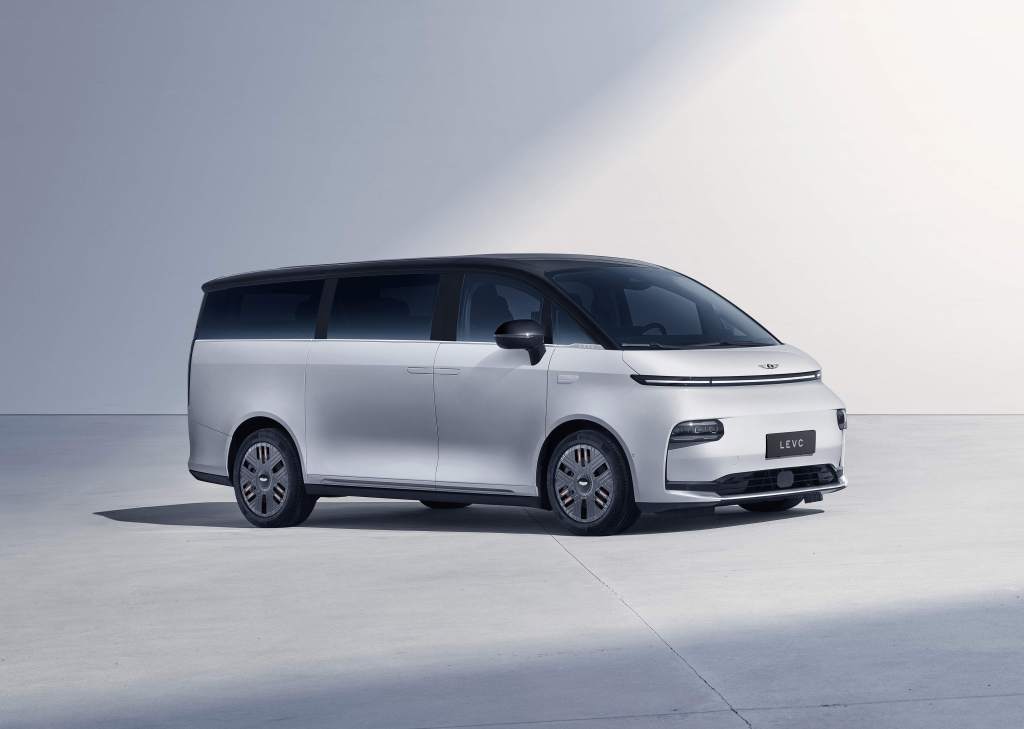
The L380, electric MPV. (Image: LEVC)

LEVC—the London Electric Vehicle Company, the firm that produces the TX, the hybrid-electric (it has a range extender) black cab that is rolling through the streets of London and elsewhere—is extending its transport offerings by putting into pilot production in a plant in Yiwu, China, the L380, a fully electric MPV.

Alex Nan, LEVC CEO, described the vehicle as “the next step forward in the company’s globalization strategy, as we rapidly accelerate our transition from manufacturing the world’s most advanced and iconic taxi, to becoming a leading e-mobility technology company.”

LEVC is a Geely Holding Group company. Which means it is related to Volvo and Polestar, Lotus and Lynk & Co., and others.

The L380 is based on the Geely Space Oriented Architecture (SOA), which is an underpinning that can be deployed for lots of vehicles, including those that aren’t vans.

The L380 will initially launch in China and then is expected to be delivered into the U.K. in about two years.

After that. . . ?

Will Minivans Make It Once Again?

By Gary S. Vasilash

One of the things that isn’t often cited with regard to the forthcoming VW ID. Buzz is that it is a minivan. Yes, an electric minivan. But nonetheless the type of vehicle that has more than its share of people who say they’d never be caught driving one.

In the U.S. market, the brand that really brought the minivan to the market back in 1983, Chrysler, is still there with the Pacifica. There is a plug-in hybrid option available for the Pacifica.

Toyota has the Sienna as a hybrid-only minivan.

And there are the Honda Odyssey and the Kia Carnival, although these are ICE-only (for now, anyway).

Which brings us to what they’re calling an “MVP,” or “multi-purpose vehicle,” but which one glance at its configuration says “minivan”: the Volvo EM90.

Volvo EM90: A minivan by any other name is still. . .a minivan. (Image: Volvo)

Volvo describes it as having an interior design that makes it “your living room on the move.”

For years (hard to imagine that the architecture is 40 years on) minivans have always had the most versatile and capacious interiors among light vehicles.

Will electrification make them more appealing to customers such that people will be boastful, not sheepish, about that comparatively boxy three-row vehicle in the driveway?

One thing about the Volvo EM90, however.

It is being launched in China and there has been no announcement it is going to be available elsewhere.

Perhaps if the ID. Buzz becomes a hit in the U.S. market Volvo may offer the EM90 there, as well.

Perhaps.