
Plenty of ICE

While “ICE vehicle” sales may decline, this doesn’t mean the number of engines necessarily is going down

By Gary S. Vasilash

It seems that when people think about types of vehicles there are:

  • Electric vehicles
  • Hybrid vehicles
  • Plug-in hybrid vehicles
  • ICE vehicles

The categorization seems to overlook one big thing:

With the exception of the EVs, all of the other types include an internal combustion engine.

So when you hear that hybrids are up, this means ICE vehicles are up.

In providing his assessment of the vehicle market in Western Europe, Matthias Schmidt noted:

“12-month trailing data shows that new models featuring an internal combustion engine under the bonnet, be that a pure ICE petrol or diesel model, a mild (MHEV) or full (HEV) hybrid, or plug-in hybrid (PHEV), saw their combined share of the new car market rise upwards once again.”

He also pointed out that EVs have been losing their spark in the Western European market, with, through May, three months of decline in a row.

According to Schmidt, “the most recent 12-month period data shows that between June 2023 and May 2024, the number of BEVs fell back to 1.97 million new units compared to 9.8 million other models.”

Other models that burn liquid fuel.
EVs in Europe (The Brits Like Them)

The populations of Germany, the U.K. and France are 83.26 million, 67.96 million and 64.86 million, respectively.

So when it comes to the purchase of EVs in those three countries, it might seem to be the case that they’d rank in that order.

Not so.

Schmidt Automotive Research has found that the U.K. is led EV acquisition in Q1 2024 for the first time ever.

The Q1 numbers for EV sales are:

  • U.K.: 84,314
  • Germany: 81,337
  • France: 79,823

This means EVs represent 15.5% of the U.K. new car market.

And in the U.S. in Q1 2024?

EVs represented 7.15% of the new car market, less than half the take in the U.K.

And demographically, the population of the U.S. is 341.81 million, or 125.73 million more people than the Germany, the U.K. and France combined.

Chinese Cars in Europe

By Gary S. Vasilash

Although some people are on pins and needles and potential massive tariffs regarding Chinese vehicles coming to America, in Europe, where there is active concern on behalf of some of the OEMs on that subject, things are really not all that whelming, over- or otherwise. At least not yet.

According to Schmidt Automotive Research, during January and February, the shares of the Western European market are:

  • 13.3% Japanese OEMs
  • 7.8% Korean OEMs
  • 2.9% Chinese OEMs

However. . .

When looked at from the point of battery electric vehicles, the “Chinese model volumes combined share was 3x as large.”

So clearly Chinese OEMs are gaining some traction in the Western European market when it comes to that tech.

One interesting aspect of the penetration of Chinese vehicles of all powertrain types there is which country is most interested in acquiring them:

Italy.

Of the ~52,000 Chinese vehicles sold during the first two months, Italy took some 12,000 of them.

Which probably doesn’t make the folks at Fiat feel good.

Western Europe, China and EVs

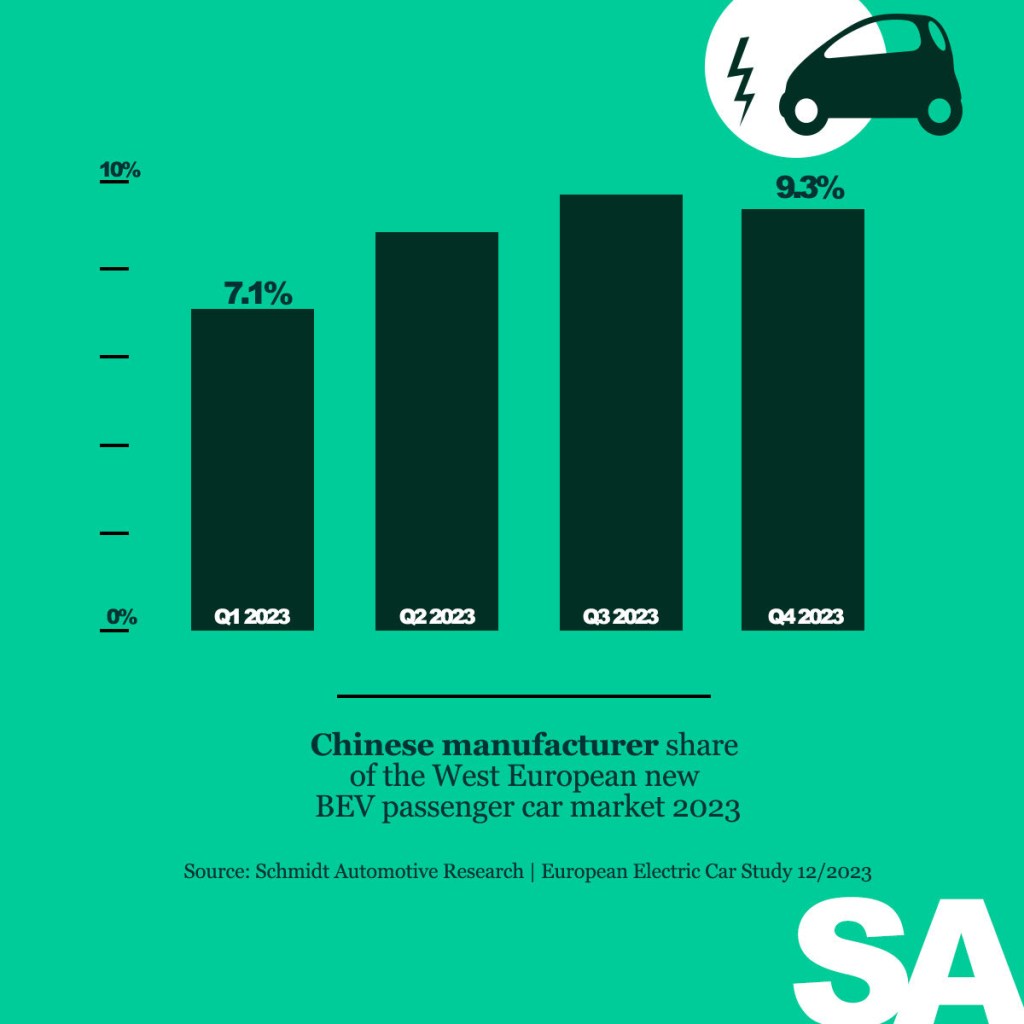
Although there was a seeming step-by-step, vehicle-by-vehicle increase in the under of Chinese battery electric vehicles registered in Western Europe last year, there was a bit of a stumble at the end, and Schmidt Automotive Research wonders whether there will be a cap of under 10% of the EV market in Western Europe for the Sino mobiles.

(Image: Schmidt Automotive Research)

As the chart shows, there was a noticeable decline in registrations in Q4. . .but then there are some reasons why this could be the case, including the increase in the amount of time it takes to ship vehicles from China to Europe while avoiding the Red Sea.

But the Schmidt study also points out some brands are offering discounts of up to €12,000, so you’d imagine that European consumers would be most interested in savings like that. . .especially as there may be higher import tariffs applied to Chinese vehicles coming into Europe this year.

Still, the fact that the Chinese OEMs have managed to gain that much of the European market in a comparatively short period of time says something about the appeal of their products.

What’s the Real EV Demand?

(A Look at Western Europe)

By Gary S. Vasilash

Although Western European vehicle buyers have consistently been more bullish on buying electric vehicles, even there things are beginning to shift according to analysis by Schmidt Automotive Research.

According to its “European Electric Car Study,” there were 1.96 million battery electric vehicles sold in the West Europe region in 2023, a 28% year-over-year improvement, which means 16.9% of the total automotive market.

But it could it have better, as there was a 25% decline in December 2023 compared with the final month of 2022, which resulted in a decline for 5% for Q4 ’23 compared with ’22.

One of the reasons for the decline: “various purchase subsidies and lower tax incentives being stripped away.”

Looking ahead into 2024, Schmidt Automotive predicts:

“Auto executives will need to wrap up and buckle up as the market begins to see a chill easterly wind arrive, with discounting expected to be the keyword of the year, accompanied by protectionism to defend against an increasingly aggressive attack from Chinese manufacturers, as states hope to buy some time for key regional employers giving them space to restructure their business and become more competitive in the new e-mobility age.”

So let’s break this down:

  1. EV demand fell as consumer subsidies and tax incentives declined
  2. Discounting will be the condition this year, which means an advantage for the consumer and bad news for the manufacturers

The Chinese manufacturers are providing inexpensive products. Yes, they happen to be EVs, but would low-cost ICE vehicles be any less appealing?

At some point the “free money” for EVs is no longer going to be available.

Which leads to a question of what the real demand for the vehicles is.

Perhaps not as much as some OEM execs would like to think.