
Crown is taking the place of other Toyota nameplates and is doing a good job at doing so. . .
By Gary S. Vasilash
There are probably more people who are familiar with the Roxy Music album of the same name than the Avalon, Toyota’s former top-of-the-line sedan in the U.S. market.
Which is a shame because the Avalon, which was introduced in model year 1995 and had a five-generation run until it became unavailable in the U.S. market, was, year in and year out, generation after generation, a fine automobile.
Perhaps a problem for the flagship that it was simply eclipsed by the Toyota Camry which, year in and year out, generation after generation (it is now the ninth), simply sold in tremendous numbers.
Someone would walk into a Toyota dealership and likely drive out in a Camry because it probably took little in the way of convincing. But for another car that cost a few thousand more, nice as it was, the persuasion would have been more challenging. So if you were a commissioned salesperson, wouldn’t you take the path of least resistance? (It has been the best-selling sedan in the U.S. for 22 years running, and this year it will likely notch 23.)
The product planners at Toyota know they need to have something at the top of the line. Something that isn’t the Camry XSE AWD (the highest trim level of the eight available).
For model year 2023 Toyota introduced the Crown to the U.S. market, the top-of-the-line that was the Avalon replacement.
Initially the Crown was positioned as a sort-of hybrid crossover, with the “sort-of” predicated on what it called a “lift-up” design.
As Toyota put it: “Crown has a raised overall height that’s nearly four inches higher than Camry. The unique height of this sedan offers increased road visibility, along with easy entry and exit.”
But sort-of isn’t enough.
So for model year 2025 Toyota is adding the Crown Signia to it lineup. This vehicle is categorized as an SUV.
And just as the Crown replaced the Avalon, the Signia Crown replaces the second-generation (the all-hybrid one that had a run from model years 2021 to 2024) Venza.
Clearly the “Crown” moniker, which has been a fixture in the Toyota Japan lineup since it went into production in 1955, is taking its place in the U.S. market in a notable way.
The Crown Signia is quite an impressive vehicle.
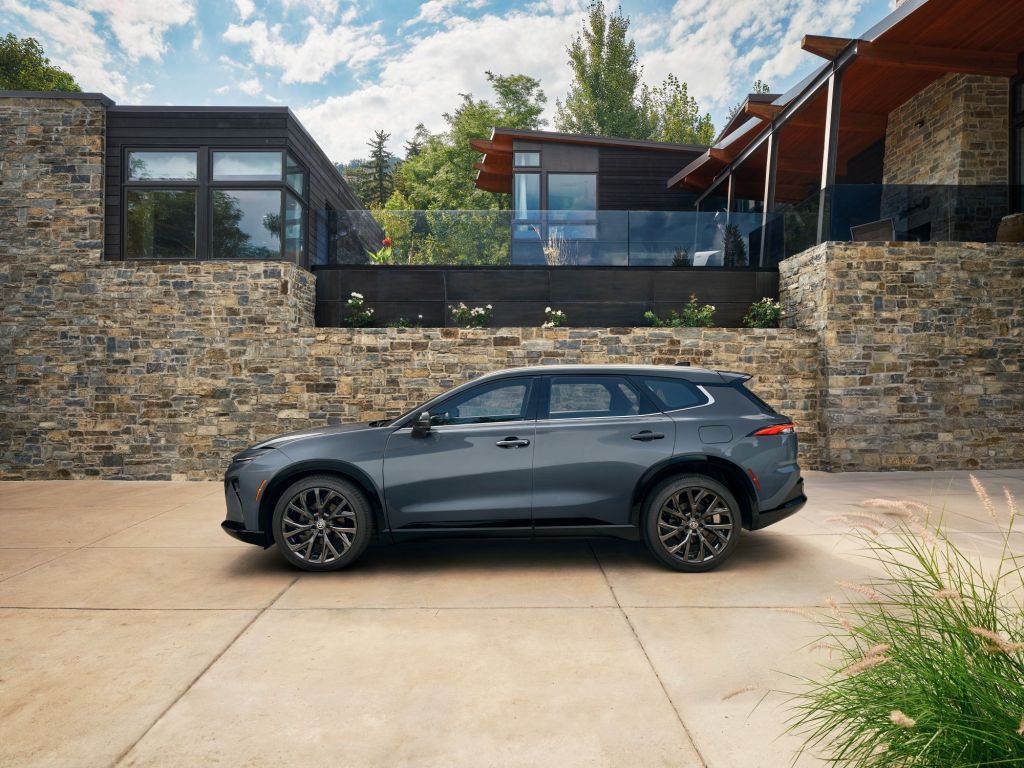
No, this is not because its hybrid powertrain’s 240 combined net horsepower (188 hp from the four-cylinder engines and the balance from its 134 kW front and 40 kW rear permanent magnet synchronous electric motors) or from its standard electronic on-demand all-wheel drive (it works when it needs to; the driver need not engage buttons or knobs or tap a selection of the 12.3-inch infotainment screen).
It’s not because it has the capability of towing 2,700 pounds or, with the second row seats folded, a 6.5-foot long cargo area.
It is because it is clear that the level of attention to detail executed in both the exterior and interior designs bring to mind the style and sophistication that had been characteristic of the Avalon.
For example, the leather-trimmed seats that are in the Limited grade have double-stitching, quilting and fillet piping. While leather seats can provoke a shrug, it is the fact that there is the double-stitching, quilting and fillet piping that takes them to a level that is not characteristic of an offering from a mass-market brand.
The vehicle as-driven has an MSRP of $51,799. That’s $47,990 for the vehicle and the remainder for the options. (There is also an addition of $1,450 on top of the $51,799 for delivery and handling.)
The options include things like premium paint ($425) and mudguards ($155). The biggest one if the advanced technology package ($1,865), which includes things like various sensors and monitors and associated functions.
So it comes to $53,249, certainly a reasonable sticker for what is a premium hybrid.

 shinymetalboxes