
Toyota’s continuous improvement ethos means that it does mess with success—it makes it better
By Gary S. Vasilash
The first Toyota hybrid, the Prius, was introduced in the US market in 2000.
In terms of chronological time, that’s a quarter century of putting electrified vehicles on the road.
Initially that road was somewhat bumpy as while that first-gen model had some serious fans, as is the case with anything with fans, there were those who weren’t supporters. There was all sorts of grumbling about how inefficient it is to have two propulsion systems and how that was something that Toyota simply could not do. (Many of these people were the same ones who grumbled about a decade before, when Lexus was introduced: it was impossible for the LS 400 to exist with a starting price of about $35,000—Detroit had years and years of Cadillacs and Lincolns so they knew that was the case.)
But Toyota continued with the Prius, generation after generation, and in addition it began putting hybrids into other models in the Toyota showroom (as well as the Lexus facilities).
And it made a tremendous statement with the model year 2025 Camry, offering it only as a hybrid. Consider: it has been the best-selling car in the US for decades (with 2025 sales it has held the crown for 24 consecutive years) and Toyota had sufficient confidence in not only the hybrid tech but the market acceptance to make that switch.
Although Toyota sells a lot of Camrys—through the third quarter of 2025, 234,426—it sells a tremendous number of RAV4 crossovers:
Through Q3 2025: 358,134.
To put that in perspective, the combined sales through Q3 of the Ford Bronco Sport (103,261), Escape (114,728), and Bronco (109,921) are fewer than the RAV4 sales: 327,910.
Or the number of Chevy Equinoxes sold through Q3 (203,583) can be added to the Ford Escape sales during the same period (114,728), and that sum, 318,311, is 39,823 units shy of the RAV4 sales.
All of which is to say that the RAV4 is an awfully popular vehicle.
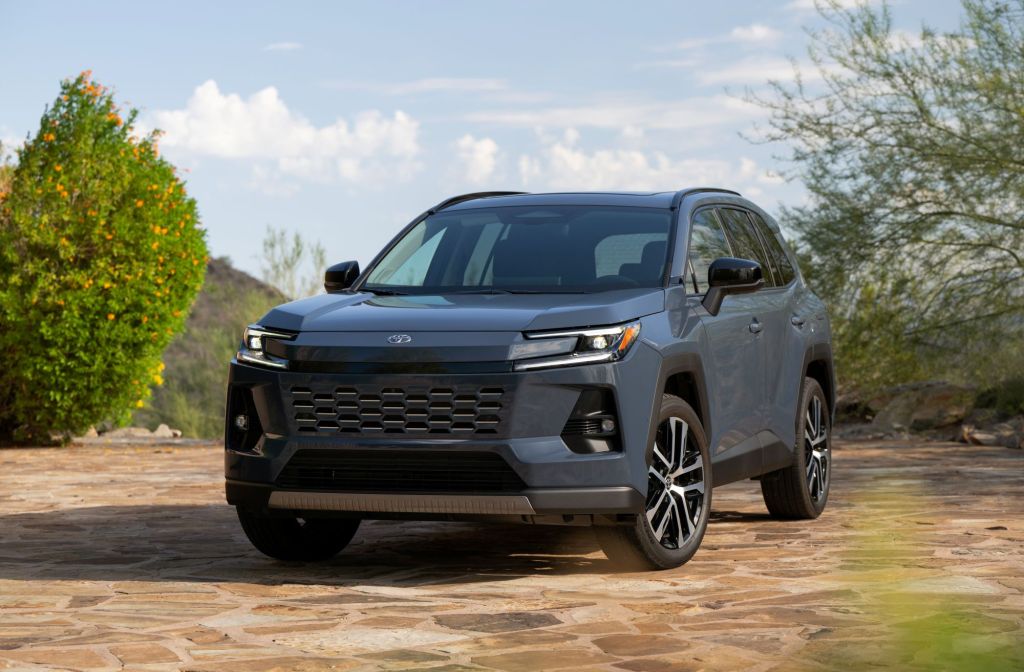
So what did Toyota do for the sixth-generation, all-new 2026 RAV4?
It decided every model on offer—LE, XLE Premium, Limited, Woodland, SE, XSE, GR SPORT—is powered by a hybrid system: a 183-hp four that is supplemented by electric motor(s) such that in front-drive setups there is a total 226 hp and for AWD 236 hp.*
Those models fit in three categories: “Core,” “Rugged” and “Sport.” The Woodland is the “Rugged,” the SE, XSE and GR SPORT are the “Sport,” and the remaining are “Core.”
While it might be imagined that the “Core” models, like the Limited driven for this, would be less visually rugged than, say, the Woodland, on a macro view, the exterior design of the RAV4 is more truck-like than, say, the fourth-generation RAV4—which was the first to offer a hybrid (model year 2016).
All of the 2026 models have a chiseled look.
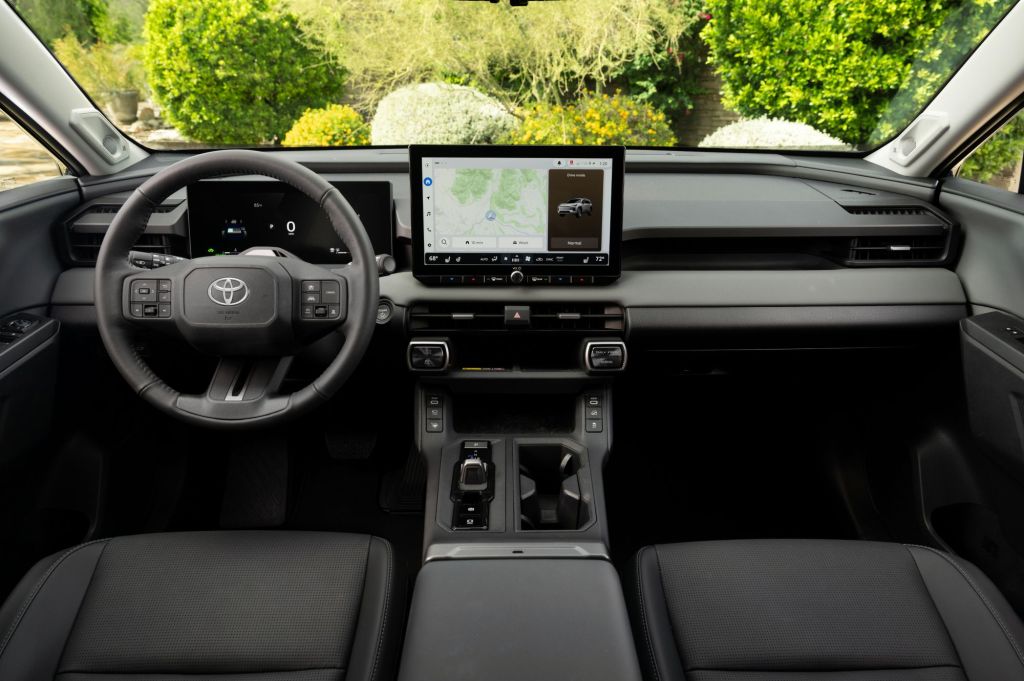
And that chiseled approach carries into the cabin. While there is an extensive use of polymer-based materials (e.g., while the heated steering wheel is leather-trimmed and the armrests are, too, the front seats are heated and ventilated SofTex, a synthetic leather), the execution is such that it doesn’t look “plasticky,” but the materials are used to their advantage so they look and feel (i.e., there are soft-touch surfaces were one is likely to touch) appropriate.
One nice touch is a slot in the instrument panel that contains two Qi-compatible wireless charging surfaces so the driver and the passenger each have one. (There are also two 45-W USB C ports in the front, as well as a center console media USB-C port, and two 15-W USB-C charging ports in the rear.)
There is a 12.9-inch infotainment screen that runs the Toyota Audio Multimedia system developed by Toyota’s Plano, Texas-based Connected Technology team.
There is also a 12.3-inch LCD-based digital gauge cluster. (The Limited trim comes with a head-up display, too.)
Yes, there are buttons for a variety of functions, like for the front defroster (something necessary to get to quickly on a Michigan winter morning), and a (smallish) knob for the audio.
The vehicle provides 98.9 cubic feet of passenger room and 70.4 cubic feet (second row folded) for cargo.
Which brings me back to the hybrid powertrain.
In this AWD model the fuel economy numbers are 44 mpg city, 39 mpg highway, and 42 mpg combined. Which is certainly nice. (As electric vehicles are always touting range, here’s something to consider: the RAV4 has a 14.5-gallon gas tank. If you drove it to empty, based on the combined range you’d go 609 miles. Yes, there are emissions involved. But fewer than if you were to drive a non-hybrid to empty.)
But the thing is, the fifth-generation Toyota Hybrid System used in the RAV4 is transparent. It just works.
Were I to be working in a dealership I might skip using the word “hybrid” and just say, “This RAV4 gets great gas mileage on regular fuel” and leave it at that.
One of the reasons the original Prius had some problems was because people wanted to know where you plugged it in. (“What do you mean it just uses gas? How do those motor-generator things get power?”)
I suspect there are more than a few people who stay away from hybrids because they can’t figure out how they work. (“Will I be stranded on the side of the road when the battery runs down?”)
So leave it at: this is a powertrain that Toyota has spent 25 years working on and it just works.
With the RAV4 it is wrapped in a nice package. Period.
*There is also a plug-in hybrid RAV4, which has a combined output of 324 hp.



 shinymetalboxes