2026 Volkswagen Jetta SEL

A solid offering in a tough category. But let’s not get carried away. . . .

By Gary S. Vasilash

According to the official Volkswagen site for consumers, the 2026 Jetta is “The compact sedan that redefines the standard.”

Well, let’s face it: that’s verbiage that came out of an advertising agency that is tasked with talking big about its clients products.

Arguably, in the compact car segment the definitional products are the Honda Civic and the Toyota Corolla.

Consider: in the first three quarters of 2025 there were 185,225 Civics sold in the U.S. and 179,983 Corollas. Yes, there are hatches among them, but still.

During the same period there were 43,610 Jettas sold.

It would be hard to redefine something with that.

Which is not to say that the Jetta is not a car worth consideration. It is a good-looking, capable compact that is competing in a tough segment (obviously).

In fact, there is something to be said for zigging while everyone else in the market is zagging.

If you go Jetta, you’re likely to be standing out wherever you drive.

VW Jetta: a competitor in a tough category. (Image: VW)

The 2026 Jetta is a seventh-generation vehicle, so there’s experience there, especially with the MQB architecture that the car is based on. All you really need to know about that is that it “feels” like a solid vehicle.

It is 186.5 inches long, 70.8 inches wide and 57.7 inches tall; the wheelbase is 105.7 inches. The Jetta offers 94.7 cubic feet of passenger volume and 14.1 cubic feet of trunk capacity.

It is powered by a 158-hp turbocharged inline four-cylinder engine that is mated to an eight-speed automatic transmission. It is a front-wheel-drive vehicle.

That eight-speed, it must be noted, is a differentiator between the Jetta and the Civic and the Corolla, as those two vehicles have a continuously variable transmission (CVT). Some people like the “feel” of a step-gear transmission more than a CVT, so that is a consideration that should be made.

It has EPA-estimated fuel-economy ratings of 29 mpg city, 40 mpg highway, and 33 mpg combined, which puts it right in the ballpark with the Civic and the Corolla.

The SEL trim driven here has a number of features, including 18-inch alloy wheels, heated and cooled front seats (heated in the rear outboard positions), leather seating surfaces, heated steering wheel, navigation, premium audio, and a sunroof.

One of the features it has that I certainly wish it didn’t is capacitive-touch “buttons.” This is the sort of thing you have on your smartphone: you simply touch a specific area to activate something rather than using a physical button, dial or switch. While this works well on your phone because odds are you are (assuming that you are a good driver, not a scoff-law) standing, sitting or maybe walking while you are doing something with your phone, not traveling at 70 mph as you may be in your Jetta while you are trying to adjust the temperature. (There are buttons and rockers on the steering wheel for a few functions.)

The base MSRP for the 2026 Jetta SEL is $30,450. There is a $1,275 destination charge.

A key consideration, of course, comes down to whether a German marque is more interesting than a Japanese—or Korean: we can’t forget the Hyundai Elantra and the Kia K4, both of which are gamers in the category.

2026 Volkswagen Tiguan SEL R-Line Turbo

This is where things become interesting for this oft-overlooked crossover. . . .

By Gary S. Vasilash

Volkswagen has had a Tiguan on offer in the U.S. market since model year 2009. It is now on its third generation of the compact crossover.

The first two generations—model years 2009 to 2017 then 2018 to 2024—were OK vehicles in a segment where the likes of the Toyota RAV4 and the Honda CR-V reside. That means OK is, well, not enough. The second gen vehicle was built all over the place—from Germany to Indonesia, from Algeria to India, yet in the U.S. it was something of a shrug.

That is, if we look at the total sales in the U.S. for the Tiguan for 2024 (gen two), it is 94,372 (and that made it the best-selling VW model overall in the U.S. for that year). Meanwhile, over at Toyota, there were 475,193 RAV4s sold.

And if it seems unfair to compare it with the top-seller in the segment (although it should be noted that on a global basis, Volkswagen is just a smidge behind Toyota in production volume, so it is actually fair; in addition to which, the third-largest global player is Hyundai, and in the U.S. market in 2024 its Tucson had sales of 206,126), that’s the segment in which it competes, so it is up against seriously stiff competition.

And Now This. . .

And with the third gen, and the R-Line Turbo model in particular, VW has a Tiguan that people who are looking for a compact crossover simply need to consider.

I won’t predict huge sales for the Tiguan (an unfortunate circumstance is that the models sold in the U.S. are built in the VW plant in Puebla, Mexico, and as such are hit with a 25% tariff), but it is, unlike its predecessors, a more serious player and if you’re going to be offering something in this highly competitive segment, it needs to be serious because otherwise it will be merely interesting.

When I mentioned to a friend that I was driving a Tiguan, he immediately responded, “The turbocharged one with 268 hp?!?”

Yes, that one.

That is a surprising level of awareness, and if it goes out to the general public, it should do good things.

A word about that performance: the standard engine provides 201 horsepower, which is a bit below the 2025 RAV4, which delivers 203 hp, but a considerable amount more than the 187 hp for the Tucson.

Improved Engine

The Tiguan is powered by the company’s venerable (it was originally launched in 2006) EA888 2.0-liter engine that has, to borrow a Toyota term, been the object of “continuous improvement” over the years. Now it is the Evo5, which brings with it plenty of improvements, notably the variable geometry turbo and a 500-bar fuel pressure system. The turbo, of course, handles the exhaust while the higher fuel pressure system (they are typically 350 bar) helps with the fuel injection into the combustion chamber (it provides smaller droplets of fuel that facilitate a better air-fuel mixture which means better combustion for both performance and fuel efficiency).

The VW Tiguan SEL R-Line Turbo: improved exterior and exterior styling and performance that is notable. (Image: Volkswagen of America)

An addition word about the turbo. Chances are the sticker on the fuel door of a vehicle with a turbocharged engine will say that premium fuel is “Recommended.” Sometimes it is “Required.” Premium generally runs about $1 per gallon more than regular. While that might not be a big deal for someone who is driving, say, an Audi or a Lexus, for many people that buy vehicles in this category it is.

Regular fuel is Recommended for the Tiguan. Yes, even the turbocharged version. Often putting regular into a turbocharged engine results in reduced output. That’s not the case with the EA888 Evo5: that 268 hp is what you get with regular unleaded.

And while of the subject of gasoline, the vehicle is stickered at 22 mpg city/29 mpg highway/25 mpg combined, with the combined number being accurate during my time with the vehicle.

There is an eight-speed automatic and VW’s 4Motion all-wheel drive system.

(Here’s something clever–and surprising: that combined mpg number for the turbo AWD Tiguan is the same as the 25 mpg combined number for the standard version with AWD. No fuel sacrifice for improved performance.)

Size and Screens

A few more numbers: it has a passenger volume of 101 cubic feet—so it can seat five—and a cargo volume behind the second row of 27 cubic feet; with the seat folded, 59 cubic feet—so you can transport stuff.

There are a 15-inch infotainment screen and a 10.25-inch reconfigurable gauge cluster. A word about that infotainment screen. The graphics have a fresh, clean look.

On the subject of fresh and clean, the vehicle as driven has a “Mistral” leather interior package that is light colored and even has American walnut trim. Often interiors of German cars seem as though the inspiration came from the Black Forest. Not this one, which is a definitive plus.

Solid Offering

But then there’s that issue of being a “German” vehicle.

It has long seemed to me that the characteristic that is most prevalent in German products—vehicular or otherwise—is that they have a lot of serious mechanical engineering behind them. Robust. Solid. (One could argue that this is not merely a stereotype given VW’s contract with Rivian to source Rivian’s electrical architecture and software stack.)

One of the things that I discerned in this third-generation Tiguan that I would comparatively lacking in even recent iterations of gen two is that this solidity is back, that when you shut the door there is a “thunk” indicating substance.

There are lots of things to like about this Tiguan, from its quickness to the puddle lamp and front light illumination when you near the vehicle at night.

But that solidity. That’s something that sets it apart from that array of other compact crossovers.

This makes a big difference.

2025 Volkswagen Atlas Cross Sport SEL Premium R-Line

Who knew this is being built in Tennessee?

By Gary S. Vasilash

“This vehicle will be a real American – large, attractive and with many high-tech features on board. Above all, the midsize SUV will be made by real Americans.

“From 2016, this vehicle will roll off production line at the Chattanooga plant – as second core model in addition to the Passat.

“This major decision was taken by the Board of Directors of Volkswagen Group of America last Friday.

“So: Our midsize SUV will be a car “made in Chattanooga”!

“A car ‘made in the US’!”

While that might sound like something you’d hear someone say nowadays as the tariff situation (there is a 25% tariff on imported vehicles that is based on Section 232 of the Trade Expansion Act of 1962; Section 232 deals with national defense: who knew that things like a midsize SUV would have military implications?), that was actually from July 14, 2014, in a speech by Dr. Martin Winterkorn, who, at the time, was CEO of Volkswagen. (He resigned the following year as a result of the Dieselgate scandal.)

The vehicle he was talking about is the VW Atlas, a seven-seat SUV that went into production late 2016 as a model year 2018 vehicle.

Yes, it was, and is, built in Chattanooga. (The Passat, however, ended production there in 2021.)

The Atlas gave rise to the model year 2020 Atlas Cross Sport. It is a five-passenger vehicle.

And the plant has been cranking out Atlases of both configurations ever since. (In addition to the electric ID.4.)

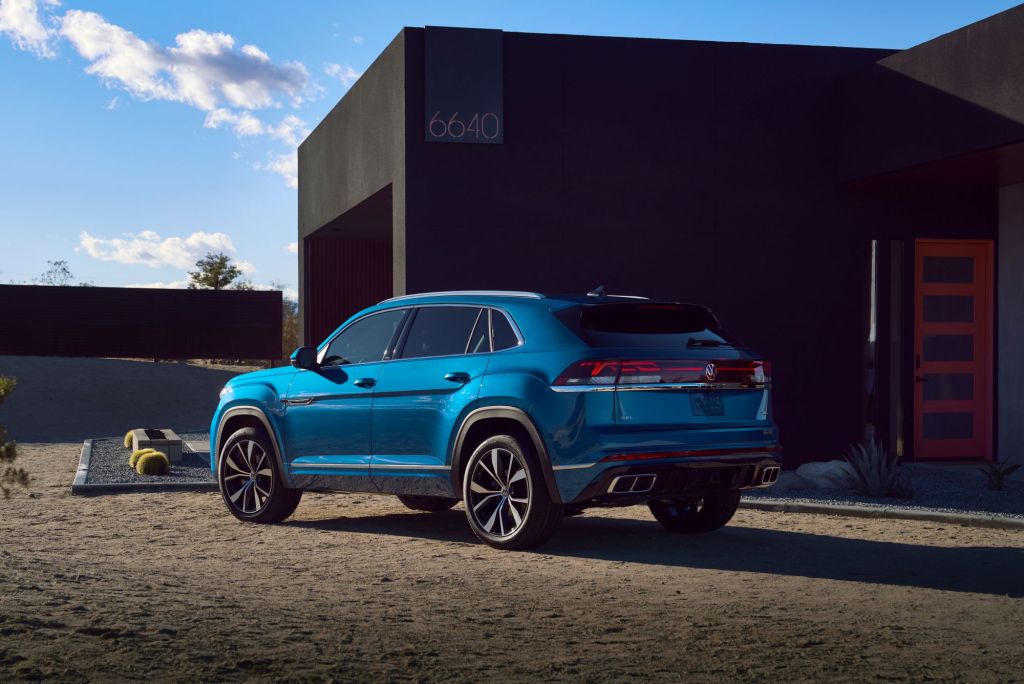
VW Atlas Cross Sport: A sporty utility vehicle. (Image: VW)

A faster roofline and more generous cargo capacity (40.3 cubic feet in the present version with the rear seat ready to accommodate people; in the standard Atlas, with the rear seatback up the cargo is 20.6 cubic feet*, but it should be noted that the Atlas version of the Atlas has a third row, so that explains the delta in space for stuff) are key differences, as are an overall, well, sportier appearance. Like a diffuser on the rear hatch that isn’t found on the Atlas.

Under the Hood

The vehicle is powered by a turbocharged, direct-injected four-cylinder engine, the “Evo4” TSI EA888, mated to an eight-speed automatic. The engine produces 269 hp and 273 lb-ft of torque, which is good for a vehicle that is 195.5 inches long, 78.3 inches wide, 67.8 inches high, has a wheelbase of 117.3 inches and a curb weight of 4,171 pounds. Merging onto a freeway and then driving on it are no problem with the vehicle.

There are sporty stainless-steel pedal caps—but one need not get too carried away thinking that this is a vehicle that will allow you to crush it on a gymkhana course.

The vehicle is EPA rated at 19 mpg city, 26 mpg highway and 21 mpg combined. Helping that is a feature of the 4Moiton with Active Control all-wheel-drive system (not all Cross Sports have this; there is a front-drive version, too).

Inside

On the inside, as this is the top-of-the-line there is good leather seating surfaces. (Lower trims offer leatherette.) The overall execution provides a sense of substance, as one would hope to get from a German car, even if it is one built some 4,600 miles away from Wolfsburg.

There is a 12-inch infotainment display. The Atlas has VW’s App-Connect system, though which things like CarPlay and Android Auto are accessible.

And there is what VW calls the “Digital Cockpit Pro,” a 10.25-inch screen that stands in for the gauge cluster. One advantage of this is that it provides things that are actually useful, like navigation information so the driver can keep eyes forward.

From the points of view of styling, content and powertrain, this is midsize that can hold its own against others in the category.

While there is a bit of a sacrifice to get that style, unless your needs are all about utility (which would then shift a look to the Atlas version of the Atlas), it is worth it.

///

*It is interesting to note that while the seats-in-position cargo capacity of the Cross Sport is about twice that of the regular Atlas, through Q1 2025 the sales of the regular Atlas were about twice that of the Cross Sport: 16,902 to 8,689. Guess people either have more than five passengers on a regular basis or they anticipate that they will so they give up some sportier style for potential utility.

2025 Volkswagen Tiguan SE

This one is really in the game. . .

By Gary S. Vasilash

VW Tiguan: “drive like Somebody.” (Image: VW)

Back in 1959 advertising agency Doyle Dane Bernbach initiated a series of ads for a then largely unknown automotive company, a series of ads that are now legendary.

It was the “Think Small” campaign for Volkswagen. In a time when cars were both enormous and ostentatious a diminutive, rounded vehicle was certainly something that was itself out of the ordinary.

Arguably that “Think Small” campaign did more to establish VW in the minds of Americans more than any campaign for any car line, period.

Although this is something that occurred some 60 years ago, arguably it is a two-edged sword for Volkswagen in America.

That is, the New Beetle hasn’t been available in the U.S. market since 2019. While enthusiasts might say “GTI” when asked to name a Volkswagen model, the average person would likely answer “Bug.”

VW = SUV

But the thing is: Volkswagen in America is largely an SUV brand. In 2024 the company sold 290,824 SUVs and 88,353 cars. (The GTI, incidentally, had total sales of 11,072.)

The Volkswagen Tiguan, a compact SUV, has been available in the U.S. since 2008.

Early on the sales were nothing to write to Wolfsburg about.

And that was the case for several years.

Perhaps one reason was that people “Thought Small” when they thought “Volkswagen,” so even though during the first decade you could get in Tiguan in the U.S. there was also the sizable VW Touareg SUV in the showroom. (It stopped being available in 2018.)

Tough Crowd

But there has been a bigger issue for the Tiguan.

Even though it was VW’s best-selling vehicle in the U.S. last year (94,372 units; the Atlas came in second at 75,516), it faces a phalanx of redoubtable competitors.

As in the Toyota RAV4, the Honda CR-V, the Ford Escape, and many more.

One fairly contemporary model with the Tiguan in the U.S. is the Hyundai Tucson, which first became available in late 2004.

The Tucson will be on its fifth generation later this year.

The third-generation Tiguan has just launched.

The point of this comparison is simply that Hyundai has been aggressively improving the Tucson in order to catch up with some of its competitors in that space.

And with the 2025 Tiguan, Volkswagen has really gotten into the race because this third-generation model is really quite competitive.

It is not like the second generation was bad. But it was the case that the competitive set were generally better.

Gamer

But now the Tiguan is really in this game.

The exterior design is more substantial without being truck-like. The front fascia has a slim lighting signature that sits above a large lower grille that signifies business. There are subtle fender flairs to provide a more-planted stance. Around back the taillamps also have the slim look that is becoming more characteristic of VW design.

Overall, the exterior design is one that doesn’t mimic other vehicles in the class.

Inside the materials seem to be a class-above.

In the late 1980s, early 1990s the craftsmanship of German vehicle interiors were the envy of other OEMs. Either the others got better or the Germans became complacent because the advantage passed.

But with the Tiguan it seems they’re paying attention again.

An issue is that while there is a nice 12.9-inch center infotainment display (it is 15 inches on top-of-range SEL R-Line models), the infotainment interface is less intuitive than in other brands. (Guess this is why you don’t see people walking around with German smartphones.) 

The turbocharged 2.0-liter engine produces 201-hp. It is mated to an eight-speed automatic. The FWD SE model as driven here provides estimated fuel economy numbers of 25 mpg city/32 highway/28 mpg combined. This is a competitive set of numbers as a 2025 FWD Honda CR-V with a turbocharged 1.5-liter engine that produces 190 hp has numbers of 28/34/30 mpg, so a few more horsepower for the VW means a few fewer miles per gallon.

Which brings me back around to positioning.

There is currently a clever TV spot created by agency Johannes Leonardo for the new Tiguan.

The tagline is: “Now anybody can drive like Somebody.”

Which goes to the point that the new Tiguan, which has a starting MSRP of $29,495 (the MSRP for the SE driven here is $32,295) seems much more special yet is accessible.

Which is as true now as “Think Small” was true then.

2025 Volkswagen Golf GTI Autobahn

Quick. And you can feel it. . .

By Gary S. Vasilash

One of the things that’s often said about why driving an electric vehicle is so much fun or exhilarating or breathtaking is that when you step on the accelerator it zooms.

It doesn’t matter whether you’re in something small like a Chevy Bolt or big like a GMC HUMMER EV. The torque of the electric motor propels the car forward with alacrity. (Yes, there are degrees, but it is generally the case.)

You generally don’t hear people say something about how the electric vehicle experience is good because they are saving the planet.

It is all about performance.

So let’s take that as the case.

The acceleration of an EV is very linear. Think of it in the context of a blender or juicer or coffee grinder.

Off. On.

It goes quickly.

Seems almost strange that even behemoths like the aforementioned GMC HUMMER EV will have presented as one of its features the fact that it goes from 0 to 60 mph in 2.8 seconds. It is unlikely a whole lot of people think, “Gee, I’ll buy a massive SUV so I can smoke people when the traffic signal goes to green.”

Feel the Speed

Fast though EVs may be, there is something lacking.

Actually “some things.”

That is, there is no engine noise. And there are no transmission steps.

Even if there is great noise cancellation and if the transmission control module orchestrates things smoothly, there still tends to be perceptible inputs when you are behind the wheel of something like the Golf GTI Autobahn.

You get on the metal-clad accelerator and you go. Arguably the experience is better than doing the same thing in an EV.

Much better.

The vehicle is powered by a turbocharged engine, a 2.0-liter engine that produces 241 hp and 273 lb-ft of torque.

The engine is mated to a 7-speed DSG dual-clutch transmission. There is paddle-shifting capability should you be so inclined.

VW Golf GTI Autobahn: the quintessential hot hatch. (Image: VW)

An interesting aspect of the engine is the way the exhaust headers are integrated into the cylinder head, thereby improving thermal efficiency of the system.

The fuel is delivered to the cylinders by a high-pressure injection system that delivers fuel at 5,075 psi, compared with the previous generation of the engine that had injectors that were doing it at 2,900 psi. This optimizes power development and efficiency.

For a car that is pretty much engineered to simply go, it has respectable fuel economy numbers: 24 mpg city, 32 mpg highway, and 27 mpg combined.

Size

One of the issues of a small hatch (or a small car, in general) is that it can feel too light so if you try to drive it hard it feels skittish.

The Golf GTI is 168.9 inches long, 70.4 inches wide, 57.7 inches high, and has a 103.6-inch wheelbase. It is a small hatch, though, given its interior volume (passenger volume: 91.9 cubic feet; cargo volume seats up: 19.9 cubic feet) it falls into the EPA midsize car category.

Notably the chassis of the Golf features two solid-mounted subframes with bolt-on front fenders and there is an extensive use of high-strength, hot-stamped steel. That and the tuning of the suspension results in a ride that feels planted.

An active damping system that adjusts to the road surface and the driver inputs provides a bandwidth from comfort to performance.

And thanks to an electronically control torque-sensing limited-slip VAQ differential, there are adjustments made to facilitate grip when doing fast corners. As this is a front-drive car, it also helps decrease understeer, which front-drive cars are prone to.

(Of course there is a “Sport” mode that enhances the VAQ settings. (There are also driver-selectable Eco, Comfort, and Custom modes.)

Inside

There is, no surprise, an abundance of the color red on the interior of the vehicle, whether seat stitching or trim. The seats, nicely bolstered, have integrated head restraints.

There is a 12.9-inch infotainment display mounted in the IP that is slightly angled toward the driver. Not ideal are touch sliders just below the display that adjust audio volume or HVAC settings—when you are driving something with alacrity a knob is a good thing to have (especially when listening to something lively on the Autobahn trim’s 480-watt Harman Kardon audio system).

The gauges are digital, in a 10.25-inch screen that can provide various types of information, from vehicle information to navigation.

This is the eighth-generation of the Golf GTI.

The ninth-generation is reportedly going to be an electric vehicle.

For those who want the visceral feel that can be experienced in an internally combustion powered hot hatch, this generation is the ticket.

Odds are the performance specs of the next one will be a lot better, but the driving experience necessarily won’t be.

2025 Genesis G80 3.5T Sport Prestige AWD

Why this model deserves serious consideration. . .

By Gary S. Vasilash

Genesis was launched as a stand-alone brand in the U.S. in 2015.

In 2008 Hyundai started selling large, lux models in the U.S. that were labeled “Genesis.” Like the “Hyundai Genesis” model.

The thing is, Hyundai was largely recognized back then as a purveyor of economical vehicles, whether it was the entry-level Accent or the sporty Tiburon.

The design revolution that was launched by the Hyundai Sonata didn’t happen until the sixth generation, starting with the model year 2011 car.

The success of that car led to a transformation of the perception of the brand from frumpy to forward.

But still, there was the association of value with Hyundai. Certainly not a bad characteristic, but most luxury buyers probably aren’t worried about whether the vehicle they buy have “America’s Best Warranty.”

The situation was not unlike that experienced at U.S. Volkswagen dealerships from 2004 to 2006, when the $70,000 Phaeton was available.

Imagine taking that car into the service department and seeing a 1978 Beetle (the last year the original was available in the U.S.) covered with Deadhead stickers up on a lift.

Somehow the exclusivity just wasn’t there.

A similar situation would be between an Accent and a Genesis

So the decision was made to make Genesis a brand onto itself.

The first two models offered in the U.S. in 2016 were the G80 and the G90.

Both sedans.

As you may recall, 10 years ago there was a real upswing in demand for lux SUVs.

But Genesis didn’t have one.

And it followed the G80 and G90 with the G70 in 2018—another sedan.

The GV80, an SUV, was launched in the U.S. in 2020.

Dealers must have sighed with considerable relief.

But the company continues to produce sedans. Including the G80.

The thing is: when the first G80 was brought on the U.S. market it was received with a “How are they able to do that?” with the “that” being producing a vehicle with features and amenities that were then primarily associated with the German marques, yet with a sticker price that the Germans had only on their entry-level vehicles.

Genesis designers and engineers have kept at it. They have made improvement after improvement to the interiors and exteriors, to the tech and to the powertrains.

2025 Genesis G80: Style and substance. (Image: Genesis)

The 2025 G80 3.5T Sport Prestige AWD starts at $77,000.

You climb inside it, sit on the quilted Nappa leather seats, look at the actual carbon fiber surfaces, assess the information on the 27-inch OLED instrument cluster and infotainment system, and you know this is something special.

You depress the Start button and the 375-hp turbocharged V6 makes a subdued rumble.

You turn the rotary shift knob located on the center console to put the car into gear, and the car moves with alacrity.

You smile.

Genesis now has a full suite of SUVs. The GV60, GV70, Electrified GV70, GV80, GV80 Coupe.

Yet it still has sedans, like this one.

At some point, I think, people are going to go into a dealership planning to get an SUV, take a sedan like the GV80 for a spin, and forget about that SUV.

VW In Europe: Getting Greener and Greener

The OEM is contributing to the generation of plenty of green electricity. . .

By Gary S. Vasilash

Although Volkswagen is going through all manner of issues in Europe predicated on things like declining sales in China which has a knock-on effect that reverberates through the entire system, the company is still working hard on the renewable energy front.

“We plan to step up our commitment in the filed of renewable energies each year in line with the development in sales of ID. models,” said Andreas Walingen, CSO and Head of Strategy of the Volkswagen Passenger Cars brand.

He explained: “Through the large-scale development of European wind and solar farms, we intend to support our customers in the region in their efforts to always use their ID. vehicles in a net carbon-neutral way. This shows that our commitment to sustainability goes far beyond the electrification of vehicles.”

Volkswagen ID.4: charging it with green electricity reduces carbon emssions by a lot. (Image: VW)

Or, VW is investing in the generation of “green power” that can then be used by drivers of their electric vehicles.

Of course, given that VW is part of the generation of some three terawatt-hours of green energy on an annual basis.

The company performed a life cycle analysis of an ID. model compared with a comparable diesel model. (Yes, there are still diesel vehicles being sold by VW in Europe.) The objective was to determine the carbon footprint of both.

The analysis looked at a period of 200,000 km (or 124,274 miles).

It was determined that an ID.4 Pro has about 25% lower emissions over the life cycle than a diesel vehicle.

“But wait!” you think. “EVs don’t have tailpipes.”

True, but in a life cycle analysis, everything is taken into account, from the creation of the battery to the manufacturing operations to build the vehicle.

Another determination is that if the ID.4 Pro is consistently charged with green electricity, it achieves a lower carbon footprint than a diesel model after some 66,000 km (41,010 miles).

Even if the conventional European Union grid electricity is used the ID.4 becomes lower at 97,000 km (60,273 miles).

So those who are looking to reduce their carbon footprints can know that by rolling in an ID. model they are helping.

Of course, one would imagine that those driving diesels probably aren’t quite as environmentally oriented.

Another Auto Brand Coming to America

Well, Spain is the second-largest auto manufacturing country in Europe. . .

By Gary S. Vasilash

From Audi to Volkswagen—and a whole lot in between—automotive brands are not something in short supply in the U.S. market.

So it should come as no surprise that still another European brand wants to make its way to the U.S. by the end of the decade (yes, tongue is firmly planted in cheek).

CUPRA, established in 2018, is a subset of Barcelona-based SEAT. SEAT is a subset of Volkswagen Group.

CUPRA CEO Wayne Griffiths:

“CUPRA’s ambition is to be a truly global brand and expanding into the United States represents one of the greatest milestones on our journey.”

Current CUPRA lineup. (Image: CUPRA)

The company intends to sell ICE, PHEV and EVs in “key states that are aligned with the brand” (whatever that means: the company describes itself as a “disruptor” and an “unconventional challenger brand,” and when a company says that about itself rather than having it said of it, there is the distinct whiff of a marketing team coming up with buzzy descriptors).

Because it recognizes the importance of having good distribution, it is in talks with the Penske Automotive Group, one of the largest automotive dealership groups in the country, with more than 200 stores in the U.S.

Questionably a smart move.

And speaking of smart moves, in 2008 Penske Automotive Group started exclusive distribution of the smart auto brand in the U.S.

That ran until 2011, when Mercedes took in the brand.

Smart ceased to be available in the U.S. after model year 2019.

VW 2025 ID. Buzz Pro S Plus

This is a vehicle that more people than you might imagine have been waiting for—even if they didn’t know it. . .

By Gary S. Vasilash

GeekWire is unique among technology and business news sites, in that we look at the world through the lens of Seattle and the Pacific Northwest, where we’re based.” So the outlet describes itself.

The site has an “intense global interest in technology, ideas and innovation emerging from our backyard. Our motto is, ‘What happens here matters everywhere.’ Microsoft and Amazon are classic examples, but countless startups, research organizations, educational institutions and others based in the Seattle region also have an outsized impact on the world.”

So while the coverage is generally about the tech and the people related to Microsoft, Amazon and an array of outfits and organizations that you’re likely not to have heard of unless you are deep in the digital tech space, it also covers other things on occasion.

Like the Seattle Auto Show.

And its story on the event opens:

“As I pulled away from the Seattle International Auto Show on Thursday during a test drive of the highly anticipated Volkswagen ‘ID. Buzz’ electric van, a driver in a Tesla Cybertruck offered a thumbs up.

“It was all the confirmation I needed that the Buzz was going to be the buzzworthy vehicle at the annual show at Lumen Field Event Center.”

Yes, it is the type of vehicle that gets love whether it is in Seattle or Detroit.

Cost Consideration?

Which is absolutely appropriate for the rebirth of the VW Microbus: while in its heyday in the 1960s the Microbus was largely associated San Francisco scene, this new EV is somehow more appropriate for places like Seattle than Silicon Valley, south of San Francisco. That is, there is an income-based accessibility to the ID. Buzz, with a starting MSRP of $59,995, which is more in line with the median household income in Seattle ($129,715) than Silicon Valley ($146,143): the former probably is more concerned with sticker prices than the latter.

However, given that the median household income in the U.S. is more along the lines of $78,046, the ID. Buzz may not be for every household budget—but that won’t matter. Those who can probably will.

VW Germany Builds. U.S. Will Buy

At least for the first couple years every ID. Buzz available in the U.S. (it is built in a VW plant in Hannover and has been available in the Europe market since the latter half of 2022) will be purchased. People are drawn to the vehicle in a way few other vehicles of any configuration command.

And not just the type of people who read GeekWire.

It looks familiar. And fresh. Quite a feat. (Image: VW)

Of all of the vehicles I have driven in the past few years the ID. Buzz has had considerably more attention than any other.

Lots of Love

A 20-something HVAC technician who came to check my furnace, who says he’s thinking about buying an Accord: “That is really a cool vehicle.”

My 30-something Alfa Giulia Quadrifoglio-driving next-door neighbor: “I LOVE it!”

A 60-something man who walked over to the ID. Buzz when I was in a Barnes & Noble parking lot: “I remember the Microbus from when I was young. This is quite nice.”

And there were many others who were walking by who stopped and stared and drivers giving me a thumb’s up when I cruised by.

The thing is, none of the people that I talked with about the ID. Buzz brought up the fact that it is an electric vehicle. They didn’t care whether it was based on the MEB platform, which is meaningless to them. They didn’t know if it was a rear-drive vehicle (the one in question is) or whether there is a low center of gravity by having the 91-kWh lithium-ion battery located beneath the floor.

They weren’t overthinking it.

They simply thought it looks great.

And evidently VW found that design is the #1 reason why people are interested in it.

The Definition of “Capacious”

Of course, if you’re going to buy something like the ID. Buzz, you’re probably going to be interested in its cargo capacity, whether that’s in the context of having three rows of seats for people (depending on the types of seats selected, it handles six or seven people, and there is considerable third row legroom: 42 inches, which is 10 inches more than that offered in the roomy Kia EV9) or a whopping 146 cubic-feet of cargo capacity—and I use the word “whopping” advisedly: its capacity bests the Chevy Suburban—which is 2.6 feet longer (the ID. Buzz is 195 inches; the Suburban 226 inches)—by one cubic foot, and on more of an apples-to-apples comparison, it bests the Chrysler Pacifica PHEV minivan by five cubic feet (about the size of an average microwave oven).

(However, a word about cargo capacity. The aforementioned 282-hp electric motor that provides rear-wheel drive isn’t located in the front of the vehicle with a drive shaft traveling back to the rear axle, as would be the case of a vehicle with an internal combustion engine up front, but it is in the rear of the vehicle, below the location of the third row. So while other minivans provide more manipulation of the third row because they’re not restricted by a motor, to get the maximum cargo capacity from the ID. Buzz the third row needs to be removed, not exactly the sort of thing you’d want to do on a regular basis. Still, the second and third rows do fold flat. It is just that the third row can’t go into the floor, like the “Magic Seat” in the Honda Odyssey.)

Because this is an EV, the range must be stated: the rear-drive ID. Buzz provides a range of an estimated 234 miles. And to put that into context, according to the EPA, the 2025 Kia EV9 Standard Range RWD has a range of 230 miles, so the ID. Buzz is certainly in the mix.

Final Thought

The VW ID. Buzz has something most vehicles nowadays lack: Character.

That’s what its predecessor had, which explains why there is a resonance—even for those who may not be aware of it—that carries on in this reimagining.

Tayron, Not Tiguan

VW adding to its SUV lineup—in Europe

By Gary S. Vasilash

This is not the next-gen VW Tiguan for the U.S:

(Image: Volkswagen)

It is the European VW Tayron SUV.

Some have thought that the Tayron will become the Tiguan.

The next-gen Tiguan will be on the long-wheelbase configuration for the Tayron.

But the Tiguan will, according to VW of America, have significantly different “sheet metal, powertrain options and equipment set.”

In other words, for ordinary people who don’t care about things like platforms, the U.S. Tiguan is a completely different vehicle than the European Tayron.

That said, the Tayron, which is available as a five- or seven-seater, is an interesting vehicle, largely because of the powertrain choices.

There will be:

  • A mild hybrid based on a 148-hp engine
  • Two plug-in hybrids, each of which will offer an electric range of over 100 km (62 miles)
  • Two turbocharged diesels

The Tayron will be slotted between the Touareg and the Tiguan in the European market.

The Touareg, a premium crossover, hasn’t been available in the U.S. market since model year 2017.

However, the U.S. has both the Atlas and the Atlas Cross Sport, which the Euros don’t have.

The next Tiguan will be announced at the LA Auto Show in November.