
Steel and Emissions

Often EVs are made with steel. And steel production means CO2 emissions. . .

By Gary S. Vasilash

When people think about reducing vehicular emissions, the first—and likely only—thought is about either what comes out of the tailpipe or whether there is a tailpipe (i.e., the first in the hybrid category and the second in the EV category).

But consider what most cars, crossovers and trucks are made with: steel.

And steelmaking is a carbon-intensive process. It is estimated that steel-making accounts for about 8% of global CO2 emissions, which is just a couple of percentage points behind the auto industry (though that’s both production and use: steel is calculated on the basis of just production).

Volkswagen Group in Germany is doing something to reduce its Scope 3 (things it buys from the supply chain emissions).

It signed a memorandum of understanding with Thyssenkrupp Steel under which the latter will provide the former with low-carbon steel.

Thyssenkrupp Steel is to open a direct reduction steel plant in 2027 that will use hydrogen and green electricity to produce what it calls “bluemint Steel.”

This will be certified under various organizations as being low carbon.

Volkswagen group calculates that 15 to 20 percent of an EV’s CO2 emissions are related to the steel used in its production.

So in order to reach carbon neutrality by 2050 it has to start vigorously reducing its CO2 emissions across the board.
Volkswagen in China: Big Plans

By Gary S. Vasilash

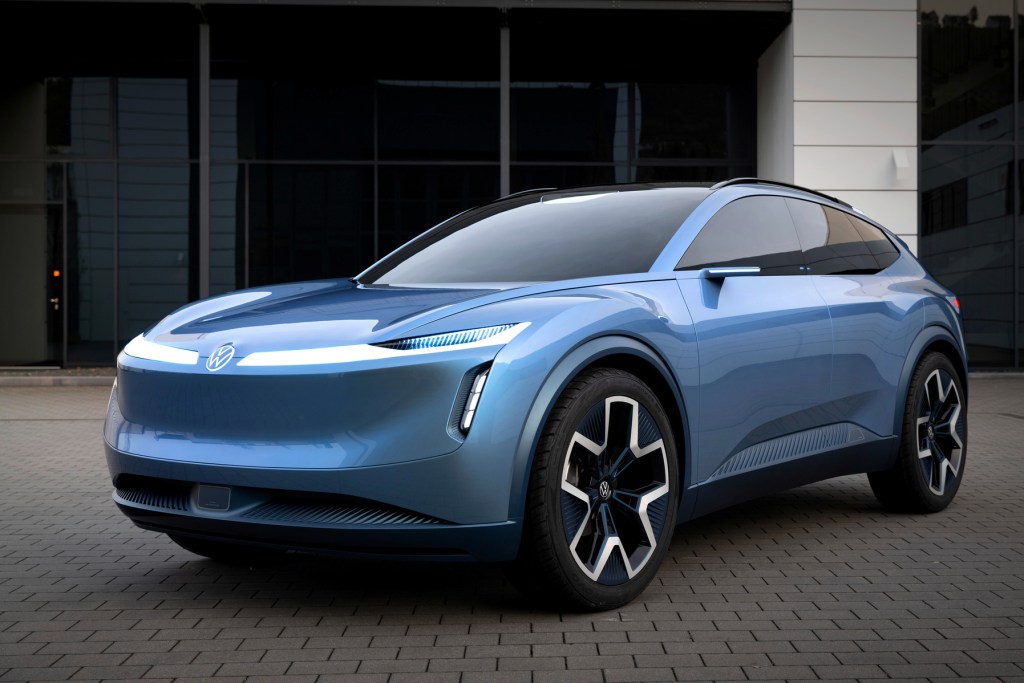
Volkswagen introduced a new electric concept at Auto China 2024, the ID.CODE. And while it is a concept—with a “newly designed living space on board. . .where the real and virtual worlds meet to create a new mobility experience” (no, I have no idea what that means, either)—it is likely to be something that will be coming out within the next few years.

Volkswagen ID.CODE concept developed for the China market. (Image: Volkswagen)

Listen to Oliver Blume, CEO Volkswagen Group, at the company’s China Capital Markets Day in Beijing:

Over the past 40 years, we have established a robust and very successful business in China. China is a very important market for us and will remain so. There are approximately 50 million of our vehicles on Chinese roads today, and we sell one in three cars worldwide in China. We are therefore proud to call China our second home market.”

So to stay in the game, the Group plans to launch 40 new models in China during the next three years, 20 of which will be electric vehicles, then by 2030 there will be at least 10 new EVs added to that.

To do this, in part, the Group is working with Chinese companies XPENG and SAIC.

It has developed what it calls its “China Main Platform” (CMP) which will be the underpinning for VW brand vehicles in China.

The CMP is engineered to allow the cost of vehicles by 40% by 2026.

It has developed the China Electrical Architecture that it says will further reduce costs.

It has established the Volkswagen Group China Technology Company (VCTC), an R&D center in Hefei.

Through VCTC it plans to reduce the time-to-market for China products by 30%.

While that’s for the Group (the company has divided its brands into Core: VW, VW Commercial Vehicles, Skoda, SEAT, and Cupra; Progressive: Audi, Bentley, Lamborghini, and Ducati; and Sport Luxury: Porsche), the brands have their approaches to the China market.

For example, the VW brand has established three pillars for the China market: a comprehensive vehicle offering; a design language specifically for the market; technical development with Chinese partners to accelerate innovation.

Hmm. . .

Volkswagen Group is betting big on China, which is actually its single-biggest market (it sells more units in Europe, but as a single country, China is the one).

While there is advantage engaging with domestic companies (it owns 4.99% of XPENG), a question is whether Chinese consumers might not have their own “In China, for China” strategy that will focus their purchases on vehicles from Chinese companies.

And to what extent the design approaches and technical developments that it is making in China will be useful in the rest of the world.

After all, should the Chinese consumer not be keen on VW’s “living space on board” and the like, then it surely is going to need to take that investment elsewhere.

VW Group Isn’t the Only OEM “Challenged”

By Gary S. Vasilash

When you see the word challenge in any form in a financial announcement, know that this really means some variant of “we are really struggling but don’t want to make it seem as though we are anything other than in control.”

(Image: VW Group)

When Volkswagen Group announced its 2023 financial results there were:

Oliver Blume, CEO: “Volkswagen Group is entering the long-distance rate of transformation from a position of strength. At the same time, we are aware of our challenges and are tackling them consistently to leverage the enormous potential of Volkswagen Group.”

Arno Antlitz, CFO and COO: “In a challenging environment, Volkswagen Group delivered robust results in 2023.”

While the company has said that it expects 50% of sales to be electric vehicles by 2030, for the full year in 2023 Group EV sales were 8.3%. So essentially it has six years to add 41.7%.

In the release about its earnings there’s this:

“Volkswagen Group is convinced that the future of mobility is electric. While some countries continue to show an impressive pace of transformation, the ramp-up of electric mobility in other regions is unfolding less quickly than expected. Volkswagen Group’s strategy is therefore characterised by flexibility. While extensive investments are being made in the expansion of electric mobility, highly competitive, efficient, and attractive models with combustion engines will remain part of the product range during the transition phase. Improved and new plug-in hybrids complement the range in many markets.”

Which could be restated as:

“We’ve bet big on EVs and are seeing returns in some areas but not like we’d hoped overall. So we figure we’d better be sure to continue to offer things that have internal combustion engines under their hoods, with or without hybrid systems attached.”

Of course, placing bets is about the future.

If VW Group doesn’t ante up on what seems as though it will play out (i.e., at some point there will be a bona-fide acceptance of EVs by a mass market, not the level of acceptance that has been puffed up (take Tesla numbers out of the sales of EVs in the West and see how well they are doing)), then it will be in a bad situation at the point that it does.

But playing is not without a cost.

It, like other OEMs, are investing billions in electrification.

There are a couple of things that are going to make receiving a return somewhat problematic:

  1. Tepid consumer interest
  2. Cheap Chinese EVs

And it isn’t VW Group alone that needs to consider its play in relation to those two factors.

Which makes it all the more. . .challenging.

VW EV Globally

By Gary S. Vasilash

Volkswagen Group—as in the whole thing, globally (everything from Audi to VW, with Lambo, Porsche and others in between—is taking the electrification of its portfolio quite seriously and so was rather pleased with its sales of battery electric vehicles during the first half of 2023.

It delivered 321,600 EVs—a 48% year-on-year improvement.

In Europe its EV deliveries were up 68%, to 217,100 EVs.

Which means 104,500 for the rest of the world.

In the U.S., there were 29,800 EVs delivered by the Group. That was a 76% improvement.

Meanwhile, over in China in the first half, things actually fell by about 2%, to 62,400 EVs.

These numbers provide a good sense of how EVs are playing out in various markets: the Europeans are buying a lot, as are the Chinese. While the numbers are growing in the U.S., compare the 76% improvement with the 2% decline in China: The Chinese bought 32,600 more EVs than U.S. customers, yet that’s a decline.