
Looks go a long way even if the vehicle doesn’t. . . .
By Gary S. Vasilash
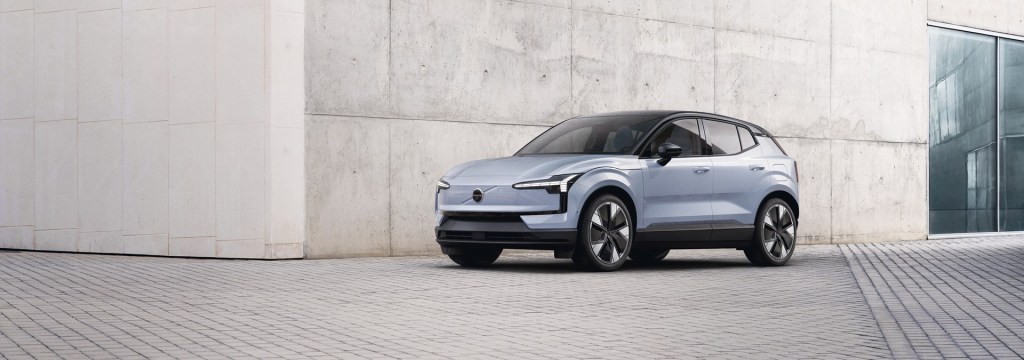
The Volvo EX30 received a “Best of the Best” design award in the RedDot 2024 design competition. While the small electric SUV has won other awards—like the World Urban Car from the World Car of the Year jury and the Eco Warrior of the Year award from Top Gear—arguably this design award is something that is more significant, for the simple reason that when you walk up to a vehicle you’re looking at the exterior styling, and, of course, when you get in it, the interior cues make a tremendous difference.
The RedDot jurors said of the EX30:
“Typical design elements have been convincingly reinterpreted and integrated into the EX30 – both on the exterior and in the interior. This vehicle is clearly recognisable as a Volvo, even without resorting to too many quotes. It is a product as if cast from a single mould with a consistent, very high design quality that convinced us across the board.”
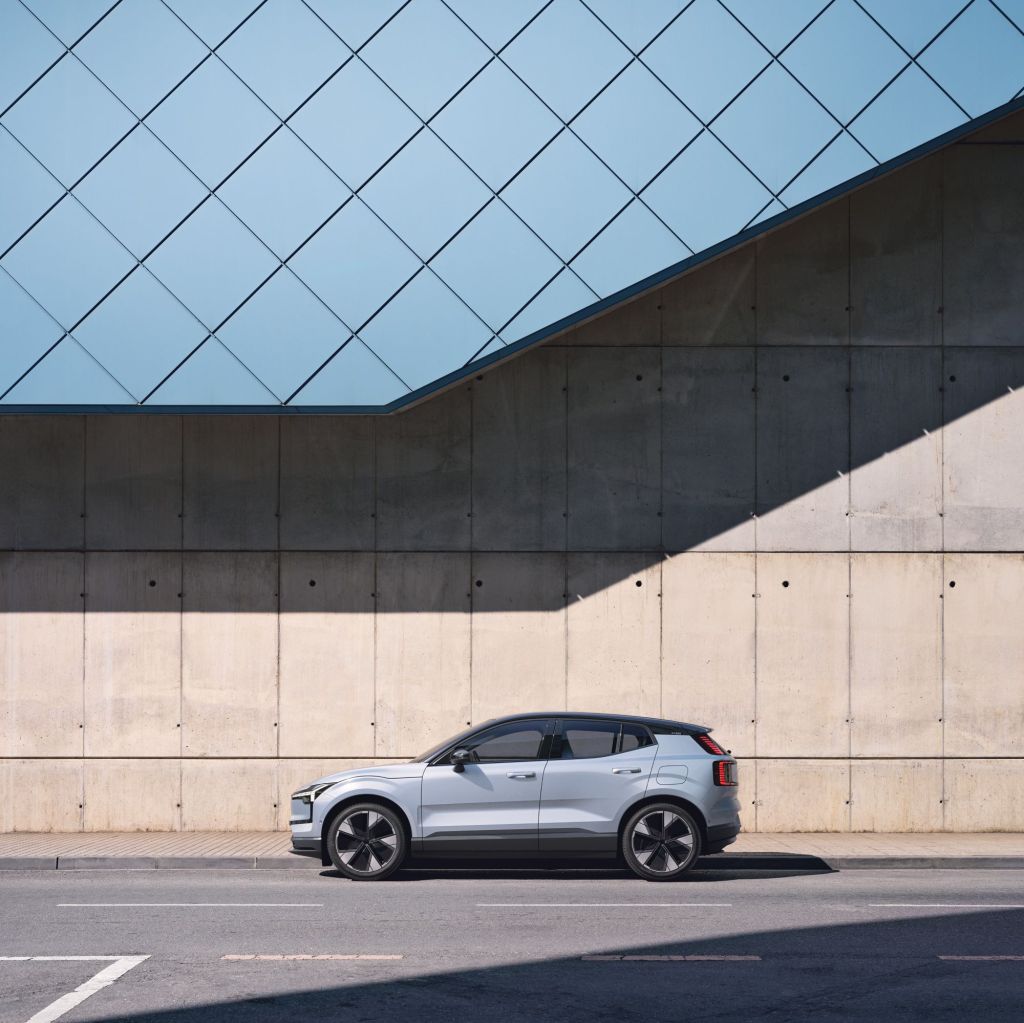
So from the outside is a stylish small hatch (while it might be in the subcompact SUV category, that probably has a lot more vis-à-vis market positioning than anything else, and whereas “SUV” is acceptable, hatches have a growing but limited acceptance), measuring 166.7 inches long, 72.3 inches wide, 61.2 inches high, and with a 104.3-inch wheelbase. Sometimes designing a small vehicle can be tough to pull off, but this is clearly a contemporary Volvo, which means (were this something designed with tools of a long-gone era) the T-square has been replaced by the French curve. Well, comparatively speaking.
And the real design win is on the interior of the vehicle.
One of the things that seems to be forgotten about electric vehicles, as everyone talks about 0 to 60 times, is that they are more environmental than ICE vehicles.
Even some OEMs seem to have forgotten that when developing their EVs (except when they were concerned about meeting regulations, which led to attention on the propulsion system primarily).
But the designers, engineers and materials specialists at Volvo worked to develop an interior that is far more sustainable than the common approach. So there are recycled and renewable materials used throughout the cabin. There are fibers used for seats that come from the leftovers from producing denim or a wool blend with some 70% recycled polyester. There’s trim that uses flax fibers (fun fact: that material is used to produce high-quality paper, some of which is used to print banknotes, so, and now we get to the point of a bad pun: the EX30 interior is money).
While you might think, “An interior that uses lots of recycled materials: this must be as comfortable and as attractive as a pile of wood shavings.” And you would be wrong. This is really well executed and provides a contemporary appearance, one that underlines the overall minimalism of the cabin.
One place where there is a bit too much minimalism is on the IP, where the gauges that you are familiar with is not where you are familiar with seeing them.
Rather, looking forward the only thing in that area is an infrared eye tracking sensor that will cause a “look at the road” warning if your eyes are wandering.
All of the information is available on a 12.3-inch touchscreen centered on the IP. Which means if you want to know how fast you are going you have to move your eyes to the right. If you want to know what time it is you have to read a small font on a screen with lots of other information.
The reduction in instrumentation is not a good thing.
Another thing that seems rather minimal is the range, with the EPA number 261 miles. Maybe the Michigan winter had something to do with it, but that number was cut by about 20%.
Now Volvo undoubtedly wanted to make sure that it was able to give the EX30 a starting MSRP around $40K (it is $40,345), and batteries are the most expensive part of an EV, so it is using a 69-kWh NMC battery in the vehicle. Although a somewhat bigger vehicle, the Chevy Equinox EV has an 85-kWh battery for an estimated 319 miles of range. That’s more reasonable. Even if the EX30 achieved the full 261 miles, it really seems that 300 miles is the number a competitive EV needs to reach.
But one might give that a pass, given the award-winning design it brings.

 shinymetalboxes