
Although it is big, some of the small details are most impressive
By Gary S. Vasilash
This is the bottom of the front cupholder on the Ioniq 9:
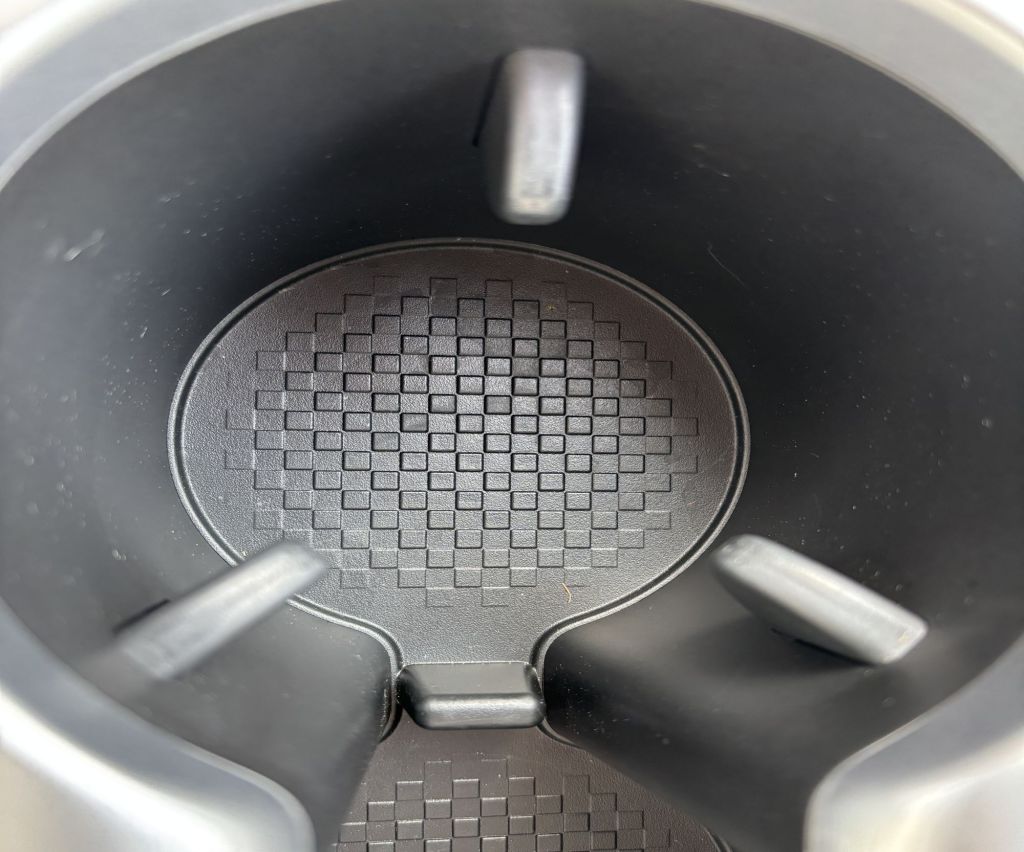
This is not the sort of thing that a review of a three-row electric vehicle that provides—depending on the powertrain setup selected—a range ranging from 311 miles to 335 miles typically opens with. In fact, it is unlikely that the bottom of a cupholder is even an issue.
After all, realize that this is quite a substantial vehicle, measuring 199.2 inches long, 78 inches wide, 70.5 inches high, with a 123.2-inch wheelbase. The top-of-the-line version tips the scales at 6,008 pounds. In the seven-passenger configuration (it can also be configured to seat six) it offers 163.4 cubic feet of passenger volume. With the third row folded it offers 46.7 cubic feet of cargo capacity. Leave it up and there’s 21.9 cubic feet.
But it is to make a point about the level of detail that the designers and engineers at Hyundai have taken in developing this vehicle.
Now the overall theme for the vehicle is one based on “pixelated design.” As in pixels, the individual square elements that make up images on digital screens. So as you can see from the bottom of that cupholder: pixels.
Hyundai designers use squares throughout the vehicle, both inside and out.
As in the front:
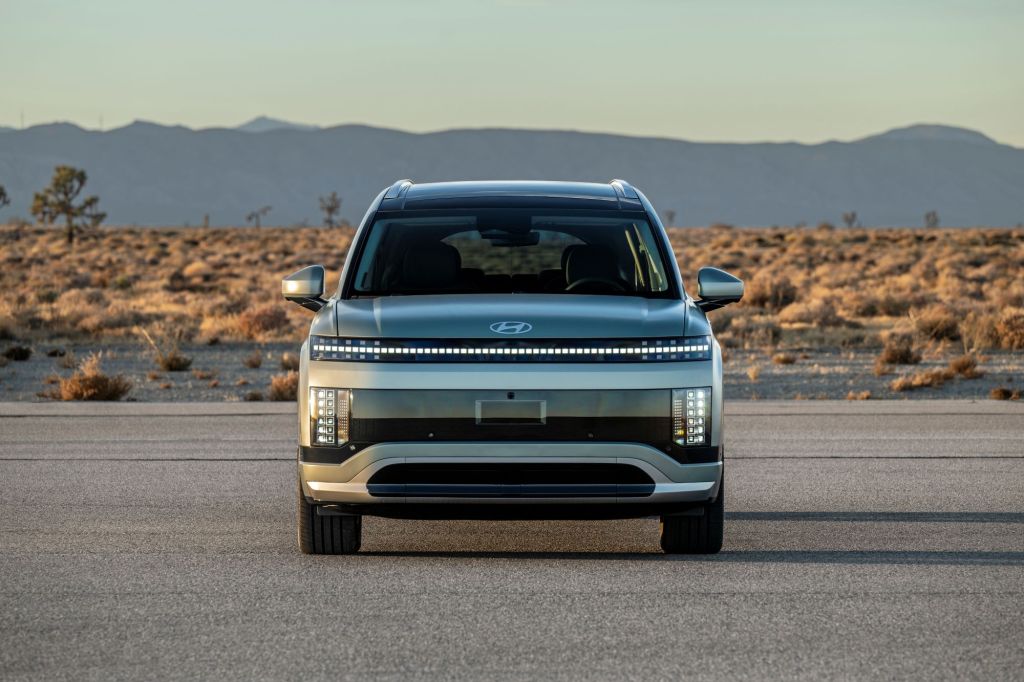
And back:

There is a remarkable consistency to this approach.
While it enhances the overall design, it also indicates that there is consistency and care in the creation of the SUV.
As legendary management consultant Tom Peters, the guy who co-wrote In Search of Excellence, put it:
“Small>>Big. Small Stuff Rules!”
Get the small stuff right and you’re likely to get the whole thing well executed.
And that is precisely the sense one gets from the Ioniq 9.
The AWD version driven here is a dual-motor arrangement that provides a total 422 hp, which means that as big as it is, the Ioniq 9 drives smartly. And while there is a RWD model on offer, which is the one that gets the 335-mile range, this model gets a respectable 311 miles.
And if you take it to a Supercharger, you can get from 10% state of charge to 80% in 40 minutes. If you are able to access a 350-kW DC fast charger, with the CCS adapter you can hit that 80% mark in 24 minutes.
But the thing is, when you have range of 300 miles+ the issue of range anxiety isn’t much of a thing—if it is a thing at all. Assuming you’re doing your pre-drive homework, you can take a road trip with several family members or friends in the Ioniq 9. If you’re just doing a daily drive, you probably won’t think much at all about charging.
Inside the vehicle there’s a lot more to it that nicely trimmed cupholders.
The driver and front passenger seats are both power 8-way adjustable, heated and ventilated. The driver gets 4-way power lumbar; the passenger 2-way. In the second row the captain’s chairs offer 4-way power adjustment and are heated and ventilated.
The seats are trimmed in the H-Tex material: a synthetic leather that looks and feels quite authentic.
In terms of technology, there is a 12.3-inch touchscreen. The gauge cluster is also a 12.3-inch screen.
And that is deserving of a word. There are some OEMs that, in vehicles that have a staring MSRP of $76,490 like this one does, figure that the more digital real estate they can throw on the IP, the better.
It isn’t.
While 12.3 inches times two certainly doesn’t go back to Peters’ “Small>>Big,” I would argue that the Hyundai approach to interface is a whole lot better than just adding screens.
It should be noted that the Ioniq 9 is counted among the 2025 Wards 10 Best Interiors & UX (full disclosure: I am one of the judges).

 shinymetalboxes