Speed of Change in the Global Industry: Blink and You May Miss It

By Gary S. Vasilash

The first thing to acknowledge is that the auto industry today is characterized by various forms of partnerships and alliances, whether they are codified like the Renault Nissan Mitsubishi Alliance or looser-but-still actionable work being done on things from entire vehicles to propulsion systems by General Motors and Honda.

Last week Volkswagen brand and XPENG and Audi and SAIC announced that there will be “strategic co-operations” for, initially, products for China that will carry the badges of the German companies, with XPENG supporting VW and SAIC Audi.

The cooperation isn’t particularly surprising. That’s just happening.

What is:

VW will build electric vehicles on an XPENG platform. Yes, there is still the VW MEB platform. But somehow it seems that’s not getting it done in China.

Audi will work with SAIC on developing electric vehicles for the China market in categories that it currently doesn’t have offerings. You’d imagine that the people in Ingolstadt would be up to the challenge, but evidently there is something that needs to be supplemented.

It wasn’t all that long ago that Chinese OEMs had partnerships with Western OEMs with the latter having the engineering and development chops and the former the production resources.

In the current case, it seems that the Chinese companies have the tech and know-how being sought by the German brands. And undoubtedly the production facilities to build the vehicles to be developed, too.

Things are moving far more rapidly than might have been expected even 10 years ago.

Interesting XPeng 2021 EV Sales Numbers

By Gary S. Vasilash

The numbers for Chinese electric vehicle manufacturer XPeng—not merely EVs, but “Smart EVs”—for 2021 are rather impressive, especially when looked at as a percentage basis compared to 2020.

As in:

  • 181% increase in the number of vehicles delivered in December 2021 vs. December 2020
  • 222% increase in deliveries in Q4 2021 vs. Q4 2020
  • 263% increase in total vehicles delivered in 2021 vs. 2020

But then when you drill down the numbers are somewhat less impressive.

  • 16,000 vehicles delivered in December 2021
  • 41,751 vehicles delivered in Q4 2021
  • 98,155 vehicles delivered in 2021

Still, directionally things are going well for the company.

XPeng P7 sport sedan. (Image: Business Wire)

The company offers both sedans and SUVs in the China market.  It is notable, as the interest in sedans in the U.S. is waning, that of its December deliveries of 16,000 vehicles, only 3,511 were SUVs—the largest share was taken by the sport and family sedans.

Another interesting thing about XPeng is that the company is building out a supercharging network—661 stations in all, located in 228 cities.

But even more notable is this: it has 311 retail outlets across 121 cities.

For a nascent company in the EV space, 311 is a lot of dealerships.

Tesla, for comparison, has about 170 galleries and showrooms in the U.S.

Fly or Drive?

How about both?

By Gary S. Vasilash

Chinese vehicle manufacturer XPeng Inc. held a tech day at which the company displayed things like its advanced driver assistance systems (XPILOT 3.5 and XPILOT 4.0) and it “X-Power” supercharging system, which, with a 800-V capability, can provide a charging range of 200 km (124 miles) in five minutes.

That is the sort of thing that even the impatient can tolerate.

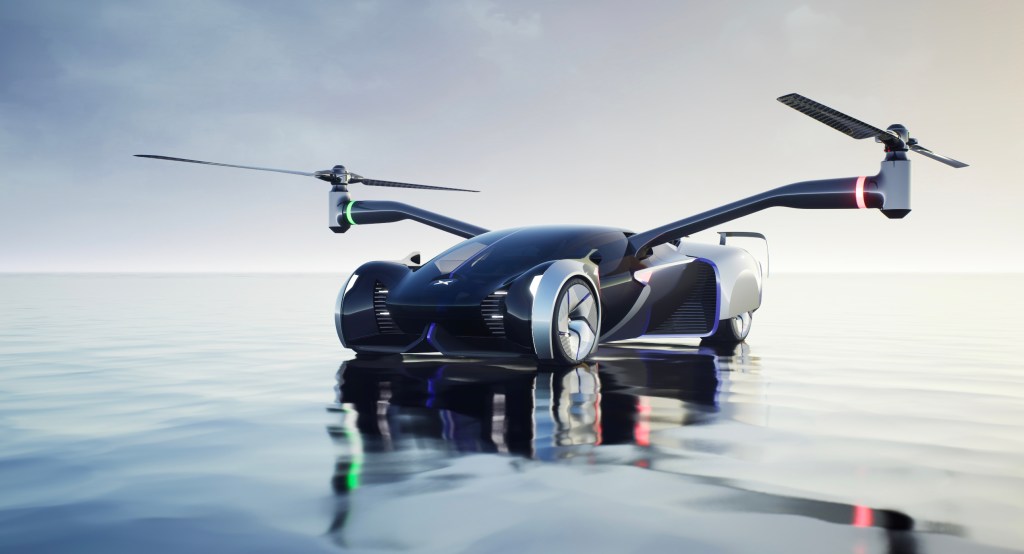
Sixth-gen flying car from HT Aero. (Image: XPeng)

But what is arguably a more interesting development is the road-capable flying car developed by affiliate company HT Aero.

The rotors adjust depending on whether the vehicle is in the air or on the highway.

The flying car is scheduled to become available in 2024.