
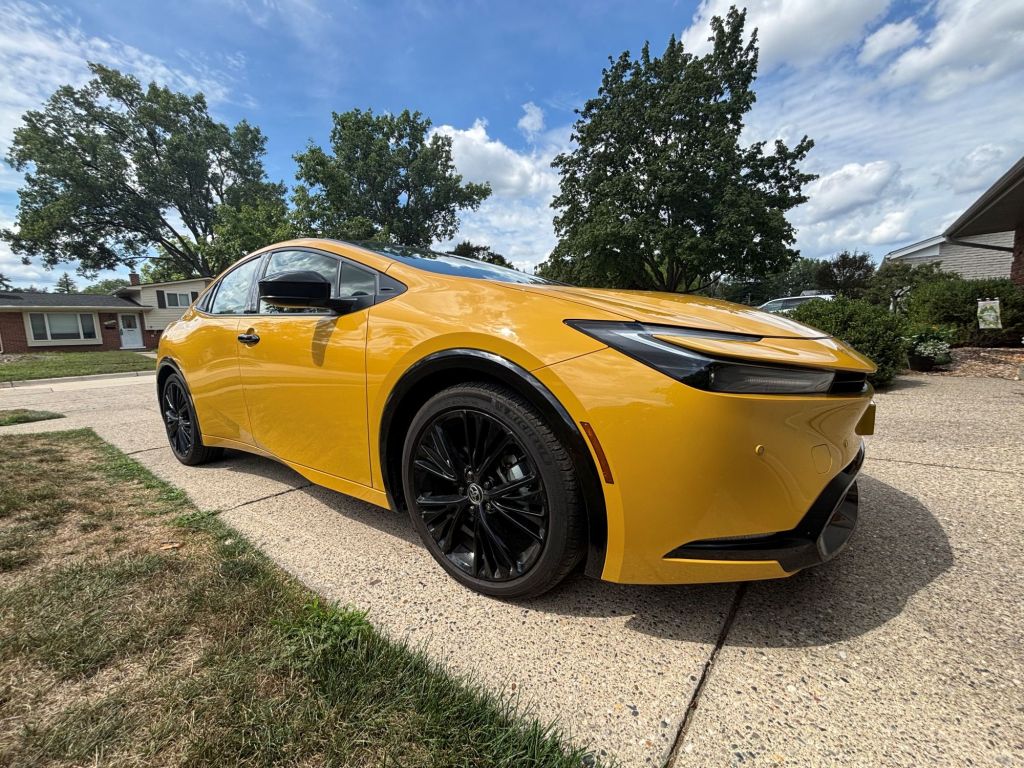
Although this Prius styling is a few years old now, it still looks fresh. . .
By Gary S. Vasilash
One of the things that automotive observers observed when the OEMs reported their 2026 first-half sales results was that the Toyota Prius had rather anemic sales: 19,518 compared with 33,845 for the first half of 2025. That’s a 42.3% reduction.
While not an apples-to-apples comparison, it is interesting to note that in the first half of 2026 only a single Cadillac model—one out of 10—had greater sales than that 19,518: The Escalade at 20,062. That’s 544 more.
Another not-exactly-a-competitor-unless-you-count-both-having-four-tires is the Jeep Gladiator. Its first half sales were 19,033, yet when it was recently suggested that Ford might come out with a Bronco with a bed on the back to compete with it, people said that it is a good plan.
But the falloff in sales of the Prius, the vehicle that is considered the first (it wasn’t: Honda launched the Insight in the US market about seven months earlier, in December 1999) and foremost (you’ve got to give it that), is somehow meant to indicate something, imply those observers.
However, given that Toyota (and Lexus) total electrified vehicle sales—mainly hybrids, with some EVs in the mix—in the first half was 53.9% of total sales, meaning that there are now hybrids in vehicle architectures across the board, a falloff in Prius sales shouldn’t surprise anyone.
A friend whose involvement with the auto industry goes no further than owning a vehicle, saw the 2026 Prius and said, “Prius—wasn’t that the sort of clunky-looking one when it first came out?”
He was most impressed looking at the current generation—the fifth, and didn’t realize that the model launched in the US in early 2023.
But he, like many, owns a compact crossover, not a sleek sedan that, with the exception of the cutlines for the rear doors, appears to be a coupe.
And let’s face it: faced with a vehicle that has 91.2 cubic feet of passenger volume and 20.3 cubic feet of cargo volume (Prius) is going to have a tough time competing with a vehicle that offers 98.9 cubic feet of passenger volume and 33.6 cubic feet (with the second row in place) of cargo volume (the RAV4).
Simply stated: a sporty design is a tough sell.
Yes, people may really like the way they look, but when it comes to making a decision about making a purchase, utility usually wins. (And if it is a RAV4, Toyota won’t mind.)
The vehicle driven here the Nightshade Plug-in Hybrid (one of four trims, with the other being the SE, XSE and XSE Premium), yes, has an outlet so it can be plugged in (with a typical 120-v outlet, it can be charged in 11 hours, or about four hours with a Level 2 charger).
But it also has a 10.6-gallon gas tank that can be filled up in a few minutes.
Now the “Plug-in” part allows the Prius to travel 39 miles on electricity alone before the conventional hybrid system does its stuff. (The base SE trim goes 44 miles.)
Then when it is operating as a hybrid you’re looking at getting 50 mpg city, 47 mpg highway. And yes, I got 48 mpg while driving in combined situations—and the driving style was simply driving.
As electric vehicles use their range as a feature—and for many of them a 300-mile range is quite an accomplishment—know that this model can go some 550 miles before a fill up (and charge up) is needed.
The net system horsepower (that is, combining the 2.0-liter engine with the motor generators) of 220, which is certainly quite reasonable for a vehicle, especially if you look at those fuel efficiency numbers.
The Nightshade Edition has 19-inch alloy wheels with a black finish; black bumper trim; black doorsills; black shark fin antenna; and black front seats.
The Prius was once analogous to a pair of orthopedic shoes. Now it has high-fashion styling.
It still provides the fuel efficiency that other OEMs still only dream of.

