
A look at the top-of-the-line trim of Mazda’s compact CUV. . .
By Gary S. Vasilash
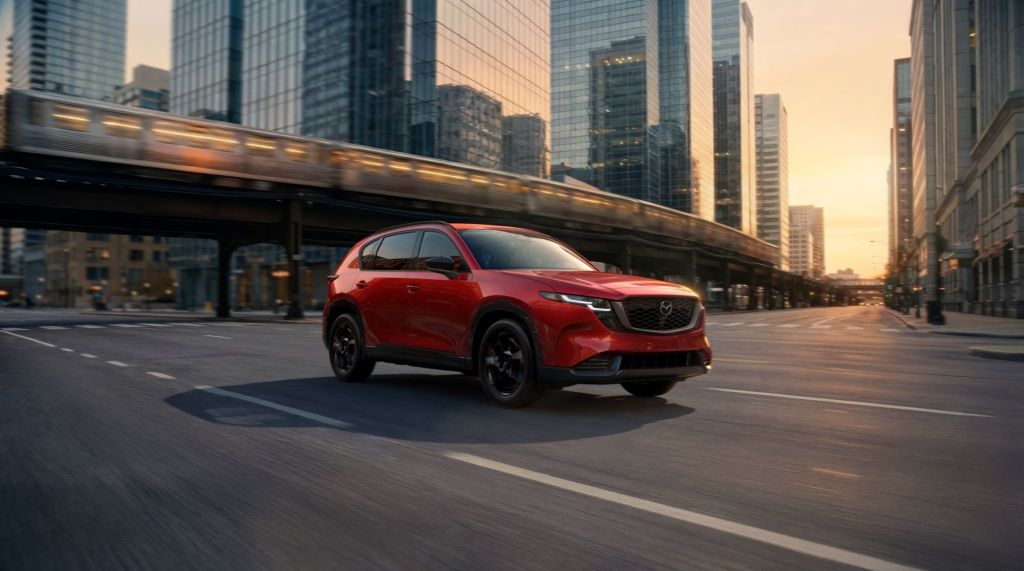
The Mazda CX-5 is a compact crossover that has undergone a redesign for the third generation of this popular Mazda: through July 2026 sales, the CX-5 is the second-most-popular vehicle in the brand’s lineup, coming in shortly behind the CX-50: 74,760 to 76,510.
The exterior styling is similar to that of gen-two, although the lines seem somewhat softer, which is again the sort of zig that Mazda tends to make when others are zagging. In this case, there seems to be a tendency to make vehicles of this type seemingly like things that are designed with an array of right angles, as though 90-degree angles make the vehicle inherently capable of doing things it is not engineered to come even close to doing (i.e., drive over Moon-like terrain).
Propulsion
The engine is the same as that used in the previous gen. It is a 187-hp, 2.5-liter four mated to a six-speed transmission. There is the carryover AWD system.
While the six-speed might seem somewhat lacking in gears, it should be noted that the Honda CR-V and the Nissan Rogue, with which the CX-5 competes, have continuously variable transmissions, which means “shifts” from one “gear” to another is simulated, and the Toyota RAV4, which is now all-hybrid, also has a CVT.
One of the benefits of a CVT is said to be fuel economy. The CX-5 returns 24 mpg city/30 mpg highway and 26 mpg combined, which is not something particularly notable. For example, a CR-V with a 190-hp, turbocharged 1.5-liter four with AWD is rated 27 city/31 highway/29 combined, so although it is just a couple of mpgs overall, when gas is $4.00+, it is a consideration.
Handling
Mazdas have long been known for their driver-oriented handling. The CX-5 continues that, which isn’t a bad thing, but which is probably something that most people who are behind the wheel of a compact crossover never think about (or experience) because vehicles of this type and drivers who buy them do so for more practical reasons than carving corners on Angeles Crest Highway (that’s why there are Miatas—and according to Mazda, the suspension tuning for the CX-5 is predicated on the Miata, but really. . . .).
Screen
The biggest change is the available 15.6-inch center touchscreen with an integrated Google interface. This screen is standard on the Premium Plus trim. Other CX-5s get a 12.9-inch screen.
Mazda has been criticized for the past few years for having a somewhat unique interface setup predicated on a dial on the center console that was turned to make selections and pushed to engage said selection.
But now this is an iPod-like (if the iPod is horizontally oriented) experience, with a matter of simply tapping on icons. Which works well. But in my experience I think maybe they went a bit too far to make up for lost time. Yes, everyone of a certain age (and I fit into that category) tends to complain about things like the lack of a volume knob. And that’s one thing I would complain about here.
While there are steering wheel controls that can make that adjustment, and there is also voice control that can control a number of functions, the passenger is going to have to make sure the right spot is selected on the screen—something that would be difficult were one doing that aforementioned “spirited” driving.
Assessment
The category the Mazda CX-5 is competing in is arguably the most brutal in that not only are there the models from Honda, Nissan and Toyota, but also Chevy, Kia, Hyundai, VW, and Jeep.
For its looks alone it is a competitor. (Yes, yes, there are other factors to take into account, like the CX-5 receiving the IIHS 2026 TOP SAFETY PICK+ award, which is absolutely an important thing for a vehicle that is likely to be carrying kids to soccer practice and the like.)
 shinymetalboxes