
2026 Mazda CX-5 S Premium Plus

A look at the top-of-the-line trim of Mazda’s compact CUV. . .

By Gary S. Vasilash

The Mazda CX-5 is a compact crossover that has undergone a redesign for the third generation of this popular Mazda: through July 2026 sales, the CX-5 is the second-most-popular vehicle in the brand’s lineup, coming in shortly behind the CX-50: 74,760 to 76,510.

The exterior styling is similar to that of gen-two, although the lines seem somewhat softer, which is again the sort of zig that Mazda tends to make when others are zagging. In this case, there seems to be a tendency to make vehicles of this type seemingly like things that are designed with an array of right angles, as though 90-degree angles make the vehicle inherently capable of doing things it is not engineered to come even close to doing (i.e., drive over Moon-like terrain).
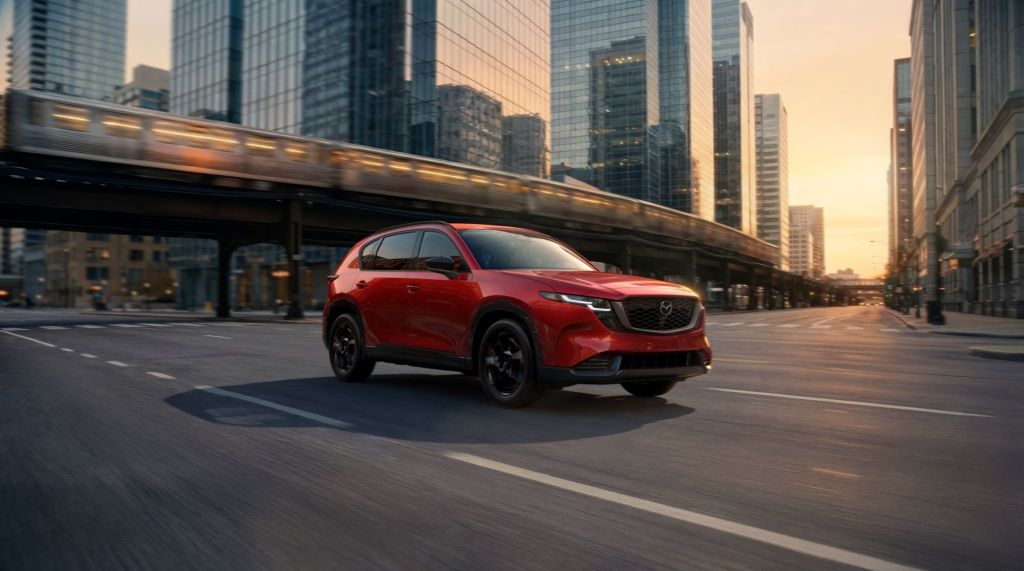
2026 Mazda CX-5 is bigger than the previous generation, by 4.5 inches in overall length, 4.6 inches in wheelbase, and 0.6 inches in width (or the ’26 is 184.6 inches long, has a 110.8-inch wheelbase, and is 73.2 inches wide.) It has cargo capacity of 33.7 cubic feet behind the second row and 66.5 cubic feet when folded. (Image: Mazda)

Propulsion

The engine is the same as that used in the previous gen. It is a 187-hp, 2.5-liter four mated to a six-speed transmission. There is the carryover AWD system.

While the six-speed might seem somewhat lacking in gears, it should be noted that the Honda CR-V and the Nissan Rogue, with which the CX-5 competes, have continuously variable transmissions, which means “shifts” from one “gear” to another is simulated, and the Toyota RAV4, which is now all-hybrid, also has a CVT.

One of the benefits of a CVT is said to be fuel economy. The CX-5 returns 24 mpg city/30 mpg highway and 26 mpg combined, which is not something particularly notable. For example, a CR-V with a 190-hp, turbocharged 1.5-liter four with AWD is rated 27 city/31 highway/29 combined, so although it is just a couple of mpgs overall, when gas is $4.00+, it is a consideration.

Handling

Mazdas have long been known for their driver-oriented handling. The CX-5 continues that, which isn’t a bad thing, but which is probably something that most people who are behind the wheel of a compact crossover never think about (or experience) because vehicles of this type and drivers who buy them do so for more practical reasons than carving corners on Angeles Crest Highway (that’s why there are Miatas—and according to Mazda, the suspension tuning for the CX-5 is predicated on the Miata, but really. . . .).

Screen

The biggest change is the available 15.6-inch center touchscreen with an integrated Google interface. This screen is standard on the Premium Plus trim. Other CX-5s get a 12.9-inch screen.

Mazda has been criticized for the past few years for having a somewhat unique interface setup predicated on a dial on the center console that was turned to make selections and pushed to engage said selection.

But now this is an iPod-like (if the iPod is horizontally oriented) experience, with a matter of simply tapping on icons.  Which works well. But in my experience I think maybe they went a bit too far to make up for lost time. Yes, everyone of a certain age (and I fit into that category) tends to complain about things like the lack of a volume knob. And that’s one thing I would complain about here.

While there are steering wheel controls that can make that adjustment, and there is also voice control that can control a number of functions, the passenger is going to have to make sure the right spot is selected on the screen—something that would be difficult were one doing that aforementioned “spirited” driving.

Assessment

The category the Mazda CX-5 is competing in is arguably the most brutal in that not only are there the models from Honda, Nissan and Toyota, but also Chevy, Kia, Hyundai, VW, and Jeep.

For its looks alone it is a competitor. (Yes, yes, there are other factors to take into account, like the CX-5 receiving the IIHS 2026 TOP SAFETY PICK+ award, which is absolutely an important thing for a vehicle that is likely to be carrying kids to soccer practice and the like.)

2025 Mazda CX-5 Turbo Signature

By Gary S. Vasilash

Nomenclature in the auto business is a trickier thing than it ought to be for consumers trying to figure out what it is that they might like to buy.

One example of this is the situation that exists between the Mazda CX-5 and the Mazda CX-50.

The CX-5 is an established moniker, having been around since model year 2013.

The CX-50 is far fresher, having been introduced in model year 2023.

Both are compact SUVs.

The addition of the “0” does indicate that the CX-50 is bigger (e.g., 185.8 inches long vs. 180.1 inches for the CX-5; a 110-inch wheelbase vs. a 106.2-inch wheelbase).

The point is, if you go into a Mazda dealership and are looking for what can be considered the “zippier” of the two, go for the CX-5, especially given that both vehicles come with a 2.5-liter engine that, at the top of the line trims (like the one here), produces 256 hp and 320 lb-ft of torque, so because the CX-5 is slightly smaller, it provides better maneuverability. (Of course, both vehicles are not particularly large in the context of many SUVs/crossovers out there, so this is a relative thing.)

2025 Mazda CX-5: the sort of presence other compact SUVs probably wish they had. (Image: Mazda)

Like all Mazdas—and this is no mean feat—the CX-5 looks great. There has been a consistency in styling for the past few years that Mazda hasn’t deviated from. The exterior sheet metal of the CX-5 is formed in a way that makes it distinctive in a category of vehicles that is becoming increasingly truck-like in appearance. (If people want trucks, don’t they simply buy trucks?)

The cabin is comfortable and the materials are what can be considered a “category-above” compared what are found in other compact crossovers. It is something of a mystery as to how a company that doesn’t sell a whole lot of vehicles vis-à-vis the competitors can have Nappa leather and leather-wrapped steering wheels and shifter, to say nothing of a solid 10-speaker Bose audio system.

The CX-5—as in all trims—is an all-wheel-drive vehicle. In this trim level there is the Mazda Intelligent Drive that allows selection of Normal, Off-Road, Sport. Somehow that central choice doesn’t seem all that relevant for a vehicle that will undoubtedly be driven normally 95% of the time and quickly 5%.

And there is a full suite of the Mazda i-Activsense safety features, including Smart Brake Support (you close too quickly on a vehicle in front of you and the vehicle will let you know it) to Adaptive Front Lighting (which is both cool and functional: when you are turning the headlights appropriately pivot to show you where you are going). When moving through sluggish traffic, there’s Traffic Jam Assist, which uses radar cruise control that can bring the vehicle to a complete stop as well as a steering function that helps keep the vehicle centered.

The EPA Passenger and Cargo volumes are 103.6 cubic feet and 30 cubic feet, respectively, so while not giant in either case, certainly reasonable.

The 2025 CX-5 starts at $29,050 and goes to $41,080 (sans delivery fees).

One option I strongly recommend: the Soul Red Crystal Metallic paint. It shows off the form in a wonderful way.

2025 Mazda CX-5 2.5 S Carbon Edition

Don’t just consider the top-of-mind when thinking “compact crossover”. . .

By Gary S. Vasilash

During a recent “Autoline After Hours” co-host John McElroy, talking about a Mazda CX-90 he was driving, said, “I don’t know why more people don’t buy Mazdas.”

Which is a solid observation.

First, however, it should be noted that Mazda’s fortunes in the U.S. market considerably improved in 2024 compared with 2023.

In ’24 it sold 424,382 vehicles. The previous year it was just 363,354. That’s nearly a 17% improvement.

Compare that with the overall U.S. market being up a mere 2.2% and you can see that Mazda’s bump is impressive.

But then there is what Mazda is up against.

In 2024 Ford sold 124,701 Bronco Sports, 146,859 Escapes and 194,094 Explorers, for a total of 450,125 vehicles.

Of course, Mazda has about 550 dealerships in the U.S. and Ford 3,000, so there is something to be said for access and availability.

The 2024 sales for the CX-5 were 134,088 vehicles. That is a drop of 12.8% compared with 2023 sales.

Mazda CX-5: Ripe for consideration. (Image: Mazda)

However, one might argue that the Mazda CX-50, another compact SUV that is approximately the same size as the CX-5 but which has a bit more of a rugged execution (sort of like the Bronco Sport and the Ford Escape, but (a) the Bronco Sport is far more rugged overall than the Escape and (b) the two Mazdas are on different platforms, so there is that difference). CX-50 sales in 2024, at 81,441, were up 82.6%.

Of course, someone looking at a new vehicle is looking now, not last year, so. . . .

The comparison with the Ford Escape isn’t coincidental. The vehicles are quite similar with a few notable differences.

For example, the CX-5 comes standard with all-wheel-drive. The Escape has that as an option.

The engine in a CX-5 is a 2.5-liter four that produces 187 hp and 186 lb-ft of torque. The base engine in the Escape is a 1.5-liter in-line three cylinder engine that produces 180 hp and 199 lb-ft of torque.

The Ford has an eight-speed automatic. It is six for the Mazda.

For those who are interested in cargo capacity the Escape clearly has the advantage with 37.5 cubic feet versus 30.8 cubic feet for the CX-5.

But to get back to McElroy’s original question, it goes to the point of why there are probably far more people who had a default thought to an Escape (or an Equinox or RAV4 or CR-V) and not the CX-5: good as they are, Mazdas are largely invisible in the market.

With a base MSRP of $32,600 the 2.5 S Carbon Edition brings such things as leather seating and a power moonroof; a 10.25-inch center display and wireless charging, Apple CarPlay and Android Auto.

It is competent and contemporary.  And because of that, the CX-5 needs to be considered.