Every OEM creates vehicles that are termed “athletic.” But Genesis does something else, too. . .
By Gary S. Vasilash
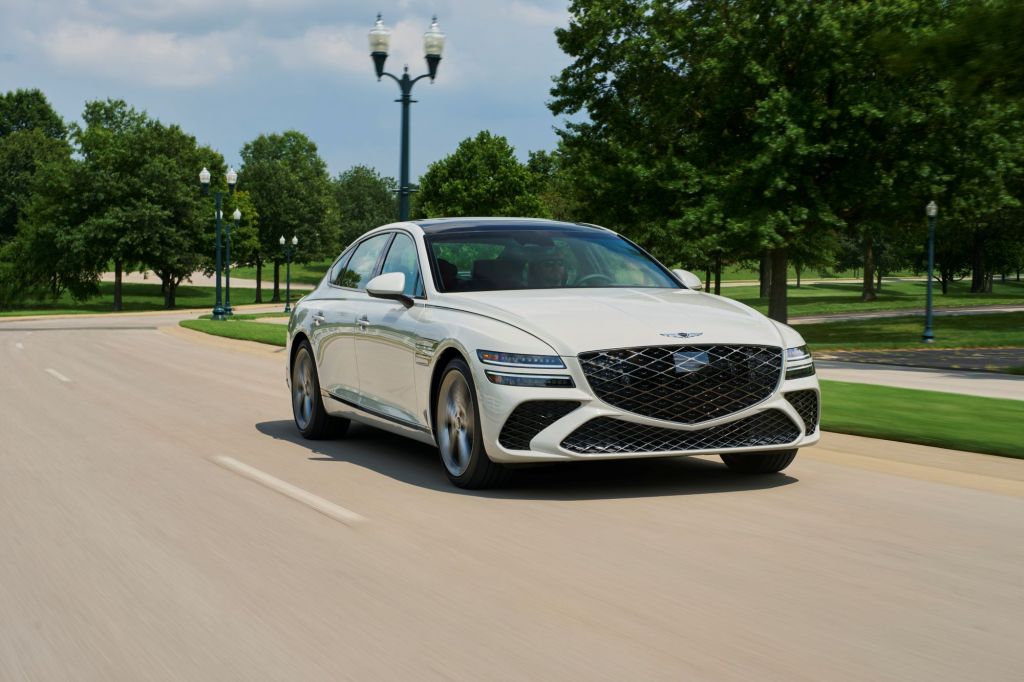
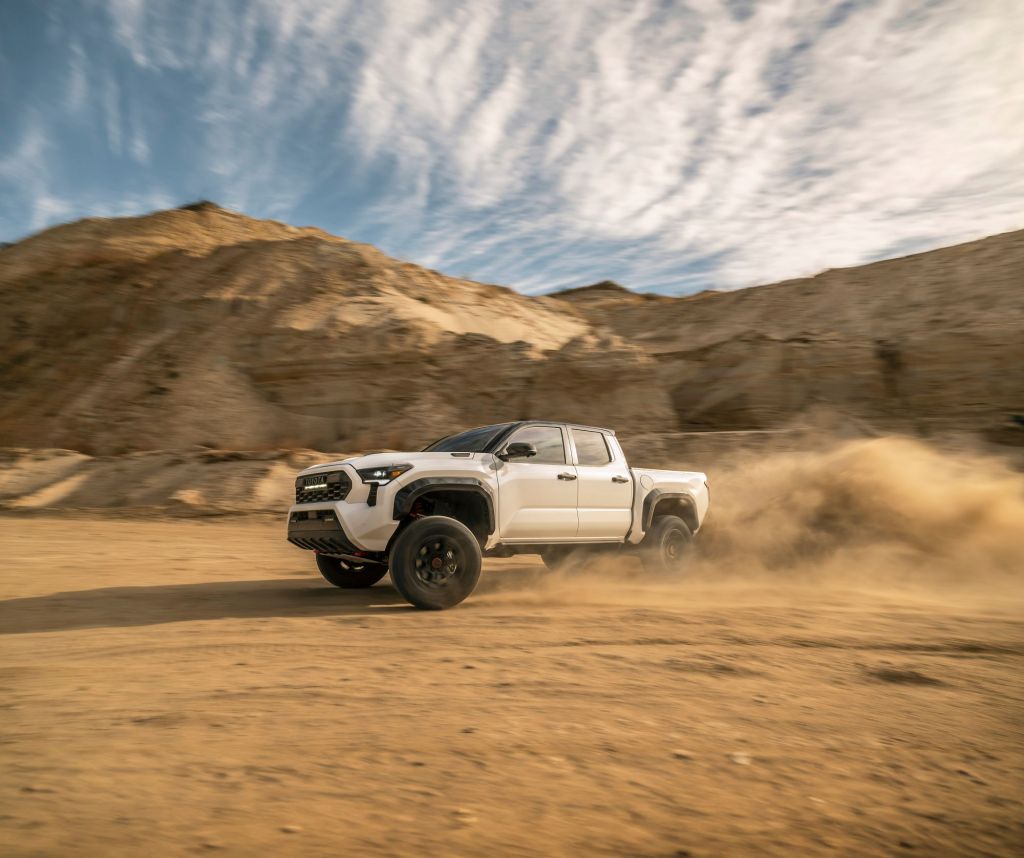
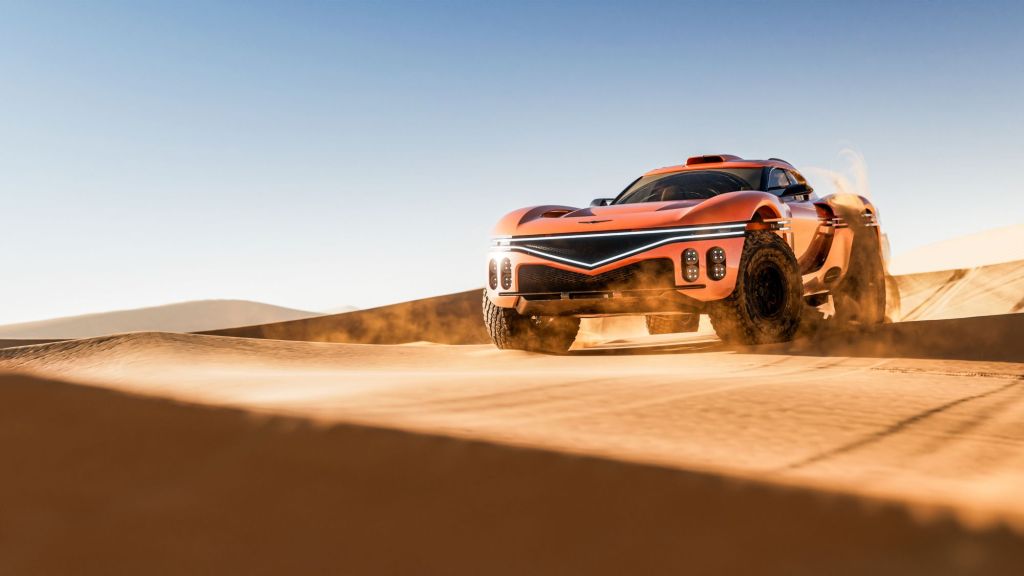
At the Liwa Oasis, United Arab Emirates, Genesis presented its latest concept vehicle, the X Skorpio Concept.
What’s interesting about this vehicle is that according to the company the X Skorpio Concept is “an off-road concept vehicle designed to perform across demanding terrain including deserts, in the Rub’ al Khali ‘Empty Quarter’ desert in the United Arab Emirates.”
Which seems somewhat specific.
But presumably vehicles like this would have more appeal in that part of the world than, say, Kansas, though it would also likely be seen crawling along places like Collins Avenue in South Beach (where the Brembo Motorsports brakes will get a workout as the X-Skorpio Concept is fitted with a 1,100- hp V8).
The X Skorpio Concept: when you want to drive the dunes in luxury. (Image: Genesis)
Talking about the marque’s approach to developing concept vehicles, Genesis Chief Creative Officer Luc Donckerwolke said:
“We create concept cars to inspire and ignite authentic passion for our vision. They are designed to deepen the emotional connection with our customers by showcasing the ultimate desirability they’ve always dreamt of. At Genesis, we craft cars that drive emotional expansion, showcasing not only our design philosophy but also the future technologies that personalize and elevate lifestyles.”
Which sounds pretty much like what all auto designers say about developing concepts and production vehicles.
But there’s something that is notable about the Genesis approach.
Again, like many brands, there is a design philosophy that the designers hew to. In the case of Genesis this is termed “Athletic Elegance.” (It is remarkable how often terms related to athleticism are applied to vehicles—“taut forms,” “strong haunches,” etc.—even though a point of driving is not having to run or walk to one’s destination.)
Here’s the Genesis difference:
There are “three emotional facets” involved in creating designs predicated on “Athletic Elegance.”
They are:
Luxury: Rewarding experiences exemplified by Korean refinement through intricate craftsmanship, understated beauty and meticulous attention to detail.
Sport: Represents quiet confidence equipped with ample power for those who enjoy challenges while balancing speed and composure.
Cool: Embodying adventurous and lifestyle-driven designs driven by individual taste and self-expression.
And what’s cool is that they actually use the word “cool.”
While designers use that word when talking about what they’ve done, it is almost never admitted to be a defining factor by car companies.
“Luxury” and “Sport”—no problem.
But “Cool”?
This undoubtedly contributes to how Genesis not only produces concept cars that are cool, but production vehicles, as well.
The word “grand” isn’t used as much today as it once was.
Way back in the day, the Latin word was grandis, meaning “full-grown,” “big,” “great.”
Then that was picked up the French (grant, grand) and then moved over to Middle English, which added some meanings, including “important” and “magnificent.”
We use “grand” to designate $1,000.
We watch the Grand Prix races.
We sometimes eat a 1000 Grand candy bar.
The Jeep Grand Cherokee was launched in model year 1993.
The Pontiac Grand Prix went out of production with model year 2008.
The Dodge Grand Caravan—evidently the folks in Auburn Hills like the adjective—ended its decades-long run in 2020.
Toyota took up the mantle in model year 2024 with the Grand Highlander.
///
One of the things that some people were concerned about who liked the Jeep Grand Cherokee was that grandis notwithstanding, it was a two-row SUV from its beginning in 1993.
Toyota rolled out with its Highlander SUV in 2001 and offered a third-row as an option. It wasn’t much of a third row if a row is supposed to accommodate people above the age of 5. The Highlander offers 28 inches of legroom.
In model year 2021 Jeep put a third row into the Grand Cherokee, creating the Jeep Grand Cherokee L. That “L,” presumably indicating “long,” put a row back there with 30.3 inches of legroom.
For model year 2024 Toyota decided that it wanted to up its game, so it brought out the Grand Highlander.
And one of the most notably grand things about it is the third row. It is designed to accommodate people who are “full-grown,” thereby getting back to that Latin etymology.
The legroom is 33.5 inches.
Grand, indeed.
///
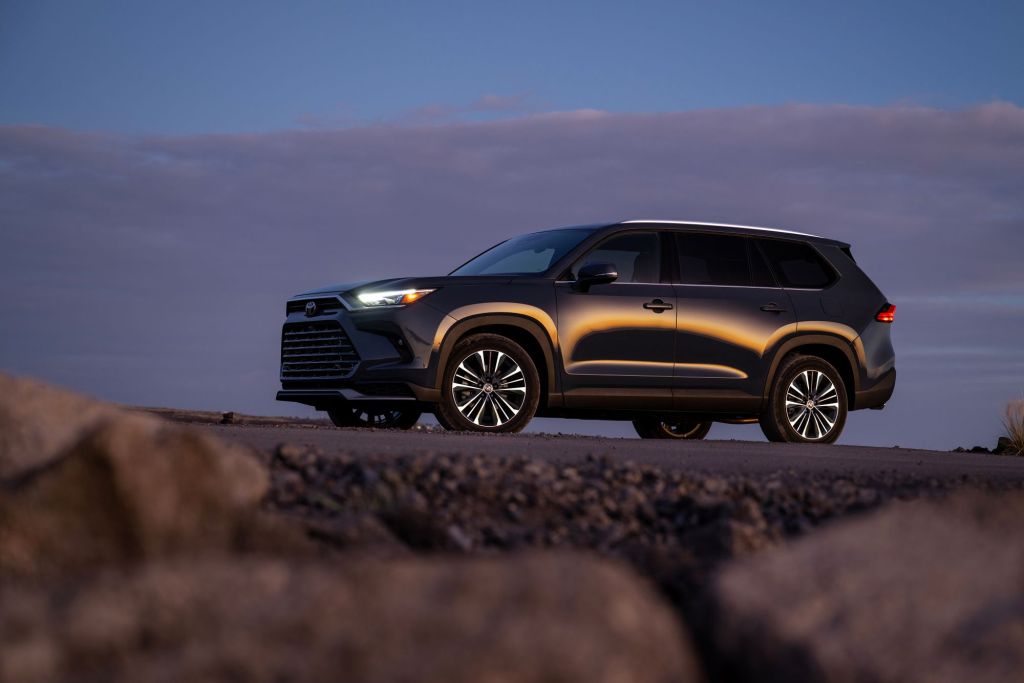
The name of this trim—one of 10 trims available—is certainly big: Grand Highlander Hybrid MAX Platinum.
2026 Toyota Grand Highlander: yes, it truly is grand. (Image: Toyota)
To dissect that, the “hybrid” part goes to the 2.4-liter turbo-charged four cylinder engine that’s supplemented by a front-mounted hybrid motor and a rear-mounted eAxle electric motor, all of which means total systems output of 362-hp and 332 lb-ft of torque and full-time electronic AWD (you don’t have to do anything; the system will figure out the demand).
Now here’s an impressive thing to know, also to the point of the hybrid: even though this model has a curb weight of 4,905 pounds, the estimated fuel economy is 26 mpg city, 27 mpg highway, 27 mpg combined.
That in a vehicle that can accommodate seven people in—dare I say?—grand comfort.
And it takes regular fuel.
Consider: this is a vehicle that’s 201.4 inches long, 78.3 inches wide, 70.1 inches high, and features an 8-inch ground clearance. This is a large vehicle with lots of visual presence. A large vehicle that is accommodating of the aforementioned seven adults. A large vehicle with plenty of technical amenities. A large vehicle that features a well-appointed cabin that is both quiet and immensely comfortable.
Yet it gets a combined 27 mpg.
And let’s take that number a bit further.
The fuel tank on this Grand Highlander has a 17.17-gallon capacity.
So let’s say that you’re a bit heavy-footed and are getting 25 mpg. And let’s round that capacity to 17 gallons.
This means that there is a possible range of 425 miles. You could drive from Memphis to St. Louis and still have some gas in the tank.
Of course, if you’re towing that number is going to be reduced. But the tow capacity is a notable number, too: 5,000 pounds.
///
Inside, where it really matters, the Toyota Grand Highlander must make the product planners who work on the Lexus TX look over their cubicle walls. This Platinum trim is very nicely done.
The seats from front to rear are trimmed with leather. There are Ultrasuede insets. The front seats are heated and ventilated; the second row heated; the third row. . .well, they’re in the third row.
There is three-zone automatic climate control, so that’s a benefit throughout.
There is a 12.3-inch infotainment screen. There is an 11-speaker JBL audio system. There is a panoramic moonroof. There is a 10-inch color head-up display.
The color and material combinations in the cabin are absolutely well done.
///
The base MSRP is $59,575.
Certainly not humble, but certainly not grand.
Arguably for all that it provides, it very well may be a bargain, which is certainly not something that you’d expect for something so grand.
Last year a colleague was involved in a serious automobile accident. After his recovery, he needed a new vehicle.
He told me, “My wife said no more fooling around. You are going to buy a Volvo.”
She remembered the company once emphasized the safety engineering that was part and parcel of Volvo vehicles.
The company pioneered such things as the three-point safety belt and the rear-facing child seat. It devised the side-impact protection system (if you are driving and in a front end collision you’ve got the whole engine in front of you and if you are hit in the rear, there is a lot of real estate between you and the rear of your vehicle, but if you happen to look to your immediate left, there isn’t a whole lot of there there). Then there were things like seat-mounted airbags and a curtain-style airbag. And there were sensor-based safety development like “City Safety,” which was autonomous emergency braking followed by pedestrian detection with full automatic braking.
But what is key in Volvos is that the company builds them using ultrahigh-strength and hot-formed boron steels, and those elements that make up the structure that you don’t see (it is under the sheet metal that you do see) are geometrically arranged so that not only is the structure sound, but any outside forces acting on it (e.g., something running into it) are channeled so there is essentially a safety cage for the occupants of the vehicle.
Safety.
But people tend to buy vehicles based not on that—at least not top-of-mind, unless they’re like the wife of my colleague, who knows what’s important—but on style and stuff.
And the 2026 Volvo XC90 B6 AWD brings both.
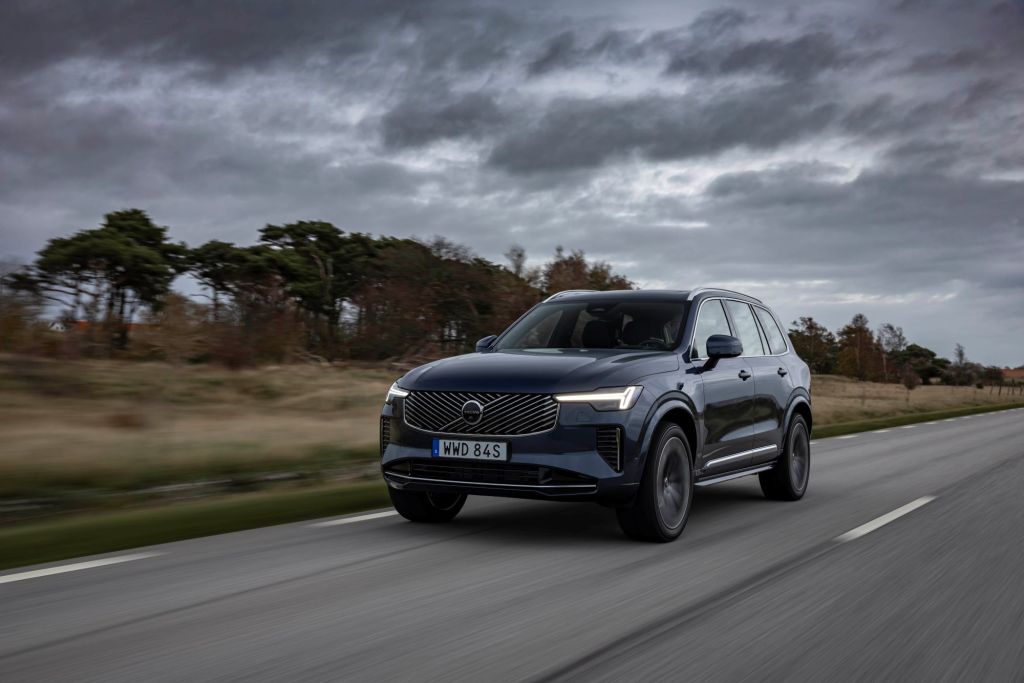
Volvo XC90: Style and substance. (Image: Volvo)
It is a large—seats up to seven—SUV. It has a handsome exterior. Although Volvos were long known for being “boxy,” that’s long gone from the brand’s design language, but there is still a hint of the upright rectangularity in the XC90, which is something of a subtle nod to its roots.
The inside is simply SCANDANAVIAN writ large.
The colors. The materials. The configuration of the seats.
One of the things that Volvo designers have working for them is a long history of a distinctive Swedish design approach that they are able to bring to the vehicle. This is a sort of aesthetic authenticity that makes the vehicle distinctive.
Let’s face it: there are plenty of large SUVs out there so having a solid basis is helpful in differentiating the XC90.
Yes, it has screens—11.2 inches in the center, 12.3 inches for the driver’s gauges—and yes it has an impressive Harman Kardon sound system. But these are the sorts of things that you can find in many vehicles, and many vehicles provide more in terms of screens and sound.
But it is the orchestration and execution that make a difference. Which is where the XC90 really makes a difference.
The vehicle is powered by a 2.0-liter engine. Which might seem like it would be too little for such a big vehicle. But the engine is both turbocharged and supercharged. It produces 295 hp and 310 lb-ft of torque. It moves the mass as necessary.
This is a “mild hybrid,” meaning that it has a 13-hp integrated starter generator and a 48-volt battery system that helps move the vehicle from stops and can add a bit of oomph during hard driving.
The vehicle driven is at the Ultra trim level, which as a starting MSRP of $73,350.
Which might seem like a lot. But then I think back to my colleague’s wife. She has a good sense of what value means.
The jurors of the North American Car, Truck and Utility of the Year (NACTOY) awards made their decisions of the vehicles that take each of those categories, and it is hard to imagine that anyone would be particularly surprised by the vehicles that won the 2026 awards:
Car: Dodge Charger
Truck: Ford Maverick Lobo
Utility: Hyundai Palisade
(Image: NACTOY)
The Charger arrived on the scene initially as a two-door muscle car powered by a 670-hp electric propulsion system. But the Dodge faithful like the smell of gasoline, so there is a 550-hp six-cylinder engine they can opt for. (There is also a 420-hp version, but c’mon.) And there is also a four-door variant.
The presentation of the awards was made at the Detroit Auto Show in downtown Detroit, just about 20 minutes away from Ford World Headquarters, which is a convenience for the truck team at Ford, because with the win for the Maverick Lobo, this means Ford trucks have taken the Ed Welburn-designed trophy for six years running. And it is the second win for the Maverick as the original version of the truck got the nod in 2022.
The second-generation Hyundai Palisade, a three-row SUV with an adult-usable third row, has striking exterior design that wraps an interior with a level of design execution and material-appropriateness that would be impressive in a vehicle with a much higher starting MSRP: $38,935. For those who are at the Detroit Auto Show and looking at the three-row SUVs: start with the Palisade. It is simply the benchmark.
General Motors is a legacy auto manufacturer that positioned itself as an EV champion. Back in 2021 corporate execs, including Mary Barra, chairman and CEO, said they intended to be all-electric by 2035.
Plans change, of course.
“We have to meet customers where they are,” Barra said yesterday at a meeting of the Automotive Press Association in Detroit.
She didn’t mean in a dealership.
GM, like other OEMs, discovered in 2025 that (a) customers were not buying EVs at a rate that had been anticipated and (b) there is still a keen interest in the customer base for vehicles powered by internal combustion engines.
Still, Barra is confident that EVs are the end game so the company is going to keep offering and developing EVs.
She claimed that 80% of EV customers say their next vehicle will be an EV.
She probably wishes, however, there were more of them.
In 2025 GM delivered 169,764 EVs in the US, so if every one of them went into a GM store only 135,811 would come out with an EV.
Barra said that based on what GM analysts have determined it takes about six months to have a good sense of what the real market impact is when something significant happens to the EV market, like the elimination of the $7,500 tax credit at the end of September 2025. So when Q1 2026 wraps up, there will be a better idea of where EVs are going.
She said there are a few things that will make customers more inclined to get an EV. Yes, there is the instant torque provided by the electric motors, which is always something EV enthusiasts cite.
But she said there needs to be (1) more affordable EVs (the average transaction price for an EV in December 2025 was in excess of $58,000 according to Kelley Blue Book, which is certainly not the defintion of “affordable”) and (2) there needs to be a more robust charging infrastructure.
The way things are looking, even if EVs gain great ground there will still be a place for vehicles with engines under their hoods, a place that in non-trivial. Barra pointed out that even if EVs were to take 50% of the market at some point, that still means 50% for gasoline-powered vehicles.
Something you probably didn’t know about NASA—and Alabama
By Gary S. Vasilash
Although when you think of “NASA” Cape Canaveral comes to mind (or Houston, as in “we’ve got a problem”), it is actually the case there is “Rocket City,” and it isn’t in Florida or Texas.
Rather, it is Huntsville, Alabama, which is where Dr. Wernher von Braun and colleagues began work in the 1950s on rockets, like the Saturn V, which launched all Apollo missions, which were the ones that got the U.S. to the Moon.
Of course, the whole space industry is changed, with companies like SpaceX and Blue Origin gaining ground in, well, space.
Huntsville is still home to operations like the NASA Marshall Space Flight Center, which is still working on extraterrestrial programs, like the Artemis II mission and the science operations on the International Space Station.
But like any city, Huntsville is diversifying.
One of the notable changes in the industrial base on Huntsville occurred in September 2021, when the Mazda Toyota Manufacturing plant went into production. (Although it is actually located in Madison, Alabama, it is in the Huntsville metro area and consequently, for geographical convenience, called the “Huntsville plant.”)
Mazda CX-50 Hybrid. Good stance. (Image: Mazda)
The first vehicle built there was the Toyota Corolla Cross. Then, a few months later, in January 2022, a Mazda went into production in the plant: the CX-50.
Here’s something to know: although both the Corolla Cross and the CX-50 are both compact crossovers, they are not based on the same platform. The Corolla Cross uses the Toyota TNGA-C platform and the CX-50 the Mazda Skyactiv-G platform.
What’s more—and it is more—the CX-50 is significantly larger (e.g., the CX-50 is 185.8 inches long and the Corolla cross 176.1 inches).
However, there is something shared between Mazda and Toyota for the hybrid version of the CX-50: the CX-50 Hybrid uses the fourth-generation Toyota hybrid system, which had been used in the previous-generation RAV4, for example. (The 2026 RAV4 moved to gen five.)
So what we have in the case of the vehicle at hand is an inside and outside executed by Mazda and a powertrain from Toyota. Which is a solid combination.
The vehicle has a good stance. While some vehicles in this category are going for a more blocky look, presumably to make them seem as they’re more capable of traveling on terrain that the owners are highly unlikely to ever even see, this Mazda, like other vehicles offered by the brand, provides a stylish appearance.
This is accentuated by the 19-inch alloy wheels. (Yes, 19-inch wheels, certainly something different for a vehicle in this category.)
On the inside, it is clear that this is a contemporary vehicle. What is refreshing, however, is that there is no pretending that this is something that would be tested at the Marshall Space Flight Center. Yes, there is a 10.25-inch infotainment screen and the gauges are in a 7-inch LCD cluster.
Good-looking interior materials and, yes, those are HVAC buttons. (Image: gsv)
And there are buttons for various functions, like controlling the HVAC. (Let’s face it, when you get into a vehicle on a cold winter morning, it is much better to make a quick stab at a button and not have to consult a screen. And speaking of winter, the trim driven here has a heated steering wheel.)
There is red stitching (which seems suited to the brand) on the trim. There is the use of metallic surrounds and accents, both bright and brushed. There is no fake wood, which is an absolute plus, as is the little bit of piano black plastic. The whole execution provides a sense of premiumness and purpose, simple and straightforward.
There are nice details, like a small light on the stalk where the windshield wipers are controlled that illuminates when the setting is for automatic wiping. Sure, this is a small thing, but it is often difficult to determine whether that is on or not. And on the subject of windshield wiping, when you activate the windshield cleaning fluid function rather than a spray on the windshield, the fluid goes through the wiper arms, an efficient approach.
You buy a vehicle for the macro. You live with the micro, like that little light on the wiper control stalk. (Image: gsv)
Another nice thing is the wireless charging pad that is tucked under the front of the arm rest covering the center console. The surface is angled back so the phone is in place better than if the surface was flat. There’s wireless Apple CarPlay and Android Auto, so there is no concern about the positioning of the phone.
About the powertrain: there’s a 176-hp four that’s supplemented by three electric motors (one in the rear to provide AWD) so there is a system horsepower of 219. The vehicle is capable of returning 39 mpg city, 37 mpg highway and 38 mpg combined.
To be sure, the CX-50 Hybrid is in a competitive field. But it more than holds its own.
Toyota’s continuous improvement ethos means that it does mess with success—it makes it better
By Gary S. Vasilash
The first Toyota hybrid, the Prius, was introduced in the US market in 2000.
In terms of chronological time, that’s a quarter century of putting electrified vehicles on the road.
Initially that road was somewhat bumpy as while that first-gen model had some serious fans, as is the case with anything with fans, there were those who weren’t supporters. There was all sorts of grumbling about how inefficient it is to have two propulsion systems and how that was something that Toyota simply could not do. (Many of these people were the same ones who grumbled about a decade before, when Lexus was introduced: it was impossible for the LS 400 to exist with a starting price of about $35,000—Detroit had years and years of Cadillacs and Lincolns so they knew that was the case.)
But Toyota continued with the Prius, generation after generation, and in addition it began putting hybrids into other models in the Toyota showroom (as well as the Lexus facilities).
2026 Toyota RAV4 Limited. (Images: Toyota)
And it made a tremendous statement with the model year 2025 Camry, offering it only as a hybrid. Consider: it has been the best-selling car in the US for decades (with 2025 sales it has held the crown for 24 consecutive years) and Toyota had sufficient confidence in not only the hybrid tech but the market acceptance to make that switch.
Although Toyota sells a lot of Camrys—through the third quarter of 2025, 234,426—it sells a tremendous number of RAV4 crossovers:
Through Q3 2025: 358,134.
To put that in perspective, the combined sales through Q3 of the Ford Bronco Sport (103,261), Escape (114,728), and Bronco (109,921) are fewer than the RAV4 sales: 327,910.
Or the number of Chevy Equinoxes sold through Q3 (203,583) can be added to the Ford Escape sales during the same period (114,728), and that sum, 318,311, is 39,823 units shy of the RAV4 sales.
All of which is to say that the RAV4 is an awfully popular vehicle.
So what did Toyota do for the sixth-generation, all-new 2026 RAV4?
It decided every model on offer—LE, XLE Premium, Limited, Woodland, SE, XSE, GR SPORT—is powered by a hybrid system: a 183-hp four that is supplemented by electric motor(s) such that in front-drive setups there is a total 226 hp and for AWD 236 hp.*
Those models fit in three categories: “Core,” “Rugged” and “Sport.” The Woodland is the “Rugged,” the SE, XSE and GR SPORT are the “Sport,” and the remaining are “Core.”
While it might be imagined that the “Core” models, like the Limited driven for this, would be less visually rugged than, say, the Woodland, on a macro view, the exterior design of the RAV4 is more truck-like than, say, the fourth-generation RAV4—which was the first to offer a hybrid (model year 2016).
All of the 2026 models have a chiseled look.
A purposeful interior.
And that chiseled approach carries into the cabin. While there is an extensive use of polymer-based materials (e.g., while the heated steering wheel is leather-trimmed and the armrests are, too, the front seats are heated and ventilated SofTex, a synthetic leather), the execution is such that it doesn’t look “plasticky,” but the materials are used to their advantage so they look and feel (i.e., there are soft-touch surfaces were one is likely to touch) appropriate.
One nice touch is a slot in the instrument panel that contains two Qi-compatible wireless charging surfaces so the driver and the passenger each have one. (There are also two 45-W USB C ports in the front, as well as a center console media USB-C port, and two 15-W USB-C charging ports in the rear.)
There is a 12.9-inch infotainment screen that runs the Toyota Audio Multimedia system developed by Toyota’s Plano, Texas-based Connected Technology team.
There is also a 12.3-inch LCD-based digital gauge cluster. (The Limited trim comes with a head-up display, too.)
Yes, there are buttons for a variety of functions, like for the front defroster (something necessary to get to quickly on a Michigan winter morning), and a (smallish) knob for the audio.
The vehicle provides 98.9 cubic feet of passenger room and 70.4 cubic feet (second row folded) for cargo.
Which brings me back to the hybrid powertrain.
In this AWD model the fuel economy numbers are 44 mpg city, 39 mpg highway, and 42 mpg combined. Which is certainly nice. (As electric vehicles are always touting range, here’s something to consider: the RAV4 has a 14.5-gallon gas tank. If you drove it to empty, based on the combined range you’d go 609 miles. Yes, there are emissions involved. But fewer than if you were to drive a non-hybrid to empty.)
But the thing is, the fifth-generation Toyota Hybrid System used in the RAV4 is transparent. It just works.
Were I to be working in a dealership I might skip using the word “hybrid” and just say, “This RAV4 gets great gas mileage on regular fuel” and leave it at that.
One of the reasons the original Prius had some problems was because people wanted to know where you plugged it in. (“What do you mean it just uses gas? How do those motor-generator things get power?”)
I suspect there are more than a few people who stay away from hybrids because they can’t figure out how they work. (“Will I be stranded on the side of the road when the battery runs down?”)
So leave it at: this is a powertrain that Toyota has spent 25 years working on and it just works.
With the RAV4 it is wrapped in a nice package. Period.
*There is also a plug-in hybrid RAV4, which has a combined output of 324 hp.
At the end of the day, what really matters about a vehicle. . .
By Gary S. Vasilash
As this vehicle is the last one I am going to write about for 2025, and as this is a performance-oriented hybrid (271-hp 2.4-liter turbocharged four that’s combined with a six-speed transmission with an integrated electric motor and an 80-kW eAxle, all of which means there’s an available 366 hp and 406 lb-ft of torque and as there is what’s called the “DIRECT4” all-wheel drive system), I ought to get all rhapsodizic about the performance that can be realized when that aluminum-trimmed accelerator pedal is pressed.
And I ought to be even more chuffed by the fact that this performance-oriented midsize SUV returns a highly respectable 27 mpg (27 city/28 highway/27 combined).
But a thing that really impresses me about the RX 500h F SPORT Performance is the driver’s seat. Leather-trimmed. Heated and ventilated.
And the most comfortable seat I’ve sat in in any vehicle this year. Comfortable on the bottom. Slightly bolstered on the sides. Really the sort of thing that allows long drives without the usual attendant side-to-side squirming that helps relieve discomfort and/or numbness.
Another thing I like about it is that, yes, it is setup and the position is stored in memory, but that when the power button is deactivated the seat automatically goes back away from the steering wheel and lowers, thereby making egress—and subsequent ingress—easier.
2025 Lexus RX 500h F SPORT Performance AWD (Image: Lexus)
Of course I should be going on about how with the “Black Line Special Edition” package there are 21-inch black alloy wheels and what owners probably feel really good about seeing as they approach the vehicle is that the brake calipers are painted orange and the front ones are massive, telegraphing the message that this is the sporty version of the RX.
Or the tech including a 14-inch touchscreen interface, a head-up display, and Mark Levinson audio.
But here’s the thing. Although it drives smoothly like a Lexus and provides the performance that the aforementioned powertrain setup is expected to provide, although the interior is trimmed throughout with excellent materials that are carefully fitted and matched, at the end of the day of a driving experience, it is pretty much about the driver’s seat. (Yes, the vehicle seats five so there are four other places, but that’s not what interests me as the driver.)
Some may think that’s a silly thing to be so fixated on—what about the charging ports? what about the sunroof? what about . . .—especially when considering something with an all-in sticker of $75,790 (base MSRP of $64,800; $9,640 in options; $1,350 for delivery, processing and handling).
But I’ve been in vehicles this year that have all the goods, a sticker that shows it, and yet was something that I initially enjoyed, but before too awfully long, the fidgeting and twisting set in.
No one buys a vehicle at any price point that they’re not going to be putting some miles on, which means some hours behind the wheel. Without an excellent seat, everything else has, over time, diminished importance.
And this RX 500h F SPORT seat didn’t let me down.
And I might add that while driving it in a Detroit winter, the heated steering wheel was a nice touch.
It isn’t easy—or inexpensive—to be an automotive supplier
By Gary S. Vasilash
One of the things that doesn’t get a whole lot of attention but should is how there is a slow but certain transition of the automotive supply base.
On the one hand there are companies that seemed as though they were fixtures that shifted. Like Continental Automotive being spun out of Continental last April and becoming Aumovio.
Previously Continental spun off its Powertrain division. It became Vitesco. Vitesco was acquired in the fall of 2024 by Schaeffler and that name is now gone.
Today ZF announced it sold its advanced driver assistance systems (ADAS) business to Harman International.
In the case of Vitesco to Schaeffler, it is a fairly understandable shift, as Schaeffler has a Powertrain & Chassis Div., as well as others that are in that sphere (E-Mobility, Vehicle Lifetime Solutions (a fancy way of saying “aftermarket”), and Bearings and Industrial Solutions).
At first blush the ZF sale of its ADAS business to a company that may be more well known for its automotive audio brands—Harman Kardon, Infinity, JBL, Lexicon, Mark Levinson, etc.–Harman International.
But Harman, which was acquired by Samsung in 2017, has been more deeply involved in automotive tech than might be expected. It has been developing various systems that provide a wide array of driver information, taking advantage of its screens, software, and connectivity.
All of those are nicely complimented by the ZF ADAS acquisition.
But ZF?
This brings up something else that doesn’t get a whole lot of attention.
Given things ranging from the tariffs to the consumer demand for electric vehicles that didn’t grow as anticipated, automotive suppliers are under significant economic pressure.
In making the announcement, Mathias Miedreich, CEO of ZF, said, in part, “the transaction will help to significantly reduce ZF’s financial liabilities. The sale enables us to focus our resources on those core ZF technologies such as chassis, powertrain, commercial vehicles, and industrial applications in which we are global leaders.“
It wasn’t that long ago that ADAS was one of “those core ZF technologies.”
Realize that there will be more demand for ADAS going forward, not less.
But there is an on-going need to advance capabilities in that space, and that takes large, consistent investment.
Evidently the ZF board recognizes that for the good of the company at large those investments are not something that it can sustain. So the sale.
As for Harman, this is a great opportunity.
And let’s face it: with a corporate parent like Samsung, which has a market cap on the order of $499 billion, access to development funds is probably not going to be a significant issue.
If only there was a higher profile and consistent position for the company. . .
By Gary S. Vasilash
I’ve long thought that Mazda would be a bigger factor in the overall auto market. Cox Automotive currently puts the OEM’s market share at 2.5% which, oddly enough ties it with BMW and puts it ahead of Mercedes (2.1%). Mazda, of course, isn’t in the higher end of the market, which explains why those two companies are where they are in the overall market.
But Mazda has an array of vehicles on offer, most of which are under $40,000, and several under $30,000, like the vehicle in question here, the CX-30, a subcompact crossover that puts it in a competitive space with vehicles like the Kia Seltos, Honda HR-V, and several others.
The “several others” is something notable because this is a highly crowded space. Which leads to another thing about Mazda, which is its comparatively small dealer body. Based on a Google search of Mazda and Honda dealerships in Michigan, Mazda has 17 and Honda 29—and Ford and Chevy are in triple digits.
So when you don’t drive past dealer lots with vehicles, or if you don’t see Mazdas parked in driveways in your neighborhood, odds are things like the CX-30 aren’t going to be on your shopping list if you’re considering a new set of wheels.
And then there is the issue of just what a Mazda is. Once it was the sporty alternative to the likes of Honda, Chevy and Ford, primarily based on the Miata (a.k.a., MX-5) as well as the enthusiast reviews of other models that cited their superb ride and handling. None of that is gone except for the sporty positioning in the market.
On the homepage of the Mazda site there’s this:
WHERE INTENTION MEETS INNOVATION
FOR THOSE WHO DO MORE THAN MOVE
We craft vehicles with the power to transform every drive into a meaningful experience. When you’re behind the wheel, you’ll feel how our design, craftsmanship and technology come together to bring you closer to your passions and your journeys.
Which sounds good, but I have no idea what it means.
I mean, I went to the grocery store in it and must confess I didn’t find it to be a “meaningful experience.”
I guess the copywriter must be a frustrated poet or something. The message doesn’t say what the vehicle is. (And doesn’t everyone “Do More Than Move”?)
Mazda CX-30. Visual presence and good mechanicals make a solid package. (Image: Mazda)
No one at Mazda HQ asked, but were I positioning the CX-30 I would concentrate on things like this:
Standout exterior styling. Yes, there are all of those other subcompact crossovers out there, many of which are simply cookie-cutter shapes. There is style and reach in the sheet metal of the CX-30.
Segment-up interior materials. This is something that is increasingly important. Arguably this is something that Kia and Hyundai have drawn attention to and that not all OEMs are following. Mazda does a good job on paying attention to the various surfaces on the inside of the vehicle, not providing what seems to be a default in many cases (especially in this segment), seeming cubic yards of fake carbon fiber or piano black. There is artificial suede used to wrap sections of the instrument panel, but it looks luxe.
Excellent drivability. The CX-30 has a 186-hp four-cylinder engine that provides fuel economy of 24/31/27 mpg city/highway/combined. It is mated to a six-speed automatic, which may seem a couple gears short (the Kia Seltos, for example, offers eight), but often in this segment it is a continuously variable transmission (CVT), so Mazda is still offering a step-gear arrangement. It has a “manual” mode and a “sport” mode for those so inclined but I suspect that they are something used by the kids who borrow the fob from their parents. All CX-30 models come with all-wheel drive (“i-Activ AWD”) and “G-Vectoring Control Plus” and “Off-Road Traction Assist.” Just know that it drives well.
Perhaps this goes to the point of the company doing a solid job in shaping sheet metal and making the mechanical aspects of the vehicle work so well, but I find the sore spot its infotainment interface. But it does offer wireless Android Auto and Apple CarPlay, so once either is set up, there’s no need to look at the Mazda execution of that.
So now that you’re aware of the Mazda CX-30, perhaps you should give it a look if you’re in the market for a solid, stylish package.