2025 Hyundai Elantra Hybrid Limited

This is an impressive package, especially for those who like to not frequent gas stations

By Gary S. Vasilash

The current-generation Hyundai Elantra, the seventh, is not what one might think of when pondering the sedan.

That is, you might think “Compact car,” with the bigger Sonata being “midsize car.”

But it turns out the Elantra, which measures:

  • Length:                            185.4
  • Width:                              71.9
  • Height:                            55.7
  • Wheelbase:                  107.1

is actually in the EPA “Midsize” segment. (And, yes, Sonata “Full-size.”)

The Elantra is a sizeable sedan (comparatively speaking, of course) and there’s plenty of interior room—as in 99.4 cubic feet in the passenger compartment—as well as adequate cargo-carrying capacity—14.2 cubic feet.
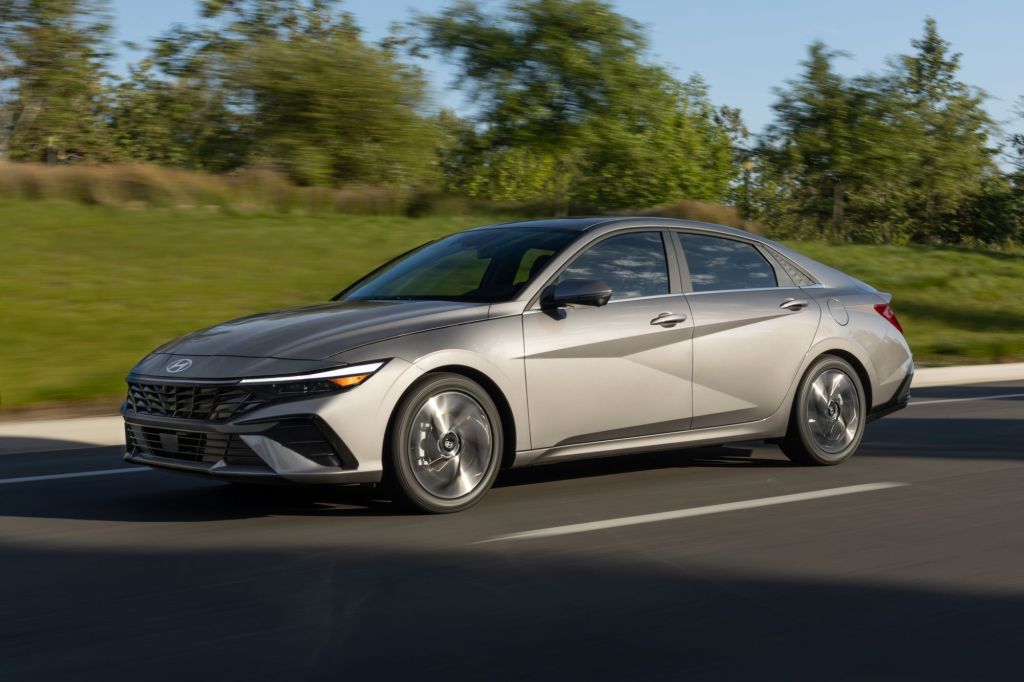
2025 Elantra Hybrid: stylish and with ~500 miles on a tank of gas, it is quite a compelling package (Image: Hyundai)

The exterior sheet metal has an array of creases and facets that make the car continue to have a distinctive appearance, even though model year 2021 is when the body styling first appeared on the car. Making something look fresh for that many years is no mean feat.

The interior has a clean look. Meaning that it is not overwrought. There are a 10.25-inch digital gauge cluster and a 10.25-inch infotainment screen. It is hard to imagine anyone needing any more digital real estate than that in a car. There are actual buttons to control the HVAC. There is a Drive Mode button that allows the selection of Eco, Smart or Sport; when making a selection the colors on the gauge cluster change (e.g., go Sport and there’s, of course, red).

The seats, covered with a simulated leather (H-Tex), are comfortable. The rear seats can accommodate adults, but odds are if you’re taking some colleagues, say, out to lunch, they’re going to be calling “Shotgun.”

One of my quibbles is the drive mode defaults to Eco. I would have liked it to stay in Smart because that adjusts the throttle and the transmission based on driving conditions.

“Sport?” you wonder.

Yes, there is a discernable difference in performance when making that selection.

But we’re talking about a hybrid here. It has a 1.6-liter Atkinson Cycle engine that produces 104 hp and 109 lb-ft of torque; with the 32-kW electric motor supplement the output is increased to 139 hp and 195 lb-ft. The Elantra Hybrid has a six-speed dual-clutch transmission (a transmission type that is becoming increasingly rare).

The point is, this is about fuel efficiency, not leaving the other vehicles behind when the light turns green.

And on the subject of fuel economy, the sticker says 49 mpg city, 52 mpg highway, and 50 mpg combined. I found my driving experience to be closer to the 49 mpg overall than the 50, though I did switch drive modes every now and then—yes, including Sport, which was handy in freeway driving.

The MSRP for the this top-trim hybrid is $29,450, It is quite an impressive package for the price for at least a couple of reasons.

First, there is the fuel efficiency that the hybrid provides. Consider that with its 11-gallon fuel tank it is good for about 500 miles before having to go to the local Shell station.

Second there’s the MSRP. For a not-very-large car payment, with the Elentra Hybrid you can get a lot of car. What’s not to like about that?

Toyota: Steady and Slow. . .

. . .well, maybe it won’t outright win the race, but its approach to technology sure seems like the right one. . . .

By Gary S. Vasilash

You may recall that not long ago Toyota was being chastised for being insufficiently aggressive in pursuing an electric vehicle strategy. It seemed as though Toyota would be like a vehicle abandoned by the side of the road, striped and desolate.

It isn’t that it wasn’t putting EVs on the road. Just not enough of them. And not just with the sort of capability that would be expected of Toyota. So went part of the criticism.

Akio Toyoda was considered backward for taking an approach that would have powertrains suited to varying needs, whether it is a straight ICE, a hybrid, a plug-in hybrid, a battery electric, or even—in exceedingly limited quantities at least—a hydrogen electric setup.

Turns out that this steady approach is actually one that is winning in the market.

According to Kelley Blue Book in Q1 2025 there were 296,227 EVs sold in the U.S.

That’s from 25 brands.

In Q1 2025 Toyota (including Lexus) sold 110,225 hybrids. That’s about 37% of the number of all the EVs sold by all of those other companies. And while those brands are struggling to make money from EVs, presumably Toyota isn’t putting hybrids under the hoods of a mulitude of vehicles because it isn’t making money selling them.

So doing what it is doing powertrain-wise is probably not a bad decision on Toyoda’s part.

Another area where Toyota wasn’t as visibly bullish as some other companies is in autonomous driving.

No real analogue to Cruise Automation or Argo AI.

There was (and is) the Toyota Research Institute, but they were doing other things, too.

And now there is no Cruise Automation. No Argo AI.

And this week Waymo and Toyota announced they’ve “reached a preliminary agreement to explore a collaboration focused on accelerating the development and deployment of autonomous driving technologies.”

Waymo is clearly the leader in the U.S. in autonomous driving tech, with the company offering rides in the San Francisco Bay Area, Los Angeles, Phoenix, and Austin.

Also this week May Mobility, an autonomous vehicle tech company, and Uber announced a partnership that will have autonomous vehicles available for ride-hail in Arlington, Texas, by the end of the year.

The vehicles for the Arlington program?

Toyota Sienna minivans. (They’re hybrids.)

Toyota is a strategic partner in May Mobility.

Toyota Sienna hybrid minivans will be used in the Uber/May Mobility deployment in Arlington, Texas. (Image: Uber/May Mobility)

2025 Genesis GV80 Coupe 3.5T E-SC AWD

Looks good. Drives well. And is full of high-quality materials and top-notch tech

By Gary S. Vasilash

All of that alphanumeric nomenclature isn’t particularly telling unless you happen to be a cipher expert and have the key necessary to decode it.

And one of the points that isn’t made in all of that but should probably be made clear is that, yes, the roofline, which swoops down toward the rear and resolves into a kick-up spoiler, is coupe-like.

But (1) coupes typically have two doors and this has two. And (2) coupes are generally cars and this is an SUV.

And what an SUV it is.

Genesis GV80 Coupe: presence and appropriate performance. (Image: Genesis)

Of the many vehicles I have driven of late, none has garnered the positive attention that this one has, from both strangers (I encountered a couple in a parking lot admiring the GV80) and relatives (a brother-in-law who has seen the panoply of vehicles I’ve driven and for the first time asked me to give him a ride).

Maybe it has something to do with the fact that, comparatively speaking, and especially in southeastern Michigan, Genesis vehicles overall are rare.

But likely it has more to do with the execution of exterior and interior design that is exceptional.

Outside

In the front of the vehicle there is the familiar crest-shaped grille, which is bold but not in-your-face. The headlamps are two lines (the two lines are a design theme of Genesis models) that seem to be much narrower than might be expected for the lights.

And it isn’t’ simply an issue of seeming: they’re using “Micro Lens Array” tech that allows the light to do their work yet in a form factor that is smaller than is ordinarily the case.

There is also restraint in the use of chrome trim on the body side, mainly used in the door undercut above and in the area below the rocker panels.

Inside

Nappa leather seating surfaces. Actual carbon fiber trim (and plenty of it). Microfiber suede headliner (no, not actual suede leather, but not only does it look like it, it also looks a heck of a lot better than tricot or other fabrics typically used).

There are power front seats. And power second row seats. The driver gets a power cushion extension, bolster, and massage function.

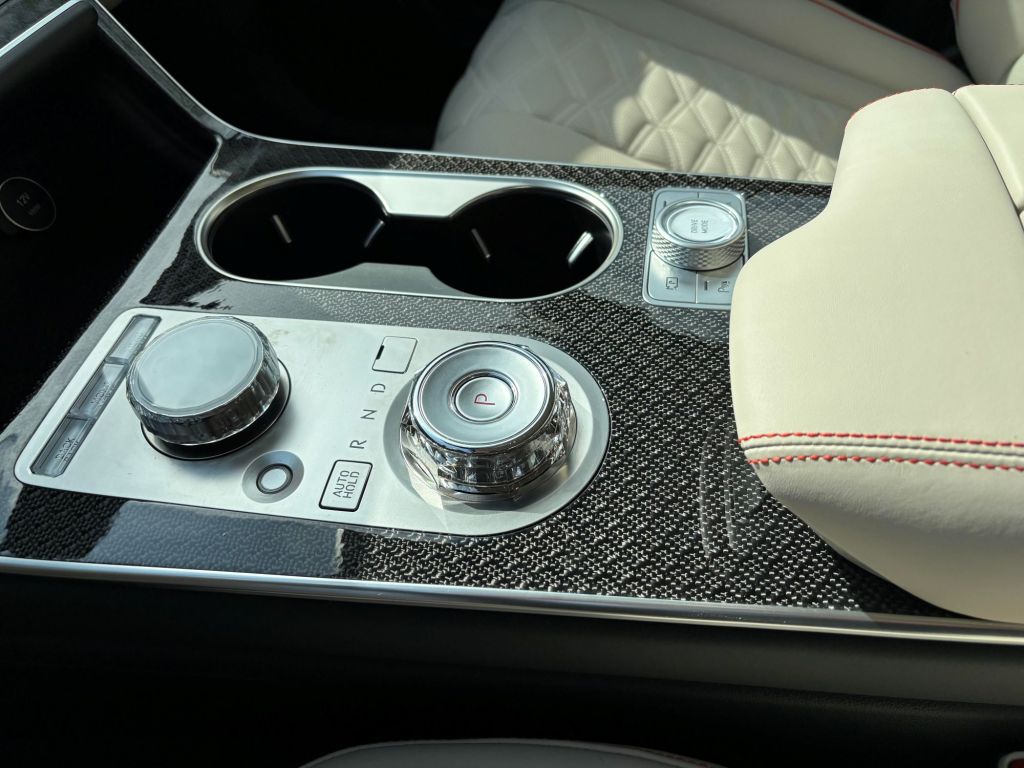
Note the carbon fiber and the color of the stitching—to say nothing of the knurled knobs that provide an interface to the infotainment system and gear selection. (Image: Vasilash)

Sometimes when there is a coupe design the second row suffers in terms of headroom. In the GV80 Coupe the front headroom is 40.2 inches and the rear is 37.6 inches. Two points about that: (1) I had a six-footer in the second row who was perfectly comfortable; (2) that second row measure is merely 0.8 inches less than the headroom in the non-Coupe GV80, so it is not like a lot is being given up.

Power

Here we get to the rest of the nomenclature in the name of the GV80 Coupe.

The powertrain is a 3.5-liter twin-turbo V6 with a 48-Volt e-Supercharger. (What’s that? An electric motor that compresses air and forces it into the engine intake, which improves combustion. This means it improves performance. It is more efficient than traditional mechanical superchargers or turbochargers. But, of course, it is more sophisticated.) It is mated to an eight-speed automatic. There are, not surprisingly, paddles on the steering wheel should you want to shift it yourself.

Tech

On the inside there is a 27-inch-wide OLED screen. What’s notable about this is that it is comparatively restrained compared to other vehicles in its class that have screens so big that they pretty much silently scream “Look at me! I am a giant screen!” The screen in the Genesis does everything necessary without digital ostentation.

The vehicle is “Cloud Connected,” which means everything from over-the-air (OTA) updates to dynamic routing in the navigation.

There is an 18-speaker Bang & Olufsen audio system.

Then there is the sensor-based functions ranging from cruise control with stop and go capability to parking avoidance assist (front/side/rear).

Price

One could say that this is a “total package,” and it is: the vehicle Driven, chock full of things that would otherwise be options on competitive vehicles, had a base MSRP of $85,750. It had two options: $650 for the paint and $30 for an NFC keycard (the size of a credit card, this card used Near Field Communication technology and provides a backup for the key fob or smartphone; it allows unlocking and starting the vehicle). The point is that while that may seem to be a steep(ish) price, again, there is so much in terms of high-quality materials and tech that were much of these things to be itemized, I’m sure the vehicle would be much more costly.

Cybertruck Repairs Can Be Expensive (to Understate the Case)

Edmunds.com found out just how expensive. And the truck was parked when the collision occurred

By Gary S. Vasilash

Although you’re likely to find a friend, neighbor, relative or even yourself who has a car-repair horror story, it is unlikely to top the one that the folks at Edmunds.com have with their Telsa Cybertruck.

According to the resource for auto information and available inventory, in July 2024 it bought a Cybertruck Foundation Series for $101,985.

The truck would undergo the Edmunds One-Year Road Test program.

But five months in, last December, the Cybertruck was involved in an accident.

The massive vehicle was parked. A compact sedan crashed into the driver’s side rear wheel and bumper so hard that it broke part of the rear axle.

Edmunds found that it needed to use a Tesla certified body shop in the LA area, where the outlet is based.

Turns out there were just two in a 50-mile radius of LA.

Here comes the tricky part.

One of the shops was in Huntington Beach. It had a one-month waiting lists. Then it indicated there would be six more months before the vehicle could be worked on.

Realize this would mean the vehicle would be towed to the shop, assessed, then towed to somewhere it would collect dust for six months before being towed back.

The second shop in Ontario, California, told Edmunds there was a one-month wait, but that after the inspection was made, it would get to work right away.

An appointment was made. And then delayed by another month.

Still, they took the truck in and after a thorough inspection that cost $1,128, got the repair estimate:

$57,879.89

The single biggest charge would be $9,149 for the rear suspension. The cost for the bed was close, at $8,762.79.

Because the value of the truck at the time were it not in the state it was would be $86,160, it was considered a total loss.

So Edmunds simply sold it to the online auction site Copart.

And got $8,000.

The price of repairs that was on the estimate for the Cybertruck is a few grand under what it would cost to buy a new 2025 Ford F-150 Lariat.

Tesla Tanking in the EU

It is down in Q1 by a big number. A very big number.

By Gary S. Vasilash

Although there are plenty of headlines about Tesla sales dropping 37.2% in Europe during the first quarter of 2025 compared to Q1 2024, it is actually a bit worse than that.

The European Automobile Manufacturers’ Association (ACEA), which reports the numbers, has two charts for new car registrations by manufacturer.

One is for the European Union.

One is for the European Union, the European Free Trade Association (EFTA) countries (Iceland, Liechtenstein, Norway, and Switzerland), and the United Kingdom.

The 37.2% drop is for the EU + EFTA + UK market.

While that combined market is bigger than the EU alone, the EU market alone had EV sales of 412,997 EVs in Q1 and the EFTA and the UK added only 160,503.

Obviously that EFTA + UK number can change the overall percentage.

But the trend in the EU itself is the one that is the more important.

The EU-only chart shows that Q1 2025 Tesla sales are down 45% compared with Q1 2024.

While there may be excuses about changeovers and Q1 not being great for sales, and it is true that there are negative numbers for several OEMs in the EU—for example, Stellantis -14%, Toyota -4.8%, Hyundai Group -7.2%, Mercedes -6.2%–but no OEM is off as much as Tesla.

Not All Red Ink

What’s more (truly more) is that the ACEA finds that Volkswagen Group for Q1-Q1 is +4.8%, Renault Group +9.5%, and BMW Group +0.4%.

Of all the countries in Europe—including the EFTA and the UK—the single biggest market in Germany. Where Tesla has a plant. And where Elon Musk became involved in politics.

Germany’s Robust EV Sales

During the first quarter of 2025 sales of battery electric vehicles in Germany were up 38.9% compared with Q1 2024.

There were 112,968 EVs sold in Germany in Q1. It is the dominant factor in all of the numbers.

While it is probably impossible to know precisely why Tesla sales were down 45% in the EU in a period when EV sales were up 38.9%, it isn’t hard to imagine why.

The Cadillac Optiq Going V-Series

Although you have likely not seen the vehicle in person yet, it is likely to become something that you see a lot of. And Cadillac has now announced a performance variant

By Gary S. Vasilash

In the compact luxury EV crossover segment Cadillac has an exceedingly fine entry in its Optiq. (One problem it may have, however, is the name: might some people not find its pronunciation troubling and so as not to embarrass themselves, go to the Audi store that’s next door and ask about the Q4, instead?)

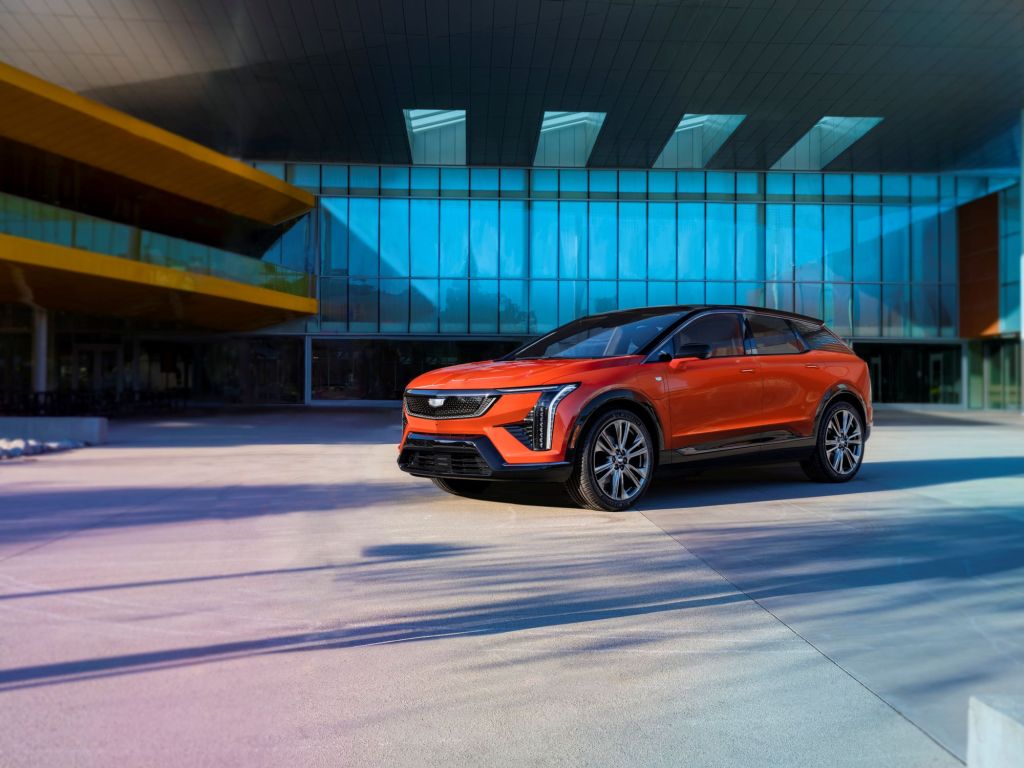
2025 Cadillac Optiq: a stylish compact crossover. (Photos: Cadillac)

The vehicle has a powertrain that provides 300 hp and an EPA estimated range of 302 miles.

It has an interior with an innovative freshness that undoubtedly will help skew Cadillac’s mature ownership numbers far lower.

And with the second row up it provides 26 cubic feet of cargo capacity—57 with it down—so there is actually more than a modicum of utility provided, an important consideration for one’s daily existence with a vehicle.

Right out of the box there were 1,716 Optiqs sold in the first quarter—502 more than the Cadillac CT4, so that’s saying something (although it is a bit of an apples-to-oranges comparison, as the CT4 is a sedan with an internal combustion engine).

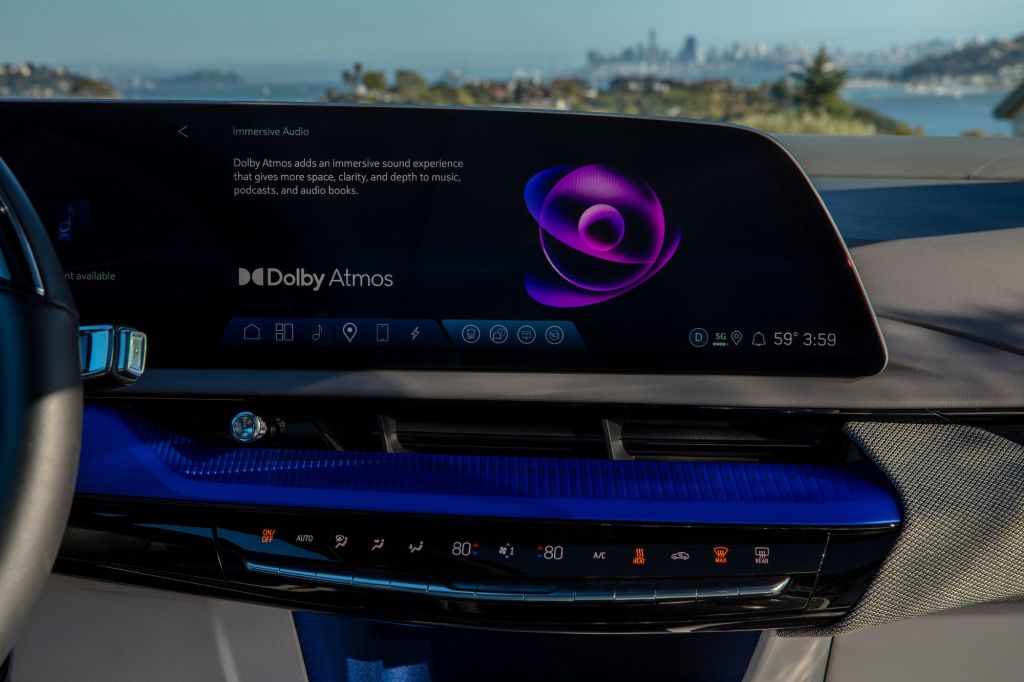
The interior is fashion-forward. Yes, it has a big screen (33-inches, diagonal) but the color and materials are much more impressive.

Undoubtedly planning to juice that number, today Cadillac announced there will be a 2026 Optiq-V series vehicle.

Details are, well, non-existent (beyond “Cadillac engineers delivered a unique package prioritizing precision, dynamic suspension and tight steering,” which is pretty much marketing-speak).

One thing that is likely the case is that the 2026 Optiq-V will have a non-trivial bump in its starting MSRP (according to Cadillac.com, the starting price for a 2025 Optiq is $52,895), not only because of what the Cadillac engineers have done, but because the Optiq is produced at a GM plant in Ramos Arizpe, Mexico.

2025 Toyota Corolla FX: Who Knew There Are So Many Corollas Out There?

An accessible vehicle that happens to be a car. . .

By Gary S. Vasilash

The Ford Model T was in production from 1908 to 1927. During that time there was an array of variants. Touring cars and coupes. Four doors. Two doors. No doors. Sedans and convertibles and wagons.

In all, an impressive >15 million were sold.

The Volkswagen Beetle is another car that had an impressive run. Between 1938 and 2019 there were some 22 million Bugs of various types sold on a global basis.

But those cars pale in comparison to the Toyota Corolla.

The Corollas was introduced in 1966. Since then, more than 50 million have been sold globally.

Yes, add all the Model Ts and Beetles and it is still considerably less than the Corolla.

Last year in the U.S. there were 232,908 Corollas sold.

If you take the F-Series out of the picture, there was no Ford brand model that came close in terms of 2024 sales. There was the Explorer at 194,094, but that’s 17% fewer than the Corolla.

And it is a similar situation at GM. Again, absent the pickups, the best-selling model in 2024 was the Chevy Equinox, at 207,730 vehicles. Closer, but no cigar.

(If we want to go down the SUV road: there were 475,193 Toyota RAV4s sold in the U.S. in 2024. . . .)

So far, the Corolla continues to perform:

Through Q1 2025 there have been 55,456 sold.

The Explorer is inching closer at 47,314 and the Equinox exceeds it with 71,002, but again, both of those vehicles are SUVs, so that would bring us to the RAV4’s Q1 sales of 115,402.

If you combine the Explorer and Equinox sales, that’s 118,316, or 2,914 more than the RAV4, to put things into some sort of perspective.

Chevy, Ford and Toyota are all, essentially, bread-and-butter brands. They’re making vehicles for most of us.

But what is surprising, given the Corolla’s clear consistently large sales—globally and in the U.S. market—is that you can’t buy a car from Chevy and the only car that Ford has in its lineup is the Mustang. That’s not exactly a mainstream model. (And to put its sales into perspective: in 2024 there were 44,003 Mustangs sold, which means that in the first quarter of ‘25 Ford moved more Explorers than Mustangs in all of ’24.)

(Another thing to be noted about Toyota and cars: last year in the U.S. it sold 309,876 Camrys. It has sold 70,308 through Q1 of ’25. Yes, a lot of cars.)

The thing about the Corolla is that like the aforementioned Model T and Beetle, it is primarily an accessible vehicle.

About the FX

The vehicle driven here, the FX, is based on the Corolla SE grade, but has been amped up a bit for a sportier look.

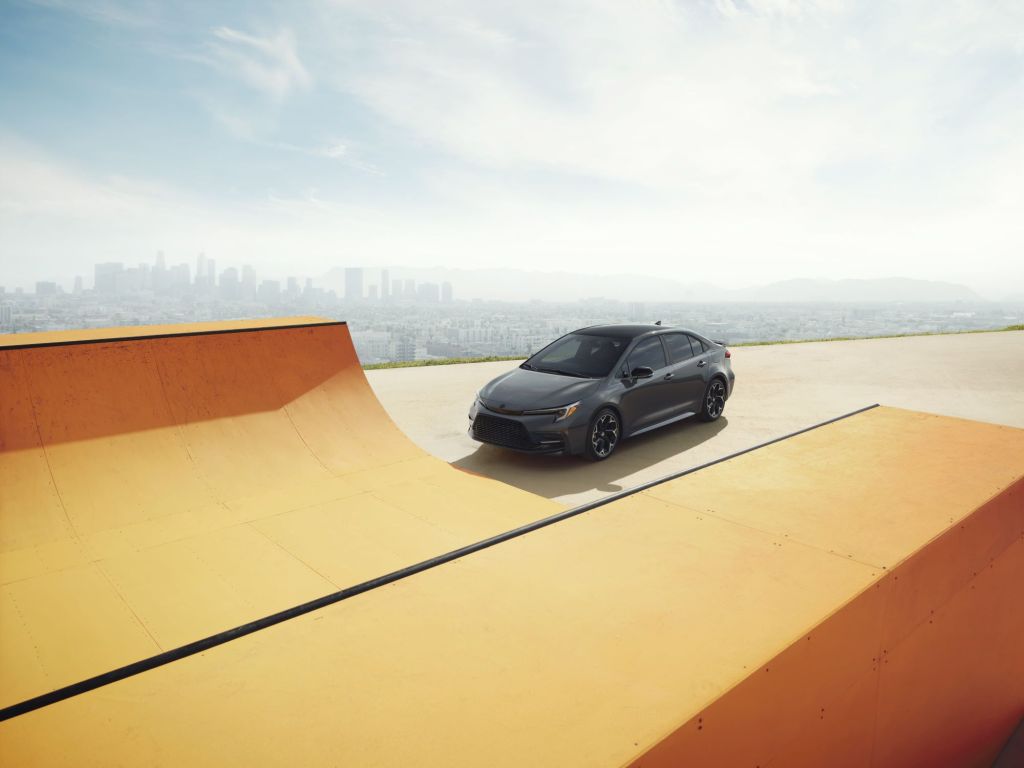
Corolla FX: Accessible style. (Images: Toyota)

Achieving that look includes a sizeable spoiler, satin-black 18-inch alloy wheels with black lug nuts, and a blacked-out roof.

Powering the car is a 169-hp four-cylinder engine. There are three drive modes: Eco, Normal and Sport. This car isn’t going to win any races. But hundreds of thousands of people who have bought Corollas over the past few years likely don’t even know where a racetrack is located, and probably don’t have any points on their licenses for speeding.

On the inside things are, as they might say, “jazzed-up” a bit with the use of orange stitching on the seats and trim.

There is a 10.5-inch infotainment screen. Where there are knobs for HVAC settings, curiously no volume or tuning knobs for the audio system. You adjust the volume either with a steering wheel button or a diminutive rocker button just below the screen, which is a bit tricky to use unless you’re sitting at a light.

It’s got the goods on the inside. (But if only one of those knobs on the IP was Volume for the audio.)

Affordability

One of the reasons—in addition to the reliability, durability and quality Toyota vehicles are known for—people buy Corollas is because they’re affordable.

The MSRP prices range from $22,325 for an LE to $28,190 for a Hybrid XLE. (These numbers are pre-Liberation Day, so who knows what anything will cost going forward.)

This FX Edition has a starting MSRP of $26,500. Throw in a few options ranging from a blind-spot monitor with rear cross-traffic alter to an LED trunk light, adding $1,644, put in the handling fee of $1,135, and it is out the door for under $30,000: $29,279.

And there aren’t a whole lot of other cars you can say that about—unless, of course, you’re talking about Corollas, and then there are a whole lot of them.

In Addition

A couple other things to know about the Corolla.

One is that it is based on the Toyota TNGA-C platform, which doesn’t mean much in and of itself. What is important to know is that it is a global platform. Which means that it is being used as the basis of vehicles all around the world. Consequently, because of economies of scale it can be engineered and built with more robustness than a platform with a more limited scale—well, that limited-scale platform can certainly be produced with desired characteristics but it will be a whole lot more costly.

The point about the platform is that it is solid, not tinny.

Second, the Corolla driven here was built. . .in Huntsville, Alabama, at the Mazda Toyota Manufacturing plant. Yes, a compact car built in the U.S.

Genesis: Clever Exterior Color for Racing

Going fast. And paying attention to detail. . .

By Gary S. Vasilash

Because of the seemingly obligatory nature of being a luxury brand and having a racing team of some sort—in this case, Genesis Magma Racing participating in the 2025 European Le Mans Series with an objective to compete in the FIA World Endurance Championship (WEC) in 2026 and the IMSA SportsCar Championship (IMSA) in 2027—the company has developed a LMDh endurance prototype hypercar that is intended to be the precursor to a bona fide vehicle that will run in the WEC and IMSA events in the future.

Of the vehicle, which was designed at Genesis Design Europe, Luc Donckerwolke, Genesis Chief Creative Officer, said, “The GMR-001 Hypercar, like every race car, is a sculpture designed by the constraints of efficiency and performance – combined with the design DNA of Genesis – the brand with the Two Lines.”

The two lines mentioned are the lighting signatures, both front and rear.

Genesis gets creative with color. (Image: Genesis)

While there was particular attention paid to making the vehicle as aerodynamic as possible, there are a couple of interesting non-aero design elements worth noting:

  1. The paint. The primary color is “Magna orange.” The color starts bright at the front of the vehicle then becomes darker as it moves toward the rear. There it is deep red. This is to indicate both the engine (i.e., red hot) as well as sound: The Doppler effect. That is, the sound is a higher pitch when the object—like a race car with a twin-turbo V8—approaches you and then becomes lower as it moves away. So brighter to darker, higher to lower.
  2. The use of Korean Hangeul lettering spelling “Magna” integrated into the design 마그마.

In both cases, it is indicative of the attention to detail that you can find in vehicles at your local Genesis dealership—vehicles that aren’t going to compete in any race series, but which do have the Two Line lighting.

2025 Volvo XC90 T8 PHEV

When you need something big but still want to have efficiency. . .

By Gary S. Vasilash

For good reason the folks at Volvo are chuffed with the EX90.

That’s the company’s flagship, seven-passenger SUV. The one that’s all electric.

But the vehicle in question here has a slight modification of the alphanumeric designation: XC90.

It is the company’s flagship, seven-passenger SUV. That features a gasoline engine.

In this case it is a 310-hp, 2.0-liter, four-cylinder turbocharged engine.

But also in this case, that engine is supplemented by an AC electric motor.

A hybrid powertrain.

And as a result, the output is a maximum 455 hp.

When I had the XC90 a colleague, who races—and I mean at places like Sebring, not up and down Woodward or Telegraph–, said, “Oh, you’ve got the quick one.”

Think on that a moment.

Here’s a vehicle that is 195 inches long, 76.1 inches wide, 69.7 inches high.

A vehicle that has three rows.

A vehicle that provides, with the second and third rows folded, 85.7 cubic feet of cargo capacity.

And my colleague described it as “quick.”

No, he wasn’t suggesting that this is something he’s going to take to the track.

But he was pointing out that for something of its size, something that is largely meant to be about getting from here to there and Costco in between, it really moves well.

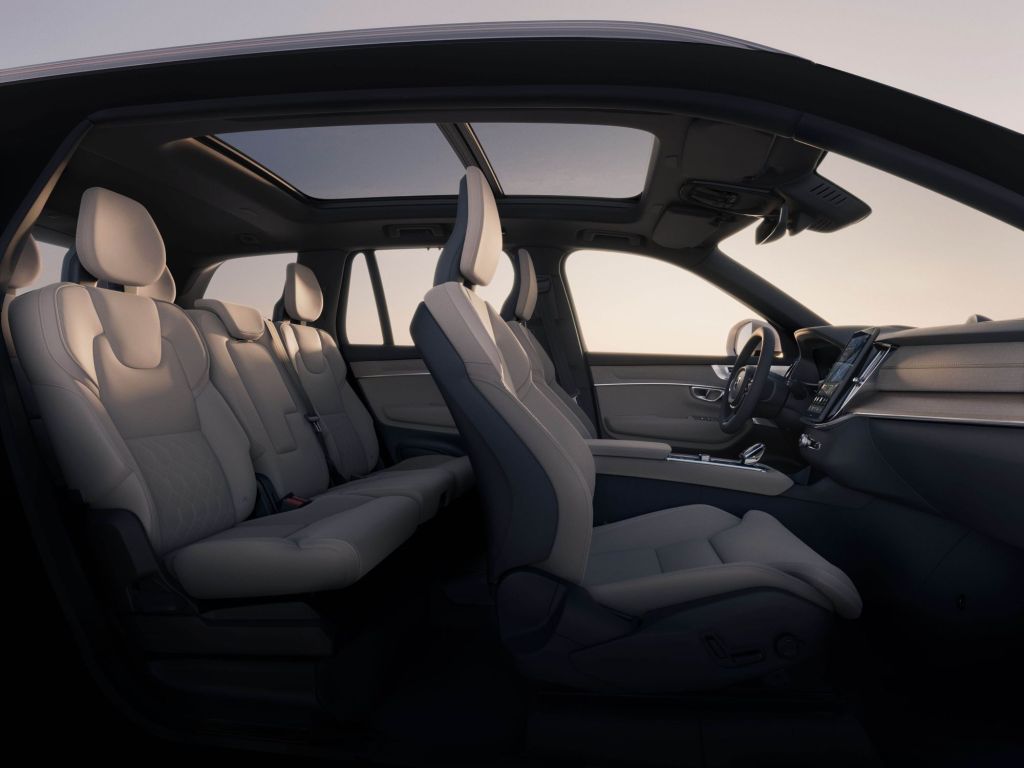
Three rows, hybrid power and overall competence: XC90 T8 PHEV (Images: Volvo)

The Distance

As mentioned, this is a hybrid. But it is a plug-in hybrid (PHEV).

Which means that on the driver’s side front quarter panel there is what seems to be a fuel door—but that’s on the passenger’s side rear quarter panel.

The one on the front is the socket to charge the vehicle. A Level 2 charger will get it filled in about five hours.

The point of a plug-in hybrid versus, well, a hybrid, is that there is a comparatively extended all-electric range.

The XC90 PHEV provides up to 32 miles running on electricity alone.

However, the estimated combined fuel—as in gasoline—economy is 27 mpg.

So given that there is an 18.8-gallon tank, if you were to want to leave yourself a margin of 0.8 gallons, you could drive for 486 miles.

In other words, no worry.

The Difference

One of the things that one might say is that there are plenty of three-row SUVs out there, even luxury hybrids (BMW, Lexus, Land Rover, Lincoln. . .).

So how does one decide?

I think all else being relatively equal, one of the places the XC90 is really an achiever is in the interior execution.

While other brands all have seats that move this, that and the other way, all you have to do is open the door and look at the driver’s seat of the XC90 and you know that this is purposeful Scandinavian design.

If you’re driving 32 miles or 486 miles, you’re in the seat. It might as well be a superb one.

Inside the XC90

Portable Power Quiet and Clean

Honda knows more than a little something about internal combustion engines that are smooth, quiet and low-emissions. These are used for new generators.

By Gary S. Vasilash

When power goes out—or you need power in places where a plug isn’t readily available—some companies are suggesting that the solution is using one’s vehicle to power whatever.

This, of course, is an electric or a hybrid vehicle.

Which is a reasonable idea. Except in cases where someone might actually need to go somewhere in that vehicle. That would result in no power.

So an alternative is a gas generator.

However, there are a couple of issues related to these.

One is that they can be rather noisy.

Another, for those living in California, is that emissions regulations can make gas generators unobtainable.

You could buy an electric pickup truck and use it when your power goes out, or you could simply buy one of these and get whatever vehicle you want–and can afford. (Image: Honda)

Honda Power Sports & Products has cleverly engineered two generators that meet both U.S. EPA Phase 3 emissions standards and California Air Resources Board (CARB) Tier 4 compliance requirements.

Consequently, those in California can go to a local retailer and pickup the Honda EU33200i Super Quiet Series and/or the EU7000is Super Quiet Series.

The names indicate the noise attenuation.

The first-named produces 3,200 watts of power and the latter 7,000 watts.