Because factories have a large carbon footprint. . .
By Gary S. Vasilash
Although the public-facing efforts vehicle manufacturers are making with regard to their environmental credentials are mainly focused on the electrification of vehicles, if the total lifecycle assessment (LCA) of a given light vehicle is assessed, there is an element of that vehicle that is responsible for a considerable amount of emissions: manufacturing.
For a gasoline vehicle, production can account for 23% of its LCA.
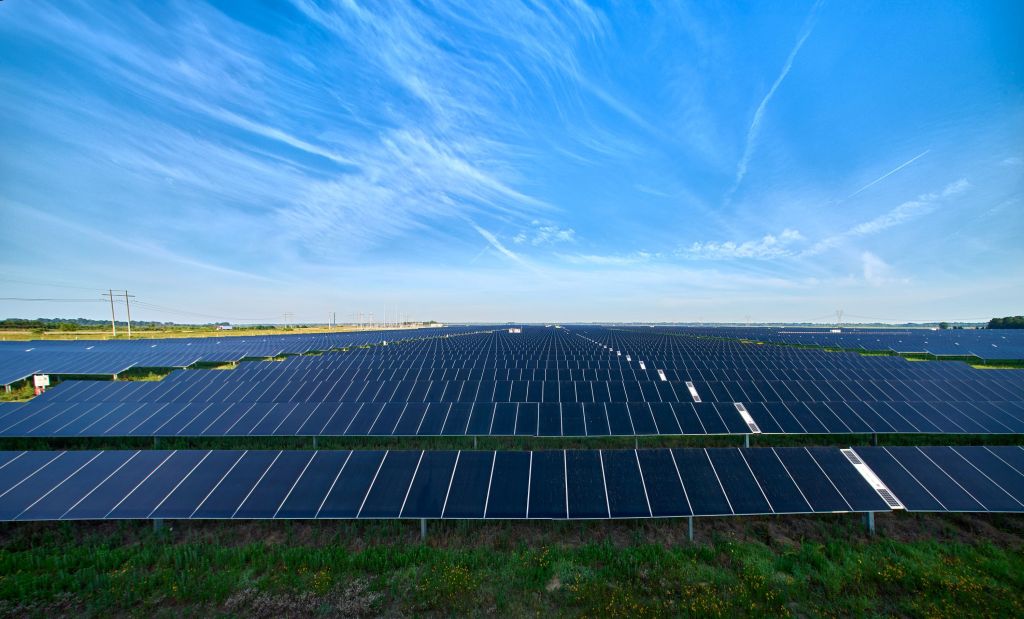
Solar in Arkansas will be used to power GM factories in Michigan and Missouri. (Image: GM)
For an electric vehicle, which has, of course, no tailpipe, the factory accounts for as much as 46% of its carbon footprint.
To address factory-related emissions, GM has signed an agreement to source solar power generated electricity for three of its assembly plants.
Electricity will be provided to the Lansing Delta Township Assembly, Lansing Grand River Assembly, and Wentzville Assembly plants via a 15-year renewable energy purchase agreement with NorthStar Clean Energy.
NorthStar’s solar facility in Newport, Arkansas, will be generating the renewable energy that will be sent up to Michigan (for the two Lansing plants) and Missouri (Wentzville).
According to GM, as it has sourcing agreements with 17 renewable energy plants it is the auto industry’s largest buyer of renewable power by capacity, based on BloombergNEF stats.
The vehicle manufacturer plans to have all of its U.S. factories powered by renewables by the end of 2025.
Odds are, unlike predictions of when a given lineup will be full EV, that 2025 plan is undoubtedly going to happen.
A new tire for lux trucks & SUVs developed to deliver performance—and on sustainability concerns, too
By Gary S. Vasilash
Bridgestone Americas, as you probably know, makes tires of all types and sizes. (Yes, the usual phrase is “all shapes and sizes,” but the tires are all round, so a bit of modification was required.)
But what you probably don’t now is that Bridgestone has what it calls its “E8 Commitment,” which is part of its sustainability efforts.
The eight are:
Energy
Ecology
Efficiency
Extension
Economy
Emotion
Ease
Empowerment
The company has just released the Dueler A/T Ascent tire for luxury and high-end trucks and SUVs.
It is designed to provide on-road manners that one would expect from a premium tire for a premium vehicle.
But given that it is a truck or SUV it may be called upon not only for a daily commute but a weekend drive that may take the vehicle off road, so the tire is engineered with a tread pattern that provides the traction needed in those conditions, as well as in the wet and during the winter.
As Jeremy Norwood, Chief Engineer, Consumer Replacement Product Engineering, put it, “Our mission with Ascent was to develop a luxury truck tire that could tackle the trails on the weekends without sacrificing the comfort of the daily commute.”
So, given that (as well as a 60,000-mile limited warranty and fitment for up to 22-inch rims), what area the E’s that the Dueler A/T Ascent encompass.
[Think about it for a moment. The answer is after the tire picture.]
Is this some sort of artwork in the style of Louise Nevelson?
No.
It is a section of a fan-blade developed by automotive supplier MAHLE for fuel cell and electric commercial vehicles.
About the design of the “bionic fan blade,” Dr. Uli Christian Blessing, Head of Thermal Management Development at MAHLE, said:
“We learn from nature, it inspires us in many areas! . . . With the help of AI, we analyzed the peculiarities of bats, swordfish and many other ideas from nature and finally ended up with the owl, the silent hunter, as the main template for our new fan.”
The fan is said to provide a 4 dB(A) reduction in noise compared with a conventional fan. That’s a cut of about 50%.
In addition, it is 10% more efficient and 10% lighter than a typical fan.
The company plans to extend the fan deployment to passenger cars.
Apparently one of the times when the noise abatement is key is during charging. MAHLE says the quieter operation “increases comfort for drivers and residents alike.”
As well as people taking a stroll through the Walmart parking lot, where plenty of charging occurs.
I had the interior designer from another car company in the 2024 Genesis GV60.
He looked at that glowing orb embedded in the center console of the vehicle that recently won the J.D. Power U.S. Automotive Performance, Execution and Layout (APEAL) study in the small premium SUV category.
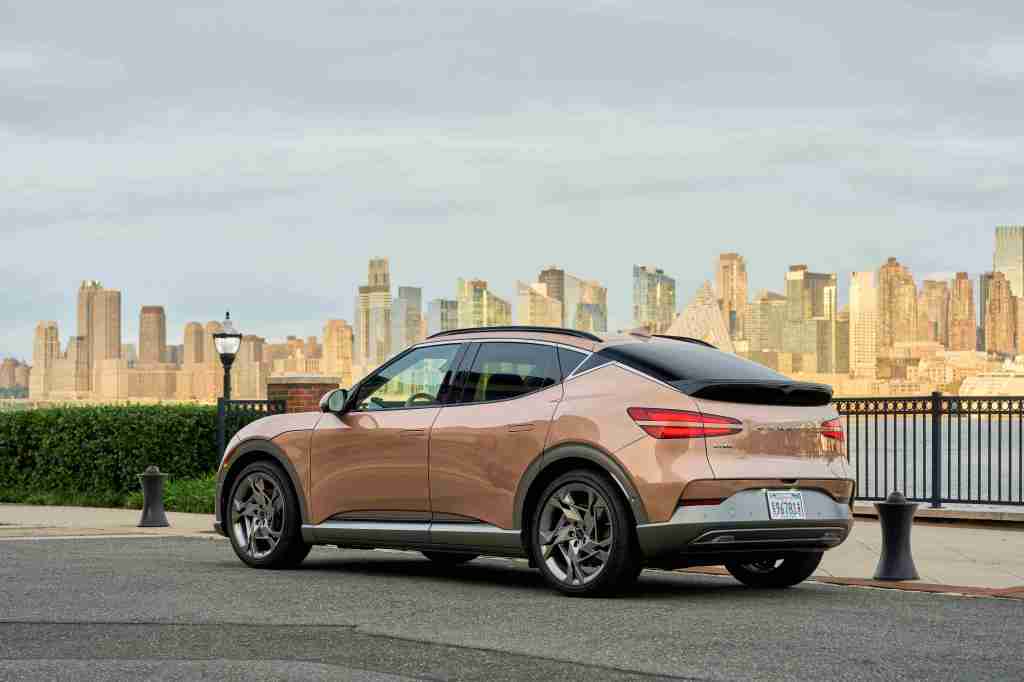
Yes, that is a glowing orb in the center console. (Images: Genesis)
That orb is actually called the “Crystal Sphere.”
It glows.
When the vehicle is started the sphere rolls over and exposes a dial that allows the gear selection (which is perhaps not as accurate a term given that the GV60 is an electric vehicle, and while EVs do have gears, they don’t have traditional transmissions with multiple gears that have to be run through for motive power, which explains, in part, why EVs have that torque from the get-go and why they are more efficient than ICE vehicles because there aren’t the mechanical losses).
The designer was intrigued by the Crystal Sphere, which I suppose is why it exists in the vehicle, although I think that the fit and finish—as well as execution and layout—of the rest of the interior is sufficiently interesting in and of itself, as in things like the patterns on the seating surfaces (which, like other items in the interior, are made from eco-friendly materials, but materials that seem like they are leather, for example).
Intriguing, all.
He told me that he thought that it was quite cool.
But then he began wondering aloud about the level of difficulty of fixing it were it to go wrong.
And then going back and forth, weighing the pluses and minuses, he finally concluded:
“We would never be able to use anything like that.”
And I could detect a bit of regret in his tone.
Elementary. . .
It’s the first dedicated EV model from Genesis.
When it was introduced, Luc Donckerwolke, chief creative officer of Genesis, said: “The GV60 is a symbolic model that materializes the unique values and the sensibilities that Genesis stands for. It offers a satisfying experience to our customers who want something valuable, but different.”
It can be opened with your face. (There is a near infrared camera in the B-pillar.)
It can be started with your fingerprint. (Further underscoring the notion of this is more than a crossover, but a highly sophisticated, comfortable, computer on wheels.)
It has two 160 kW motors, one in the front, one in the back. Which means 320 kW or 429 hp.
It has a 77.4-kWh battery that can be charged on a fast charger (>250 kW) from 10 to 80% in 18 minutes.
It—as in the model in question here—does have eco-friendly, but the seats are Nappa leather, which comes from things with four legs.
It has a 14-way power adjustable driver seat that not only has power lumbar (four-way), but even a cushion extension. (Notably, all trims have this seat.)
It has an infotainment system accessed via a 12.3-inch LCD display. The “tainment” portion is predicated on a 17-speaker Bang & Olufsen sound system.
It can tow. 2,000 pounds.
It has 101.1 cubic feet of passenger volume (think five people but two happier ones if they’re not joined by a third in the back seat).
It has 24 cubic feet of cargo volume behind the second row.
It has a 0.71-cubic foot frunk (think small microwave oven).
And some of you have probably already seen it and are thinking that I’m slow to the draw here.
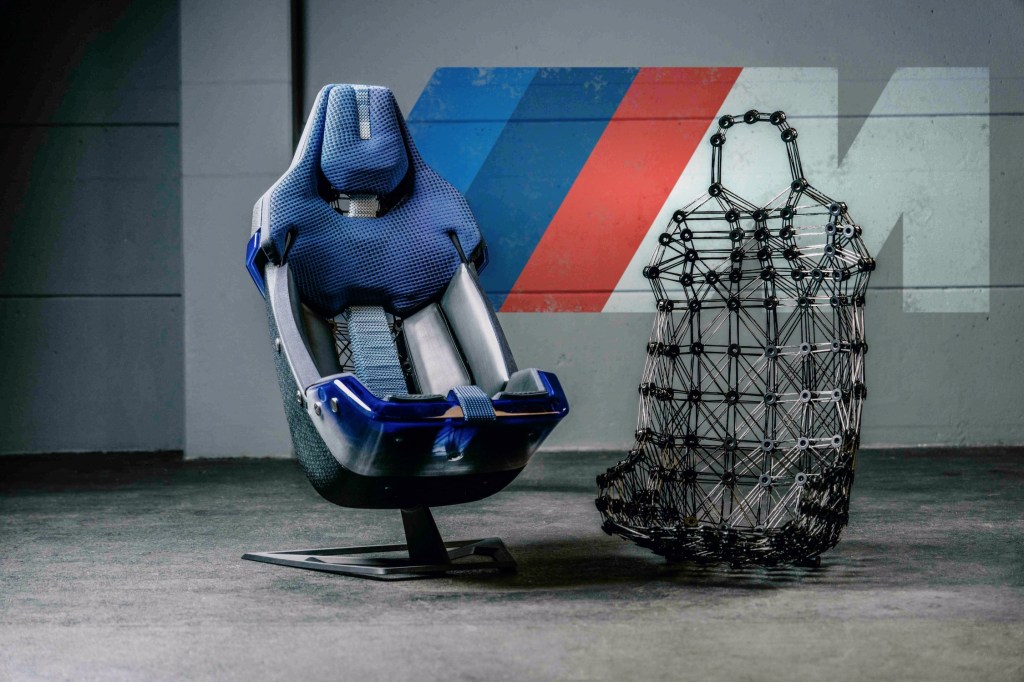
The BMW M Visionary Materials Seat. On the left you can see a printed foam structure. On the right those are the fiber-would support elements use. (Image: BMW)
I wanted to get a bit more info on the seat, about which Falco Hollmann, Innovation Manager Lightweight Design & Sustainability at BMW M GmbH, said: “We are showing today what will be possible tomorrow with existing technologies and materials in order to take our efforts to reduce emissions and conserve resources to the next level. This is about more than just substituting materials; it is above all about designing for circularity.”
Many reports have it that it doesn’t have a support structure, which may make it sound like it is, well, floppy. Which wouldn’t be particularly effective as a seat.
Although it doesn’t have a conventional seat structure, it does have structural elements.
For example, there are robotically wound fiber composite elements (the black stick-like pieces on the object on the right of the photo) that form a load-carrying core structure.
Then there is the blueish/white mesh structure that you can see on the left side of the photo in the center part of the seat, which, according to a BMW spokesperson, is “made from a soft, gel-supported (reusable) structure from an additive manufacturing technology.”
(That is not a cutaway of the seat. It is designed with a minimalist approach so that foam component is visible.)
One of the things associated with the development of the seat is LCA: life cycle assessment. From start to finish—and beyond.
There is another factor taken into account, something less familiar than LCA: SQR.
That’s “secondary raw materials quota.”
A goal was to use materials that would go on to have a post-seat useful existence without additional processing steps (as would be the case with typical recycling), which led to the deployment of natural fibers, fiber composites, leather alternatives and algae-based polymers.
One of the important aspects of the development of the seat is the learnings obtained that can be applied to things that aren’t merely concepts.
Roberto Rossetti, Head of Development Total Vehicle-Lifecycle at the BMW Group:
“One of our biggest lessons was the balancing, in other words, how to model our process chain to generate missing primary data. The data obtained provides new insights, both in terms of today’s negative contributing factors and the design of tomorrow’s processes. This experience provides a solid foundation for continuously improving sustainability and developing innovative solutions for forward-thinking mobility.”
The European Union is ahead of the U.S. in the acceptance of electric vehicles. That is, according to Cox Automotive, in 2023 the EV share of the U.S. vehicle market was 7.6%.
The European Union has just reported that in 2023 the number of EVs registered represents 14.6%.
What’s interesting about the 2023 number in the U.S. is that Cox Automotive reckonings show that Tesla sales represented 55% of all EV sales in the U.S.
There are now 30 brands offering EVs in the U.S., including Tesla, yet the company that seems to be going out of favor through the first half of 2024 has 49.7% of the market.
Taking out its estimated (it doesn’t provide clarity about sales in particular countries, including the U.S.) 304,451 vehicles from the 2024 first half total of 599,372, that means there were a total of 294,921 EVs sold in the U.S. in the first half of 2024.
To put that into perspective, in the first half of 2024 there were 248,295 Toyota RAV4s sold in the U.S.
So this means that 29 vehicle brands sold 46,626 more vehicles than a single model.
Questions
It is easy to get excited about percentage increases until they are contextualized.
Will the number of EVs on offer continue to grow? Yes.
Will the number of EVs sold increase as they become available in different segments? Yes.
Will growth in EV sales continue should there be a change in Washington that eliminates the incentives to buy an EV?
There’s the question that doesn’t have an answer.
But there’s something that provides perhaps of a hint in Germany.
Cautionary tale?
Meanwhile, back in Europe, EV growth continues, primarily because of government support and/or regulations.
According to T&E, “Europe’s leading advocates for clean transport and energy,” during the first half of 2024 EV sales were up in the EU by 9.4%–but that’s by leaving out the largest car market, Germany.
With Germany, the EV sales grew in the EU by 1.3%.
The organization’s Lucien Mathieu, cars director, said, “Germany is the sick man of Europe when it comes to electric cars. Meanwhile, markets which have strong, predictable incentives for EV adoption are reaping the rewards.”
At the end of 2023 Germany stopped providing a subsidy for the purchase of an electric vehicle. T&E calculates that that caused a 16.4% decrease in EV sales in Germany in the first half of 2024.
According to T&E:
“In the first half of 2024, EV sales grew in markets with supportive regulatory environments:
In France, which has a social leasing scheme to provide cheap electric cars to low-income households, BEV sales increased by 14.9% in H1 2024;
In Italy, BEV sales increased by 7.0% in the first half of the year, with a sales peak in June 2024 when new EV incentives were launched;
In Belgium, the company car segment drove the BEV market with a 47.8% increase in the first half of the year;
In the UK, the ZEV mandate has driven the BEV market, with sales increasing by 9.2% in H1 2024.”
Which raises a question: are “markets which have strong, predictable incentives” real markets or artificial ones?
Germany has some appealing EVs from small VWs to generally lauded BMWs to Mercedes lux.
And it is not like no one is buying EVs in Germany: T&E has EV sales in the first half representing 12.5% of the market.
Still, given the amount of investment and attention paid to EVs, the numbers seem somewhat small.
Here’s something you probably don’t want to experience: aspects of the standard features offered in the new 2025 Police Interceptor Utility:
Police Perimeter Alert. . . Police Engine Idle. . . Police Dark Car Feature. . . Rear Camera on Demand. . . H8 AGM Battery. . . Blind Spot Monitoring with Cross-Traffic Alert . . .Manual Police Pursuit Mode – Steering Wheel Switch Execution. . . Red/White Dome Lamp – Cargo Area. . . Rearview Camera with Washer Viewable in 8″ Center Stack Screen. . . Ford Pro Upfit Integration System. . . Keyless Entry with 4 Manual Keys. . . 6-Way Power Passenger Seat. . . Police Accessory Independent Timed-Release Output (PAITRO) – Output Tied to Liftgate Release Switch. . . Climate Control – Rear Aux A/C System. . . Updated Police Grade Cloth Trim Seat Material. . . 12.3″ Digital Instrument Cluster with Certified Calibration. . . Keyless Entry – Key FOB Only (Less PATS). . . Simple Fleet Key (w/o microchip, easy to replace: 4-keys). . . Two 50-amp power distribution junction box
The 2025 Ford Police Interceptor Utility. Departments looking for fuel economy can opt for a hybrid powertrain. (Image: Ford)
Seems like the only thing you’d really be interested in were you to find yourself in the back of one is that rear aux A/C system. And perhaps the seating material.
The rest of the stuff is germane to the professionals.
The Police Interceptor is based on the Explorer that you can find in a dealer near you.
But this vehicle isn’t simply an Explorer with additional lights and a profoundly different paint scheme.
It is engineered to be a police vehicle. It is being offered through Ford Pro, underlining that this is a commercial, not consumer, vehicle.
There are three powertrain options. There is a 3.3-liter V6 that produces 285 hp. A 3.0-liter EcoBoost V6 that produces up to 400 hp—but that’s if the vehicle is using Premium gas, which is probably not something that municipalities are in favor of.
And there is a 3.3-liter V6-based hybrid that produces a system output of 318 hp.
One of the arguments that Ford makes for the hybrid is that the onboard equipment operates even when the engine shuts off. This, it is calculated, means a savings of up to 838 gallons of gas per year because the engine isn’t idling so that various things in the vehicle work.
So, if gas is at $3.50 per gallon, this can translate into a savings of $17,500 over a six-year period.
Which matters as budgets at municipalities are stretched.
(Here’s something interesting: the new consumer version of the Explorer is not offered with a hybrid, something that had been available before the recent midcycle refresh. Given the popularity of that powertrain—as consumers budgets are being stretched—it seems likely Ford may rectify that. After all, they like fuel efficiency, too.)
OK. The images give it away. But still: who would have thought?
By Gary S. Vasilash
Tyler Hill, Ford global brand licensing manager: “These new _______ will allow more people to experience the adventurous spirit of a Bronco and the exhilaration of a Mustang from the moment they grip the __________.”
That would be:
e-bikes
handlebars
That’s right, a Bronco e-bike and a Mustang e-bike.
These bikes, developed with N+, are not for the causal rider.
Both feature 750-W hub motors that can allow the rider up to 28 mph.
To help stop, there are four-piston hydraulic brakes.
(Images: Ford)
The Bronco bike has a dual-suspension system that is said to allow the bike to handle “any type of terrain,” just like the SUV that inspires it.
The Mustang comes in a special 60th anniversary model. A little quick math indicates that were someone in 1964 able to afford a Mustang that person would have probably been at least 20 years old, so that person is likely not to be in the intended customer for the e-bike.
And speaking of customers, the Bronco bike has an MSRP of $4,500 and the Mustang $4,000.
When it comes to customers, auto companies like them young and well-heeled.
Young because if they get the customers early and they do a good job in at least meeting and ideally exceeding expectations, this increases the possibility that they’ll stick with the brand or go up a level (i.e., from Chevy to Cadillac; from Toyota to Lexus; from VW to Audi).
And as for having plenty of disposable income—well, that’s obvious. After all, those Platinum and Unobtainium trims don’t come cheap.
This is borne out by a study conducted by research firm Numerator on electric vehicles.
As for comparative youth, it found that 42% of EV owners are Gen Z’ers or Millennials. That’s in the context of those two cohorts representing only 30% of all vehicles.
As for wealth, there are at least a couple of indicators: 44% are said to be from high-income households. Only 30% of the average vehicle owners are in that stratum.
And 77% of EV owners live in households with two or more vehicles. This is compared to 68% of all households with vehicles.
What seems somewhat odd, however, is that EV owners are twice as likely to walk or bike to get around and are four times as likely to take public transit than the non-EV owners.
While it might be thought that these Gen Z and Millennial EV owners are all about the environment, Numerator found that only 48% of them cited the environment as why they opted to go electric.
Seventy-four percent said it was for cost savings on fuel.
To put some numbers around that:
According to the EPA, the average cost of a gallon of regular was $3.48 in 2023. Also, the average miles per gallon achieved in new vehicles in 2023 was 26 mpg. In its “Fuel Economy Guide” it estimates the average driver racks up 15,000 miles per annum.
So, 15,000 divided by 26 is 577. And multiplying that by 3.48 gets us to an annual outlay of $2,008, or $38.61 per week.
Not a whole lot, but evidently even the wealthy watch their wallets.
ExxonMobil announced its Q2 earnings last week, which includes both a 12% year-over-year revenue increase (to $90.06 billion) and a 17% profit increase (to $9.24 billion).
And what is more interesting: It recorded its highest production of oil in the company’s history: 4.4 million oil-equivalent barrels per day. That’s up 15% compared with Q1.
In reporting its numbers, the company states it is working with Air Liquide on achieving the capacity to produce “virtually carbon-free hydrogen” that will be used for industrial customers, not fuel cell vehicles.
It is working with a major fertilizer and ammonia producer, CF Industries, for a carbon capture and storage arrangement.
It has a company named Proxxima that takes “lower-value” gasoline molecules and transforms them into a high-performance thermoset resin, which can be used to build composite structures.
And there is a Carbon Materials operation that it hopes will turn “low-value, carbon-rich feeds from the company’s refining processes” into things like carbon fiber and polymer additives.
What isn’t here?
Anything in the way of a transition to electric vehicles.
But the company did note it has signed a non-binding memorandum of understanding with battery company SK On for up to 100,000 metric tons of lithium over multiple years from a “planned” lithium project in Arkansas.
Clearly the company is still knee-deep in oil and it doesn’t seem that that is going to change anytime soon.





 shinymetalboxes