Those associated with paint shops in this case. . .
By Gary S Vasilash
While there is a considerable—and justified—amount of attention paid to tailpipe emissions, there is also plenty of spew associated with the production processes that create those cars and trucks.
Like when the vehicles are painted.
You know how fresh paint has a pungent fragrance?
That is generally the result of things like volatile organic compounds that are not particularly good for the environment.
So in automotive paint shops there are measures taken to clean the exhaust before sending it out the smoke stacks (a.k.a, chimneys).
This includes running the exhaust through a bed of ceramic media that is at very high temperatures—as in 1,000 degrees Celsius.
To get those temps natural gas is usually deployed for the ovens.
BMW has completed testing on a method that uses electricity from renewable sources to achieve these temperatures.
It’s called eRTO—for “electric regenerative thermal oxidation).
BMW is installing paint shop equipment that will help clean exhaust using electricity from renewable sources rather than natural gas. (Image: BMW)
Says Michele Melchiorre, head of Production System, Planning, Tool Shop, Plant Construction at BMW Group:
“For other energy-intensive paint shop processes, such as vehicle drying and water heating, solutions already exist for working without natural gas. So, electric exhaust purification is the final steppingstone for the BMW Group to run its paint shops on regenerative energy in the future.”
And that future is pretty much now in BMW plants in Germany and China, where eRTO is working along side the natural gas process.
Next year, a new BMW Group plant in Debrecen, Hungary, will have eRTO only.
When someone refers to the “Motor City,” it is typically thought of in terms of cars.
But Detroit is (1) on the Detroit River and (2) located in the “Great Lakes State.”
Which brings us to Sharrow Engineering, a Detroit-based advanced engineering and design firm.
And within Sharrow Engineering there’s Sharrow Marine, which produces propellers for outboard motors.
The company has just launched the Sharrow X10 for Mercury V10, 350- and 400-hp engines.
Sharrow X10 propeller provides operational advantages in the water. (Image: Sharrow Marine)
The propeller, which is CNC machined from a stainless-steel alloy, “offers superior performance, greater fuel efficiency, and a significantly quieter ride,” according to Greg Sharrow, the founder and CEO of the company.
Here’s an interesting thing: Greg Sharrow invented the propeller design not while pursuing advances for outboard motors. Rather, he was working in video production and worked to develop a quieter drone.
It was determined that by reducing or eliminating tip vortices there is significant noise-reduction—as well as the other benefits that are achieved for the propellers used in water.
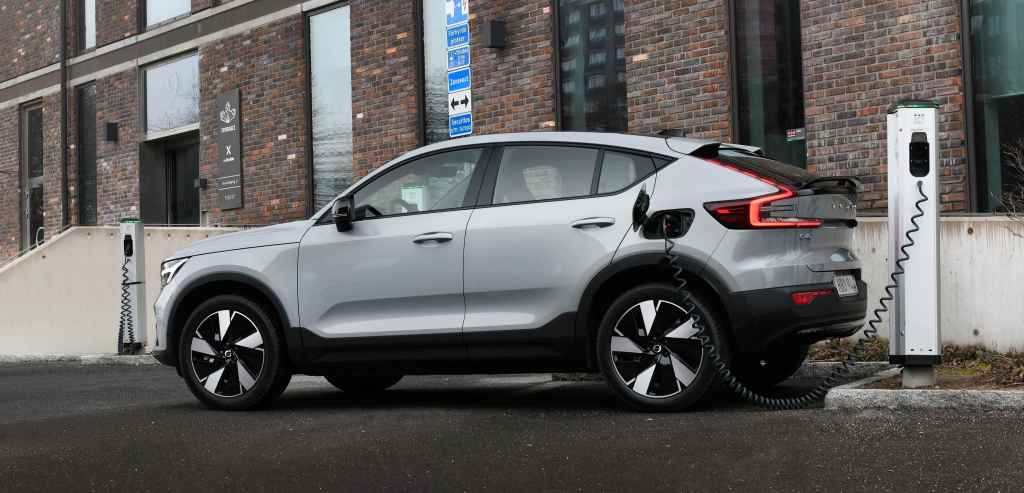
The Volvo C40 Recharge is, as its name implies, a vehicle that needs recharging because it is an electric vehicle. A small SUV. But a stylish small SUV, as it has what is, for SUVs, a coupe-like roofline, sloping back. In fact, arguably it is the most stylish among the Volvo SUVs, of which there are numerous (XC90, XC90 Recharge, XC60, XC60 Recharge, XC40, EX90, XC40 Recharge, and the forthcoming EX30.)*
The XC40 Recharge is the C40 Recharge with a different top on it. It is what is historically the more Volvoesque of the two, meaning it is boxier. And style comes with a bit of a price, and not just in terms of MSRP, although there is that, too (C40 Recharge starts at $53,600; XC40 Recharge starts at $52,450).
Dimensionally the two vehicles are the same with the exception of one thing.
They are both 174.8 inches long and have a 106.4-inch wheelbase. They are both 80.1 inches wide.
But the C40 Recharge is 62.6 inches high and the XC40 Recharge is 64.8 inches high.
A consequence of that difference is that the C40 Recharge has a cargo capacity of 49 cubic feet and the XC40 Recharge has 57.5 cubic feet back there, so it is a non-trivial difference.
Volvo C40 Recharge: Charge and go. (Image: Volvo)
Still, it is not like the C40 Recharge is lacking in capacity. And sometimes you just have to sacrifice a bit to standout with more style.
And speaking of styling, the vehicle has great-looking 20-inch wheels, which add presence to the exterior. I must confess that I am not wholly engaged yet with the replacement of a grille with a solid slab with the badge affixed in the middle.
One of the interesting things about this vehicle is that it comes with a four-year subscription to the Digital Services Package. While some OEMs want to have their own digital setup, Volvo is working with Google so that this vehicle has Google built-in, as it were, so that there are native Google Maps, Google Play Store and Google Assistant. And that four-year package provides all these.
(And perhaps not entirely coincidentally, there is 48-month/50,000-mile limited warranty coverage (48 months = 4 years), and complementary factory scheduled maintenance for the first four years or 40,000 miles. Four years evidently is a key metric vis-à-vis the C40 Recharge.)
The C40 Recharge is Volvo’s first leather-free vehicle. One of the available material options is a wool blend seating fabric that is an exceedingly nice alternative even were leather to be available. In fact, it speaks to the style of the vehicle: A man’s suit in leather looks, well, goofy (or creepy) in most wearings (sure, some guys can get away with it, but they are few and far between); a good wool suit is stylish and classic regardless of the person inside.
Of course, as this is an electric vehicle, we’ve got to get to the battery-related things.
The “Extended Range” in the name of the vehicle goes to the 82-kWh battery that provides an estimated range of 297 miles on a single charge. And on the subject of charging, on a Level 2 (11 kW) charger, such as you might get installed in your garage, it can be charged from 10% to 90% in eight hours; with a DC fast charger, 20 minutes will take the battery from 10% to 80%.
This vehicle has a single 248-hp motor driving the rear wheels. Although people talk about a benefit of EVs is their ability to go quickly quickly, there is another characteristic that is beneficial for driving: their comparatively sizable mass provides a sense of solidity, which combined with the power means a feeling of improved control.
Having said plenty of positive things about the style I do need to point out something that I found understandable but unusual.
Because the rear glass (a.k.a., backlight) is at a somewhat fast angle, the view from the rearview mirror is truncated. Yes, there are 360-degree cameras when maneuvering, say, out of a garage, and there are highly noticeable blind-spot detector warnings in the side mirrors. But still, a glance in the mirror to see what’s going on back there is not fully informative.
The usual part is that the C40 Recharge has a “panoramic” roof—essentially, with the exception of what amounts to a frame, the whole roof provides a fulsome view of, well, the sky. Not exactly handy, of course, when you’re driving.
A remarkable EV gets some remarkable performance. But if efficiency, range and economy are of interest. . .
By Gary S. Vasilash
Credit to Lucid Group for what it says is “the most efficient and thus most sustainable vehicle made,” the 2025 Lucid Air Pure.
5.0 miles per kWh of energy? Huh? (Image: Lucid Motors)
The vehicle achieves a 146 MPGe EPA rating. This means it achieves “a landmark 5.0 miles per kilowatt hour of energy.”
More to the point of people without a slide rule handy, this means the Lucid Air Pure can travel an estimate 420 miles before requiring recharging.
According to the EPA, the Lucid Air Pure is in the Large Car Category. For those who are looking for something a bit more economical than the $69,900 starting MSRP, there’s the 2024 Hyundai Ioniq 6, which provides an MPGe of 140.
It also starts at $42,450.
But back to the Lucid Air Pure.
It is interesting that suddenly things like range and efficiency become important metrics for vehicles.
According to the EPA, the 2024 Honda Accord Hybrid has the best fuel efficiency among non-full-EV vehicles in the Large Car Category: a combined 48 mpg.
This means than on its 12.8-gallon tank of gas, it can travel 614 miles, or 194 miles further than the Lucid Air Pure.
And while no one is likely to cross shop an Accord Hybrid with a Lucid Air Pure, the former has a starting MSRP of $32,895, which means that compared to the Lucid , you could buy two and have money left for gas.
Clever idea, but they should expand the geography to include places that are not so flat. . .
By Gary S. Vasilash
One thing that the people at Stellantis North America do better than any other OEM team is create special editions of their vehicles. This helps generate interest in products that may be waning or just provide the incentive that some on-the-fence consumers might have to go visit a dealer.
Jeep Gladiator High Tide Edition: Why is it towing a dune buggy? It has the capability to handle things like dunes, doesn’t it? (Image: Jeep)
Jeep has announced the availability of the 2024 Jeep Gladiator High Tide Edition.
It features a variety of unique badging as well as 17-inch black-painted aluminum wheels, 32-inch mud terrain tires, steel rock rails, and black McKinley leather-trimmed seats.
But what makes this Jeep, which has a starting MSRP of $48,275, really special is that it is available only in Florida.
While Florida is comparatively flat—according to Visit Florida, which clearly wants people to visit the state so it is not dissing it in any way, the highest point in the state, Britton Hill, is 345 feet above sea level and is “the lowest ‘high point’ in the United States—and while Jeeps are known for their ability to crawl up things like mountains (the High Tide Edition has the Jeep Command-Trac 4×4 part-time and two-speed transfer case with a 2.72:1 low-range gear ratio), you might think that Jeeps aren’t exactly the thing in the Sunshine State.
However, last April an annual Jeep event was held in Daytona Beach, which Bil Peffer, senior vice president and head of Jeep Brand North America, described as “one of the largest Jeep brand gatherings globally and a testament to Floridians’ deep passion for our 4×4 vehicles.”
Which goes to the point of the Florida-only High Tide Edition.
But if someone in Florida buys a High Tide Edition, the only other people who are likely to see it most often are other Floridians, and chances are, only Jeep-oriented Floridians are likely to realize how special it is.
And if someone drives it to, say, Brasstown Bald in Georgia, which is 4,439 feet higher than Britton Hill, and encounters other bona-fide Jeep people, wouldn’t being from a comparatively flat state reduce off-street cred?
The High Tide Edition ought to be available everywhere that there are high tides.
While that would include the states along the Atlantic south to Florida, then Louisiana and Texas on the Gulf of Mexico and then California, Oregon and Washington of the Pacific, not only would this still make it special, it would increase the potential sales of Gladiators, which were down 14% during the first half, to 23,478 vehicles.
Expanding the availability of micro-vehicles in Europe. . .
By Gary S. Vasilash
While lots of OEMs talk about being a “mobility provider” rather an ancient “car company,” Nissan is proving itself to be one.
It has announced it is expanding its partnership with a company that makes micromobility vehicles, such as a small EV and electric motorcycle, ACCIONA.
Nissan has added the UK to countries that it has distribution and service rights to the ACCIONA Silence product line. The other countries are Italy, France and Germany.
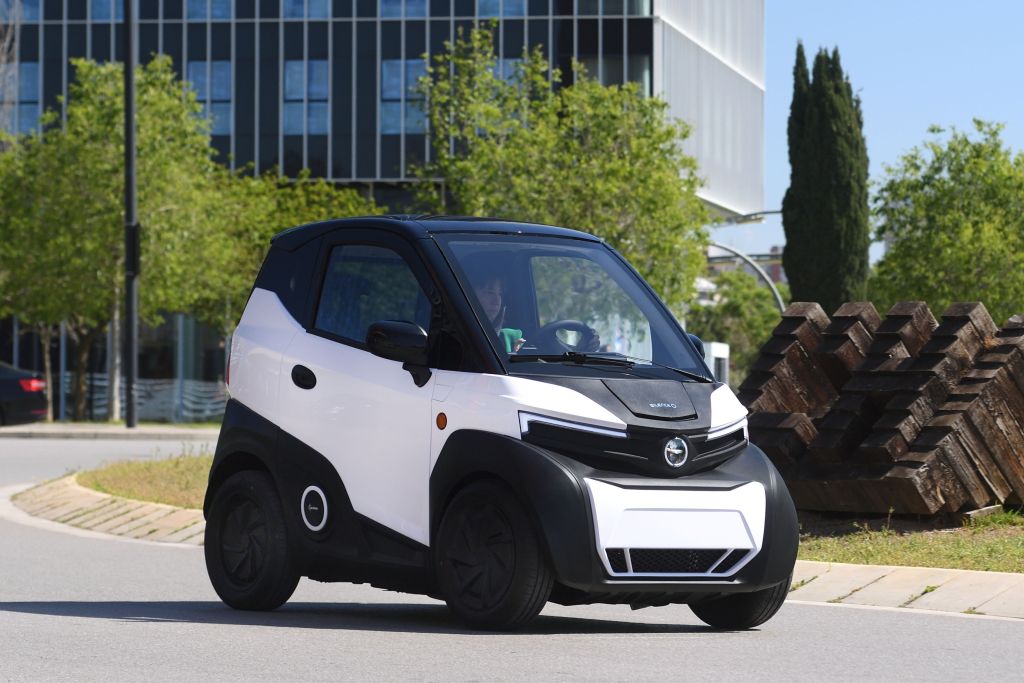
S04 EV micro-vehicle will be available in Nissan UK dealerships this Fall. (Image: Nissan)
Gareth Dunsmore, Managing Director e-Micro Mobility at Nissan AMIEO, said, “By opening access to Silence’s diverse range of alternative products, we are easing the EV transition by combining clean mobility with cutting-edge technology, in functional and flexible vehicles.”
The S04 Nanocar is designed for city use.
It measures 90 inches long, 50 inches high, and 62 inches wide. The S04 seats two. It is powered by a 14-kW motor. It is said to have a top speed of 53 mph, which is arguably something that will only be reached by some daredevils given the diminutive size of the vehicle.
It is powered by two batteries that provide 5.6-kW and can be readily removed and transported with a hand truck to a place where they can be replaced with charged batteries.
There is also a battery subscription service, so rather than buying the vehicle with the batteries are swapped on an as-needed basis, which is said to reduce the overall price of an S04 by up to 40%. (The base model has an MSRP of £14,614.)
What’s notable—and laudable—about this is that Nissan could have undoubtedly made its own micro-vehicles.
Yet there is evidently a recognition that there are already companies like ACCIONA making these vehicles so a partnership can provide mutual benefit between the two companies, as well as for the consumer.
Just in case you need to pick up a carton of milk really, really quickly. . .
By Gary S. Vasilash
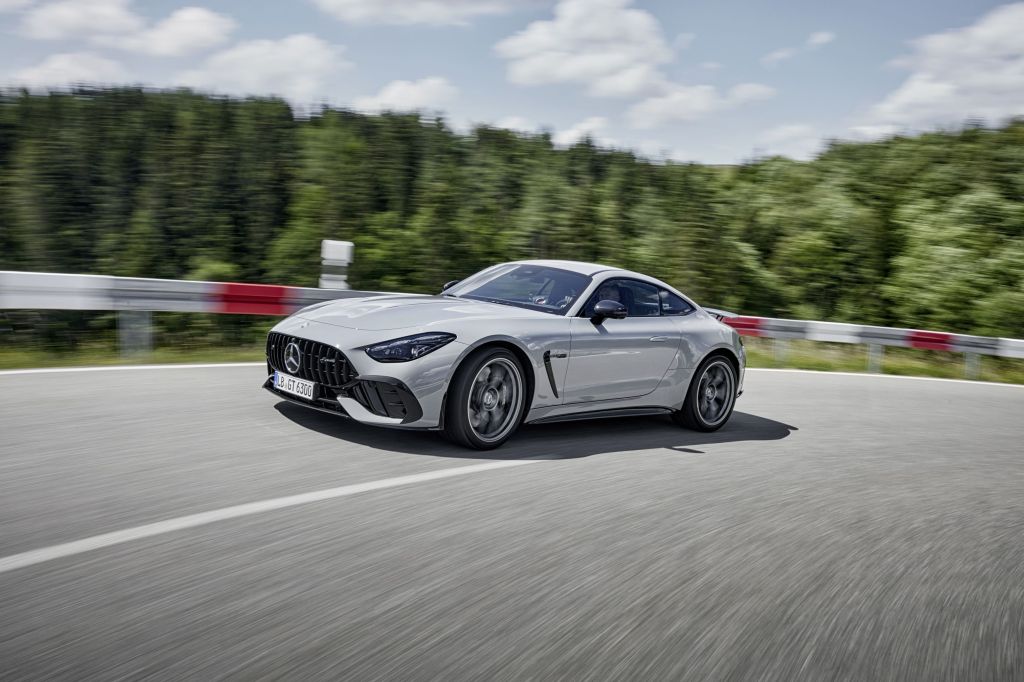
The Mercedes-AMG 2025 AMG GT 63 PRO 4MATIC+ (quite a name), which will become available in the U.S. next year, the second generation of the vehicle, was, according to the folks at Mercedes, developed so that it has “improved daily usability compared to the previous model series,” something that customers of the first-gen model were interested in.
Maybe the supermarkets in Affalterbach have severely limited hours so getting there quickly after work is a necessity, explaining the 2025 AMG GT 63 PRO 4MATIC+. (Image: Mercedes)
The vehicle has a 4.0-liter bi-turbo V8 that produces 603 hp and 627-lb-ft of torque.
In can go from 0 to 124 mph in 10.9 seconds.
It is estimated to have a 0 to 60 mph time of 3.1 seconds.
It has a top speed of 197 mph.
There are two radiators, one each in the left and right front wheel arches.
There is an array of aero elements, such as the AIRPLANEL active air control in the front fascia, the AMG Aerodynamics package with fixed wing in the back, and fins and deflectors on the underbody.
There are 21-inch forged split spoke wheels with Michelin Pilot Sport 5 tires or, Michelin Pilot Sport Cup 2 R extreme performance tires.
There is a carbon ceramic brake system with six-piston fixed calipers and 16.5-inch brake discs in the front. There are single-piston floating calipers in the rear.
From advanced manufacturing tech to a really complex model. . .
By Gary S. Vasilash
McLaren Automotive, builder of an array of composite-intensive supercars, recently announced that it is partnering with Divergent Technologies, which has developed an additive manufacturing system it calls the “Divergent Adaptive Production System” (DAPS) which allows the creation of lightweight chassis components that otherwise couldn’t be created with traditional manufacturing methods.
As Michael Leiters, CEO of McLaren, put it, “This technology will help us to further reduce weight in our complex structures, which will ultimately benefit the driving experience of our customers and support McLaren’s mission to push the boundaries of performance.”
One of the interesting things related to McLaren and Divergent is that the DAPS was developed to produce the Czinger 21C supercar (i.e., it is a 1250-hp hybrid–certainly not a Prius (yes, even though the current gen Prius is rather cool, you know what I mean)).
But clever tech is clever tech, so the use by McLaren is in keeping with its drive toward even more innovation in its vehicles.
This is the LEGO Technic McLaren P1—all 3,893 elements assembled. (Image: McLaren Automotive)
But what will probably draw more attention than the organic chassis components in a future car is the LEGO Technic McLaren P1.
Yes, a 3,893-piece LEGO set.
And it is rather technical, as the model includes a seven-speed gearbox, V8 piston engine, adjustable rear wing, dihedral doors, and a suspension (undoubtedly injection molded, not 3D printed).
“It’s amazing to see so many of the elements from the original P1 brought to life by the LEGO team for the LEGO Technic McLaren P1. I hope this collaboration inspires the next generation of designers and engineers to push the boundaries of automotive innovation.”
I’m guessing that the DAPS will be more influential for next-gen designers—but then I’m not the chief design officer of a supercar company.
Incidentally, the McLaren P1 LEGO Technic model can be purchased starting August 1 here for an MSRP of $449.99.
Porsche Cars North America reported its sales for the first half of 2024, including, of course, the second quarter.
And in Q2 the sales of the 911 being nothing short of impressive.
Porsche 911 Turbo S (Image: Porsche)
That is, for the year it has delivered 6,720 911s, of which 4,790, or about 71%, were delivered in Q2.
Which means that in Q1 dealers had a bit of time on their hands as there were 1,930 911s delivered.
OK. They had other vehicles to sell, but still that number of 911s is notable.
The best-selling Porsche in the U.S. during the first half of 2024?
The Macan, at 12,004 vehicles (though that is down from the 14,306 sold in H1 2023).
Second best-selling?
The Cayenne, at 10,168 vehicles (which is up from the 8,911 in H1 2023).
Together, those two SUV models, with a combined 22,172 vehicles, are some 64% of Porsche’s total 34,733 delivered in H1 2024.
Which sort of begs the question of when there is going to be a Corvette SUV. After all, the car can be an alternative to a 911, but it is highly unlikely that anyone is going to cross-shop a Chevy Equinox or Traverse with a Porsche SUV.
Isn’t this a case of the proverbial “money left on the table”?
While you’ve undoubtedly heard about some of the people in the European Union (EU) being rather agitated by Chinese electric vehicles showing up on the streets of Rome and Paris and elsewhere, French research firm Inovev provides some interesting statistics regarding those vehicles.
Notably, within the EU, the United Kingdom, Switzerland, and Norway, during the first quarter of 2024 Chinese EVs accounted for 8.5% of all the EVs sold during that period—approximately 50,000 out of 594,000 EVs.
But then there’s more.
For example, taking into account “European models imported from China”—as in Smart (a joint venture between Mercedes and Geely) and Dacia (part of Renault)—that 8.5% share grows to about 11%.
Then there are vehicles that are built in China by non-Chinese brands that are brought in, like the BMW iX3 and the Tesla Model 3.
Add them into the mix and the number rises to 17%.
And while some might think that European exports to China might offset some of this, Inovev, using Germany as an example, points out that German vehicle exports to China peaked in 2018 and have been declining since.
Part of this is because German brands are building vehicles in China that are sold there so there is no need to export.
But then there is this observation, which ought to make people in Wolfsburg, Stuttgart and Munich nervous: “Chinese customers are increasingly moving towards Chinese brand cars and are gradually losing interest in imported foreign cars, especially with the development of the BEV market.”







 shinymetalboxes