California wants carbon neutrality by 2045. This could help. . .
By Gary S. Vasilash
Symbio is an interesting company that you’ve probably not heard of, interesting for two reasons:
It is developing vehicles like hydrogen-powered trucks
It is jointly owned by Forvia, Michelin and Stellantis. Forvia produces a number of products, from automotive interiors to containment cylinders for hydrogen. Michelin is heavily involved in developing green mobility solutions, such as low rolling-resistance tires. And Stellantis, of course, is in the business of vehicle manufacture.
Big rig. Zero emissions. (Image: Symbio)
Symbio has developed a Class 8 truck that is powered by hydrogen, a demonstrator vehicle called the “H2 Central Valley Express.”
The name of the vehicle relates to where the truck will operate in California: a route between the Inland Empire and Northern San Joaquin Valley in California.
The truck’s 400-kW StackPack fuel cell system is said to be comparable to a 15-liter diesel engine.
There is a 70-kg hydrogen tank onboard. It gives the truck a range of 450-miles.
And unlike a diesel, there are no emissions.
The truck will go into operation later this week on a 400-mile route. On the route there are four different operating conditions, such as urban, high-speed, and hill climb and descent. The demonstration period is to last 12 months.
This isn’t some sort of engineering undertaking: the truck will be in revenue service for Total Transportation Services.
Odds are that things like the Tesla Semi notwithstanding, when it comes to commercial freight operations hydrogen is going to be the way to go to zero emissions.
Oliver Zipse, chairman of the Board of Management of BMW AG, spoke to the company’s investors earlier this week and opened with a topic that is absolutely important to any company—in automotive and everywhere else—but tends not to get the attention it deserves: the employees.
“Becoming a little bit better every day—that is what we aspire to.” –Oliver Zipse (Image: BMW)
Zipse noted that the company has more than 150,000 employees in locations across the world (fun fact: BMW’s largest plant is located. . .in Spartanburg, South Carolina; Zipse said that at BMW the U.S. is referred to as the company’s “second home”).
Zipse:
“In autumn of last year, we surveyed all our associates around the world: 85 percent said they fully support the company’s goals and strategy. And even 93 percent are proud to work for the BMW Group.”
Without having supportive people, people who are proud of where they work and undoubtedly proud of what they produce, then no company can consistently produce products that people are proud to own.
And regardless of whether it is electric or ICE, autonomous or manual, it all comes down to the women and men who work on building the vehicles.
Credit to Zipse and his colleagues for recognizing that and putting it at the top of his speech, where it belongs.
While the attention to developments in the arena of high-voltage batteries that can power vehicles is considerable and understandable, turns out that low-voltage batteries—along the lines of the batteries under the hoods of ICE vehicles—shouldn’t be overlooked.
According to Clarios, a Wisconsin-based producer of batteries and battery systems, the low-voltage network in EVs and hybrids support such things as steer-by-wire, brake-by-wire, and cabin infotainment, and the number of things being supported is only expected to grow.
It has signed a Joint Development Agreement with Altris, a Swedish developer and prototype manufacturer of sodium-ion (Na-ion) batteries, for these low-voltage applications.
Why is this interesting?
Because according to the companies the Na-ion batteries:
Provide a power density equivalent to LFP (lithium iron phosphate) batteries
Are environmentally friendly: the materials used to produce Na-ion batteries include salt, wood, iron, and air
Clearly there’s some remarkable chemistry going on in those cells.
One of the things that EV proponents promote about EVs and why someone would want to drive one is the fact that they are, by and large, peppy.
Unlike internal combustion engines (ICEs), which build torque over time—and torque is what causes the tires to bite into the pavement and propels the vehicle forward—electric motors provide that torque from the proverbial get-go.
Think only of a food blender with its row of buttons from slow to fast. You can hit the fast button at the start and the blades whir at that speed.
More Power
One of the ways that EV producers are able to provide vehicles that seem to be the same but which have different performance characteristics is analogous to what ICE vehicle producers do: add something.
In the case of the ICE, it is generally the addition of cylinders (from four to six, say, as eight or more seem to be disappearing) or turbochargers.
In the case of an EV, it is generally the addition of another motor.
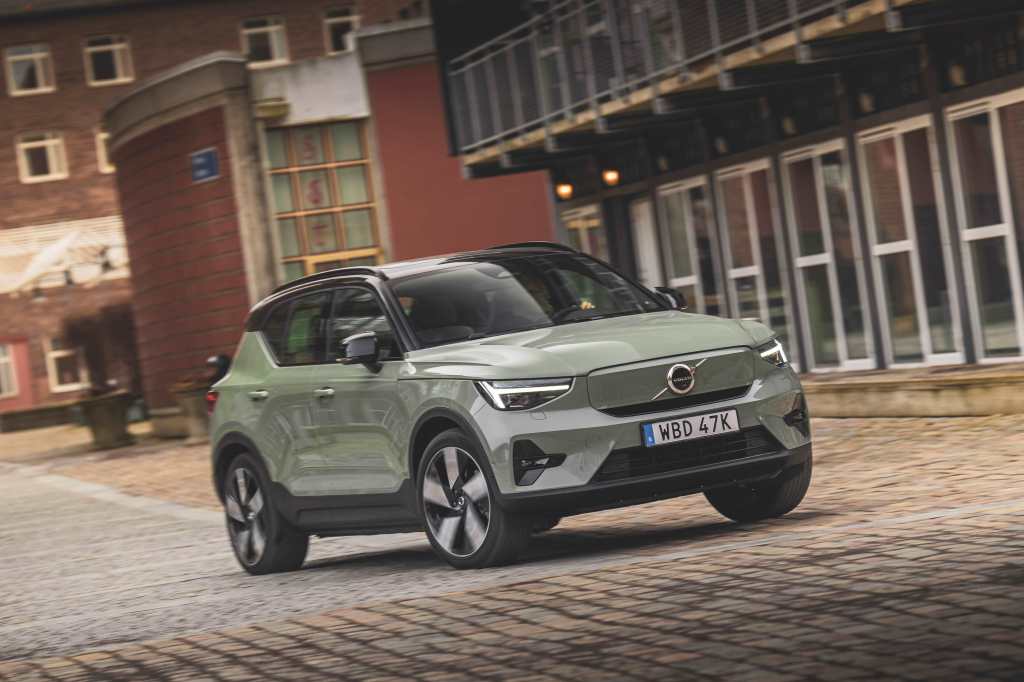
Volvo XC40 Recharge: a charming EV. (Image: Volvo)
So in the case of the Volvo XC40 Recharge, there is one available as a rear-drive vehicle and another as an all-wheel drive vehicle.
The former has one motor that provides the vehicle with 248 hp. The latter has two motors, which brings the output up to 402 hp.
So while the single-engine propels the compact crossover from 0 to 60 mph in 6.9 seconds, the dual-engine model goes from 0 to 60 mph in 4.6 seconds.
Now that reduction of 2.3 seconds comes at a cost.*
As in $1,750 to the cost of the vehicle.
Range and Charging
And as in a range reduction from 293 miles for the single motor to 254 miles for the dual motor, or about a 13% reduction in range. That reduction could have been greater had Volvo not deployed an asynchronous motor on the front axle: it operates only when required.
However, the extra motor doesn’t reduce the 57.5 cubic feet of cargo capacity, nor does it increase the 2,000 pounds of towing capacity.
And overall to help improve range, there are 19-inch wheels used. These not only look better, but they help with aerodynamics. Every little bit counts.
The XC40 Recharge has an 82-kWh battery pack that allows charging at up to 200 kW at a DC fast charger. This means a battery can go from 10% state-of-charge to 80% in less than a half hour.
Compact Charm
The XC40—pre-EV—was introduced as a model year 2018 subcompact luxury SUV. It is a vehicle that was part of putting Volvo on more consideration lists as it combines exterior style (and even an extra bit of charm as it was offering a different color roof from the body color at a time when that was still limited in auto-dom) and interior execution that one would associate with a Scandinavian furniture store: superb execution combining attractive looks with function.
The SUV features Google Maps, Google Assistant and Google Play for additional apps—which is to say that the folks at Volvo undoubtedly figure that the folks in Mountain View are a bit better at software than the folks in Gothenburg. They’re right.
==
*On the subject of the 2.3 seconds: according to research from the University of Idaho, when it comes to the amount of time a driver reacts to suddenly seeing something that requires braking and braking, “An alert driver may react in less than 1 second, while other drivers may require up to 3.5 seconds.” Consequently, “Extensive research has shown that 90% of the driving population can react in 2.5 seconds or less. The brake reaction time normally used in design, therefore, is 2.5 seconds.” Which is to say, drivers of all vehicles need to pay attention, but particularly those who can go from A to B tout suite.
One of the more bizarre exercises in automotive branding occurred last year when Renault created HORSE.
It is a company that is based on designing, engineering and producing internal combustion engines (and, to be fair, hybrids, too).
You know, those things that generate horsepower.
2.0-liter turbocharged diesel from HORSE. (Image: HORSE)
HORSE is a stand-alone company based in Madrid that encompasses eight manufacturing operations with a production capacity of 3.2-million units per year.
Last year, when HORSE was announced, the CEO of the company, Patrice Haettel, said, “In 2040, combustion and hybrid vehicles will still account for more than 50% of global sales.”
Given what’s going on in the market right now, he’s undoubtedly right.
HORSE announced last week that it has signed its first contract with a company that is not affiliated with Renault.
It is HABAŞ , a company based in Türkiye. The company will start producing light commercial vehicles.
It is sourcing engines from HORSE. 2.0-liter turbo diesel engines.
According to HORSE the engine meets Euro 6d+e emissions regulations and can run on B10 diesel, so there’s that.
So. . .
There are large parts of the world where advanced thermal engines matter. Sure, there will be growth in EVs.
But diesel- and gas-powered powertrains aren’t going away any time soon.
Six minutes is the amount of time that AMCI Testing calculates the average driver spends refueling an gasoline-powered vehicle.
So the company established a rating designated “MP6” for EV charging.
Stated simply: How much range does an EV get in six minutes of charging.
The testing is performed on the Tesla Supercharger network. For the non-Tesla EVs in the study the Tesla Magic Dock is used (it is an adapter that allows non-Teslas to be charged just like Teslas).
The most-recent test puts the 2024 Tesla Model 3 Highland in first place. It bested what had been in first, the Toyota bZ4X (which is, given the fairly general criticism of the bZ4X, probably the only first prize it has ever won).
Before looking at the results from AMCI Testing, it is worth keeping something in mind:
The average light vehicle in the U.S. in 2023 achieved 26 miles per gallon.
Let’s say for the sake of argument that the average size of the fuel tank is 14 gallons.
So 26 x 14 = 364.
Or, in six minutes of refueling, the average vehicle with a thermal engine obtains 364 miles of range.
How About Them EVs. . .?
So, onto the MP6 results:
Tesla Model 3 RWD 60.5 miles
Toyota bZ4X 35
Ford Mustang Mach-E 32.5
Mercedes-Benz EQE 31.5
Hyundai IONIQ 5 28
Kia EV6 GT-Line RWD 23
Ford F-150 Lightning 21.2
Rivian R1S 20.5
David Stokols, CEO of AMCI Testing’s parent company, AMCI Global:
“Although probably not unexpected, these definitive AMCI Testing results show just how significant Tesla’s charging advantage is in the real world. Other OEMs competing in the EV space will certainly need to increase their charging performance, convenience and ease of use now that every BEV can use the same charger; the Tesla Supercharger.”
Also in the real world, when the best EV gets just 17% of the range with a six-minute stop as the average gasoline-powered vehicle, there is quite a disconnect when it comes to transportation functionality.
It has a 3.3-liter twin-turbo V6 that produces 365 hp and 376 ft-ft of torque. Which is to say that it is a robust engine that doesn’t need the Active Sound Design feature that allows you to hear a more full-throated engine note. But this is the sort of thing that Genesis provides in its vehicles, which is to say a lot of things even if some of them you never use, which is the opposite of what some OEMs do.
G70: Confident in appearance and you’ll feel confident driving it. (Image: Genesis)
Now it should be pointed out that the sport sedan of interest here is the top-of-the-line variant of the vehicle that is the entry way into the Genesis lineup. Including the $1,250 for “freight” (hey, it is a long way from Namyang, South Korea, so that’s a deal), the total price for the sport sedan is $57,750, and know that this is for an absolutely loaded vehicle.
Such as:
• 19-inch alloy wheels
• Power trunk (this one is sort of silly: I mean the trunk isn’t that high to simply reach up and close, but it is an indicator that this is an elevated vehicle brand-wise)
• Power-folding outside mirrors that project the Genesis logo on the ground at night when approaching the vehicle with your fob
• Nappa leather seats (the driver has a power bolster and cushion extension as well as four-way power lumbar, which the passenger gets, too). And they are both heated and ventilated.
• Microfiber suede headliner (interrupted by a large sunroof) and pillars (while you may not pay much attention to the fabric up top and on the sides because it generally doesn’t deserve attention, but when you have this material you do)
• Various types of “Assist” (e.g., Forward Collision-Avoidance, Lane Keeping, Lane Following, Rear Cross-Traffic Collision-Avoidance)
And this could go on. And on.
As it is a sport sedan there are MacPherson struts in the front and a multilink rear suspension in, well, the rear. As this is a premium sport sedan, the suspension is electronically controlled. And because when you go quickly you generally need to stop quickly, as well so there are Brembo brakes (and if nothing else, the calipers that can be seen through the wheels telegraphs that this is a bona-fide sport sedan).
As it is a Genesis, the exterior styling of the vehicle is superb. Genesis has gotten to the point in its short existence where it is confident in what it is putting out with its winged-badge affixed. It isn’t the case where it is trying to out-Europe the Europeans or trying to meld in with the other Asians (i.e., Lexus, Acura).
Although sport sedans are becoming a less-important part of the lineup for many OEMs, those that have continued to produce the models have, overall, realized that in order to attract the decreased number of buyers they have to elevate their offerings. Add to that the fact that Genesis is still something of a challenger brand, and it has to step up to the Euros and other Asians and then step a bit beyond.
What’s more, as mentioned, the G70 is the least-expensive model in the Genesis lineup (it starts at $41,500), the company wants to make sure that what may be a consumer’s first experience a good one, so it is making sure that the G70 is more than simply worthwhile.
One wonders if there is a specific slot for a skateboard. . .
By Gary S. Vasilash
This is an interior shot of the Roll-Royce Black Badge Cullinan Series II.
Rolls describes this as catering to “a select subset of Rolls-Royce clients with specific tastes and priorities.” Certainly that. (Image: Rolls-Royce)
About this interpretation of the SUV Anders Warming, director of Design at Rolls, says:
“The dark, primal elements that are so essential to the Black Badge character are expressed here in extremis, and are further amplified by dramatic and assertive coachwork reserved for this disruptive expression of the brand.”
Those seats feature a material named “Duality Twill.” It is a rayon made with bamboo. The bamboo is “inspired by the extensive bamboo grove in Le Jardin des Méditerranées on the Côte d’Azur.” That grove was nearby Sir Henry Royce’s winter home, Villa Mimosa. Royce, incidentally, has been dead since 1933. Given the price of real estate in the neighborhood, one wonders about the existence of a bamboo grove.
The embroidery on the fabric for all of the seats features 2.2 million stitches made with 11 miles of thread.
Also, the seats can be made with “Placed Perforation.” This means up to 107,000 holes measuring 0.8 and 1.2 millimeters.
The perf pattern is said to be “inspired by the constantly changing shapes and shadows of the clouds over the Home of Rolls-Royce at Goodwood in the twilight hours.” Of course it is.
But one thing: isn’t that color scheme something that one could imagine on the inside of a Jeep Wrangler inspired by Monster Energy Drink?
This time, it requires a little more effort from the driver. . .
By Gary S. Vasilash
The bicycle industry is in some ways like the auto industry in the context of electrification.
On the one hand, there are the traditional human-powered bicycles, which are analogous to vehicles with internal combustion engine.
On the other, there are electric bikes, just as there are electric cars.
In both bikes and autos the traditional dominates by a considerable amount.
And in both there is growth in the sales of electrified versions.
But what seems to be a bit of a difference is that electric bikes are still moving upwards on the sales charts while in autos there is a considerable moderation.
Audi EVs in Q1
Audi, like any good European luxury brand, has a full suite of EVs.
Audi of America announced that its Q1 2024 sales were down 16% year over year, but its EV sales were up 29%.
However, the combined sales of the e-tron GT, Q4 e-tron, Q4 Sportback e-tron, Q8 e-tron, and Q8 Sportback e-tron is 5,714 vehicles.
While sales of the Q5 were down 33% year-over-year, it still sold 11,473 of them, considerably more than the five EV models.
Two-Wheelin’
Ride electric with Audi. (Image: Audi of America)
Audi has added a new model to its lineup: the Audi eMTB.
It is an electric mountain bike.
Audi worked with Italian motorcycle and e-bike manufacturer Fantic on the bike, which features an aluminum frame, full suspension (Öhlins shocks in the back and fork up front), off-road tires, Sunstar Braking’s F.I.R.S.T. calipers and S3 Batfly rotors, and other elements.
There is a 720-Wh, 36-volt lithium-ion battery pack that powers a Brose S-MAG 250-watt motor, which delivers up to 90 Nm of torque.
The electrical setup provides four levels of assistance at speeds up to 20 mph.
The battery range is between 12 and 90 miles. Yes, quite a spread there, but how far one will go depends on such things as the terrain, amount of assistance used and rider weight.
Like an Audi with four tires, the engineering comes at a price: MSRP for the eMTB is $9,795.
The bike is being sold through Audi Genuine Accessories.
Maybe if the EVs aren’t moving at the dealership the eMTB will.
This car looks like something out of a video game. Elaborate. Expressive. Excessive.
But it is what the TWR Supercat is supposed to look like—the physical version, in all of its carbon fiber glory, will be introduced by the British builder of vehicles this summer.
Deliveries of the £225,000 limited-build vehicle (base price) are to start in Q4 2024. Prospective owners can place a £10,000 deposit (refundable) to get in the queue.
One of the more interesting aspects of the Supercat is it lead designer: Khyzyl Saleem.
TWR describes Saleem as “among the world’s leading digital and 3D car concepting stylists.”
According to his LinkedIn page he specializes in “Vehicle Design using 3D software.” He has worked as an artist for a gaming company. He is the co-founder, director, head of 3D for digital design firm FUZE Studio.
All of which is to say that at least so far as limited-run vehicles go, it very well may be that designers like Saleem may be the ones whose imaginations are in greater demand than traditional car designers who come from a more mechanically based background.